



 Chat with AI
Exam 3: Biochemistry

Exam 1: Anatomy265 Questions
Exam 2: Behavioral Sciences178 Questions
Exam 3: Biochemistry102 Questions
Exam 4: Embryology59 Questions
Exam 5: Epidemiology, Biostatistics, and Medical Informatics94 Questions
Exam 6: Genetics88 Questions
Exam 7: Histology46 Questions
Exam 8: Immunology147 Questions
Exam 9: Microbiology and Virology330 Questions
Exam 10: Pathology817 Questions
Exam 11: Pharmacology and Toxicology509 Questions
Exam 12: Physiology339 Questions
Exam 13: Psychiatry and Psychotherapy23 Questions
Select questions type


A 3-year-old boy is brought to the office due to abnormal motor development. He was born at 40 weeks gestation and had an unremarkable perinatal course. The boy developed normally during the first year of life. However, for the past 2 years, he has had progressive bilateral leg stiffness and abnormal involuntary movements. His cognitive and motor development is also delayed. There is no significant family history of neurological or muscular disorders. The patient's height, weight, and head circumference are below the 3rd percentile. Examination shows bilateral spastic paresis of his lower extremities and frequent choreoathetoid movements. Comprehensive laboratory testing reveals significantly elevated arginine levels in plasma and cerebrospinal fluid. The deficient enzyme in this patient is normally involved in the production of which of the following?
(Multiple Choice)
4.9/5  (62)
(62) A kid aged 18 months is being tested for neurologic regression. He had a typical newborn and early development track till the age of 5 months. The kid then had steady regression of developmental milestones, and he is now unable to sit without assistance, has poor head control, and has lost his social grin. Weight and height are both lower than the 5th percentile. The physical examination reveals an enlarged liver and spleen, as well as decreased deep tendon reflexes in both limbs and hypotonia. The display includes funduscopic results. 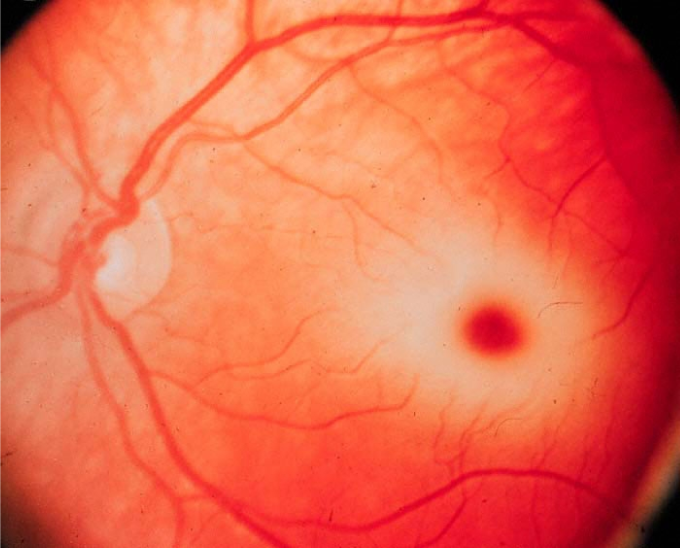 This patient most likely has an accumulation of which of the following substrates?
 (Multiple Choice)
4.9/5 (89)
(89) A 54-year-old woman is brought to the physician by her brother because of abdominal pain and vomiting. She had similar episodes which resolved without treatment. Laboratory tests show high serum amylase which she is admitted, and treatment with bowel rest and intravenous fluids is begun. In the next morning she is evaluated for a new confusion and agitation. She is unable to personally give a history. On mental status examination, she is confused and oriented only to person. She recalls 0 out of 3 words after 5 minutes. Neurologic examination shows horizontal nystagmus on lateral gaze. She has difficulty walking without assistance. Which of the following most likely precipitated this patient's current neurologic condition?
(Multiple Choice)
4.7/5 (88)
(88) A 3-year-old boy is brought to the physician because of arm pain following a fall that took place 5 hours ago. According to his mother, the boy was running in the yard when he fell and injured his right arm. The boy is crying and clutching his arm. During the past year, he has been brought in 4 other times for extremity pain following falls, all of which have been diagnosed as long bone fractures. His right forearm is diffusely erythematous. The patient withdraws and yells when his forearm is touched. His left arm has two small ecchymotic regions overlying the elbow and wrist. A photograph of his eyes is shown. 1ec160b_3a5f_7b1a_9249_b532365e1285_MD0001_00 This patient's condition is most likely associated with impairment of which of the following processes?
(Multiple Choice)
4.8/5 (64)
(64) A 6-year-old girl is brought to office due to prolonged fatigue and difficulty walking. Her childhood developmental growth was normal but rapidly becomes weak and tired. The patient has not been ill recently and is usually happy and playful. She has a history of mild motor delays but is otherwise developmentally normal. Vital signs are within normal limits. Examination shows mildly decreased power in all extremities but no ataxia. Cardiac auscultation reveals a 1/6 systolic murmur and an S3 gallop. Laboratory results are as follows: 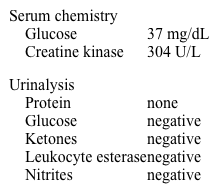 Muscle biopsy shows a very low carnitine content. This patient most likely has deficient synthesis of which of the following substances?
 (Multiple Choice)
4.9/5 (85)
(85) A 3-year-old boy who recently immigrated to the United States is brought to the physician by his parents because he has not yet begun to walk or speak. Assessment of his developmental milestones shows severe intellectual disability. He dies 6 months later from refractory seizures resulting in respiratory failure. Autopsy shows pallor of the substantia nigra, locus ceruleus, and vagal nucleus dorsalis. The underlying condition responsible for this patient's death is most likely caused by a deficiency of which of the following enzymes?
(Multiple Choice)
4.7/5 (67)
(67) A 4-month-old boy is brought to the office due to difficulty feeding. His mother says that he has difficulty holding his head up while breastfeeding and his suckling seems weaker than usual. Weight is at the 5th percentile. Length and head circumference are tracking along the 25th percentile. Physical examination shows hepatomegaly and hypotonia in all 4 limbs. Cardiac auscultation shows a gallop rhythm, and chest x-ray reveals severe cardiomegaly. Muscle biopsy shows enlarged lysosomes containing periodic acid-Schiff (PAS)-positive material. Which of the following enzymes is most likely deficient in this patient?
(Multiple Choice)
4.8/5 (74)
(74) A geneticist is doing research to modify protein structures by inserting changed amino acids into polypeptide sequences. She incubates cutaneous fibroblasts in a medium containing fluorescently tagged lysine residues during the procedure. After many hours, she discovers that fibroblast aminoacyl tRNA synthetase "loads" lysine residues onto tRNA molecules carrying the anticodon UUU. In the figure below, which of the following residues is most likely attached to tRNA? 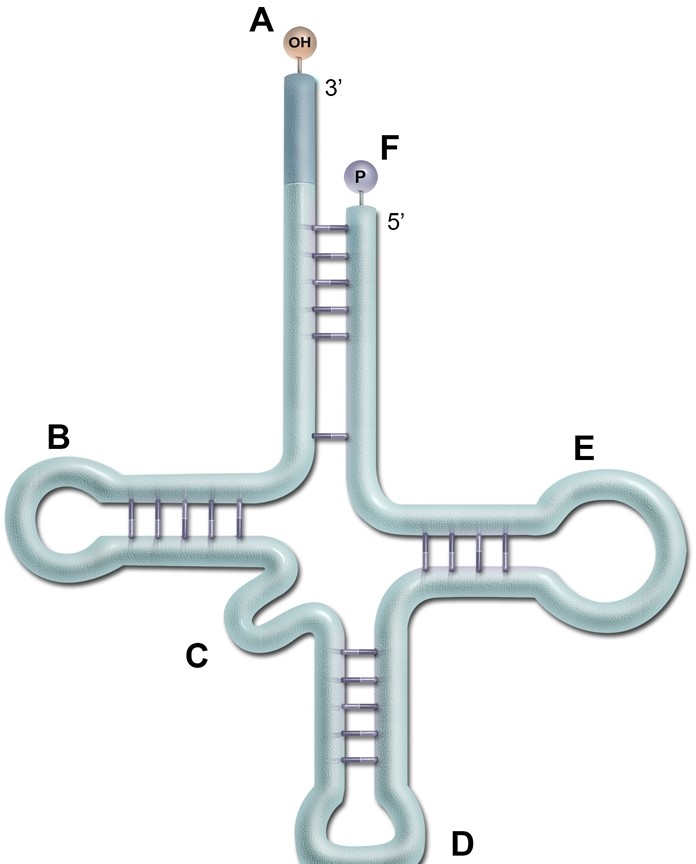
(Multiple Choice)
4.8/5 (68)
(68) A 9-month-old boy is brought to the clinic for a routine follow-up. His mother is concerned because the patient is not yet able to sit up unsupported. He was born at term and has had muscle weakness since birth. Vital signs are normal. The patient is alert but has diminished tone. Examination shows a prominent forehead with a depressed nasal bridge. Eye examination shows epicanthal folds. Analysis of lysosomal acid hydrolases shows an increased concentration within the serum and a decreased level within the cultured skin fibroblast cells. This patient most likely has a defect in which of the following steps of enzyme production?
(Multiple Choice)
4.7/5 (79)
(79) A 34-year-old woman is admitted to the hospital with a diagnosis of acute appendicitis. She started having right lower quadrant abdominal pain approximately 30 hours earlier but did not go to the hospital because she thought the pain would subside on its own. The patient had no food, only sips of water, during that time. Blood pressure is 115/72 mm Hg and pulse is 106/min. Mucous membranes are dry and there is tenderness in the right lower quadrant of the abdomen. Laboratory evaluation shows mild leukocytosis, normal serum electrolytes, borderline low serum glucose levels, and moderate ketones in the urine. Based on the evaluation, it is suspected that this patient is utilizing ketone bodies as a significant reserve of energy. Which of the following tissues cannot use this energy source?
(Multiple Choice)
4.8/5 (87)
(87) A 69-year-old woman with Alzheimer disease is brought to the emergency department after getting lost while taking a walk in her neighborhood. Her son has been unable to contact the patient for the last 2 days, and today the police found her wandering in a park. The patient says that she drank water from a park fountain but has not had anything to eat for over 24 hours. On physical examination, she is mildly confused with dry mucous membranes. Laboratory studies show a blood glucose level of 92 mg/dL. Which of the following hormones binds to an intracellular receptor to help maintain this patient's laboratory findings within the normal range?
(Multiple Choice)
4.9/5 (87)
(87) A group of researchers is looking at how catecholamine production is regulated in response to extreme stress. Subject rats are randomly allocated to either an experimental or a control group in the experiments. The pituitary gland is resected in the experimental rats, while the control rats get a craniotomy without pituitary resection. When compared to control animals, the experimental animals produce less epinephrine from the adrenal medulla and less cortisol from the adrenal cortex. Which of the following enzymes' decreased activity is most likely responsible for the reduced epinephrine levels in the experimental animals?
(Multiple Choice)
4.9/5 (84)
(84) Erythroblasts isolated from a bone marrow biopsy sample of a patient with neonatal jaundice are incubated in a medium containing radiolabeled glucose. The cells are unable to generate NADPH from glucose metabolism but are able to convert fructose-6-phosphate to ribose-5-phosphate, which is required for nucleic acid synthesis. Which of the following enzymes is essential for the latter conversion?
(Multiple Choice)
4.9/5 (99)
(99) A 62-year-old woman is brought to the emergency department after lying on the floor in her home for the past 2 days. The patient's neighbor called police after phone calls were not answered and no one opened the door. She was found awake on the bathroom floor lying in feces and urine. The patient says she fell and injured her right hip and was unable to get up to call for help. She did not eat or drink anything during that time. On examination, the patient appears dehydrated and has right hip tenderness. Laboratory studies show serum glucose of 72 mg/dL and positive urine ketones. Radiographs of the right hip show a right femoral neck fracture. Increased activity of which of the following enzymes is most likely contributing to both the serum and urine laboratory findings?
(Multiple Choice)
4.9/5 (81)
(81) A 17-month-old boy is being evaluated for neurologic regression. He had a normal neonatal course and early development until age 5 months. The boy subsequently experienced gradual regression of developmental milestones, and now has inability to sit with support, poor head control, and loss of a social smile. Weight and height are below the 5th percentile. Physical examination shows an enlarged liver and spleen, diminished deep tendon reflexes in all limbs, and hypotonia. Funduscopic reveals cherry-red macular spot. This patient most likely has an accumulation of which of the following substrates?
(Multiple Choice)
4.9/5 (77)
(77) A 26-year-old man comes to the office due to skin lesions on his palms. The patient has yellowish skin nodules over the palmar creases that have been increasing in size and number over the past several years. He also has small clusters of yellow papules on his elbows, knees, and buttocks. His father died of a myocardial infarction at age 56. Biopsy of his lesions shows accumulation of lipid-laden macrophages. Immunoblot analysis suggests a lack of ApoE3 and ApoE4 in his circulating lipoproteins. Which of the following is most likely impaired in this patient?
(Multiple Choice)
4.8/5 (79)
(79) An 8-month-old boy is evaluated for developmental delay, failure to thrive, and episodic seizures. Physical examination shows ophthalmoplegia and hypotonia. Laboratory studies reveal an elevated serum lactate level. Further histochemical studies show severely reduced pyruvate dehydrogenase enzyme activity in both freshly isolated peripheral blood lymphocytes and cultured fibroblasts. Increasing which of the following substances in his diet is most likely to help this patient generate energy without further elevating lactate levels?
(Multiple Choice)
4.9/5 (70)
(70) A scientist is investigating the structure of several hormone receptors. From a homogenized tissue sample, receptor proteins are extracted and purified. According to detailed structural study, one of the proteins has a 30-amino acid pattern that coordinates a zinc molecule, as illustrated in the picture below. 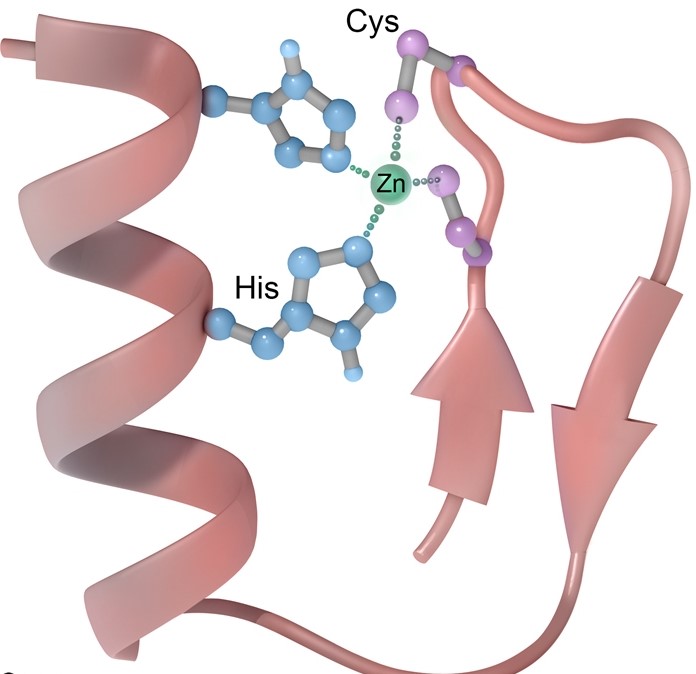 A receptor for which of the following hormones was most likely isolated in this experiment?
 (Multiple Choice)
4.9/5 (87)
(87) An autopsy is being performed on a 4-year-old boy who recently died from a myocardial infarction. The child had a history of intellectual disability. Autopsy shows a prominent forehead and broad nose. There is a diffuse haze over the corneas bilaterally. The heart, liver, and spleen are enlarged. Sampling of the coronary arteries is most likely to reveal intimal accumulation of which of the following substances?
(Multiple Choice)
4.8/5 (73)
(73) A 64-year-old man comes to the emergency department due to severe abdominal pain, nausea, and vomiting. He has a history of hypertension, myocardial infarction, and systolic heart failure. His blood pressure is 100/60 mm Hg, pulse is 116/min and irregular, and respirations are 24/min. Examination shows a soft, mildly distended, and tender abdomen. Laboratory results are as follows: 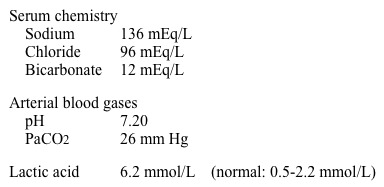 CT scan of the abdomen reveals distal ileal wall thickening and lack of enhancement with intravenous contrast. Decreased activity of which of the following enzymes best explains the acid-base disorder in this patient?
 (Multiple Choice)
4.8/5 (84)
(84) 
Filters
- Essay(0)
- Multiple Choice(0)
- Short Answer(0)
- True False(0)
- Matching(0)