



 Chat with AI
Exam 3: Biochemistry

Exam 1: Anatomy265 Questions
Exam 2: Behavioral Sciences178 Questions
Exam 3: Biochemistry102 Questions
Exam 4: Embryology59 Questions
Exam 5: Epidemiology, Biostatistics, and Medical Informatics94 Questions
Exam 6: Genetics88 Questions
Exam 7: Histology46 Questions
Exam 8: Immunology147 Questions
Exam 9: Microbiology and Virology330 Questions
Exam 10: Pathology817 Questions
Exam 11: Pharmacology and Toxicology509 Questions
Exam 12: Physiology339 Questions
Exam 13: Psychiatry and Psychotherapy23 Questions
Select questions type


A 34-year-old woman arrives at the emergency department in the early morning, confused, trembling, and sweating. Her spouse claims she did not wake up to her alarm clock and was difficult to awaken. The patient has experienced comparable experiences in the morning before eating and after exercising in the last week. The patient's medical history is ordinary. The blood pressure is 135/95 mm Hg, the pulse is 110 beats per minute, and the respirations are 24/ minute. The patient is receptive to voice but does not obey directions. The assessment of the cranial nerves, muscular tone, and deep tendon reflexes are all normal. The glucose level on a bedtime fingerstick is 35 mg/dL. The patient receives an intravenous infusion of glucose, which improves her mental condition quickly. Further evaluation reveals that her episodes of hypoglycemia are due to increased levels of an endogenous hormone. This hormonal imbalance is most likely causing the patient's symptoms by stimulating which of the following conversions? 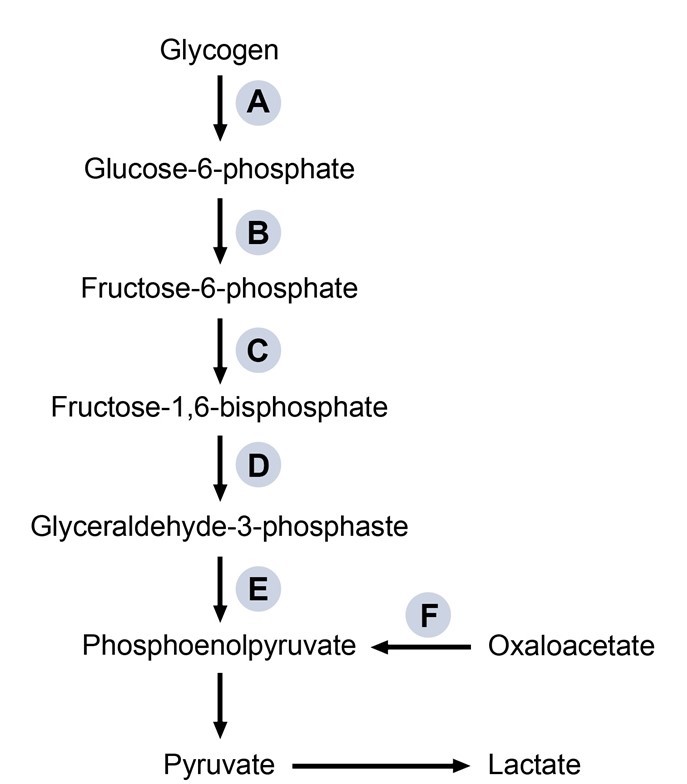
(Multiple Choice)
4.9/5  (65)
(65) A 55-year-old man comes to the office with a long history of fatigue and exertional dyspnea. He has early satiety and frequent upper abdominal discomfort. On physical examination, the patient has palpable splenomegaly but no lymphadenopathy. Laboratory tests are as follows: 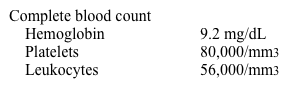 Reverse transcription polymerase chain reaction is used to diagnose chronic myelogenous leukemia in this patient. Which of the following is most likely to be detected by this test?
 (Multiple Choice)
4.9/5 (73)
(73) A 5-day-old infant is brought to the emergency department due to abnormal body movements. He has had intermittent episodes of tonic posturing over the past 3 hours as well as poor feeding, vomiting, and irritability for the past 2 days. The mother also reports that his diapers smell like "caramelizing sugar." There are no known medical problems in the family, but the child's maternal aunt died "sometime in the first year" of life from unknown causes. Examination shows a lethargic infant with intermittent posturing episodes and increased generalized muscle tone. Laboratory studies of plasma and urine confirm the diagnosis. In addition to appropriate dietary restriction, supplementation with which of the following may improve this infant's condition?
(Multiple Choice)
4.9/5 (82)
(82) Researchers are investigating the specifics underlying glucose transport across adipose cell membranes. One of their experiments shows that, in the presence of insulin, D-glucose transport across the plasma membrane of adipocytes is much faster than L-glucose transport. Which of the following transport processes best describes the mechanism for glucose entry into these cells?
(Multiple Choice)
4.8/5 (76)
(76) A 15-year-old boy comes to the office for health check-up. The patient is incidentally found to have mild hypercalcemia on laboratory testing. Further questioning reveals that several of his family members also have mild hypercalcemia. Subsequent laboratory studies show a borderline high parathyroid hormone concentration, very low urinary calcium level, and normal 25-hydroxyvitamin D level. A mutation in which of the following receptors is most likely responsible for this patient's laboratory abnormalities?
(Multiple Choice)
4.9/5 (75)
(75) Hepatocytes are isolated from biopsy samples acquired from patients getting standard treatment at a local tertiary referral center as part of a research project studying enzyme activity in both normal and sick liver tissue. To remove membrane components and organelles, the cells are homogenized and centrifuged. Following several centrifugation rounds, the residual supernatant comprises solely cytosol and cytosolic proteins. Which of the following enzymes' activity is most likely to be detectable in the supernatant of healthy liver cells?
(Multiple Choice)
5.0/5 (66)
(66) A 16-year-old boy arrives at the emergency department complaining of left-sided abdominal pain and blood in his urine. The intensity of the pain fluctuates and does not improve with rest or position changes. He has had similar pain episodes in the past, but this is the first time he has had gross hematuria. On physical examination, the left costovertebral angle is tender. The urine was examined under a microscope. 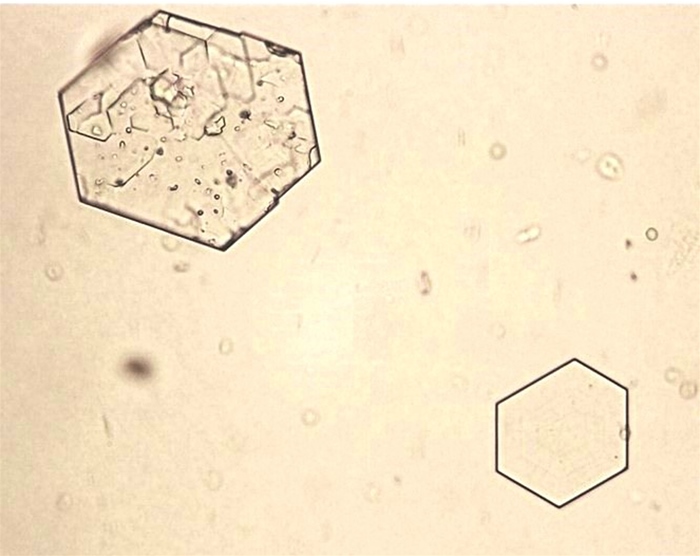 Further quantitative laboratory evaluation is most likely to detect which of the following abnormalities in this patient?
 (Multiple Choice)
4.8/5 (82)
(82) Hepatocytes are isolated from biopsy samples acquired from patients getting standard treatment at a local tertiary referral center as part of a research project studying enzyme activity in both normal and sick liver tissue. To remove membrane components and organelles, the cells are homogenized and centrifuged. Following several centrifugation rounds, the residual supernatant comprises solely cytosol and cytosolic proteins. Which of the following enzymes' activity is most likely to be detectable in the supernatant of healthy liver cells?
(Multiple Choice)
4.9/5 (88)
(88) A 56-year-old man is evaluated for progressive visual impairment. The patient works as part of the grounds crew at an airport, and says he has trouble identifying aircraft at a distance and with filling out paperwork at the end of his shift. His medical history includes poorly controlled diabetes mellitus, hypertension, and gout. A year ago, the patient underwent an uncomplicated repair of a right inguinal hernia. Physical examination shows bilateral clouding of the lens. The remainder of the examination is unremarkable. Which of the following metabolic conversions is most likely contributing to this patient's current condition?
(Multiple Choice)
4.8/5 (79)
(79) A 60-year-old man comes to the office due to progressive blurry vision over the last year that has begun to affect his ability to drive. He has difficulty reading road signs at night and reports excessive glare from the headlights of oncoming cars. The patient has a long history of hypertension and type 2 diabetes mellitus. Funduscopy reveals a diminished red reflex bilaterally with obscuration of retinal detail. It is determined that the patient's condition is in part due to intracellular accumulation of sorbitol. In healthy cells, this sugar alcohol is normally metabolized into which of the following substances to facilitate excretion?
(Multiple Choice)
4.9/5 (81)
(81) A pharmacist is studying the mechanism of action of verapamil on the muscle tissue in the pathients who have a hypertension. He found that verapamil affects cardiac contractility but has a minimal effect on skeletal muscle. Which of the following properties of skeletal muscle is responsible for its resistance to the medication?
(Multiple Choice)
4.9/5 (78)
(78) A 70-year-old man comes to the office due to four weeks history of increase dyspnea, generalized weakness, lethargy, and palpitations. He also reports tingling and numbness in both lower limbs. His daughter, who is visiting from another state, adds that since his wife's death a year ago, the patient has not been taking care of himself. Blood pressure is 105/50 mm Hg and pulse is 104/min. Cardiovascular examination shows a displaced apical impulse at the sixth intercostal space, a third heart sound, and high-volume, collapsing carotid pulses. Bilateral basal crackles, 2+ bilateral pedal edema, and mild hepatomegaly are also present. Neurologic examination shows decreased light touch and vibration sense in the feet, with decreased knee and ankle reflexes bilaterally. Laboratory evaluation shows normal blood counts. Deficiency of which of the following nutrients is most likely responsible for this patient's symptoms?
(Multiple Choice)
4.8/5 (75)
(75) An 8-year-old boy is evaluated for exercise intolerance. The patient experiences fatigue, muscle pain, and cramps during exercise as well as severe muscle stiffness following strenuous activity. Physical examination is unremarkable. A forearm ischemic exercise test is performed by applying a blood pressure cuff on the patient's exercising forearm and sampling blood lactate several minutes after the exercise. The patient's blood samples show no rise in lactate levels. Biochemical analysis of a muscle biopsy reveals absent lactate dehydrogenase activity. In this patient, strenuous exercise leads to inhibition of glycolysis in skeletal muscle due to intracellular depletion of which of the following substances?
(Multiple Choice)
4.7/5 (75)
(75) A pharmaceutical researcher is studying a target protein involved in the signal transduction and cellular response to TSH. The protein is isolated and purified from thyroid follicular cells. Further analysis reveals that the protein contains multiple alpha-helical regions. Each of these regions is composed of approximately 20 amino acid residues consisting primarily of valine, alanine, and isoleucine. This particular region of the protein most likely performs which of the following functions?
(Multiple Choice)
4.8/5 (77)
(77) A 5-day-old infant is brought to the emergency department due to abnormal body movements. He has had intermittent episodes of tonic posturing over the past 3 hours as well as poor feeding, vomiting, and irritability for the past 2 days. The mother also reports that his diapers smell like "caramelizing sugar." There are no known medical problems in the family, but the child's maternal aunt died "sometime in the first year" of life from unknown causes. Examination shows a lethargic infant with intermittent posturing episodes and increased generalized muscle tone. Laboratory studies of plasma and urine confirm the diagnosis. In addition to appropriate dietary restriction, supplementation with which of the following may improve this infant's condition?
(Multiple Choice)
5.0/5 (85)
(85) A 5-year-old boy with developmental delay is brought to the office due to difficulty "seeing the board" at school. Examination shows a boy with a tall, thin habitus with elongated limbs. Funduscopy shows bilateral lens subluxation. Four years later, the patient dies suddenly of a massive cerebrovascular accident. Autopsy shows middle cerebral artery thrombosis and old renal infarcts. His parents wish to know if anything could have been done to have prevented his death. Which of the following would have been the most appropriate supplementation for this patient?
(Multiple Choice)
4.7/5 (97)
(97) A 26-year-old man is brought to the emergency department due to progressive confusion. His roommate says that he has been binge drinking for the last 5 days and probably has had very little to eat. The patient's medical history is significant for alcohol-related seizures 1 year ago. He had been sober until 2 weeks ago, when he started drinking again. The patient's past medical history is otherwise unremarkable. On examination, he responds to voice but does not follow commands. Fingerstick glucose is 35 mg/dL and urine is strongly positive for ketones. Suppression of which of the following is the primary cause of this patient's hypoglycemia?
(Multiple Choice)
4.8/5 (69)
(69) A previously healthy 20-year-old girl is brought to the emergency department by her roommate because of abdominal pain, nausea, and vomiting for 6 hours. Over the past 6 weeks, she has also had increased frequency of urination, and she has been drinking more water than usual. She has lost 6 kg (13 lb) over the same time period despite having a good appetite. Her temperature is 37.8 C (100 F), blood pressure is 96/58 mm Hg, and pulse is 112/min She appears lethargic. Physical examination shows dry mucous membranes and her urine has a strong, fruity odor. Laboratory studies show a blood glucose level of 452 mg/dL and high anion gap metabolic acidosis. Urinalysis is positive for ketones. It is determined that the patient's insulin deficiency is causing increased production of gluconeogenic precursors that are subsequently converted to glucose in the liver. Which of the following enzymes is most likely to provide these precursor substrates?
(Multiple Choice)
4.8/5 (81)
(81) Following a car collision, paramedics transport a 23-year-old man to the emergency room. He was an unconstrained front-seat passenger. His fluid volume and plasma osmolarity are measured several days after his admission and are depicted in the figure below (solid line, normal; dotted line, patient). 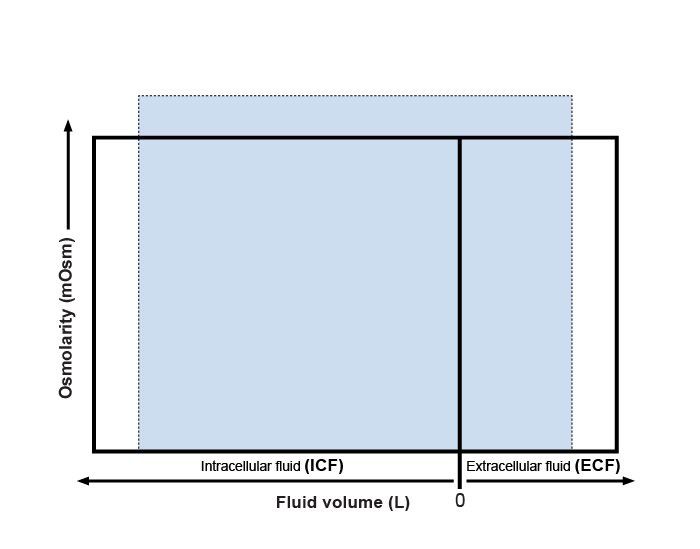 Which of the following conditions is most likely to cause the findings shown in the image?
 (Multiple Choice)
4.9/5 (77)
(77) A couple visits the clinic for preconception advice. Because they are of Ashkenazi Jewish origin, they are given genetic testing. Both are carriers for a lysosomal enzyme deficiency condition, which results in reduced metabolic breakdown of a phospholipid substrate to ceramide, resulting in phospholipid accumulation. They are advised about the possibility that their children would be afflicted by this condition. The couple is interested in learning about the clinical characteristics of a sick child. Which of the following results is most likely to be associated with this condition?
(Multiple Choice)
4.8/5 (78)
(78) 
Filters
- Essay(0)
- Multiple Choice(0)
- Short Answer(0)
- True False(0)
- Matching(0)