



 Chat with AI
Exam 9: Microbiology and Virology

Exam 1: Anatomy265 Questions
Exam 2: Behavioral Sciences178 Questions
Exam 3: Biochemistry102 Questions
Exam 4: Embryology59 Questions
Exam 5: Epidemiology, Biostatistics, and Medical Informatics94 Questions
Exam 6: Genetics88 Questions
Exam 7: Histology46 Questions
Exam 8: Immunology147 Questions
Exam 9: Microbiology and Virology330 Questions
Exam 10: Pathology817 Questions
Exam 11: Pharmacology and Toxicology509 Questions
Exam 12: Physiology339 Questions
Exam 13: Psychiatry and Psychotherapy23 Questions
Select questions type


A previously healthy 19-year-old man comes to the physician with right-sided, dull, throbbing scrotal pain for 12 hours. He has also had a burning sensation on urination and increased urinary frequency for the past 3 days. He has not had urethral discharge. He is sexually active with one female partner and does not use condoms. Vital signs are within normal limits. Physical examination shows a tender right testicle; lifting it provides relief. The penis appears normal, with no discharge at the meatus. Diagnostic testing reveals Chlamydia trachomatis as the sole causative pathogen. Which of the following additional results are most consistent with this patient's diagnosis? 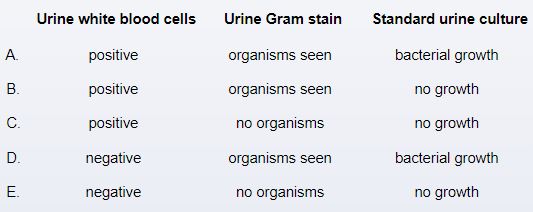
(Multiple Choice)
4.8/5  (73)
(73) Four days after admission to the hospital for community-acquired pneumonia, a 68-year-old woman has abdominal pain and multiple episodes of loose stools. They are watery, foul-smelling, and occasionally streaked with blood. She has approximately 6 episodes daily. She feels tired. She is currently being treated with intravenous ceftriaxone and oral azithromycin. She has hypertension and type 2 diabetes mellitus. Current medications include metformin, enalapril, and chlorthalidone. Abdominal examination shows mild diffuse tenderness throughout the lower quadrants. The abdomen is not distended. The remainder of her examination shows no abnormalities. Her hemoglobin concentration is 12 g/dL, leukocyte count is 14,100/mm3, The toxin responsible for his current condition most directly impairs which of the following components of intestinal mucosal cells?
(Multiple Choice)
4.8/5 (77)
(77) A 28-year-old woman comes to the emergency department for a 1-week history of jaundice and nausea. She recalls eating some seafood last weekend at a cookout. She lives at home with her 4-year-old son who attends a daycare center. The child's immunizations are up-to-date. The patient's temperature is 37.5°C (99.5°F), pulse is 82/min, and blood pressure is 134/84 mm Hg. Examination shows scleral icterus. The liver is palpated 2 cm below the right costal margin and is tender. Her serum studies show: 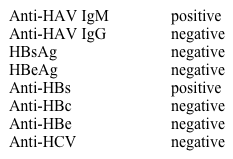 Which of the following is most likely to be elicited on further history taking?
 (Multiple Choice)
4.8/5 (97)
(97) A 45-year-old guy arrives at the emergency department after suffering from a cough and fever for many days. His temperature is 38.4 degrees Celsius (101.2 degrees Fahrenheit), his blood pressure is 117/76 mm Hg, his pulse is 92 beats per minute, and his respirations are 18 beats per minute. Physical examination of the right lung reveals rales and diminished breath sounds at the base. A lung infiltration, hilar adenopathy, and a right-sided pleural effusion are all seen on a chest x-ray. The following findings are shown by lung tissue collected from the patient: 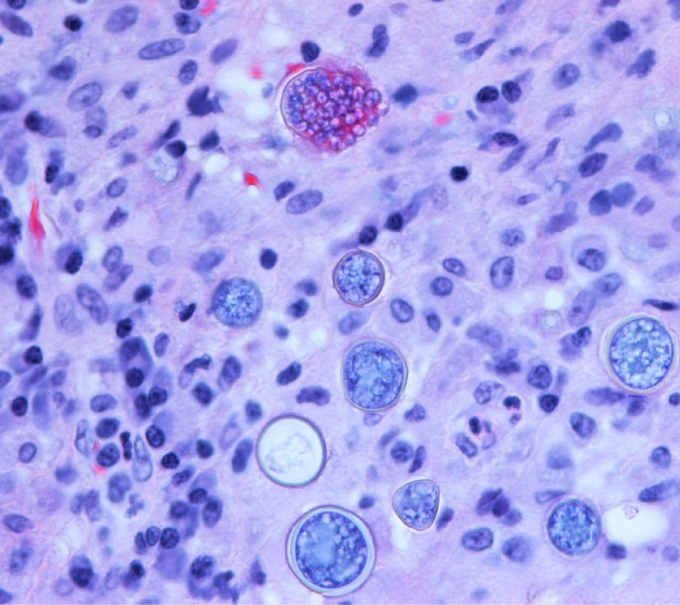 Which of the following is the most likely cause of this patient's condition?
 (Multiple Choice)
4.9/5 (94)
(94) An epidemic of seasonal influenza infection A strain has been identified in a tiny community. The strain is comparable to the one that was prevalent the previous year. Despite lengthy and frequent exposure to unwell contacts, around 70% of the adult population in that community remains uninfected. Which of the following is the most important host factor in these participants' ability to avoid influenza infection?
(Multiple Choice)
4.8/5 (71)
(71) A 22-year-old man with fever and joint pain is found to have atypical lymphocytes on his blood smear. Further evaluation shows that his condition is caused by an enveloped virus containing partially double-stranded circular DNA. An enzyme packed in its virion has RNA-dependent DNA-polymerase activity. This patient is most likely infected with which of the following viruses?
(Multiple Choice)
4.9/5 (76)
(76) A 4-year-old boy is brought to the emergency department for evaluation of a fever for 1 day. The mother reports that he has had severe pain in his lower extremities and difficulty eating since yesterday. He has not had a cough, nausea, or vomiting. He was born at term and has been healthy. His immunizations are up-to-date. He appears irritable. His temperature is 38.5°C (101.3°F). Examination shows several flesh-colored, tender papules over the trunk, knees, palms, and soles. There are multiple 2-mm, reddish macules on the hard palate. The remainder of the examination shows no abnormalities. The infectious agent most likely responsible for this patient's current condition is also associated with which of the following?
(Multiple Choice)
4.8/5 (77)
(77) A previously healthy 6-month-old boy is brought to the emergency department because of irritability and poor feeding for 6 days. He has also not had a bowel movement in 9 days and has been crying less than usual. He is bottle-fed with formula and his mother has been weaning him with mashed bananas mixed with honey for the past 3 weeks. His immunizations are up-to-date. He appears weak and lethargic. He is at the 50th percentile for length and 75th percentile for weight. Vital signs are within normal limits. Examination shows dry mucous membranes and delayed skin turgor. There is poor muscle tone and weak head control. Neurological examination shows ptosis of the right eye. Which of the following is most likely to confirm the diagnosis in this patient?
(Multiple Choice)
4.8/5 (67)
(67) A 5-year-old boy is brought to the emergency department by his grandmother because of difficulty breathing. Over the past 2 hours, the grandmother has noticed his voice getting progressively hoarse and occasionally muffled, with persistent drooling. He has not had a cough. His grandmother is unsure if patient's immunizations are up-to-date. He appears uncomfortable and is sitting up and leaning forward with his chin hyperextended. His temperature is 39.5°C (103.1°F), pulse is 110/min, and blood pressure is 90/70 mm Hg. Cardiac examination reveals tachycardia and a normal rhythm without rubs or murmurs. The abdomen is soft and nondistended. Which of the following additional signs is most likely to be found on examination?
(Multiple Choice)
4.8/5 (81)
(81) A 28-year-old primigravid woman at 38 weeks' gestation is brought to the emergency department in active labor. She has not had regular prenatal care. She has a history of HIV infection but is not currently on antiretroviral therapy. Her previous viral load is unknown. A decision is made to continue with the vaginal delivery due to advanced labor. Intravenous zidovudine is administered to the patient during the delivery and to the infant immediately after birth. This medication helps decrease the risk of perinatal transmission by inhibiting which of the following components of viral genome replication?
(Multiple Choice)
4.9/5 (69)
(69) A 45-year-old man comes to the office with groin pain and swelling. About a month ago, he noticed a sore on his penis but did not seek medical attention because the ulcer was not painful and disappeared within a week. Several days ago, he began to experience painful swelling in his inguinal region, with inflammation of the overlying skin and eventual formation of several draining ulcers. He also has mild fever and malaise that began around the same time as his groin symptoms. The patient is a sailor. His other medical problems include well-controlled hypertension and hyperlipidemia. Cell scrapings from his lesions show cytoplasmic inclusion bodies. Which of the following is the most likely cause of this patient's condition?
(Multiple Choice)
4.9/5 (80)
(80) A 3175-g (7-lb) female newborn is delivered at 37 weeks to a 26-year-old primigravid woman. Apgar scores are 8 and 9 at 1 and 5 minutes, respectively. The pregnancy had been uncomplicated. The mother had no prenatal care. She immigrated to the US from Brazil 2 years ago. Immunization records are not available. One day after delivery, the newborn's temperature is 37.5°C (99.5°F), pulse is 182/min, respirations are 60/min, and blood pressure is 82/60 mm Hg. The lungs are clear to auscultation. Cardiac examination shows a continuous heart murmur. The abdomen is soft and nontender. There are several discolored areas on the skin that are nonblanchable upon pressure application. Slit lamp examination shows cloudy lenses in both eyes. The newborn does not pass her auditory screening tests. Which of the following maternal interventions would have most likely prevented this infant's condition?
(Multiple Choice)
4.7/5 (76)
(76) A 5-year-old boy is brought to the emergency department by his parents for severe respiratory distress. He has not received any immunizations due to parental preference, and his medical history is otherwise unremarkable. The patient appears very uncomfortable and anxious. He is leaning forward and making a loud, harsh sound with every inspiration. Temperature is 39.6 C (103.4 F). The patient is intubated immediately. During intubation, the epiglottis is visualized and appears markedly swollen and erythematous. Which of the following is a major virulence factor of the pathogen causing this patient's infection?
(Multiple Choice)
4.9/5 (58)
(58) An epidemiologic study is conducted after a sudden increase in the rate of severe postoperative infections in a rural hospital. It is determined that all the patients who developed the infection were operated on with surgical instruments sterilized by a specific autoclave machine. The machine was found to be inadequately sterilizing the equipment due to a malfunction limiting the temperature to 100 C (212 F) during the 15 minute cycle. These patients most likely developed infection from which of the following bacteria?
(Multiple Choice)
4.8/5 (69)
(69) A 14-year-old girl is brought to the physician by her father because of fever, chills, abdominal pain, and profuse nonbloody diarrhea. Her symptoms began 1 week ago when she had several days of low-grade fever and constipation. She returned from Indonesia 2 weeks ago, where she spent the summer with her grandparents. Her temperature is 39.3°C (102.8°F). Examination shows diffuse abdominal tenderness and mild hepatosplenomegaly. Cultures of the stool yield gram-negative bacilli that are non-lactose fermenting and oxidase negative. Which of the following is the most likely complication associated with this patient's current infection?
(Multiple Choice)
4.8/5 (76)
(76) An 8-year-old child is taken to the emergency department after experiencing fever and chills for 24 hours. The temperature is 38.3 degrees Celsius (101 F). The patient is sluggish and has dry mucous membranes on inspection. No oropharyngeal abnormalities are seen, and the tympanic membranes are normal. Auscultation reveals clean lungs and good heart sounds. The abdomen is nontender and soft. There is no rash on the skin. According to laboratory results, the leukocyte count is 24,000/mm3, with 15% bands, 80% neutrophils, and 5% lymphocytes. The exhibit depicts a peripheral blood smear. . 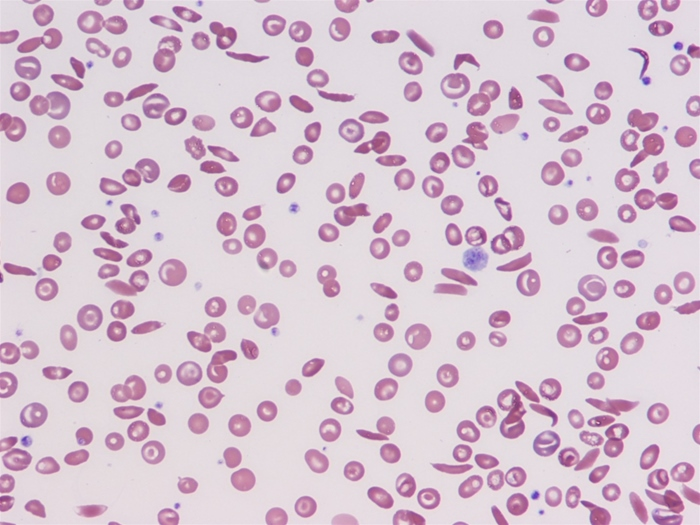 Blood cultures are obtained and intravenous fluids and empiric antibiotics are initiated. The patient's blood cultures are most likely to grow which of the following organisms?
 (Multiple Choice)
4.8/5 (73)
(73) A 5-year-old girl is brought to the office by her mother due to 2 weeks of anorexia, nausea, epigastric discomfort, and loose bowel movements. She has had no fever or bloody stools. The patient recently returned from rural Brazil, where she spent the summer with family. She had no gastrointestinal symptoms during the trip but developed intensely pruritic eruptions between the toes of her right foot. The skin rash spontaneously resolved within a few days and was attributed to insect bites from walking barefoot in the fields. The patient has no prior medical conditions, takes no medications, and has received all age-appropriate vaccinations. On physical examination, the abdomen is soft and nontender with normoactive bowel sounds. Stool microscopy reveals smooth, thin-walled eggs. If left untreated, this patient's condition can lead to which of the following complications?
(Multiple Choice)
4.8/5 (82)
(82) A 2-month-old boy is brought to the physician by his parents because of a 1-week history of increased fussiness and a rash. Initially, the rash was bright and copper-red but gradually started to fade and peel off. The patient has been feeding poorly and has not gained much weight since birth. He was born at 38 weeks gestation via an uncomplicated vaginal delivery and had an unremarkable neonatal course with no history of birth trauma or excessive bleeding. The mother had inconsistent prenatal care. He cries but calms when his mother picks him up. He is at the 3rd percentile for length and weight. Vital signs are within normal limits. Examination shows diffuse erythematous plaques on the soles and buttocks with desquamation. There is nasal congestion and a white nasal discharge. The liver is palpated 3 cm below the right costal margin. Which of the following is the most likely cause of this patient's illness?
(Multiple Choice)
4.8/5 (82)
(82) A 70-year-old woman is brought to the emergency department because of a 3-day history of fever, irritability, and discharge from her right ear. She has had type 2 diabetes for many years and has been noncompliant with her medications and follow-up appointments. She appears ill. Her temperature is 39.3°C (102.7°F). On examination, moving or touching the pinna produces extreme pain. Otoscopic examination shows granulation tissue in the left ear canal with a scant amount of discharge. The tympanic membrane is clear, and there is no middle ear effusion. Initial cultures from the ear show a Gram-negative rod. Which of the following microbiological characteristics best describes the infecting organism?
(Multiple Choice)
4.9/5 (82)
(82) A 32-year-old man comes to the physician because of severe burning with urination for the past 3 days. During this period, he has had clear urethral discharge early in the morning. He has no history of serious illness, except for similar symptoms 3 months ago, and urethral swab microscopy showed numerous neutrophils and intracellular gram-negative diplococci. The symptoms resolved after treatment with ceftriaxone and doxycycline but recurred 4 days ago. The patient takes no medications. He is sexually active with one male and one female partner; they use condoms inconsistently. Temperature is 36.8°C (98.0°F), pulse is 75/min, and blood pressure is 135/78 mm Hg. Nucleic acid amplification testing of a clean catch urine specimen is positive for Neisseria gonorrhoeae and negative for Chlamydia trachomatis. Which of the following is the most likely reason for the recurrence of infection in this patient?
(Multiple Choice)
4.7/5 (71)
(71) 
Filters
- Essay(0)
- Multiple Choice(0)
- Short Answer(0)
- True False(0)
- Matching(0)