



 Chat with AI
Exam 9: Microbiology and Virology

Exam 1: Anatomy265 Questions
Exam 2: Behavioral Sciences178 Questions
Exam 3: Biochemistry102 Questions
Exam 4: Embryology59 Questions
Exam 5: Epidemiology, Biostatistics, and Medical Informatics94 Questions
Exam 6: Genetics88 Questions
Exam 7: Histology46 Questions
Exam 8: Immunology147 Questions
Exam 9: Microbiology and Virology330 Questions
Exam 10: Pathology817 Questions
Exam 11: Pharmacology and Toxicology509 Questions
Exam 12: Physiology339 Questions
Exam 13: Psychiatry and Psychotherapy23 Questions
Select questions type


A 59-year-old man comes to the emergency department because of fever, urinary frequency, and lower back pain for the last 3 days. During this period, he has also had pain with the 3 times he has defecated. He is sexually active with one female partner and does not use condoms. His father died of colon cancer at the age of 67 years. The patient has smoked one pack of cigarettes daily for 14 years and drinks alcohol occasionally. His temperature is 39.1°C (102.3°F), pulse is 114/min, and blood pressure is 140/90 mm Hg. Physical examination shows mild suprapubic pain on deep palpation and a swollen, tender prostate. The remainder of the examination shows no abnormalities. His hemoglobin concentration is 15.4 g/dL, leukocyte count is 18,400/mm3, and platelet count is 260,000/mm3. Which of the following pathogens is most likely responsible for this patient's current symptoms?
(Multiple Choice)
4.9/5  (90)
(90) A 32-year-old man comes to the office due to 2 weeks of fever, malaise, and arthralgia. Temperature is 38.2 C (100.8 F) and pulse is 102/min. Physical examination reveals several enlarged cervical, axillary, and inguinal lymph nodes and a diffuse maculopapular skin rash. Serum aminotransferase levels are elevated. During further testing, the patient's serum is added to a mixture of cardiolipin, cholesterol, and lecithin, which leads to extensive clumping and flocculation. Evaluation for antibodies directed against which of the following is the best next step in management of this patient?
(Multiple Choice)
4.9/5 (63)
(63) A 60-year-old man comes to the physician because of a3 weeks history of intermittent low-grade fever and a worsening productive cough. During this time, he also has had a 4-kg (9-lb) weight loss despite no change in his appetite. He recently came back from rural China after attending a family wedding party. He has hypertension and takes lisinopril regularly. His temperature is 38.3 C (101 F), blood pressure is 110/80 mm Hg, pulse is 94/min, and respirations are 18/min. He weighs 60 kg (132.3 lb). Chest-x ray reveals a cavitary lesion on the right. Sputum culture is obtained. When exposed to drug A, isolates of the pathogen growing in culture quickly become less resistant to decoloration with an acid-alcohol agent and stop proliferating. Which of the following is drug A most likely to be?
(Multiple Choice)
4.9/5 (83)
(83) A 46-year-old man is brought to the emergency department because of worsening confusion and weakness in his right arm and leg for 2 days. He has also had fever and headache that began 5 days ago. He has hypertension and type 2 diabetes mellitus. Current medications include metformin and lisinopril. His temperature is 39.3°C (102.7°F), pulse is 103/min, and blood pressure is 128/78 mm Hg. He is confused and agitated. He is not oriented to person, place, or time. Neurologic examination shows nuchal rigidity. Muscle strength is 3/5 on the right upper and lower extremity but normal on the left side. His speech is incoherent. An ECG shows no abnormalities. MRI of the brain shows swelling of the temporal lobes. CSF analysis is most likely to reveal which of the following? 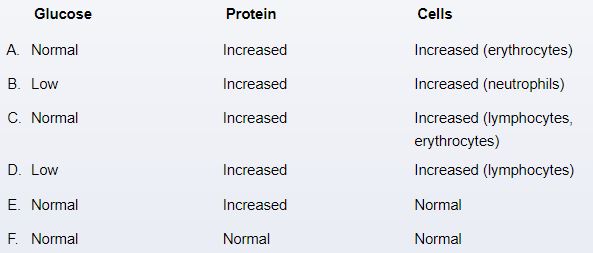
(Multiple Choice)
4.8/5 (81)
(81) A 25-year-old man with multiple injuries sustained in a motorcycle accident develops osteomyelitis while in the hospital. The organism is identified as methicillin-sensitive Staphylococcus aureus, and antibiotics are started. Which of the following is the most important measure to reduce the risk of transmission to other patients?
(Multiple Choice)
4.8/5 (77)
(77) A 7-year-old boy is brought to the emergency department because of a 6-hour history of involuntary muscle contractions and pain in his back and neck. Last week, he fell while playing in the sandbox and scraped his knees. He has not received any vaccinations since birth. His temperature is 38.5°C (101.3°F). He is diaphoretic. Examination shows inability to open his mouth beyond 1 cm. There is hyperextension of the lumbar spine and resistance to neck flexion. Which of the following is the best approach to establishing diagnosis in this patient?
(Multiple Choice)
4.8/5 (68)
(68) A 19-year-old man comes to the office with an ulcer on his penis. The patient first noticed the lesion 3 days ago. His temperature is 37.1 C (98.8 F). Physical examination shows an indurated and painless ulcer near the glans penis, with no surrounding erythema and no inguinal lymphadenopathy. The patient is a college student. He has no significant past medical history and takes no medications. He has no known drug allergies. The first-line treatment for this patient has structural similarities with which of the following?
(Multiple Choice)
5.0/5 (90)
(90) A 5-year-old boy is brought to the emergency department because of abdominal pain and diarrhea. The symptoms began abruptly with high fever and cramping, periumbilical abdominal pain and were quickly followed by low-volume diarrhea mixed with blood and mucus. He lives with his family and they have cats and dogs at home. The patient attends daycare. His immunizations are up-to-date. His temperature is 38.0°C (100.4°F), pulse is 140/min, and blood pressure is 80/45 mm Hg. Physical examination reveals mild diffuse abdominal tenderness with no guarding or rebound tenderness. Bowel sounds are hyperactive. Stool occult blood testing is positive, and there are numerous leukocytes in the stool. Culture of the stool yields gram-negative, oxidase-positive, curved rods. Which of the following is the most likely pathogen responsible for this patient's symptoms?
(Multiple Choice)
4.9/5 (90)
(90) A 26-year-old man comes to the physician because of a one-week history of diffuse abdominal pain. His temperature is 39.1°C (102.3°F). Physical examination shows numerous scars and excoriations along both arms, scleral icterus, and tender hepatomegaly. He is not married and has a history of multiple heterosexual partners. The patient recently stopped smoking, drinks alcohol socially and does not use illicit drugs. Physical examination is notable for a moderately enlarged and tender liver. No jaundice is seen. Laboratory studies show significant elevations in serum alanine aminotransferase (ALT) and aspartate aminotransferase (AST). Which of the following is the most likely diagnosis in this patient?
(Multiple Choice)
4.8/5 (75)
(75) A 56-year-old immigrant from Haiti comes to the hospital with a three week history of cough and fever. He has a history of hypertension, hyperlipidemia, and has a 30 pack year smoking history. On physical exam, the upper right lung field is dull to percussion. There are no other significant exam findings. Her temperature is 98.7 °F (37 °C), blood pressure is 142/85 mmHg, pulse is 87/min, respirations are 18/min. Sputum cultures grown on a selective medium demonstrate mycobacteria that appear as parallel chains (serpentine cords) under microscopy. This observed growth pattern in culture medium most strongly correlates with which of the following?
(Multiple Choice)
4.8/5 (87)
(87) A skin rash on the upper back of an 8-year-old child is brought to the clinic for assessment. The rash is not unpleasant, although it is slightly itchy. She has no preexisting medical issues, no medicines, and is fully vaccinated. The vital indicators are within normal ranges. The exhibit depicts a skin examination of the right scapular region. 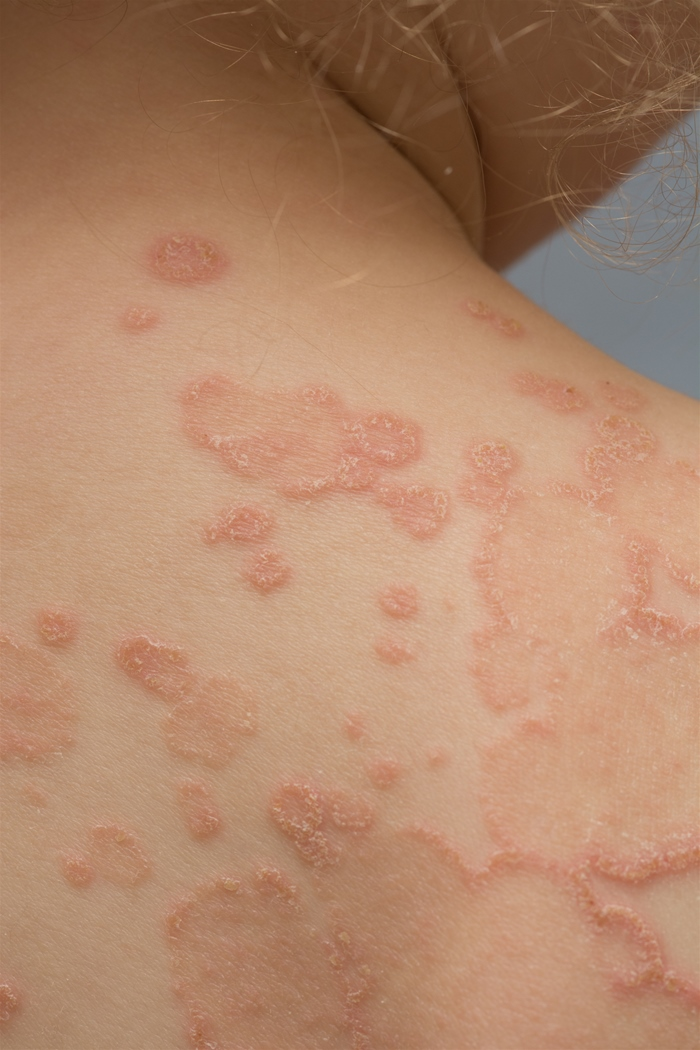 The remainder of the examination is normal. Which of the following is the most likely cause of this patient's current condition?
 (Multiple Choice)
4.8/5 (78)
(78) A 29-year-old man is being evaluated in the surgical departemnt due to a new fever and chills over last 12 hours. Two weeks ago, he was brought to the emergency department after sustaining a gunshot wound to the abdomen. He underwent a partial bowel resection due to bowel injury without complications. He has been receiving parenteral nutrition by inserted central venous catheter. His temperature is 38.2 C (101 F), blood pressure is 105/65 mm Hg, and pulse is 104/min. Abdominal examination shows a well healed wound with soft nontender on palpation. The catheter site on the left arm is mildly tender but shows no erythema. A yeast growth is detected on the blood culture Which of the following is characteristic of the most likely organism causing this bloodstream infection?
(Multiple Choice)
4.9/5 (84)
(84) In order to find novel therapeutic targets, researchers examine the HIV viral structure and replication process. They discover that the virus encodes a large glycoprotein that is split into the surface and transmembrane subunits. In the virion, these subunits continue to be noncovalently linked to one another. The transmembrane component undergoes conformational changes upon activation of the surface protein, revealing the functional inner core. A unique medication is created that preferentially binds and stops the transmembrane component from functioning normally, interfering with the typical viral replication cycle. This agent most likely directly inhibits which of the following viral processes?
(Multiple Choice)
4.9/5 (88)
(88) A 24-year-old man is brought to the physician with fever, malaise, and unilateral facial pain and swelling that began 2 days ago. He has an appendictomy 3 days ago. His temperature is 38.2°C (100.8°F). There is erythema, edema, and tenderness of the right parotid glands. Physical examination shows firm swelling of the preauricular area on the right side extending to the angle of the mandible. Which of the following serum markers is most helpful for confirming the diagnosis?
(Multiple Choice)
4.9/5 (78)
(78) A 9-month-old girl is brought to the physician by her mother because of a generalized nonpruritic rash for 2 days. The rash began on her trunk and spread to her extremities. Five days ago, she was taken to the emergency department for fever of 40.5°C (104.9°F) and a 1-minute generalized tonic-clonic seizure. The mother says the fever resolved abruptly. The patient was born at term and has no history of serious illness. Her immunizations are up-to-date. Current medications include acetaminophen. Her temperature is 37.2°C (99.0°F) and pulse is 120/min. Examination shows a maculopapular rash that blanches on pressure. Posterior auricular lymphadenopathy is present. Infection with which of the following is the most likely cause of this patient's condition?
(Multiple Choice)
4.8/5 (70)
(70) A 75-year-old man comes to the physician with fever diffuse muscle aches and nausea for 3 days. His niece had similar symptoms 1 weeks ago. His medical problems include hypertension and iritable bowel syndrome. The patient's temperature is 38.9 C (102 F). Lung examination is unremarkable. A rapid influenza test is positive. The patient is started on oseltamivir. Which of the following is most likely impaired in the patient's infected cells as a result of the treatment?
(Multiple Choice)
4.7/5 (79)
(79) A 62-year-old man with limited, unresectable small cell lung cancer comes to the emergency department because of fever for the past 2 days. He has been on numerous chemotherapy regimens. His last round of treatment was with cisplatin and etoposide and ended 10 days ago. He feels fatigued but has not had nausea or vomiting. He appears ill. His temperature is 38.5°C (101.3°F), pulse is 115/min, and blood pressure is 100/60 mm Hg. Physical examination shows dry mucous membranes. His hemoglobin level is 9.5 g/dL, and leukocyte count is 900/mm3 with an absolute neutrophil count of 100/mm3. Chest x-ray reveals a dense infiltrate involving the right upper lung lobe. Broad-spectrum antibiotic therapy is instituted. Five days later, the patient is still febrile. Bronchoscopy with biopsy is performed and the tissue samples from the bronchoscopy grow mold. Which of the following organisms is most likely responsible for this patient's current condition?
(Multiple Choice)
4.8/5 (78)
(78) A scientist is conducting research to discover novel drug targets for antiretroviral agents against HIV. An HIV-positive blood sample is analyzed in the laboratory, and purified CD4 T lymphocytes are extracted. Using molecular tracing techniques, the scientist follows a viral HIV protein that is synthesized in the blood sample's T cells. The protein becomes glycosylated before being proteolytically cleaved into 2 smaller proteins in the Golgi apparatus. Which of the following best describes the function of these 2 newly formed HIV proteins?
(Multiple Choice)
5.0/5 (83)
(83) A 55-year-old man comes to the emergency department because of headache, fever, chills, shortness of breath, and abdominal pain for 1 week. He also feels tired and nauseous. He returned from a trip to Botswana 2 weeks ago. He has type 2 diabetes mellitus. He has smoked one pack of cigarettes daily for the past 30 years and drinks a glass of beer daily. His only current medication is metformin. His temperature is 39.3°C (102.8°F), pulse is 122/min, respirations are 28/min, and blood pressure is 109/84 mm Hg. Pulse oximetry on room air shows an oxygen saturation of 94%. Examination shows jaundice. Peripheral blood smear shows intraerythrocytic Plasmodium falciparum. Which of the following is the most likely underlying cause of this patient's infection?
(Multiple Choice)
4.9/5 (75)
(75) A 22-year-old man arrives at the clinic with a painful lesion on his upper back. A few days ago, the patient noticed a little sore papule that grew in size and became red and unpleasant. He's had three identical lesions on his upper back in the last six months, all of which were treated with incision and drainage, as well as medications. The patient has no additional medical problems and is not on any drugs. He does not smoke, drink, or use illegal drugs. On physical examination, his right upper back has a 3-cm painful pustule with surrounding erythema. Below is a Gram staining of purulent discharge from the lesion. 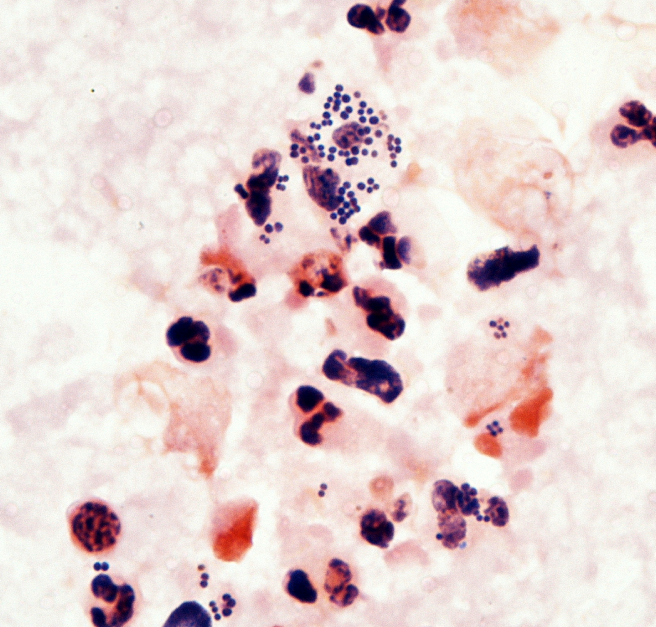 Which of the following most likely predisposed this patient to recurrent infections?
 (Multiple Choice)
4.7/5 (64)
(64) 
Filters
- Essay(0)
- Multiple Choice(0)
- Short Answer(0)
- True False(0)
- Matching(0)