



 Chat with AI
Exam 9: Microbiology and Virology

Exam 1: Anatomy265 Questions
Exam 2: Behavioral Sciences178 Questions
Exam 3: Biochemistry102 Questions
Exam 4: Embryology59 Questions
Exam 5: Epidemiology, Biostatistics, and Medical Informatics94 Questions
Exam 6: Genetics88 Questions
Exam 7: Histology46 Questions
Exam 8: Immunology147 Questions
Exam 9: Microbiology and Virology330 Questions
Exam 10: Pathology817 Questions
Exam 11: Pharmacology and Toxicology509 Questions
Exam 12: Physiology339 Questions
Exam 13: Psychiatry and Psychotherapy23 Questions
Select questions type


A 26-year-old man is being screened as a potential kidney donor for his mother, who has end-stage renal disease. The patient has no history of diabetes, hypertension, or kidney disease and is up to date with all recommended vaccinations. Physical examination is unremarkable. Blood type and crossmatch testing demonstrate biological compatibility. As part of the evaluation, screening for transmissible diseases is performed and is notable for the following results: 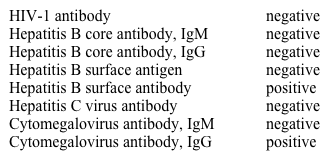 Based on these data, the patient most likely has had which of the following conditions in the past?
 (Multiple Choice)
4.8/5  (87)
(87) A 65-year-old woman presented to the office complaining of painful blisters on the left forehead. Yesterday, she started feeling numbness in her forehead. Physical examination shows vesicles involving the left forehead. This patient could develop blindness due to the involvement of which the following nerves?
(Multiple Choice)
4.7/5 (73)
(73) For one week, a 48-year-old man is evaluated for shortness of breath and a dry cough. The patient has never had similar symptoms before and does not take any medications. He has a 5-pack-year smoking history and does not drink or use illegal drugs. The patient is a pig farmer from Ohio who has not traveled in a long time. The temperature is 37.8 degrees Celsius (100 degrees Fahrenheit), the blood pressure is 128/85 mm Hg, the pulse rate is 95 beats per minute, and the respirations rate is 16 beats per minute. Auscultation of the lungs reveals scattered wheezing and crackles. The image below depicts a peripheral blood smear. 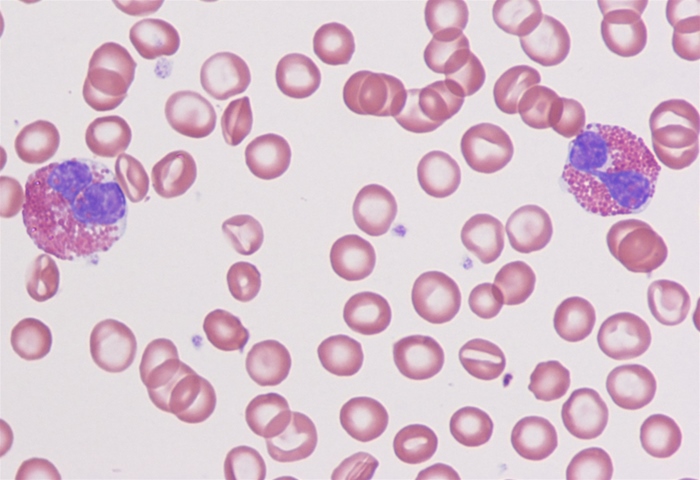 The nucleated cells seen on this patient's peripheral smear most likely perform which of the following functions?
 (Multiple Choice)
5.0/5 (85)
(85) A novel antimicrobial agent that inhibits bacterial glycosyltransferase enzyme is developed. Bacteria grown in a medium containing this antibiotic become spherical, cease to grow, and subsequently lyse. So that the activity of this antibiotic against various bacteria can be determined, disks enriched with the drug are placed on agar plates containing bacterial colonies. The plates are incubated alongside control plates with the same organisms but no antimicrobial disks. The control plates all show organism growth. In the plates with the diffusion disks, resistance to the drug is determined by measuring the zone of complete growth inhibition around the disk. Which of the following bacteria is most likely to be resistant to this drug?
(Multiple Choice)
4.8/5 (77)
(77) A group of experts is looking at the substances that cause infections in immunocompromised people. The trial includes patients with solid-organ cancer who have received standard treatment. Any patient who gets fever during chemotherapy-induced neutropenia has detailed microbiologic data collected. Which of the following infections is most likely to be found in the vast majority of these patients?
(Multiple Choice)
4.8/5 (91)
(91) A 64-year-old man comes to the emergency department because of a 2-day history of lower back pain, fever, and chills. He has had nausea but no vomiting during this time. He has hypertension, chronic kidney disease, and type 2 diabetes mellitus. Three months ago, he underwent amputation of his left third toe because of a nonhealing ulcer. He has smoked a pack of cigarettes daily for 48 years. Current medications include hydrochlorothiazide, metoprolol, and insulin. His temperature is 39.4°C (102.9°F), pulse is 102/min, respirations are 18/min, and blood pressure is 150/94 mm Hg. Physical examination shows suprapubic and costovertebral angle tenderness. Urinalysis shows 3+ leukocyte esterase and numerous white blood cells. Urine and blood cultures grow non-lactose-fermenting Gram-negative rods. Which of the following pathogens is the most likely culprit?
(Multiple Choice)
4.8/5 (77)
(77) A 6-year-old boy whose family recently immigrated to the United States is brought to the office due to sore throat and fever. Physical examination reveals pharyngeal erythema and edema with coalescing, gray exudate. Bilateral cervical lymph nodes are enlarged and tender. A rapid streptococcal test result is negative. The toxin responsible has a mechanism of action most similar to another toxin produced by which of the following bacteria?
(Multiple Choice)
4.7/5 (72)
(72) A 35-year-old man comes to the emergency department with fever, chills, dyspnea, and a productive cough. His symptoms began suddenly 2 days ago. The patient has no prior medical conditions and does not use tobacco, alcohol, or illicit drugs He lives in Illinois and works as a carpenter. His temperature is 38.8°C (101.8°F), pulse is 110/min, respirations are 24/min, and blood pressure is 105/74 mm Hg. Pulse oximetry on room air shows an oxygen saturation of 92%. Examination reveals crackles over the right lower lung base. The remainder of the examination shows no abnormalities. An x-ray of the chest shows a right lower-lobe infiltrate of the lung. The underlying immune response to this patient's infection largely involves T helper (Th1) cells, interferon-gamma, and interleukin-2. Which of the following is the most likely pathogen responsible for this patient's pneumonia?
(Multiple Choice)
4.9/5 (77)
(77) A 35-year-old woman comes to the office due to a vulvar lesion. She has also experienced occasional headaches and memory loss recently. The patient has had unprotected sexual intercourse with multiple partners. Cardiovascular examination is notable for a diastolic murmur with a prominent second heart sound. There is a painless indurated nodule on her vulva. Cervical cultures are negative for gonorrhea, but a serum Venereal Disease Research Laboratory (VDRL) test is positive. Chest x-ray reveals calcifications at the level of the ascending aortic arch. Blood cultures are negative. Lumbar puncture shows mild pleocytosis and a positive VDRL result. HIV testing is negative. Which of the following best describes this patient's vulvar lesion?
(Multiple Choice)
4.9/5 (83)
(83) A 7-year-old girl is brought to the office due to a diffuse rash. The father says she developed a lace-like, erythematous rash this morning on her stomach, back, and extremities. Two days ago, the girl developed red, flushed cheeks. She also had congestion, headache, and a low-grade fever for 3 days earlier this week. Last week, her younger brother had similar symptoms that resolved spontaneously. The infectious agent most likely responsible for this patient's disease replicates in progenitors of which of the following cell lines?
(Multiple Choice)
4.9/5 (78)
(78) Six days after being admitted to the hospital for cholecystectomy, a 56-year-old woman has high-grade fevers, chills, malaise, and generalized weakness. She has been hospitalized twice in the last year for acute cholecystitis. She had a molar extraction around 2 weeks ago. She has mitral valve prolapse, hypertension, rheumatoid arthritis, and hypothyroidism. Current medications include metformin, rituximab, levothyroxine, and enalapril. Her temperature is 38.3°C (101°F), pulse is 112/min, and blood pressure is 138/90 mm Hg. Examination shows painless macules over her palms and soles and linear hemorrhages under her nail beds. The lungs are clear to auscultation. There is a grade 3/6 systolic murmur heard best at the apex. Blood is drawn and she is started on intravenous antibiotic therapy. Two sets of blood cultures grow Streptococcus gallolyticus (formerly S bovis). Echocardiography shows a large oscillating vegetation on the mitral valve and moderate mitral regurgitation. Additional workup for this patient should focus on which of the following conditions?
(Multiple Choice)
4.8/5 (85)
(85) A 40-year-old man presents to his physician with complaints of a cough and fatigue that have significantly affected his daily routine. He lives alone and denies any sick contacts at his workplace but notes that he was formerly incarcerated and released 3 months ago. Upon further questioning, he states that he has coughed up blood a few times in the past weeks and has been having occasional night sweats. A chest x-ray demonstrates a right apical lung lesion. A tuberculosis diagnosis is made. Which of the following would most likely happen during the first week of infection?
(Multiple Choice)
4.8/5 (71)
(71) Five days after admission to the hospital for treatment of community-acquired pneumonia, a 76-year-old man develops watery diarrhea and cramping lower abdominal pain. Today, he has had three episodes of foul-smelling, nonbloody diarrhea without nausea or vomiting. He has hypertension and hyperlipidemia. His medications include lisinopril, atorvastatin, cefotaxime, and clarithromycin. His temperature is 37.5°C (99.5°F), pulse is 95/min, respirations are 16/min, and blood pressure is 140/85 mm Hg. Pulse oximetry on room air shows an oxygen saturation of 97%. Crackles are heard over the right lower lung base. Abdominal examination shows mild tenderness throughout the lower quadrants. Stool testing for occult blood is negative. Which of the following is the single best stool test to establish the cause of this patient's diarrhea?
(Multiple Choice)
4.8/5 (81)
(81) A 31-year-old man is brought to the emergency department after a tonic-clonic seizure. The patient has no known medical conditions. He grew up in a rural part of Guatemala and immigrated to the United States 3 years ago. The patient works as an architect and owns a cat. He has no history of tuberculosis. On examination, the patient is afebrile and has no focal neurologic deficits or meningeal signs. HIV antibody test and interferon-gamma release assay are negative. Chest x-ray is normal. MRI of the head reveals a 1.5-cm cyst within the left sylvian fissure that has minimal enhancement and no associated edema. Which of the following is the most likely means of acquisition of the infection responsible for this patient's findings?
(Multiple Choice)
4.8/5 (77)
(77) A 21-year-old female college student comes to the physician because of a 2-week history of vaginal itching and burning. She also noticed white vaginal discharge despite cleaning her genital area daily using a "soap-free, natural" vaginal douche. She is worried that she might have contracted a sexually transmitted disease after meeting her new boyfriend around one month ago. She has type 1 diabetes mellitus. She had an intrauterine device implanted 3 months ago and does not use barrier protection. She smokes one pack of cigarettes per day and does not drink alcohol. Pelvic examination shows an erythematous vulva and a thick white discharge that adheres to the vaginal wall. The rest of the physical examination is normal. Microscopic examination reveals budding cells. Which of the following is the most likely underlying cause of her current condition?
(Multiple Choice)
4.9/5 (74)
(74) A 68-year-old lady arrives to the emergency room with a cough and shortness of breath. She has chronic obstructive lung disease and frequently coughs up clear sputum in the morning. Her cough, however, has increased substantially over the last four days, and she is now expectorating thick, yellow sputum. When walking short distances or doing light housework, the patient also feels "winded." She was a former smoker with a 40-pack-year smoking streak. The temperature is 37.2 C (99 F), the blood pressure is 130/70 mm Hg, the pulse rate is 90 beats per minute, and the respirations rate is 22 / minute. With pursed lips, the sufferer is breathing. The expiry period is extended. Auscultation of the lungs reveals vesicular breath sounds with scattered wheezes. An x-ray of the chest reveals hyperinflated lungs with a flattened diaphragm. There are no parenchymal opacities or pleural effusion. Respiratory infection with which of the following pathogens most likely triggered this patient's worsening symptoms?
(Multiple Choice)
5.0/5 (69)
(69) A 34-year-old man visited the office after seeing white plaques on his buccal mucosa while cleaning his teeth. He was HIV positive after an adequate workup, with a CD4+ T lymphocyte count of 280/mm3. He was referred to an infectious diseases expert for further evaluation, but he failed to keep appointments. The patient returns three years later after suffering from perirectal discomfort and itching for several months. He also experiences occasional rectal bleeding and frequently sees bright red blood on tissue after wiping. Because he believed he had hemorrhoids, the patient did not seek medical attention. A solitary, hard mass with superficial ulceration of about 2x2 cm is discovered in the anal canal during inspection. No hemorrhoids are present. There is no palpable regional lymphadenopathy. Which of the following pathogens is most likely responsible for this patient's current anal pathology?
(Multiple Choice)
4.7/5 (85)
(85) A 22-year-old woman comes to the physician because of yellow vaginal discharge, itching, and pain with urination for the past 6 days. She has been sexually active with multiple male partners over the past year and uses condoms inconsistently; she has been taking an oral contraceptive for the past 2 years. She has no history of serious illness or sexually transmitted diseases. Pelvic examination shows erythema of the vulva and vagina and foul-smelling, frothy, yellow-green vaginal discharge. Which of the following is the best test to confirm the diagnosis in this patient?
(Multiple Choice)
4.8/5 (85)
(85) A 30-year-old woman comes to the office because of a 2-day history of fever and malaise. Yesterday, she developed a rash on her chest that has since spread to her shoulders, arms, neck, face, and stomach area. She tries her best not to scratch her body but describes the rash as "very itchy." She has not had nausea, vomiting, or diarrhea. The patient has recently immigrated from South Africa with her family. Her temperature is 38.3°C (100.9°F), pulse is 90/min, respirations are 17/min, and blood pressure is 126/84 mm Hg. Examination of the skin shows a papular rash with vesicles and crusted lesions. The remainder of the physical examination shows no abnormalities. This patient's symptoms are most likely due to an infection with which of the following pathogens?
(Multiple Choice)
4.9/5 (73)
(73) A 54-year-old man with HIV is part of a large clinical study. He was diagnosed with HIV-1 infection 5 years ago. Blood samples are obtained periodically to perform sequencing analysis of the viral genome. Current testing reveals a large number of isolates with mutation in the pol gene compared to the previous analyses. This finding is most closely associated with which of the following?
(Multiple Choice)
4.9/5 (90)
(90) 
Filters
- Essay(0)
- Multiple Choice(0)
- Short Answer(0)
- True False(0)
- Matching(0)