



 Chat with AI
Exam 9: Microbiology and Virology

Exam 1: Anatomy265 Questions
Exam 2: Behavioral Sciences178 Questions
Exam 3: Biochemistry102 Questions
Exam 4: Embryology59 Questions
Exam 5: Epidemiology, Biostatistics, and Medical Informatics94 Questions
Exam 6: Genetics88 Questions
Exam 7: Histology46 Questions
Exam 8: Immunology147 Questions
Exam 9: Microbiology and Virology330 Questions
Exam 10: Pathology817 Questions
Exam 11: Pharmacology and Toxicology509 Questions
Exam 12: Physiology339 Questions
Exam 13: Psychiatry and Psychotherapy23 Questions
Select questions type


A 3-month-old male is brought to the emergency department because of fever and poor feeding for 2 days. He became very fussy the previous evening and cried for most of the night. The mother does not recall any sick contacts at home. He appears irritable. His temperature is 38.6°C (101.5°F), pulse is 180/min, and blood pressure is 82/51 mm Hg. Examination shows scleral icterus. He becomes more agitated when picked up. There is full range of motion of his neck and extremities. The anterior fontanelle feels soft and flat. A lumbar puncture is performed, and the results of cerebrospinal fluid (CSF) analysis are as follows: 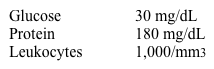 Gram-negative coccobacilli are isolated from the CSF. These organisms demonstrate little growth on 5% sheep blood agar but grow well when incubated on the same media alongside colonies of Staphylococcus aureus. Staphylococci promote the growth of these bacteria by supplementing which of the following substances?
 (Multiple Choice)
4.8/5  (76)
(76) A 22-year-old woman comes to the physician because of urinary frequency, pelvic discomfort, and purulent urethral discharge following unprotected sex with a new partner. She has a history of chronic ear infections and asthma. Her only medication is a combined fluticasone-albuterol inhaler. She does not smoke cigarettes and drinks alcohol socially up to 4 times per week. Her temperature is 36.0°C (96.8°F), pulse is 70/min, and blood pressure is 125/80 mm Hg. Nucleic acid amplification testing is positive for Neisseria gonorrhoeae infection. The patient develops antibody against the bacterial pili that enhance attachment to host cells. Her symptoms resolve with adequate treatment. Several weeks later, the patient develops N gonorrhoeae reinfection after repeat exposure to the same partner. Which of the following is the most likely reason for the lack of long-lasting immunity against the bacteria despite antibody formation in this patient?
(Multiple Choice)
4.8/5 (80)
(80) A 2-hour-old girl develops tachypnea and grunting in the newborn nursery. The patient was born via cesarean delivery to a 26-year-old mother, gravida 2 para 2. Respiratory rate is 82/min. The other vital signs are within normal limits. Physical examination shows grunting and subcostal retractions but clear lungs. Blood culture reveals gram-positive rods after 11 hours of incubation. Which of the following pathogens is the most likely cause of this patient's condition?
(Multiple Choice)
4.9/5 (93)
(93) A 6-day-old female infant is brought to the emergency department because of poor feeding and irritability for two days. She was born at 39 weeks' gestation, and the pregnancy and delivery were uncomplicated. Her temperature is 39.2°C (102.6°F). She appears lethargic and makes occasional twitching movements in both upper extremities. The anterior fontanelle is soft and full. Empiric cefotaxime and vancomycin therapy is initiated. A lumbar puncture is performed and analysis of the cerebrospinal fluid shows increased protein and decreased glucose. Cerebrospinal fluid culture shows an organism that is resistant to cefotaxime. Which of the following organisms is most likely causing this patient's infection?
(Multiple Choice)
5.0/5 (82)
(82) A 4-year-old girl is brought to the physician with progressively worsening fever, malaise, and a sore throat. Her parents say "Our daughter has not received vaccinations because her body has to learn how to fight infections." Her temperature is 38.5C (101.3 F). Physical examination shows marked cervical lymphadenopathy. There are gray-white membranes over the tonsils and posterior pharynx that bleed when scraped off. A sample of the pharyngeal exudate is obtained by oropharyngeal swab. Bacteria isolated from the exudate demonstrate exotoxin production in the laboratory. Which of the following best describes the mechanism of action of the exotoxin?
(Multiple Choice)
4.9/5 (79)
(79) A 20-year-old lady arrives to the office complaining of increased vaginal discharge and vulvar pruritus. For the previous four days, the patient has had vaginal discharge. She has several sexual partners and uses oral contraception pills. Vital indicators are typical. Pelvic examination is carried out, and wet mount microscopy of a vaginal sample is displayed. 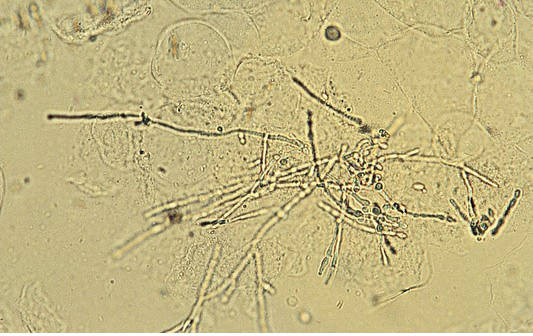 Which of the following is the most appropriate pharmacotherapy for this patient?
 (Multiple Choice)
4.8/5 (81)
(81) A 48-year-old guy visits his doctor with a 6-month history of coughing and exhaustion. He has also noticed fatigue and weight loss. He has no recollection of any ill encounters. The patient works as a carpenter. He smokes one pack of cigarettes every day. The temperature is 37.1 degrees Celsius (98.8 F). The left lower lobe crackles upon examination. HIV testing came back negative. A pulmonary infiltration in the lower lobe of the left lung is shown by a chest x-ray. The following are the results of sputum potassium hydroxide preparation. 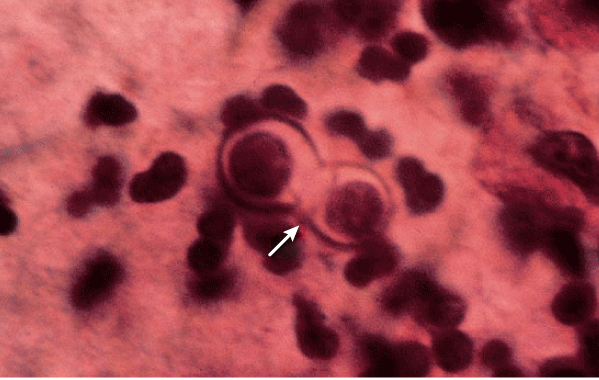 Which of the following is the most likely cause of this patient's condition?
 (Multiple Choice)
4.9/5 (67)
(67) A 40-year-old woman is evaluated for neck pain that has gradually worsened over the past several months. The patient reports a pulling sensation in her neck that causes difficulty in keeping her head straight. She has had no trauma and has no other medical conditions. Physical examination shows a spastic and thickened sternocleidomastoid muscle causing head tilt. The patient is diagnosed with idiopathic torticollis. She is treated with injections of a bacterial product into the affected muscle, with significant relief of her symptoms. The substance administered to this patient is derived from bacteria that most likely demonstrate which of the following characteristics?
(Multiple Choice)
4.7/5 (81)
(81) A 34-year-old man comes to the hospital due to several hours of difficulty swallowing, dry mouth, and blurred vision. The patient has a history of major depression. Examination shows mydriasis and poorly reactive pupils. Electrodiagnostic studies reveal normal nerve conduction velocity but decreased compound muscle action potential (CMAP). Rapid, repetitive nerve stimulation leads to facilitation of CMAP. Further review of this patient's medical history would most likely reveal which of the following?
(Multiple Choice)
4.7/5 (91)
(91) A 10-year-old kid is sent to the emergency room with respiratory distress. Rapid, loud breathing has gradually evolved during the last 6 hours. The temperature is 40.1 C (104.2 F), the blood pressure is 105/75 mm Hg, the pulse rate is 120 beats per minute, and the respirations rate is 32 / minute. Inspiratory stridor and supraclavicular retractions are seen on examination. The exhibit depicts a lateral neck x-ray. 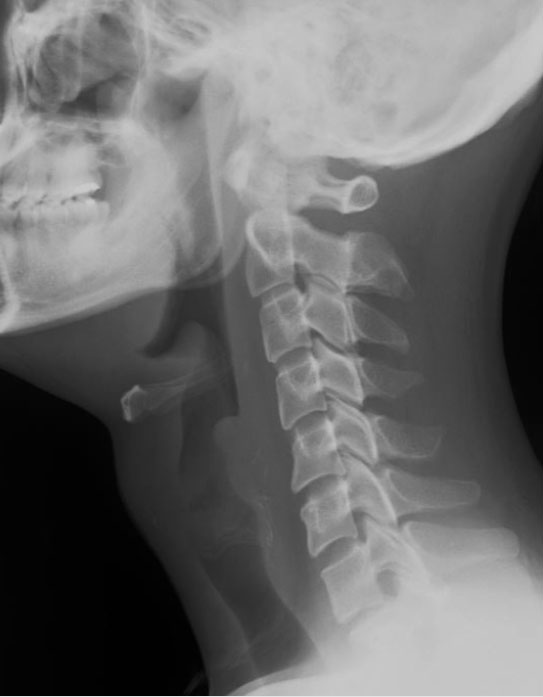 The patient is admitted to the hospital, and blood cultures are obtained. If blood cultures are positive, which of the following would most likely be seen on Gram stain?
 (Multiple Choice)
4.8/5 (63)
(63) A 10-year-old boy is brought to the emergency department because of high-grade fever and lethargy for 4 days. He has had a severe headache for 3 days and 2 episodes of non-bilious vomiting. He appears ill. His temperature is 40.1°C (104.2°F), pulse is 131/min, and blood pressure is 92/50 mm Hg. Examination shows nuchal rigidity. Kernig and Brudzinski signs are present. A lumbar puncture is performed. Analysis of the cerebrospinal fluid shows a decreased glucose concentration, increased protein concentration, and numerous segmented neutrophils; a Gram stain shows gram-negative cocci in pairs. The parents are concerned about their younger son, who shares a bedroom with the patient. Which of the following is the most appropriate management of this patient's household contacts?
(Multiple Choice)
4.9/5 (77)
(77) A 60-year-old man comes to the physician because of a3 weeks history of intermittent low-grade fever and a worsening productive cough. During this time, he also has had a 4-kg (9-lb) weight loss despite no change in his appetite. He recently came back from rural China after attending a family wedding party. He has hypertension and takes lisinopril regularly. His temperature is 38.3 C (101 F), blood pressure is 110/80 mm Hg, pulse is 94/min, and respirations are 18/min. He weighs 60 kg (132.3 lb). Chest-x ray reveals a cavitary lesion on the right. Sputum culture is obtained. When exposed to drug A, isolates of the pathogen growing in culture quickly become less resistant to decoloration with an acid-alcohol agent and stop proliferating. Which of the following is drug A most likely to be?
(Multiple Choice)
4.9/5 (75)
(75) A 36-year-old man comes to the emergency department because of progressively worsening shortness of breath and fever for 2 days. He also has a nonproductive cough. He does not have chest pain or headache. His temperature is 38.1°C (100.6°F), pulse is 103/min, respirations are 26/min, and blood pressure is 130/70 mm Hg. Pulse oximetry on room air shows an oxygen saturation of 91%. Pulmonary examination shows diffuse crackles. The spleen tip is palpated 4 cm below the left costal margin. The patient's serum fails to agglutinate horse erythrocytes. The agglutination test is repeated a week later and, again, no agglutination is noted. HIV testing is negative. Which of the following is the most likely cause of this patient's condition?
(Multiple Choice)
4.9/5 (77)
(77) A 44-year-old man comes to the physician for a follow-up examination. Two months ago, he was diagnosed with HIV infection and antiretroviral treatment was begun. He feels well. He does not smoke or drink alcohol. Current medications include integrase inhibitor. Which of the following steps of viral replication is most likely to be inhibited as a result of this patient's treatment?
(Multiple Choice)
4.7/5 (67)
(67) A 19-year-old man visits the doctor because he has been suffering from diarrhea for the past four months. He went to a student health center at his university a month ago and was given medicines, but his diarrhea did not improve. He also experiences continuous nausea, bloating, and a weight reduction of 6.8 kg (15 lb). The exhibit shows a microscopic inspection of his faeces for ova and parasites after trichrome staining. 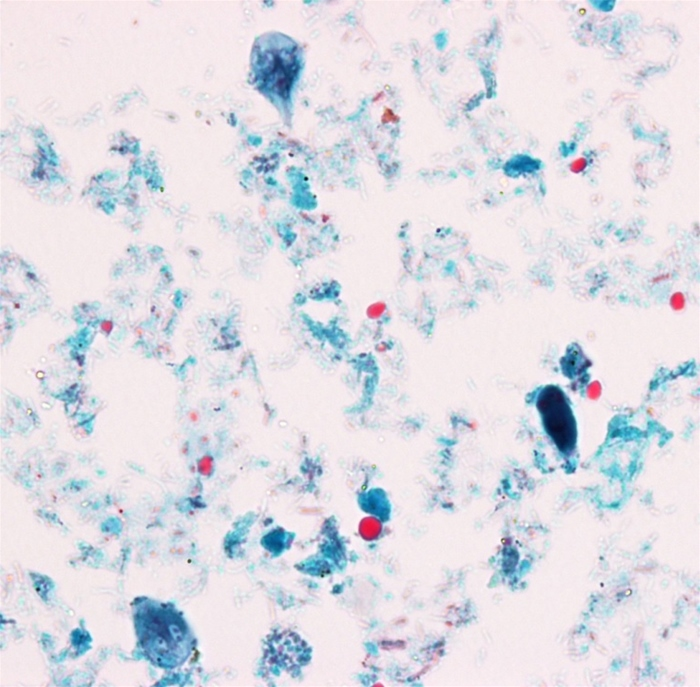 Impairment of which of the following immune functions would most likely predispose to this patient's infection?
 (Multiple Choice)
4.8/5 (63)
(63) A 65-year-old man comes to his physician because of progressively worsening shortness of breath for the past 2 months. He does not experience shortness of breath at rest. He also occasionally has a dry cough. He has not had fever, chills, or night sweats. The patient has smoked a pack of cigarettes daily for 40 years. His temperature is 37°C (98.6°F), pulse is 86/min, respirations are 22/min, and blood pressure is 133/85 mm Hg. Lung auscultation reveals a prolonged expiratory phase and end-expiratory wheezing. Sputum cultures in specialized media grow round-to-oval, budding yeast, which form germ tubes when incubated at 37 C in serum. Which of the following best explains the presence of the organism in this patient's sputum sample?
(Multiple Choice)
4.9/5 (81)
(81) A 29-year-old man is being assessed for a skin rash that has been affecting his hands, feet, and scalp for the past two weeks. The rash is moderately pruritic and has deteriorated with time. The patient has a history of HIV and is not taking antiretroviral medication. An inspection of the skin reveals erythematous areas with scales and crusting. A rash biopsy reveals organisms burrowed in the epidermis, as seen below: 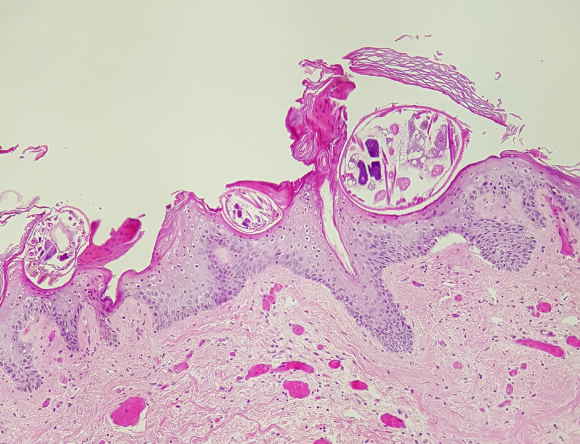 Which of the following is the most appropriate treatment for this patient?
 (Multiple Choice)
4.9/5 (80)
(80) A 25-year-old woman comes to the physician because of a 4-day history of vaginal discharge. She has no pain or pruritus. Menses occur at regular 27-day intervals and last 5 days. Her last menstrual period was 2 weeks ago. She is sexually active with two male partners and uses a diaphragm for contraception. She had a normal Pap smear 3 months ago. She has no history of serious illness and takes no medications. Her temperature is 37.3°C (99°F), pulse is 75/min, and blood pressure is 115/75 mm Hg. Pelvic examination shows malodorous, gray vaginal discharge. The pH of the discharge is 5.0. Which of the following would most likely be seen on wet mount microscopy?
(Multiple Choice)
4.7/5 (83)
(83) A 52-year-old man is brought to the emergency department because of headaches, vertigo, and changes to his personality over the past few weeks. He was diagnosed with HIV 14 years ago and was started on antiretroviral therapy at that time. Medical records from one month ago indicate that he followed his medication schedule inconsistently. Since then, he has been regularly taking his antiretroviral medications and trimethoprim/sulfamethoxazole. His vital signs are within normal limits. Neurological examination shows ataxia and apathy. Mini-Mental State Examination score is 15/30. An MRI of the brain with contrast shows a solitary ring-enhancing lesion involving the corpus callosum and measuring 4.5 cm in diameter. A lumbar puncture with subsequent cerebrospinal fluid analysis shows slight pleocytosis, and PCR is positive for Epstein-Barr virus DNA. Tissue biopsy from the frontal lobe lesions would likely predominantly show an abnormal population of which of the following cells?
(Multiple Choice)
4.9/5 (72)
(72) A 35-year-old man is found to have elevated alanine aminotransferase and aspartate aminotransferase levels. He has no abdominal pain, nausea, or vomiting. The patient has used intravenous drugs in the past but denies significant alcohol use. His past medical history is negative for blood transfusions or excessive acetaminophen use. Physical examination findings are normal. Laboratory studies show high titers of IgG directed against the hepatitis C envelope protein. Which of the following is the most likely reason that these antibodies do not confer effective immunity against the infection?
(Multiple Choice)
4.9/5 (66)
(66) 
Filters
- Essay(0)
- Multiple Choice(0)
- Short Answer(0)
- True False(0)
- Matching(0)