



 Chat with AI
Exam 9: Microbiology and Virology

Exam 1: Anatomy265 Questions
Exam 2: Behavioral Sciences178 Questions
Exam 3: Biochemistry102 Questions
Exam 4: Embryology59 Questions
Exam 5: Epidemiology, Biostatistics, and Medical Informatics94 Questions
Exam 6: Genetics88 Questions
Exam 7: Histology46 Questions
Exam 8: Immunology147 Questions
Exam 9: Microbiology and Virology330 Questions
Exam 10: Pathology817 Questions
Exam 11: Pharmacology and Toxicology509 Questions
Exam 12: Physiology339 Questions
Exam 13: Psychiatry and Psychotherapy23 Questions
Select questions type


A 46-year-old obese man comes to the emergency room because of paresthesias in his feet and a hypopigmented skin lesion on his knee that he first noticed 6 weeks ago. He has also had fever, fatigue, and malaise for the last week. He has a history of chronic autoimmune thyroiditis for which he takes levothyroxine. He immigrated from Indonesia 3 years ago to join his family in the United States. His temperature is 38.7°C (101.7°F) and blood pressure is 122/84 mm Hg. Physical exam shows a well-defined hypopigmented skin lesion approximately 3 cm in diameter over the anterior aspect of the right knee. The area has no hair growth and remains dry although he is diaphoretic. There is diminished sensation to light touch and pinprick in the skin lesion when compared to surrounding skin. There is reduced light touch sensation in the big toes bilaterally. A full-thickness skin biopsy confirms the diagnosis. Which of the following organisms is the most likely cause of this patient's condition?
(Multiple Choice)
4.7/5  (91)
(91) Two days after hospital admission and surgical treatment for a cut on his right thigh from a sickle, a 35-year-old man presents to the emergency department with wound swelling, fever, chills, and severe pain. He had a similar injury 4 months ago that resolved after treatment with bacitracin ointment and daily dressings. He works on a farm on the outskirts of the city. He appears anxious. His temperature is 38.5°C (101.3°F), pulse is 103/min, and blood pressure is 114/76 mm Hg. Examination shows a 6-cm edematous deep, foul-smelling wound on the medial surface of the right thigh. The skin over the thigh appears darker than the skin on the lower leg. There are multiple blisters around the wound. Light palpation around the wound causes severe pain; crepitus is present. The microorganism most likely responsible for this patient's condition is also commonly associated with which of the following conditions?
(Multiple Choice)
4.9/5 (74)
(74) A 13-year-old girl comes to the emergency department due to rapidly progressive exertional dyspnea and generalized fatigue. Two weeks ago, the patient had a low-grade fever and lace-like rash on her arms and trunk for several days. She has a history of sickle cell disease and takes a daily folic acid supplement. The patient appears to be in distress. Her temperature is 38.5°C (101.4°F), pulse is 130/min, and respirations are 25/min. On examination, the patient has conjunctival pallor but no icterus. A cardiac flow murmur is present. The abdomen is soft and nontender with no organomegaly. Laboratory studies show a hematocrit of 16% with reticulocyte count of 0.1% (normal range, 0.5%-1.5%). Leukocyte and platelet counts are normal. Which of the following best describes the virus most likely responsible for this patient's current condition?
(Multiple Choice)
4.9/5 (88)
(88) A 38-year-old man is sent to the emergency room after having a widespread tonic-clonic seizure. Prior to the occurrence, he had been suffering from a worsening headache, vomiting, and bewilderment. The temperature is 38 degrees Celsius (100.4 F). A sluggish patient with bilateral papilledema and neck stiffness is revealed on physical examination. His condition deteriorates over time, and he dies in the hospital several days later. An autopsy is done, and the results of the brain histology are presented below. 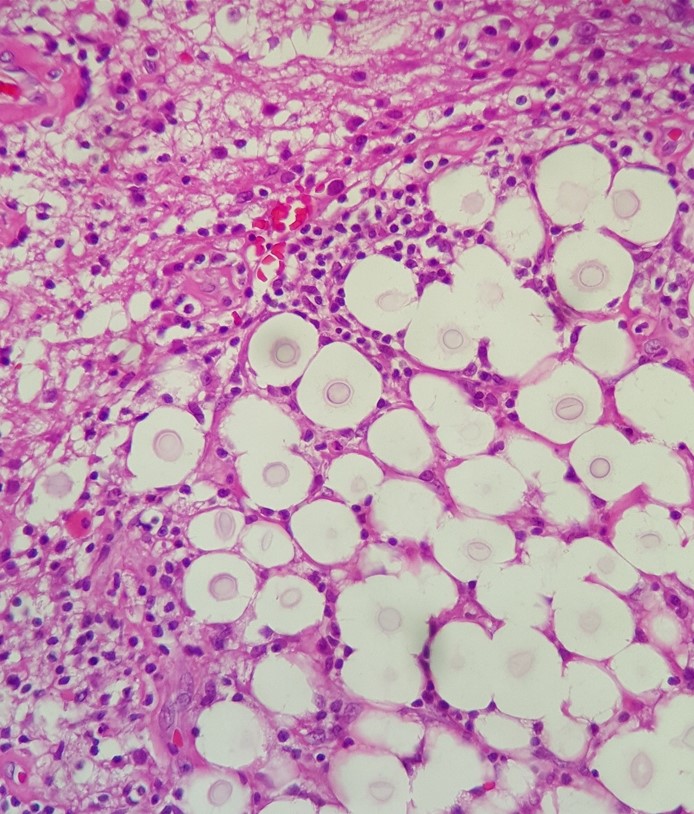 Which of the following pathogens is most likely responsible for these findings?
 (Multiple Choice)
5.0/5 (80)
(80) A 28-year-old woman comes to the emergency department because of a 6-day history of abdominal pain, fever, vomiting, and decreased appetite. Her pain started as dull and diffuse but has progressed to a sharp pain on her right side. She did not seek medical attention earlier because she has no medical insurance and "was waiting for the pain to disappear." She has no history of serious illness. She is sexually active with one male partner and uses condoms consistently. Her temperature is 38.2°C (100.8°F), pulse is 88/min, respirations are 18/min, and blood pressure is 125/75 mm Hg.There is right lower quadrant tenderness with rebound as well as a palpable mass. CT scan of the abdomen and pelvis demonstrates a periappendiceal fluid collection. Culture of this fluid would most likely isolate which of the following organisms?
(Multiple Choice)
4.7/5 (84)
(84) A 2-year-old boy is brought to the physician by his mother because of fever and pain in the left ear for the past 3 days. The mother states that he has been rubbing his left ear repeatedly since he woke up this morning. The patient has had 2 previous episodes of acute otitis media. Temperature is 38.1 C (100.6 F). Otoscopic examination shows a perforated right tympanic membrane with erythema and purulent exudate. Cultures from the exudate yield small, oxidase-positive, gram-negative coccobacilli that grow on factor X- and factor V-supplemented media, consistent with Haemophilus influenzae. The patient's immunizations are up to date. Which of the following best explains this patient's susceptibility to the pathogen causing his current infection?
(Multiple Choice)
4.9/5 (82)
(82) A 34-year-old man, who is a military veteran, comes to the office because of a 2-day history of fever, headache, myalgias, and a lesion on his face. He first noticed a blister on his right cheek, which gradually progressed into a dark sore. He denies recent insect bites, rodent exposure, or animal bites or scratches, but he scratched his face on the ground during a combat exercise. One week ago, he returned from a 1-year deployment in Afghanistan where he worked as an infantry soldier. The patient's medical history is unremarkable. He appears ill and fatigued. His temperature is 38.3°C (101°F). Physical examination shows a 2-cm painless cutaneous ulcer over the right cheek that is surrounded by an edematous halo; the center of the lesion is necrotic. He has multiple abrasions on his face and elbows. There is cervical lymphadenopathy. The toxin causing edema around this patient's ulcer has a mechanism of action most similar to a different toxin produced by which of the following bacteria?
(Multiple Choice)
4.8/5 (76)
(76) A 70-year-old woman comes to the physician for the evaluation of back pain. For the past six days, she has had a burning pain in her upper right back and chest. She cannot recall any recent injury and has no prior history of back pain. She has a history of hypertension and gastroesophageal reflux. The patient volunteers at an animal shelter three times a week. She does not smoke or drink alcohol. Current medications include ramipril and pantoprazole. The patient appears healthy and well-nourished. Her temperature is 36.9°C (98.4°F), pulse is 76/min, and blood pressure is 145/92 mm Hg. Examination shows a long erythematous rash covered with multiple clear vesicles and crusty lesions extending from her back to below her right breast. This patient is at greatest risk of developing which of the following complications as a result of her current condition?
(Multiple Choice)
4.8/5 (81)
(81) A 3-year-old boy is brought to the emergency department because of abdominal pain and diarrhea for the past 3 days.. The stools were initially watery but have now become bloody. On physical examination, his temperature is 100.4 F (38 C). There are signs of dehydration and he has a mildly distended abdomen with diffuse pain elicited on palpation. Stool studies are positive for fecal leukocytes and occult blood. Fecal cultures grow non-lactose fermenting, gram-negative rods on MacConkey agar. The bacteria ferment glucose without gas production, do not generate hydrogen sulfide when grown on triple sugar iron agar, and cannot replicate at refrigeration temperatures. Which of the following bacterial factors is the most important during the pathogenesis of this patient's disease?
(Multiple Choice)
4.9/5 (83)
(83) A 28-year-old homeless man presents to the emergency department with pain and discoloration of his left foot. He says that a few days ago, he accidentally stepped on a piece of scrap metal while walking across a parking lot with bare feet. He went to the emergency room and received a dose of tetanus toxoid vaccination for wound prophylaxis. Last night, he felt the sudden onset of pain on the bottom of his left foot and notes that severe pain has spread diffusely to the dorsum of his foot as well. His temperature is 100.8°F (38.2°C), pulse is 110/min, respirations are 18/min, and blood pressure is 108/58 mmHg. Palpation of the skin on the dorsum of his left foot reveals tenderness and crepitus. Which of the following best describes the mechanism of action of the toxin responsible for the necrotic effects seen in this patient?
(Multiple Choice)
4.8/5 (78)
(78) A 6-year-old previously healthy girl is brought to the office due to diarrhea and abdominal pain. She started having watery diarrhea after a barbeque dinner 4 days ago; her stools became grossly bloody 2 days later. Her mother also had similar symptoms. The patient's temperature is 37 C (98.7 F). The abdomen is soft with mild generalized tenderness. Stool culture is performed on sorbitol-MacConkey agar and reveals sorbitol-negative colonies with biochemical properties of Escherichia coli. Enzyme immunoassay detects a substance capable of inhibiting protein synthesis in human cells. The substance detected in this patient is most similar to the toxin produced by which of the following bacteria?
(Multiple Choice)
4.9/5 (77)
(77) A 28-year-old primigravid woman at 31 weeks' gestation comes to the physician because of fever, myalgia, abdominal pain, nausea, and diarrhea for 3 days. Her pregnancy has been uncomplicated. Her only medication is a prenatal vitamin. Her temperature is 39.4°C (102.9°F). Physical examination shows diffuse abdominal pain. Blood cultures incubated at 4°C (39.2°F) grow a gram-positive, catalase-positive organism. Which of the following is the major virulence factor of the organism responsible for this patient's clinical presentation?
(Multiple Choice)
4.9/5 (78)
(78) A previously healthy 2-year-old boy is brought to the clinic with fever and mouth pain that began yesterday. He has consumed an adequate amount of fluids but refuses to eat due to the pain. The patient has no medical problems and takes no medications. Physical examination reveals swollen gums and vesicular, inflamed lesions on his hard palate and lips. He has enlarged and tender cervical lymph nodes. Which of the following is most likely responsible for this patient's condition?
(Multiple Choice)
4.7/5 (81)
(81) A 34-year-old woman comes to the emergency department because of right flank pain and vomiting for 5 hours. She has had fever and chills for the past 2 days. She attended a barbecue 3 days ago, where she ate egg salad. She underwent surgery for left ovarian torsion a year ago. Menses occur at regular 28-day intervals and last 5 days. She is sexually active with two male partners and uses condoms inconsistently. Her only medication is an oral contraceptive pill. She is 163 cm (5 ft 4 in) tall and weighs 72.5 kg (160 lb); BMI is 28 kg/m2. She appears uncomfortable. Her temperature is 38.9°C (102°F), pulse is 101/min, and blood pressure is 118/76 mm Hg. The lungs are clear to auscultation. The right lower quadrant and right flank show severe tenderness to palpation. Pelvic examination shows no abnormalities. Laboratory studies show: 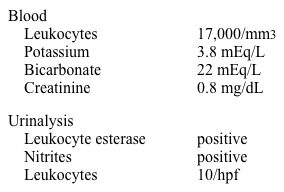 Blood and urine cultures are performed, and empiric antibiotics are initiated. Urine cultures grow gram-negative rods that are lactose-fermenting and indole-positive. Which of the following is the most likely organism causing this patient's infection?
 (Multiple Choice)
4.9/5 (87)
(87) A 25-year-old primigravida has a stillbirth at 18 weeks gestation. Her only symptom during pregnancy was pain in both knees and feet, which she attributed to pregnancy-related weight gain and being "on my feet all day" as an elementary school teacher. The pain lasted approximately a week and resolved without medication. The patient was taking prenatal vitamins daily, and her prenatal care was appropriate. Fetal autopsy shows pleural effusion, pulmonary hypoplasia, and ascites. Infection with which of the following is the most likely etiology of the stillbirth?
(Multiple Choice)
4.8/5 (86)
(86) A 55-year-old guy arrives at the office complaining of malaise and cough for the previous two months. He mentions yellow sputum with intermittent blood streaks. The patient smokes a pack of cigarettes every day and has a history of alcohol use disorder with past binge drinking episodes. The temperature is 37.1 degrees Celsius (98.8 F). Dental caries, gingivitis, and swollen submandibular lymph nodes are seen during the examination. During right lung auscultation, coarse rhonchi are heard. With air bronchograms, a chest CT scan demonstrates an extensive right lung consolidative process. Bronchoscopy is conducted, and the results of a lung biopsy specimen are shown in the image below. 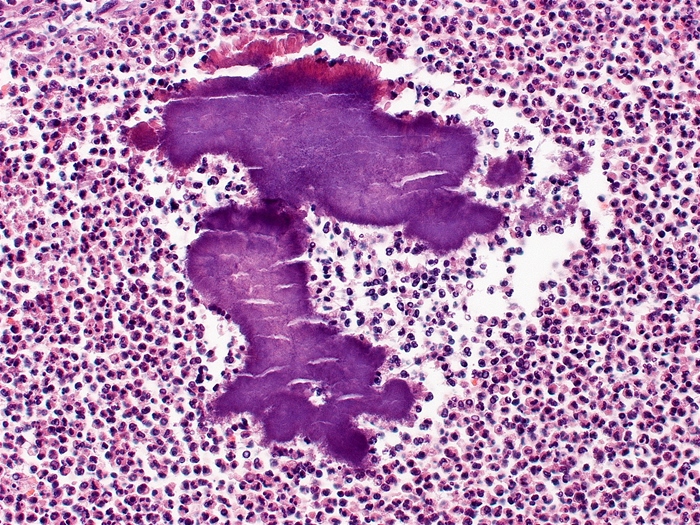 Which of the following is the most likely diagnosis?
 (Multiple Choice)
5.0/5 (82)
(82) A 28-year-old lady visits the doctor's office complaining of progressively worsening stomach discomfort and sporadic diarrhea over many months. She claims not to have a fever or chills, but she has lost weight from a lack of hunger. The patient has spent a lot of time in the region over the past five years while working for an organization that installs wood pellet cookstoves in remote villages in Central Africa. Blood pressure is 126/72, temperature is 37.8 C (100 F), and pulse is 86. 19 kg/m2 is the BMI. Physical inspection is typical. The following are the laboratory findings: 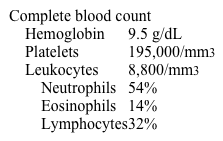 An intestinal biopsy sample is shown in the exhibit.
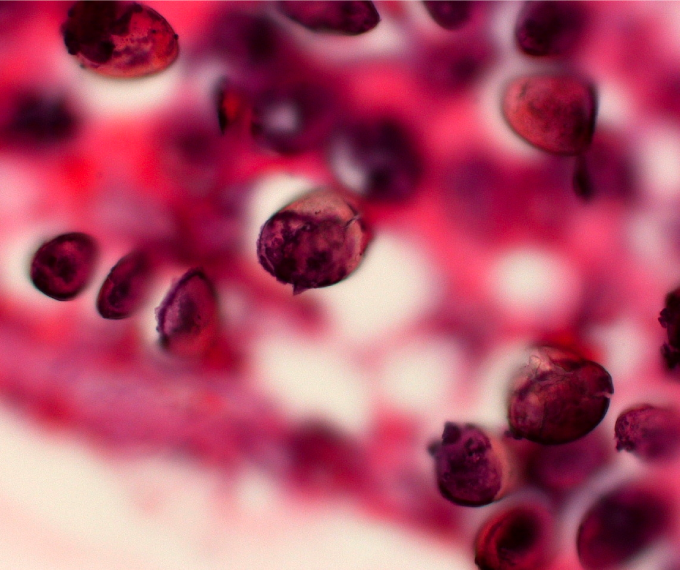 Which of the following is the most appropriate treatment for this patient?
An intestinal biopsy sample is shown in the exhibit.
Which of the following is the most appropriate treatment for this patient? (Multiple Choice)
4.9/5 (87)
(87) A 3-week-old baby boy is brought to the emergency department with fever, irritability, and poor feeding. Examination of the cerebrospinal fluid shows a leukocyte count of 600 cells/µL (80% neutrophils), protein of 160 mg/dL, and glucose of 20 mg/dL. Blood cultures grow gram-negative rods that form pink colonies on MacConkey agar. Which of the following is the most important bacterial virulence factor for the development of this patient's condition?
(Multiple Choice)
4.9/5 (71)
(71) A 3-year-old boy is brought to the emergency department because of fever, vomiting, and diarrhea for 3 days. Her parents report at least 8 watery stools daily. She has had three upper respiratory tract infections since she started daycare 2 months ago but has otherwise been developing normally. Her mother has a history of celiac disease. The patient is at the 57th percentile for height and the 65th percentile for weight. Her immunizations are incomplete. Her temperature is 38.5°C (101.3°F), pulse is 145/min, and blood pressure is 92/54 mm Hg. Examination shows dry mucous membranes and decreased skin turgor. Bowel sounds are hyperactive. Polymerase chain reaction testing of the stool sample yields a virus with a segmented, double-stranded RNA genome. Which of the following pathologic findings is most likely to be present in this patient?
(Multiple Choice)
4.8/5 (70)
(70) A 7-year-old girl is brought to the physician because of itching of the vulva and anal region, especially during the night. Physical examination shows excoriation marks around the vulva and perianal region. There is minor perianal erythema, but no edema or fissures. An adhesive tape is applied to the perianal area shortly after she wakes in the morning. Microscopic analysis of the tape reveals the presence of eggs that are asymmetrically flattened on one side. Which of the following is the most appropriate treatment for this patient's condition?
(Multiple Choice)
4.9/5 (63)
(63) 
Filters
- Essay(0)
- Multiple Choice(0)
- Short Answer(0)
- True False(0)
- Matching(0)