



 Chat with AI
Exam 9: Microbiology and Virology

Exam 1: Anatomy265 Questions
Exam 2: Behavioral Sciences178 Questions
Exam 3: Biochemistry102 Questions
Exam 4: Embryology59 Questions
Exam 5: Epidemiology, Biostatistics, and Medical Informatics94 Questions
Exam 6: Genetics88 Questions
Exam 7: Histology46 Questions
Exam 8: Immunology147 Questions
Exam 9: Microbiology and Virology330 Questions
Exam 10: Pathology817 Questions
Exam 11: Pharmacology and Toxicology509 Questions
Exam 12: Physiology339 Questions
Exam 13: Psychiatry and Psychotherapy23 Questions
Select questions type


A previously healthy 4-year-old boy is brought to the physician because of blisters and redness on his neck and chest for 2 days. He has also had a fever. He is lethargic and has not eaten well since the rash appeared. He has not had coughing, wheezing, or dysuria. He is an only child and there is no family history of serious illness. His immunizations are up-to-date. His temperature is 38.9°C (102°F), pulse is 90/min, and blood pressure is 80/40 mm Hg. Examination shows flaccid blisters over his neck and trunk that rupture easily. Areas of erythematous moist skin are also noted. Twirling an eraser over the trunk results in a blister. Oropharyngeal examination is normal. Which of the following is the most likely cause of this patient's symptoms?
(Multiple Choice)
4.8/5  (86)
(86) A 4-year-old girl is brought to the emergency department by her parents because of fever, coughing, difficulty swallowing, and increasing shortness of breath for 6 hours. Physical examination shows cervical lymphadenopathy and a blue-gray film over the posterior pharynx. Microscopic examination of a throat culture shows bacilli arranged at acute angles. Specialized staining of the sample shows metachromatic granules at the polar region. Which of the following best explains the pathogenicity of the organism most likely responsible for this patient's condition?
(Multiple Choice)
4.9/5 (91)
(91) A 61-year-old man comes to the physician because of a 5-month history of sharp, shooting pain in both legs. Twenty years ago, he had a painless ulcer on his penis that resolved without treatment. He has no history of serious illness. Examination shows small pupils that constrict with accommodation but do not react to light. Sensation to pinprick and light touch is decreased over the distal lower extremities. Patellar reflexes are absent bilaterally. His gait is unsteady and broad-based. This patient is at increased risk for which of the following complications?
(Multiple Choice)
4.8/5 (73)
(73) A 1-day-old male newborn is brought to the emergency department because of fever and poor feeding for 2 hours. He became very fussy the previous evening and cried for most of the night. He was born at 36 weeks' gestation and weighed 2430 g (5 lb 3 oz) to a 21-year-old woman who came to the emergency department in active labor with ruptured membranes; she had not received adequate prenatal careHe appears irritable. His temperature is 38.6°C (101.5°F), pulse is 180/min, and blood pressure is 82/51 mm Hg. Examination shows scleral icterus. He becomes more agitated when picked up.Blood samples are obtained, and empiric antibiotics are initiated for the treatment of sepsis. Cultures on blood agar grow bacterial colonies with a narrow zone of clear hemolysis. When these bacteria are grown in the presence of Staphylococcus aureus, the zone of hemolysis is enhanced around the staphylococcal colonies. Which of the following is the most likely pathogen infecting this patient?
(Multiple Choice)
4.9/5 (83)
(83) A 49-year-old homeless man comes to the emergency department because of fatigue, cough, and worsening shortness of breath for 2 weeks. He was diagnosed with HIV-infection 25 years ago but has never had any symptoms. He has always refused to take antiretroviral medication. Pulmonary examination shows diffuse crackles over bilateral lower lung fields. An x-ray of the chest shows diffuse, symmetrical interstitial infiltrates. A trimethoprim-sulfamethoxazole is initiated and the physician discussed the need to resume antiretroviral therapy. Therefore, HIV genotyping assay is performed. Additional testing for HLA-B*57:01 yields positive results. Which of the following medications is contraindicated in this patient due to the risk of a potentially fatal hypersensitivity reaction?
(Multiple Choice)
4.8/5 (93)
(93) A 21-year-old man comes to the emergency department due to shortness of breath, fatigue, myalgias, and debilitating retroorbital headaches for the past several days. The patient is on summer break and came to work at his grandparents' dairy farm 3 weeks ago. He cleans out animal waste from the barn, but he does not handle hay. His past medical history is insignificant. He does not use tobacco or illicit drugs. The patient's temperature is 38.8 C (101.8 F). Bronchial breath sounds are heard in the right lower lung. There are no cardiac murmurs. Abdominal examination is unremarkable. Chest x-ray demonstrates right lower and middle lobe consolidation. Laboratory results are as follows: 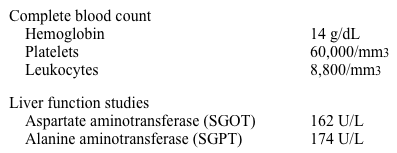 An HIV test is negative.Which of the following is the most likely cause of this patient's symptoms?
 (Multiple Choice)
4.8/5 (84)
(84) A 32-year-old man comes to the office due to 2 months of increase neck swelling under his right jaw. The swelling hasn't improved despite it was opened and drained pus a month ago. The patient has no medical conditions other than dental caries; he had a tooth extracted prior to symptom onset. Physical examination shows an indurated, nontender mass in the rightt submandibular area with a small opening on the overlying skin. Gentle pressure on the mass yields thick pus containing sand/grain-like particles. The microbial pathogen with which of the following characteristics is the most likely cause of this patient's condition?
(Multiple Choice)
4.9/5 (71)
(71) A 50-year-old man comes to the physician because of a 4-week history of intermittent fevers, productive cough, and shortness of breath. Three weeks ago he was treated with amoxicillin-clavulanate and azithromycin, which did not improve his symptoms. He is also worried because he has noticed "some new bumps on his skin". He lives in upstate New York along the Mohawk River. He has rheumatoid arthritis. He does not smoke cigarettes. His medications include methotrexate and a multivitamin. His temperature is 38.1ºC (100.6°F), pulse is 72/min, respirations are 16/min, and blood pressure is 128/75 mm Hg. Diffuse crackles are heard over both lung fields. Skin examination shows multiple, white, verrucous papules and nodules on the thighs. A CT scan of the chest shows bilateral tree-in-bud opacities in the lower lobes. A biopsy of a skin nodule shows pyogranulomatous inflammation and round yeast cells. Which of the following is the most likely causal pathogen?
(Multiple Choice)
4.8/5 (74)
(74) A 43-year-old man with a fever, chest discomfort, and hemoptysis visits the emergency room. He had previously undergone a course of chemotherapy for a hematologic malignancy. Neutropenia caused by the chemotherapeutic drugs is evident in laboratory tests. On a chest CT, a nodule with surrounding hypoattenuation is visible. Assays for galactomannan and beta-D-glucan are increased. Aspergillus can develop in sputum cultures. Amphotericin B is administered intravenously to the patient. He has headaches, rigors, and hypotension while receiving the infusion. Amphotericin is blamed for the deterioration in renal function that occurs during the following several days. These toxic effects are likely due to binding of the antifungal agent to which of the following?
(Multiple Choice)
4.9/5 (67)
(67) A 43-year-old type 1 diabetic woman who is poorly compliant with her diabetes medications presented to the emergency department with hemorrhage from her nose. She says that he has lost a significant amount of weight recently despite no significant change in dietary habits. Laboratory studies show a serum pH of 7.1 and positive serum ketones. His mucus membranes are extremely dry. Treatment is initiated, and the patient's condition improves. However, he now has fever, headache, and eye pain. Examination of the nasal cavity shows a black necrotic eschar adherent to the inferior turbinate. Which of the following procedures would most likely reveal the pathogen responsible for this patient's infection?
(Multiple Choice)
4.9/5 (77)
(77) A 44-year-old man comes to the physician because of progressive memory loss for the past 6 months. He reports that he often misplaces his possessions and has begun writing notes to remind himself of names and important appointments. He generally feels fatigued and unmotivated and has poor concentration at work. Neurologic examination shows mild ataxia and an inability to perform repetitive rotary forearm movements. Mental status examination shows a depressed mood and short-term memory deficits. Serum glucose, vitamin B12 (cyanocobalamin), and thyroid-stimulating hormone concentrations are within the reference range. Upper esophagogastroduodenoscopy shows streaky, white-grayish lesions. Viral proliferation in which of the following central nervous system cells is most likely involved in this patient's disease process?
(Multiple Choice)
4.9/5 (76)
(76) A 5-year-old boy is brought to the emergency department because of irritability and fever for 2 days. His symptoms began shortly after returning from a family trip to Canada. He was born at term. His immunizations are up-to-date. The boy appears weak and lethargic. He is at the 50th percentile for height and 75th percentile for weight. His temperature is 39.2°C (102.5°F), pulse is 110/min, respirations are 28/min, and blood pressure is 92/55 mm Hg. Examination shows mild pharyngeal erythema in addition to neck stiffness. Capillary refill time is 4 seconds. The remainder of the examination shows no abnormalities. His hemoglobin concentration is 12 g/dL, leukocyte count is 19,000/mm3, and platelet count is 225,000/mm3. A lumbar puncture is done; cerebrospinal fluid analysis shows 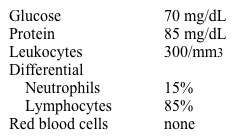 Which of the following infectious agents is most likely to have caused this patient's illness?
 (Multiple Choice)
4.7/5 (91)
(91) A 32-year-old man is brought to the emergency department because of a 2-day history of confusion and rapidly progressive dyspnea. He has had a fever and chills for the past five days. . He has smoked two packs of cigarettes daily for 15 years and drinks one to two beers daily. He has a history of intravenous heroin use. He appears pale, anxious, and in severe distress. His temperature is 39.3°C (102.7°F), respirations are 30/min, pulse is 59/min, and blood pressure is 80/50 mm Hg. Pulse oximetry on room air shows an oxygen saturation of 75%. Examination shows multiple linear hemorrhages underneath the nails. There are nontender maculae on both palms and soles. Fine rales are heard bilaterally on auscultation of the chest. Cardiac examination shows an S3; a grade 3/6 high-pitched decrescendo early diastolic murmur is heard along the left sternal border and right second intercostal space. Chest imaging reveals scattered bilateral peripheral lung opacities. HIV testing is negative. This patient's blood cultures are most likely to grow which of the following organisms?
(Multiple Choice)
4.7/5 (81)
(81) A 36-year-old man comes in to talk about a skin rash on his shoulders and upper chest. The patient initially noticed the rash while on vacation at a seaside resort two months ago. The rash has developed over time and is accompanied by slight itching, but he has no other symptoms. The patient is a road construction worker who frequently works in hot, humid conditions. Seasonal allergies and childhood asthma are significant medical histories. He does not consume either cigarettes or alcohol. The results of the skin examination are depicted in the figure below. 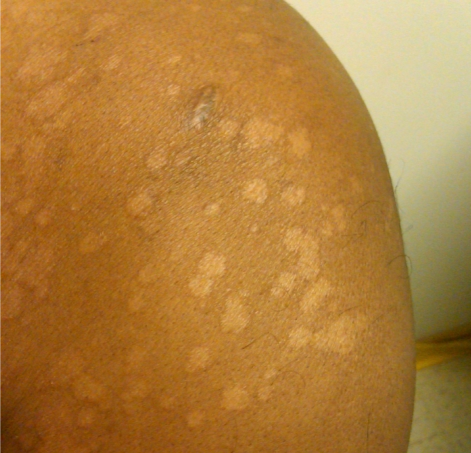 Which of the following is the most likely cause of this patient's condition?
 (Multiple Choice)
4.9/5 (84)
(84) A 10-day-old male newborn is brought to the emergency department by his mother because of episodes of weakness and spasms for the past 12 hours. His mother states that he has also had difficulty feeding and opening his mouth. He has not had fever, cough, diarrhea, or vomiting. He was born at 39 weeks' gestation via uncomplicated vaginal delivery at home. Pregnancy was uncomplicated. The mother refused prenatal vaccines out of concern they would cause side effects. She is worried his symptoms may be from some raw honey his older sister maybe inadvertently fed him 5 days ago. He appears irritable. His temperature is 37.1°C (98.8°F). Physical examination shows increased muscle tone throughout, arching of the back, and dorsiflexed feet. In addition to avoid honey feeding to newborn, which of the following is the most effective strategy to prevent this condition?
(Multiple Choice)
4.8/5 (74)
(74) A 25-year-old woman arrives at the workplace after a week of coughing and dyspnea. She also experiences crampy stomach ache and diarrhea on occasion. There is no history of respiratory sickness or other chronic medical issues in the patient, but he was recently diagnosed with immune thrombocytopenia, which was treated with high-dose glucocorticoid medication. She does not smoke, drink, or use illegal drugs. She moved to the eastern United States from Myanmar eight years ago but has not traveled since. The temperature is 37.2 C (99 F), the blood pressure is 120/78 mm Hg, the pulse rate is 88 bpm, and the respirations rate is 18 /minute. A nontender abdomen and scattered wheezes are found on physical examination. Eosinophilia is discovered in laboratory tests, and sputum microscopy is illustrated in the figure below: 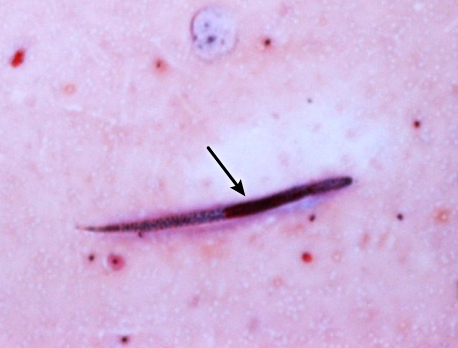 This patient most likely acquired the pathogen via which of the following modes of transmission?
 (Multiple Choice)
4.9/5 (82)
(82) A previously healthy 24-year-old man comes to the physician because of a 4-day history of fever, headache, myalgias, and abdominal pain. He developed a new rash this morning. He returned from a camping trip in the Appalachian Mountains 5 days ago. He was camping outdoors, drank only filtered water, and used sunscreen. He is sexually active and uses condoms for contraception. He appears ill and fatigued. His temperature is 39.5°C (103.1°F). Physical examination shows conjunctival injection in both eyes without exudate or pus. There is a blanching, macular rash on the palms and soles and petechiae on the wrists and forearms. The patient should be immediately initiated on a medication that targets which of the following?
(Multiple Choice)
4.8/5 (91)
(91) A 31-year-old man arrives at the office with mouth lesions that cause little discomfort when eating. He also claims to be tired and to have lost weight unintentionally. The patient has no past medical issues and does not use any drugs. The results of the oral examination are displayed below. 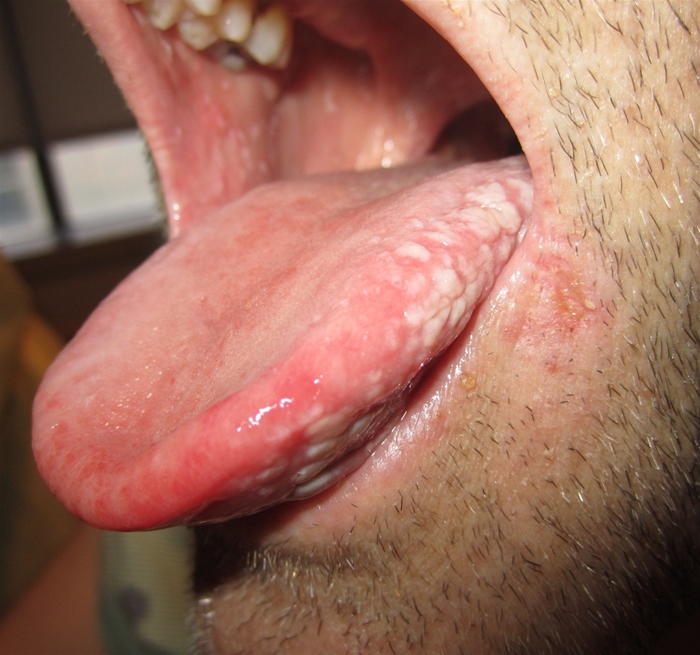 The lesions can be easily scraped off, revealing erythematous mucosa underneath. There are several enlarged cervical and axillary lymph nodes. Which of the following diagnostic tests is most appropriate during further workup of this patient?
 (Multiple Choice)
4.8/5 (85)
(85) A 2-year-old boy is brought to the emergency department because of fever and poor feeding for 2 days. He became very fussy the previous evening and cried for most of the night. Examination shows a stiff neck. The pupils are equal and reactive to light. Neck flexion results in flexion of the knee and hip. Muscle strength is decreased in the right upper extremity. Laboratory results are as follows: 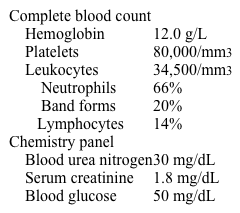 While being evaluated, the patient develops apnea and asystole. Despite aggressive resuscitation efforts, the patient dies. Autopsy would most likely reveal which of the following?
 (Multiple Choice)
4.8/5 (73)
(73) A 78-year-old man is brought to the emergency department due to fever, cough, and shortness of breath. The patient recently moved into an assisted living facility after living with his family that owned several pets. He has a 40-pack-year smoking history. Temperature is 39.4 C (103 F), blood pressure is 106/62 mm Hg, pulse is 112/min, and respirations are 28/min. There is dullness to percussion and bronchial breath sounds over the left lung. Chest x-ray reveals a left lower lobe consolidation. Sputum microscopy shows gram-positive diplococci. Which of the following would have been most helpful in preventing this patient's lung infection?
(Multiple Choice)
4.9/5 (75)
(75) 
Filters
- Essay(0)
- Multiple Choice(0)
- Short Answer(0)
- True False(0)
- Matching(0)