



 Chat with AI
Exam 9: Microbiology and Virology

Exam 1: Anatomy265 Questions
Exam 2: Behavioral Sciences178 Questions
Exam 3: Biochemistry102 Questions
Exam 4: Embryology59 Questions
Exam 5: Epidemiology, Biostatistics, and Medical Informatics94 Questions
Exam 6: Genetics88 Questions
Exam 7: Histology46 Questions
Exam 8: Immunology147 Questions
Exam 9: Microbiology and Virology330 Questions
Exam 10: Pathology817 Questions
Exam 11: Pharmacology and Toxicology509 Questions
Exam 12: Physiology339 Questions
Exam 13: Psychiatry and Psychotherapy23 Questions
Select questions type


An outbreak of hepatitis in New Delhi was characterized by high incidence of fulminant hepatitis in pregnant women, who experienced a mortality rate of 20%. The virus responsible for the outbreak:
(Multiple Choice)
4.8/5  (76)
(76) A 41-year-old man comes to the physician because ofintermittent rectal bleeding and itching for 2 weeks. He has a history of HIV infection for which he takes zidovudine, emtricitabine, and efavirenz. he has been sexually active with 3 male partners. He uses condoms inconsistently. Digital rectal examination and anoscopy show an exophytic mass on the anal margin that is protruding into the anal canal. The mass is tender to palpation and bleeds easily on contact. Laboratory studies show a leukocyte count of 7,600/mm3 and a CD4+ T-lymphocyte count of 410/mm3. Which of the following factors is most likely responsible for the development of this patient's anal lesion?
(Multiple Choice)
4.9/5 (83)
(83) A 38-year-old man is brought to the emergency room because of diarrhea for 2 days. He has abdominal cramps and has also noticed that his stools have a dark red tint. He returned from a trip to Mexico 3 weeks ago, where he completed a marathon. . He does not smoke and drinks 3-4 beers on weekends. His temperature is 38.8°C (101.8°F), pulse is 65/min, and blood pressure is 120/75 mm Hg. Stool testing is negative for C difficile toxin, and stool culture yields no bacteria. Sigmoidoscopy reveals colonic ulcers with undermining edges that contain trophozoites. The causative organism for this patient's current condition can also produce which of the following manifestations?
(Multiple Choice)
5.0/5 (79)
(79) A 3-year-old boy is brought to the emergency department because of abdominal pain and diarrhea for the past 3 days. This morning he also had nausea and his stool had a red tint. The family recently brought home a new puppy from a kennel. The patient attends daycare. His immunizations are up-to-date. His temperature is 38.0°C (100.4°F), pulse is 140/min, and blood pressure is 80/45 mm Hg. Examination shows dry mucous membranes. The abdomen is soft, and there is tenderness to palpation. The patient's stool is positive for occult blood but negative for ova and parasites. Which of the following is the most likely cause of this patient's symptoms?
(Multiple Choice)
4.9/5 (79)
(79) A 44-year-old man arrives to the emergency department with a persistent cough and gradual weight loss. Over the last three months, he has shed 5 kg (11 lb). The patient just moved to the United States from Southeast Asia. The temperature is 37.4 degrees Celsius (99.3 degrees Fahrenheit), the blood pressure is 113/70 mm Hg, the pulse rate is 78 beats per minute, and the respirations rate is 18 / minute. An x-ray of the chest indicates an apical left lung infiltration. Gram stain and cultures on sputum are negative. A lung biopsy specimen culture, on the other hand, develops acid-fast bacilli. The lung specimen was microscopically examined. 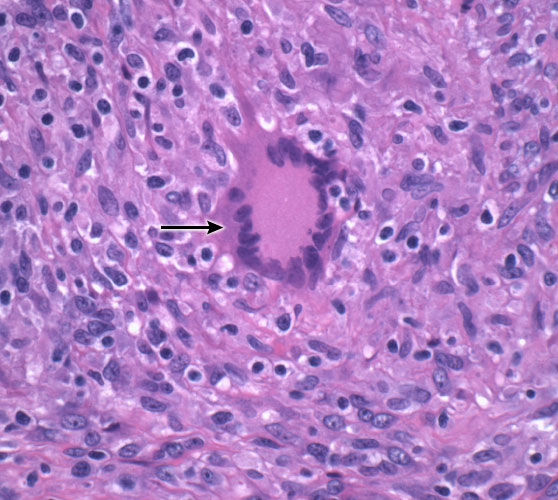 Which of the following processes is most likely to contribute to formation of the finding indicated by the arrow?
 (Multiple Choice)
5.0/5 (83)
(83) A 38-year-old man is suffering from acute myeloid leukemia. Initially, he suffered fevers and complained of being tired and sluggish all of the time. However, he has been experiencing more severe right-sided headaches recently. He reports the discomfort as throbbing and centered behind his right eye. He also complains of nasal stuffiness. The patient has no prior allergy history. Right-sided proptosis and periorbital discomfort are found on physical examination. A biopsy of the mucosa of the right maxillary sinus reveals the following: 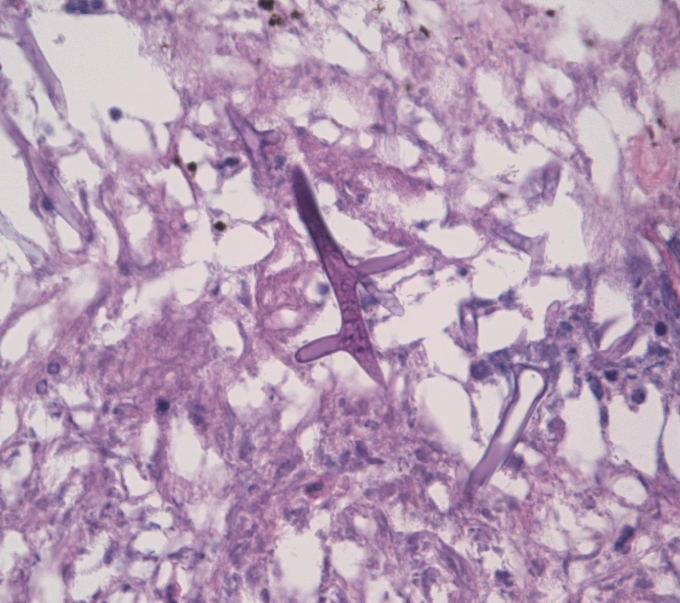 Which of the following is the most likely cause of this patient's condition?
 (Multiple Choice)
4.8/5 (90)
(90) coli colonies grown on a lactose-containing medium up-regulate the production of the enzymes Beta-galactosidase and galactoside permease. Which of the following best explains the synchronous production of both enzymes in response to lactose?
(Multiple Choice)
4.8/5 (72)
(72) A 39-year-old man comes to the physician because of a 3-month history of fatigue. During this period, he has also had a 7.7-kg (17-lb) weight loss, despite having a normal appetite. He is sexually active with 3 female partners and uses condoms inconsistently. He is found to be HIV-positive and his CD4 count is 45/mm3. The patient's condition improves on a newly instituted treatment, but 4 weeks later at outpatient follow-up he is found to have significantly elevated fasting blood glucose. Which of the following medications is most likely responsible for his hyperglycemia?
(Multiple Choice)
4.9/5 (75)
(75) A 45-year-old woman comes to the emergency department because of abdominal cramping, vomiting, and watery diarrhea for the past 4 hours. One day ago, she went to a seafood restaurant with her family to celebrate her birthday. Three of the attendees have developed similar symptoms. The patient appears lethargic. Her temperature is 38.8°C (101.8°F). A comma-shaped, oxidase-positive, gram-negative rod naturally found in salt water is implicated in her illness. Stool microscopy is most likely to demonstrate which of the following findings?
(Multiple Choice)
4.9/5 (80)
(80) A 38-year-old man comes to the physician for difficulty swallowing and retrosternal pain for the past 4 months. He has trouble swallowing solid foods but not liquids. The retrosternal pain occurs after meals and worsens when the patient lies down. He has already tried over-the-counter antacids, but they have not provided any symptom relief. The patient has been hospitalized several times recently with Pneumocystis jirovecii pneumonia. He has a history of intravenous drug use. His temperature is 37.8 C (100 F). Oropharyngeal examination is remarkable only for poor dentition. Esophagogastroduodenoscopy is performed and reveals esophageal hyperemia and linear ulcerations. Which of the following is the most likely cause of this patient's condition?
(Multiple Choice)
4.7/5 (69)
(69) A 67-year-old man comes to the physician because of a 6-month history of increasing shortness of breath on exertion, dry cough, and fatigue. He has night sweats and weight loss. Chest x-ray shows pulmonary infiltrates and an area of cavitation in the right upper lobe. Sputum microscopy shows acid-fast bacilli. Which of the following is the most accurate statement concerning this patient's pulmonary infection?
(Multiple Choice)
4.9/5 (83)
(83) A 24-year-old man comes to the emergency department due to 4 days of progressive fatigue, nausea, and abdominal pain. The patient is a known hepatitis B carrier. He admits to using IV drugs and has shared needles with other drug users on several occasions. His temperature is 37.7 C (99.9 F). Examination shows scleral icterus and mild, tender hepatomegaly. Laboratory studies are notable for highly elevated levels of liver aminotransferases and serum bilirubin and also show the following results: 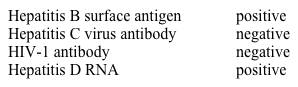 This patient's chronic infection assists which of the following life cycle aspects of the current infectious agent?
 (Multiple Choice)
4.9/5 (71)
(71) A 43-year-old man comes to the office due to increasing discomfort and pain with sitting for the past several months. He also has had occasional perianal pruritus. Physical examination shows multiple, cauliflower-shaped, verrucous growths measuring 1 to 2 cm on the perianal skin. Histopathologic examination of one of the lesion reveals hyperplastic papillary squamous epithelium with parakeratosis, nuclear irregularity, and "perinuclear halos" of cytoplasmic vacuolization. Which of the following additional studies is most appropriate for this patient at this time?
(Multiple Choice)
4.8/5 (81)
(81) A 38-year-old woman arrives to the emergency department after experiencing headache, nausea, and photophobia for two days. She has suffered migraines since her early twenties, but they have become more common in recent years. The current headache is more severe than normal, and ibuprofen provided little relief. The symptoms were preceded by a flu-like condition. The temperature is 38.3 C (100.9 F), the blood pressure is 144/86 mm Hg, and the pulse rate is 110 beats per minute. The patient seems tired. Cranial nerves, sensory, and motor capabilities are all normally functioning. When asked to touch her chin to her chest, she complains of neck ache. There is no skin rash. A noncontrast CT scan of the head reveals no anomalies. Which of the following is the best next step in this situation's management?
(Multiple Choice)
4.8/5 (69)
(69) A 54-year-old man comes to the emergency department due to worsening fever, cough, and shortness of breath. The patient initially presented a week ago with a fever, headache, myalgia, nasal discharge, and a sore throat. He tested positive for influenza A and was discharged home with symptomatic treatment. The patient's symptoms gradually improved, but over the past 2 days he has had high fevers, cough productive of yellowish sputum, sharp right-sided chest pain, and shortness of breath. The patient has no other medical problems and does not use tobacco, alcohol, or illicit drugs. Temperature is 38.9 C (102 F), blood pressure is 118/66 mm Hg, and pulse is 110/min. Physical examination reveals right-sided lung crackles. Chest x-ray reveals infiltrates in the right lung. Which of the following pathogens is most likely to be isolated from this patient's sputum?
(Multiple Choice)
4.9/5 (79)
(79) A 45-year-old man comes to the emergency department due to 2 weeks of chest pain and cough. He has a history of advanced HIV and has taken his antiretroviral medications inconsistently over the past few months. Temperature is 38.1 C (100.6 F). Crackles are heard on pulmonary examination. CD4 cell count is 98/mm3. Chest x-ray reveals nodules and hilar lymphadenopathy. A bronchoscopy is performed. Mucicarmine staining of the patient's bronchoalveolar fluid shows budding yeast forms with thick capsules. Symptomatic infection with the organism causing this patient's condition most commonly manifests as which of the following?
(Multiple Choice)
4.8/5 (90)
(90) A 32-year-old man comes to the emergency department due to a 2-day history of progressive difficulty walking and tingling in his feet. He says that his feet feel "like they've gone to sleep" and states that he tripped while walking this morning. Medical history is unremarkable except for an episode of acute diarrhea 2 weeks ago that resolved spontaneously. The patient takes no medications. He drinks 1-2 alcoholic beverages daily and does not use tobacco products or illicit drugs. Vital signs are within normal limits. Physical examination shows decreased muscular strength in the lower extremities bilaterally with absent deep tendon reflexes. Which of the following agents is most likely associated with this patient's condition?
(Multiple Choice)
4.7/5 (79)
(79) A 67-year-old woman is brought to the emergency department due to fever, headache, vomiting, and confusion. Today, the patient was noted to be confused and had difficulty ambulating due to left lower extremity weakness. The patient has a history of lymphoma in remission, hypertension, and type 2 diabetes mellitus. She is visiting her family in Texas for the summer and has never traveled outside the United States. Physical examination shows neck rigidity and left lower extremity weakness with fasciculations. CT scan of the head shows no abnormalities. Lumbar puncture is performed, and cerebrospinal fluid analysis shows lymphocytic pleocytosis and elevated protein. Cerebrospinal fluid polymerase chain reaction testing yields viral RNA. The agent infecting this patient most likely uses which of the following modes of transmission?
(Multiple Choice)
4.9/5 (85)
(85) A 24-year-old woman comes to the physician for a routine health maintenance examination. She feels well. Menses occur at regular 28-day intervals and last for 3-5 days, with normal flow. They are occasionally accompanied by pain. Three years ago, she was diagnosed with chlamydial cervicitis and treated with doxycycline. She has been sexually active with multiple partners since the age of 18 years. She regularly uses condoms for contraception. She drinks 2-3 beers on weekends and smokes half a pack of cigarettes daily. Vital signs are within normal limits. Speculum examination reveals an ulcerative lesion at the external cervical os. Cervical biopsy shows malignant squamous cells invading the underlying stroma. Further analysis of the malignant cells reveals that a double-stranded DNA virus, which encodes several proteins including E6 and E7, has integrated into the host genome. Which of the following is the most likely mechanism by which these viral proteins are involved in this patient's condition?
(Multiple Choice)
4.9/5 (89)
(89) A 34-year-old woman comes to the physician complaining of fever, dysuria, and flank pain. Her temperature is 37.8 C (100 F), blood pressure is 122/78 mm Hg, and pulse is 84/min. Physical examination elicits suprapubic and costovertebral angle tenderness. Urine dipstick analysis reveals positive leukocyte esterase and nitrite. A subsequent urine culture grows colonies of motile Gram-negative rods demonstrating a green metallic sheen on eosin methylene blue (EMB) agar and hemolysis on blood agar. Which of the following is the most important bacterial factor responsible for this patient's condition?
(Multiple Choice)
4.7/5 (81)
(81) 
Filters
- Essay(0)
- Multiple Choice(0)
- Short Answer(0)
- True False(0)
- Matching(0)