



 Chat with AI
Exam 9: Microbiology and Virology

Exam 1: Anatomy265 Questions
Exam 2: Behavioral Sciences178 Questions
Exam 3: Biochemistry102 Questions
Exam 4: Embryology59 Questions
Exam 5: Epidemiology, Biostatistics, and Medical Informatics94 Questions
Exam 6: Genetics88 Questions
Exam 7: Histology46 Questions
Exam 8: Immunology147 Questions
Exam 9: Microbiology and Virology330 Questions
Exam 10: Pathology817 Questions
Exam 11: Pharmacology and Toxicology509 Questions
Exam 12: Physiology339 Questions
Exam 13: Psychiatry and Psychotherapy23 Questions
Select questions type


A 22-year-old man comes to the office due to 3 months of progressive back pain. He has also had intermittent subjective fever. The patient emigrated from Nepal for a master's program 6 months ago. He has no other medical conditions, takes no medication, and does not use tobacco, alcohol, or illicit drugs. Temperature is 38.3 C (100.9 F), blood pressure is 122/78 mm Hg, and pulse is 84/min. BMI is 19 kg/m2. Tenderness is noted over the lumbar spine; flexion, extension, and rotation of the spine are limited due to pain and muscle spasm. MRI of the lower spine reveals partial destruction of the anterior portion of the L1-L3 vertebral bodies and a fluid collection beneath the anterior longitudinal ligament. Which of the following is the most likely diagnosis?
(Multiple Choice)
4.8/5  (84)
(84) Microbiology researchers conduct a series of experiments to determine how pathogenicity is transmitted among different strains of Streptococcus pneumoniae. In the first experiment, they inject nonvirulent strain A into the peritoneal cavity of laboratory mice and observe no ill effects. In the second experiment, researchers subject virulent strain B to a detergent agent that kills and lyses the bacterial cells. They then inject the lysate into the peritoneal cavity of a new group of mice and again observe no ill effects. During a third experiment, they inject live strain A bacteria in combination with the killed strain B lysate, resulting in death of the mice. Which of the following genetic processes most likely accounts for the observed findings of these experiments?
(Multiple Choice)
5.0/5 (83)
(83) A 73-year-old man is brought to the emergency department because of fever, headaches, and confusion for the past 24 hours. Three years ago, he underwent heart transplantation because of congestive heart failure. His temperature is 38.1°C (100.5°F). He is oriented only to person. Physical examination shows nuchal rigidity. A cerebrospinal fluid culture on blood agar grows colonies of a gram-positive bacillus surrounded by a narrow transparent rim. Which of the following processes is most important for eliminating these bacteria from the body?
(Multiple Choice)
4.9/5 (88)
(88) A 23-year-old man comes to the physician because of an ulcer on his penis. He reports a painful ulcer and draining yellow purulent material. He returned from a study abroad trip to India 3 months ago. His immunizations are up-to-date. He is sexually active with one female partner and uses condoms inconsistently. He appears uncomfortable. His temperature is 37.2°C (99.0°F), pulse is 94/min, and blood pressure is 120/80 mm Hg. Examination shows tender inguinal lymphadenopathy. There is a 2-cm ulcer with a necrotic base proximal to the glans of the penis. Which of the following is the most likely diagnosis?
(Multiple Choice)
4.8/5 (90)
(90) A 48-year-old man dies in a motor vehicle crash. He had a history of intravenous drug use and had recently been released from prison. The patient's other medical conditions included hepatitis C and hypertension. On autopsy, he is found to have a small, fibrotic focus in the upper portion of the lower lobe of the right lung and a calcified right hilar lymph node. These autopsy findings are most consistent with which of the following?
(Multiple Choice)
4.8/5 (71)
(71) A 35-year-old woman comes to the physician because of a history of malodorous vaginal discharge. She has no pain or pruritus. Menses occur at regular 27-day intervals and last 5 days. Her last menstrual period was 2 weeks ago. She is sexually active with two male partners and uses a diaphragm for contraception. She had a normal Pap smear 3 months ago. She has no history of serious illness and takes no medications. Her temperature is 37.3°C (99°F), pulse is 75/min, and blood pressure is 115/75 mm Hg. Pelvic examination shows malodorous, gray vaginal discharge. The pH of the discharge is 5.0. Application of potassium hydroxide solution to the discharge yields a strong odor. Which of the following is the best treatment option for this patient?
(Multiple Choice)
4.7/5 (94)
(94) A 14-year-old girl is brought to the physician by her father because of fever, chills, abdominal pain, and profuse nonbloody diarrhea. Her symptoms began 1 week ago when she had several days of low-grade fever and constipation. Her father describes continuous fever that has risen slowly to reach a high plateau and is relieved only by antipyretics She returned from Southeast Asia 2 weeks ago, where she spent the summer with her grandparents. Her temperature is 39.3°C (102.8°F). Examination shows diffuse abdominal tenderness and mild hepatosplenomegaly. There is a faint salmon-colored maculopapular rash on her trunk and abdomen. Which of the following is the most likely route of transmission of this patient's infection?
(Multiple Choice)
4.9/5 (87)
(87) A 4-year-old girl is brought to the emergency department because of chest pain for 3 hours. One week ago, she was admitted to the hospital for treatment of low-grade fever, malaise, and sore throat. The hospitalization was complicated by pharyngitis with pseudomembrane formation and severe cervical lymphadenopathy briefly requiring intubation. She has not received any routine childhood vaccinations. Serum studies show elevated cardiac troponins. An ECG shows diffuse T wave inversions and prolonged PR interval. Administration of which of the following at the time of her previous admission is most likely to have prevented this patient's cardiac symptoms?
(Multiple Choice)
4.9/5 (84)
(84) A 34-year-old woman arrives at the emergency department after experiencing exhaustion and occasional fever for 6 days. A person's medical history is important when it comes to depression. She does not use smoke, alcohol, or illegal substances, and she does not have any drug allergies. The patient resides in New York City and recently returned from Central Africa, where she assisted in the establishment of a feeding program. The exhibit displays the results of her blood microscopy. 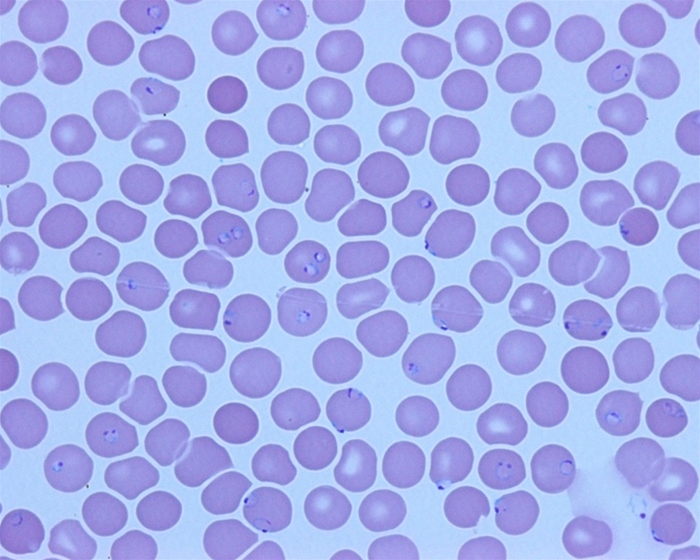 Urine pregnancy test is negative. Which of the following is the best treatment for this patient?
 (Multiple Choice)
4.9/5 (71)
(71) A 56-year-old woman comes to the emergency department because of worsening pain and swelling in her right knee for 3 days. She underwent a total knee arthroplasty of her right knee joint 5 months ago. The procedure and immediate aftermath were uneventful. She has hypertension and osteoarthritis. Current medications include glucosamine, amlodipine, and meloxicam. Her temperature is 37.9°C (100.2°F), pulse is 95/min, and blood pressure is 115/70 mm Hg. Examination shows a tender, swollen right knee joint; range of motion is limited by pain. The remainder of the examination shows no abnormalities. Blood cultures repeatedly grow gram-positive cocci in clusters, which are identified as Staphylococcus epidermidis. This pathogen most likely demonstrates which of the following characteristics?
(Multiple Choice)
4.8/5 (92)
(92) A previously healthy 3-week-old infant is brought to the emergency department 6 hours after the onset of fever and persistent irritability. He had been well until 2 days ago, when he started feeding poorly and sleeping more than usual. He appears lethargic and irritable when roused for examination. His temperature is 39.0°C (102°F). He cries when he is picked up and when his neck is flexed. The remainder of the physical and neurological examinations show no other abnormalities. His serum glucose is 95 mg/mL. His total serum bilirubin is 6.3 mg/dL. CSF culture grows numerous gray colonies on blood agar, with a narrow area of clearing surrounding each colony. Gram staining shows gram-positive cocci in short chains. Which of the following virulence factors is primarily involved in the pathogenesis of this patient's infection?
(Multiple Choice)
4.7/5 (85)
(85) A 24-year-old man comes to the physician with painful blisters on the shaft of his penis. The lesions erupted 2 days ago. The patient has had 5 lifetime sexual partners and is currently sexually active with one female partner; he uses condoms inconsistently. Examination shows multiple vesicular lesions on the penis. HIV testing is negative. The patient has had several similar episodes every year for the past 2 years but had been too embarrassed to seek treatment until now. Which of the following is the best diagnostic test for this patient's condition?
(Multiple Choice)
4.8/5 (70)
(70) A 10-week-old boy is brought to the office for a follow-up visit. As part of his routine immunization schedule, the patient received the first dose of the Haemophilus influenzae type b (Hib) conjugate vaccine when he was 8 weeks old. However, following vaccine administration, he developed anaphylaxis, requiring epinephrine administration and hospitalization. As a result, the decision was made not to administer additional doses of the Hib vaccine. The patient was born full-term by uncomplicated vaginal delivery and has otherwise been healthy. Physical examination is unremarkable. His older brother has completed the full vaccination course. This patient is at highest risk of which of the following infections compared to his brother?
(Multiple Choice)
4.9/5 (66)
(66) A 42-year-old woman comes to the physician because of a 3-month history of fatigue and muscle pain. Over the past month, she has had intermittent episodes of nausea. She has a history of intravenous drug use, but she has not used illicit drugs for the past five years. She has smoked one pack of cigarettes daily for 14 years and drinks one alcoholic beverage daily. She takes no medications. Her last visit to a physician was 4 years ago. Her temperature is 37.0°C (98.6°F), pulse is 90/min, respirations are 20/min, and blood pressure is 110/70 mm Hg. Physical examination shows jaundice and hepatosplenomegaly. Hepatitis C infection is confirmed with positive HCV RNA testing. After appropriate counseling is provided, combination therapy with sofosbuvir and ledipasvir is planned. This treatment is most likely to help clear the infection through which of the following mechanisms?
(Multiple Choice)
4.9/5 (67)
(67) A 29-year-old man who recently immigrated to the United States comes to the physician for a routine health maintenance examination. He has no history of serious illness. His mother has hypertension and his father died of testicular cancer at the age of 51 years. He does not smoke or drink. He is sexually active and uses condoms consistently. He takes no medications. His immunization records are unavailable. He works as a financial consultant and will go on a business trip to Mexico City in 6 weeks. His temperature is 36.7°C (98.7°F), pulse is 78/min, and blood pressure is 122/78 mm Hg. Cardiopulmonary examination shows no abnormalities. Laboratory studies show: 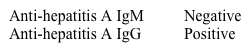 The patient's country of origin does not offer universal immunization against hepatitis A, and he says he has not been vaccinated against the virus. Which of the following do these laboratory findings most likely suggest?
 (Multiple Choice)
4.9/5 (71)
(71) A 9-year-old girl is brought to the emergency department following a 3-minute generalized seizure. She has had a fever with a worsening headache for 3 days. The girl has no medical problems and is not taking any medications. She lives with her parents and pet cat and has traveled to Canada and England. On physical examination, she is disoriented and has difficulty staying awake. Her speech is difficult to understand due to inappropriate word choice. She is admitted to the intensive care unit for further workup. The patient becomes unresponsive the following day and dies overnight. Autopsy reveals bilateral, hemorrhagic necrosis of the inferior and medial temporal lobes. This patient's condition was most likely caused by infection with which of the following?
(Multiple Choice)
4.9/5 (75)
(75) A previously healthy 32-year-old man, who is a military veteran, comes to the emergency department because of high-grade fever and malaise for 3 days. He has severe generalized joint and body pains refractory to acetaminophen. He also has a severe stabbing pain behind his eyes. One week ago, he returned from deployment for a peace-keeping mission in Taiwan. He is sexually active and uses condoms inconsistently. His temperature is 38.7°C (101.7°F), pulse is 102/min, and blood pressure is 100/70 mm Hg. Examination shows nontender inguinal lymphadenopathy. There is a maculopapular rash over the trunk and extremities. Abdominal examination shows no abnormalities. Laboratory study results show thrombocytopenia. Urinalysis is normal. An ELISA test for HIV is negative. Transmission of the pathogen causing this patient's current symptoms can cause which of the following diseases?
(Multiple Choice)
4.8/5 (77)
(77) A 52-year-old man is brought to the emergency department due to worsening right leg pain, fever, and confusion. The patient injured his leg while operating a motorized watercraft on the ocean near Florida 2 days ago. Temperature is 38.9 C (102 F), blood pressure is 90/50 mm Hg, and pulse is 120/min. The patient is lethargic and diaphoretic. Physical examination reveals a small laceration on the dorsum of the right foot with surrounding edema, erythema, and several hemorrhagic bullae. Leukocyte count and serum lactic acid levels are elevated. Intravenous fluids and empiric antibiotics are administered, and surgical debridement of the wound is performed. Blood and wound cultures yield curved gram-negative rods. Which of the following is the greatest risk factor for this patient's infection?
(Multiple Choice)
4.8/5 (79)
(79) A 35-year-old woman comes to the emergency department due to an itchy rash that appeared earlier this morning. She recently returned from a family vacation at a resort in Cancun. Two days ago, the patient's husband developed similar symptoms. The patient has no significant past medical history and takes no medications. She has no known allergies. Her temperature is 37.6 C (99.7 F). On examination, there is a diffuse, pruritic, papulopustular rash that is most noticeable on the trunk and extremities. Microbiologic analysis of a pustular fluid sample demonstrates oxidase-positive gram-negative rods that produce pigment on culture medium. Which of the following is the most likely source of this patient's infection?
(Multiple Choice)
4.8/5 (86)
(86) Two days after hospital admission and surgical treatment for a cut on his right thigh from a sickle, a 35-year-old man presents to the emergency department with wound swelling, fever, chills, and severe pain. He had a similar injury 4 months ago that resolved after treatment with bacitracin ointment and daily dressings. He works on a farm on the outskirts of the city. He appears anxious. His temperature is 38.5°C (101.3°F), pulse is 103/min, and blood pressure is 114/76 mm Hg. Examination shows a 6-cm edematous deep, foul-smelling wound on the medial surface of the right thigh. The skin over the thigh appears darker than the skin on the lower leg. There are multiple blisters around the wound. Light palpation around the wound causes severe pain; crepitus is present. Gram staining of the bullae fluid reveals numerous gram-positive rods, and subsequent culture grows Clostridium septicum. Which of the following is the greatest risk factor for this patient's current condition?
(Multiple Choice)
4.9/5 (81)
(81) 
Filters
- Essay(0)
- Multiple Choice(0)
- Short Answer(0)
- True False(0)
- Matching(0)