



 Chat with AI
Exam 6: Genetics

Exam 1: Anatomy265 Questions
Exam 2: Behavioral Sciences178 Questions
Exam 3: Biochemistry102 Questions
Exam 4: Embryology59 Questions
Exam 5: Epidemiology, Biostatistics, and Medical Informatics94 Questions
Exam 6: Genetics88 Questions
Exam 7: Histology46 Questions
Exam 8: Immunology147 Questions
Exam 9: Microbiology and Virology330 Questions
Exam 10: Pathology817 Questions
Exam 11: Pharmacology and Toxicology509 Questions
Exam 12: Physiology339 Questions
Exam 13: Psychiatry and Psychotherapy23 Questions
Select questions type


A genetic study performed on a 10-year-old boy reveals a single base substitution mutation involving a DNA segment that encodes a cellular protein, as shown in the image below.  This mutation is most likely to affect which of the following processes?
 (Multiple Choice)
4.8/5  (71)
(71) Geneticists are studying a malfunctioning protein that causes impaired endothelial cell migration and angiogenesis. They have noticed that the amino acid sequence of the protein is truncated compared to normal controls. The mutated mRNA strand is isolated, and analysis shows a nonsense mutation located near the 3' end of the coding region. The 3' terminal coding sequence of the abnormal mRNA strand is shown below.  Which of the following tRNA anticodons is responsible for adding the last amino acid to the truncated polypeptide during protein translation?
 (Multiple Choice)
4.9/5 (79)
(79) A 60-year-old man comes to the office due to dark, rusty-colored urine for the last 2 weeks. He reports no pain, urinary frequency, or urgency. The patient has no chronic medical conditions and takes no medications. He smoked a half pack of cigarettes daily for 10 years but quit 30 years ago. His father had hypertension and his mother has Alzheimer dementia. Urinalysis shows a large number of red blood cells. Renal ultrasound reveals a mass in the right kidney. Cytologic evaluation of the mass shows malignant cells with a chromosome 3p deletion. The deletion most likely involves which of the following genes?
(Multiple Choice)
5.0/5 (88)
(88) A scientist is investigating the pattern of gene expression. Messenger RNA is extracted from various tissues, electrophoresed, blotted, and probed with radiolabeled DNA containing exon 4 sequences from that gene. An x-ray film is then put over the blotting membrane, and the autoradiogram findings are presented below: 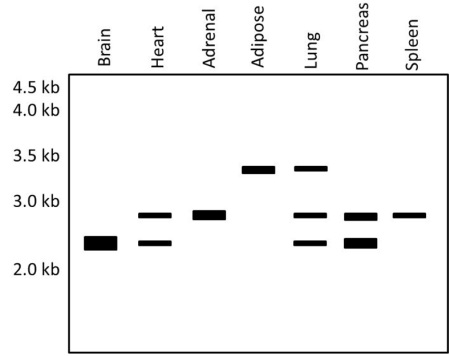 Which of the following best explains the autoradiogram findings in the different tissues?
 (Multiple Choice)
4.8/5 (77)
(77) A pharmaceutical company researching novel therapeutic agents for the treatment of Burkitt lymphoma creates a 21-base pair double-stranded RNA molecule. The RNA molecule has a base pair sequence that is complementary to an mRNA region that encodes c-Myc. When the RNA molecule is introduced into tumor cells, cell proliferation is significantly reduced. The results of a Western blot examination of equal numbers of treated and untreated cells are displayed below. 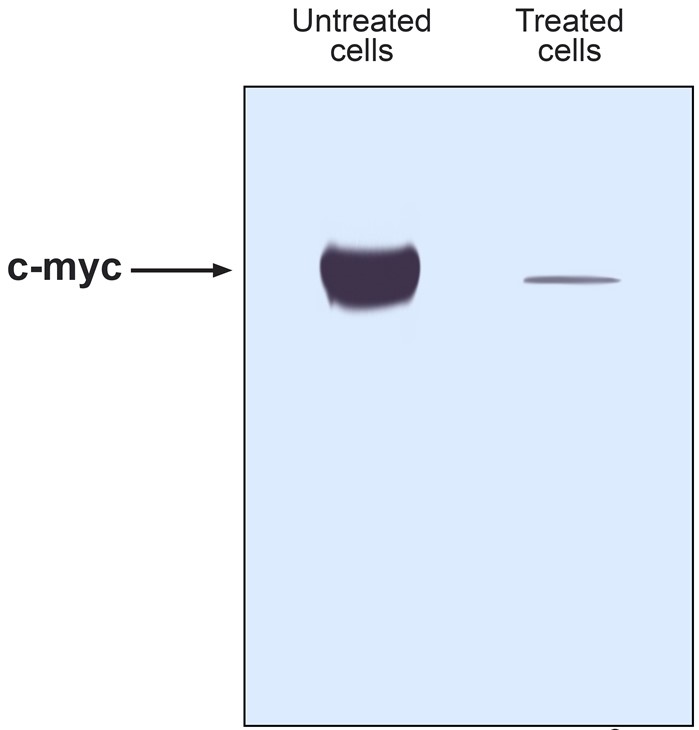 Which of the following processes was most likely directly interrupted in the cells exposed to the RNA molecule?
 (Multiple Choice)
4.9/5 (68)
(68) A 22-year-old woman who has recently relocated comes in for a new patient appointment. She has a slight intellectual handicap and has graduated from high school. The patient has no serious health issues, but he does have recurrent swelling in his hands and feet. She reached menarche at the age of 13, and she has regular menstrual periods. Short height and a webbed neck are revealed through physical examination. Karyotype examination of peripheral leukocytes reveals that 40% of the cells have a 45,X genotype and the remaining 60% have a 46,XX genotype. Which of the following is most likely to be the source of this patient's condition?
(Multiple Choice)
4.9/5 (87)
(87) Certain drugs cause extreme intolerance in a 25-year-old man. His responses to various medicines have required hospitalization on two occasions. The following chart depicts his family lineage in relation to this ailment, with the red arrow denoting his place within the family. 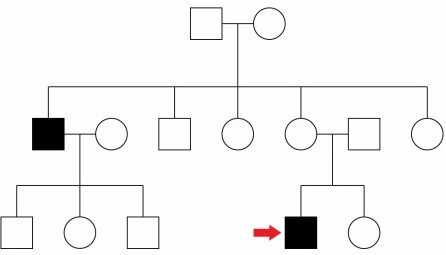 Assuming that the genetic condition demonstrates complete penetrance and is rare in the general population, which of the following inheritance patterns is most likely?
 (Multiple Choice)
4.8/5 (81)
(81) A 14-year-old girl arrives at the clinic for a normal health assessment. The patient will shortly begin her freshman year of high school. She is a clarinetist in the school band but does not participate in any sports. The patient claims to be sexually inactive and to not use cigarettes, alcohol, or illegal substances. Height is in the fifth percentile, while weight is in the twenty-fifth percentile. Her temperature is 36.7 degrees Celsius (98 degrees Fahrenheit), her blood pressure is 120/80 mm Hg, her pulse is 88 beats per minute, and her respirations are 16 beats per minute. Physical examination reveals a short and robust neck, a large chest, and bilaterally shortened fourth metacarpals. During cardiac auscultation, a murmur is heard. Which of the following is most likely to be found on an echocardiogram?
(Multiple Choice)
4.7/5 (71)
(71) 
Filters
- Essay(0)
- Multiple Choice(0)
- Short Answer(0)
- True False(0)
- Matching(0)