



 Chat with AI
Exam 6: Genetics

Exam 1: Anatomy265 Questions
Exam 2: Behavioral Sciences178 Questions
Exam 3: Biochemistry102 Questions
Exam 4: Embryology59 Questions
Exam 5: Epidemiology, Biostatistics, and Medical Informatics94 Questions
Exam 6: Genetics88 Questions
Exam 7: Histology46 Questions
Exam 8: Immunology147 Questions
Exam 9: Microbiology and Virology330 Questions
Exam 10: Pathology817 Questions
Exam 11: Pharmacology and Toxicology509 Questions
Exam 12: Physiology339 Questions
Exam 13: Psychiatry and Psychotherapy23 Questions
Select questions type


A 28-year-old woman comes to the physician because of a 4-day history of lower abdominal pain and pain with urination. A urine sample is collected and sent for culture. Gram-negative bacteria isolated from the urine are found to form pink colonies on lactose-containing MacConkey agar. Several days later, bacterial isolates from a second urine sample are found to form white colonies when plated on the same type of medium. Genetic analysis shows that the more recent isolates have a single nucleotide deletion within the lac operon DNA sequence. This genomic change is most consistent with which of the following?
(Multiple Choice)
4.8/5  (75)
(75) A 25-year-old Caucasian man is undergoing evaluation for azoospermia. The patient has been monogamous with his long-term girlfriend and does not use contraception during sexual intercourse. They have been trying to conceive for the past year with no success. The patient has a past medical history of recurrent pneumonia with frequent hospitalizations for antibiotic treatment. He takes no medications and does not use tobacco, alcohol, or illicit drugs. The patient has no allergies and his immunizations are up-to-date. His family history is unknown as he was adopted as an infant. Physical examination shows digital clubbing. A transrectal ultrasound shows bilateral absence of the vas deferens. Which of the following tests would most likely confirm the underlying diagnosis of this patient's condition?
(Multiple Choice)
4.9/5 (69)
(69) A 33-year-old woman, gravida 2 para 1, comes to the office for a prenatal visit at 20 weeks gestation. She feels well and reports experiencing fetal movements. The patient has no medical problems other than a history of cleft lip, which was repaired in childhood. Her husband is healthy, but her previous child was born with spina bifida. She takes a daily prenatal vitamin. Physical examination is unremarkable and uterine size is in accordance with ultrasound dates. The patient is worried that the fetus may develop the same birth defect as her previous child. Which of the following is the most likely mode of inheritance of this disorder?
(Multiple Choice)
4.8/5 (82)
(82) A 3-year-old boy is brought to the office by his parents. They say that the child cannot keep up with his cousin, who is the same age. The boy climbs up from a squat by using his hands to push off the ground and his lower extremities. His calves appear enlarged on physical examination. This patient's condition is most likely associated with which of the following?
(Multiple Choice)
4.8/5 (82)
(82) A 28-year-old man is evaluated for abnormal movements of the hands and face. The patient reports that he started experiencing involuntary grimacing a year ago, which has gradually worsened. He is taking a selective serotonin reuptake inhibitor for major depression but has not taken any antipsychotic medications. His 52-year-old father was diagnosed with an inherited movement disorder 2 months ago. Physical examination shows normal strength and normal deep tendon reflexes. No sensory deficits are noted. Which of the following best explains the difference in disease presentation between this patient and his father?
(Multiple Choice)
4.7/5 (83)
(83) On physical examination, a 1-day-old child in the newborn nursery has a noisy, holosystolic murmur. The baby was delivered at 39 weeks to a 36-year-old mom who chose not to get prenatal screening. According to a review of medical data, there is no family history of genetic or chromosomal problems. The infant's vital signs are within normal limits for his age. The remainder of the physical exam reveals a flat face profile, a projecting tongue, and tiny ears. Which of the following events is most likely to have occurred prior to conception?
(Multiple Choice)
4.9/5 (75)
(75) A 52-year-old man with HIV infection is brought to the emergency department because of a generalized tonic-clonic seizure that began 1 hour ago. The seizure resolved without treatment en route to the hospital. Medical history obtained from his son discloses that the patient has become increasingly forgetful, agitated, and restless during the past 5 months. He has hypertension and type 2 diabetes mellitus. Medications are lisinopril, insulin, and combined antiretroviral therapy, but he is often noncompliant with his medications. On arrival, he is somnolent and oriented only to person. His temperature is 36.8°C (98.2°F), pulse is 78/min, and blood pressure is 136/68 mm Hg. Cervical and axillary lymphadenopathy is present. Neurological examination shows moderate left hemiparesis with normal tone and no other focal deficits. Hemoglobin concentration is 10.2 g/dL, leukocyte count is 3800/mm3, CD4+ T-lymphocyte count is 148/mm3. An MRI of the brain is shown. Reactivation of which of the following pathogens is most likely responsible for this patient's current symptoms?
(Multiple Choice)
4.7/5 (63)
(63) A 30-year-old man comes to the office because he has a concern regarding last semen analysis result. He has been married for 5 years and failed to concieve. A semen analysis shows a normal sperm count but completely immobile sperm due to abnormal tail function. Which of the following additional findings is most likely associated with this patient's condition?
(Multiple Choice)
4.8/5 (82)
(82) A 32-year-old woman arrives to the office, concerned that she may become bald. Her father began to have a receding hairline with apical baldness at the age of 20 and was entirely bald by the age of 35. The patient's paternal grandmother and several other relatives on her paternal side were likewise affected by early-onset baldness, but her father's siblings and the maternal side of her family were not affected. Physical examination reveals slight loss of hair at the temporal regions, with a normal hairline, thickness, and colour elsewhere. She has normal female pubic hair development and no excessive hair growth on her face or torso. Thyroid palpation is quite normal. Which of the following is the most likely inheritance pattern of the hair loss in this patient's family?
(Multiple Choice)
4.9/5 (85)
(85) After a deadly car accident, an autopsy was done on a 17-year-old girl. On the surface, her ovaries seem tiny and undeveloped. A light microscopic examination reveals that the ovaries are mostly connective tissue, with no follicles. Which of the following additional anomalies is most likely to be discovered during a postmortem examination?
(Multiple Choice)
4.8/5 (73)
(73) A 16-year-old boy is brought to the physician by his mother for a well-child examination. He recently stopped attending his swim classes. The patient is at the 97th percentile for height and the 50th percentile for weight. Examination shows decreased facial hair, bilateral breast enlargement, and long extremities. Genital examination shows scant pubic hair, small testes, and a normal-sized penis. Laboratory evaluation would most likely show which of the following findings?
(Multiple Choice)
4.8/5 (77)
(77) An infant born to a 26-year-old woman is evaluated shortly after delivery. Birth weight and length are at the 10th and 15th percentiles, respectively. Vital signs are normal. Physical examination shows a protruding tongue, excessive skin at the nape of the neck, and upslanting palpebral fissures. The startle reflex is symmetric and weak. Cardiac auscultation reveals a harsh, III/VI systolic murmur heard best over the lower left sternal border. The patient has normal external female genitalia. Review of maternal medical records shows a past history of 2 spontaneous abortions in the last 3 years. Echocardiography confirms the presence of a ventricular septal defect. Which of the following karyotypes is most likely to be found in this infant?
(Multiple Choice)
4.8/5 (78)
(78) An infant born to a 26-year-old woman is evaluated shortly after delivery. Birth weight and length are at the 10th and 15th percentiles, respectively. Vital signs are normal. Physical examination shows a protruding tongue, excessive skin at the nape of the neck, and upslanting palpebral fissures. The startle reflex is symmetric and weak. Cardiac auscultation reveals a harsh, III/VI systolic murmur heard best over the lower left sternal border. The patient has normal external female genitalia. Review of maternal medical records shows a past history of 2 spontaneous abortions in the last 3 years. Echocardiography confirms the presence of a ventricular septal defect. Which of the following karyotypes is most likely to be found in this infant?
(Multiple Choice)
4.7/5 (76)
(76) A 41-year-old man with trisomy 21 is evaluated in the clinic due to cognitive decline. The patient has a history of moderate intellectual disability, but his higher cognitive functions have become progressively impaired in the past several years. He previously volunteered at a community library but recently lost his position as he could no longer perform his duties. The patient is now completely dependent on a caregiver for assistance with his activities of daily living such as getting dressed, bathing, and using the toilet. The patient keeps wandering in the group home and has become lost on several occasions. Which of the following is most likely to be increased in this patient?
(Multiple Choice)
4.7/5 (90)
(90) A pharmaceutical researcher is evaluating a nuclear enzyme inhibitor for the treatment of an inherited disorder. During an experiment, he extracts and purifies nuclear enzymes from skin cells of an affected patient. One of these enzymes is found to catalyze the methylation of cytosine residues in DNA using S-adenosyl-methionine (SAM) as the methyl donor. This enzyme most likely plays a crucial role in which of the following genetic processes?
(Multiple Choice)
4.7/5 (72)
(72) A 13-year-old boy comes to the office for evaluation of worsening scoliosis. He lost the ability to walk a year ago and has since been wheelchair bound. He has significant back pain and difficulty sitting in his wheelchair for extended periods. The patient also feels "too weak" to cough or take a deep breath. Review of medical records shows genetic studies confirming a mutation of the dystrophin gene on X chromosome p21. Histopathology of the patient's calf most likely indicates which of the following findings?
(Multiple Choice)
4.8/5 (76)
(76) A 9-year-old boy is brought to the physician for a well-child examination. His mother says his teachers report him being easily distracted, lagging behind his classmates in most of the subjects, and frequently falling asleep during class. She says that her son has complained of leg pain on multiple occasions. He is at the 45th percentile for height and 35th percentile for weight. Vital signs are within normal limits. Examination shows ptosis and a high-arched palate. Muscle strength is decreased in the face and hands. Muscle strength of the quadriceps and hamstrings is normal. Sensation is intact. Percussion of the thenar eminence causes the thumb to abduct and then relax slowly. The patient's condition is best described as which of the following?
(Multiple Choice)
4.8/5 (75)
(75) A 50-year-old previously healthy man is evaluated for progressive fatigue, weakness, and recurrent gingival bleeding. Laboratory studies reveal normocytic normochromic anemia, thrombocytopenia, and leukocytosis with circulating myeloblasts. Bone marrow biopsy establishes a diagnosis of acute myeloid leukemia. Induction chemotherapy followed by allogeneic hematopoietic cell transplantation (HCT) is planned. Molecular typing of human leukocyte antigen (HL A) -A, -B, -C, -DP, -DQ, and -DR is performed. The patient's biological sister, with whom he shares both parents, is eligible for stem cell donation and undergoes HLA typing. Which of the following is the most likely probability that the sibling will be an identical HLA match with this patient?
(Multiple Choice)
4.8/5 (67)
(67) An 18-year-old man comes to the urgent care clinic due to painful erythema affecting his extremities, trunk, and face. He is vacationing in Florida and spent 5 hours at a Gulf coast beach earlier in the day. The patient did not apply any sunscreen as it was cloudy. The physician explains that cloud cover does not afford a high degree of protection against the sun, especially with prolonged exposure in highly reflective environments like the beach. He is advised to wear protective clothing and apply sunscreen to prevent recurrence. Which of the following is most likely to happen within the patient's skin cells as a result of his exposure?
(Multiple Choice)
4.9/5 (80)
(80) A 65-year-old woman arrives at the emergency room complaining of growing weariness and lower-extremity paresthesias. Otherwise, the patient's medical history is minimal, and he or she does not take any drugs. According to laboratory findings, the average corpuscular volume is 112 fL. Upper gastrointestinal endoscopy reveals atrophic mucosa in the stomach body and fundus, as well as a normal antrum. Which of the following stomach layers is most likely to blame for this patient's symptoms? 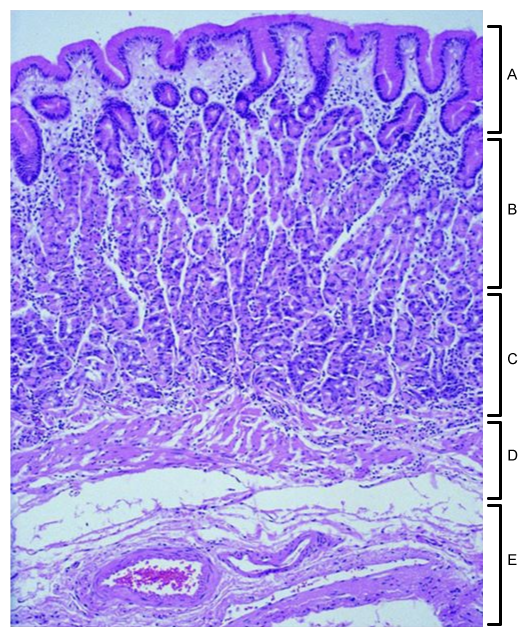
(Multiple Choice)
4.8/5 (79)
(79) 
Filters
- Essay(0)
- Multiple Choice(0)
- Short Answer(0)
- True False(0)
- Matching(0)