



 Chat with AI
Exam 6: Genetics

Exam 1: Anatomy265 Questions
Exam 2: Behavioral Sciences178 Questions
Exam 3: Biochemistry102 Questions
Exam 4: Embryology59 Questions
Exam 5: Epidemiology, Biostatistics, and Medical Informatics94 Questions
Exam 6: Genetics88 Questions
Exam 7: Histology46 Questions
Exam 8: Immunology147 Questions
Exam 9: Microbiology and Virology330 Questions
Exam 10: Pathology817 Questions
Exam 11: Pharmacology and Toxicology509 Questions
Exam 12: Physiology339 Questions
Exam 13: Psychiatry and Psychotherapy23 Questions
Select questions type


A 16-year-old boy with mild intellectual disability is brought to the office to be evaluated for attention deficit-hyperactivity disorder. The parents state that he has always been impulsive and inattentive and that teachers are concerned about his inattentiveness and poor grades. Review of medical records shows a history of gross motor and speech delay for which he received physical and speech therapies during childhood. On physical examination, the boy has a long and narrow face, a prominent mandible, and large testes. There is hyperlaxity of his finger and thumb joints. Which of the following is the most likely diagnosis in this patient?
(Multiple Choice)
5.0/5  (93)
(93) A three-year-old kid is being assessed for recurring respiratory infections. Five months after his birth, the patient's family emigrated to the United States. Since then, the boy has had many bouts of pneumonia and bronchitis, as well as a chronic cough and failure to grow. His older sibling is in good health. A genetic test finds a mutation in an exon of a gene encoding a transmembrane chloride channel. The aberrant mRNA is extracted from epithelial cells in culture, and its complementary DNA is produced. Base pair length is determined by analyzing amplified cDNA samples from both the patient and his healthy sister using gel electrophoresis and comparing them to DNA fragments of known size. The outcomes are presented below. 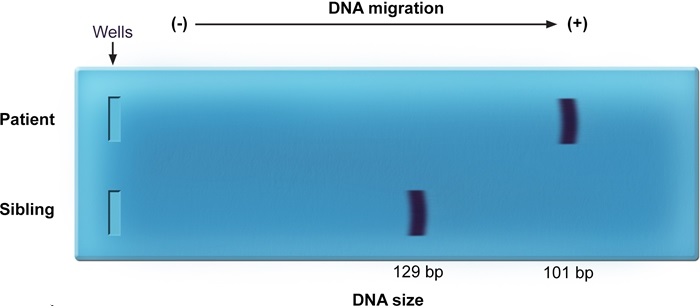 Which of the following is most likely responsible for this patient's condition?
 (Multiple Choice)
4.9/5 (76)
(76) A small-for-gestational-age infant is born prematurely to a 38-year-old woman who had inconsistent prenatal care. Physical examination shows a small head and eyes as well as a cleft lip and palate. There is a small, round punched-out lesion with an overlying thin membrane on the patient's scalp. A small, membranous sac with a loop of bowel protrudes from the patient's abdominal midline. The infant is transferred to the neonatal intensive care unit for further workup and management. Which of the following is most likely responsible for this patient's condition?
(Multiple Choice)
4.8/5 (66)
(66) A 7-year-old boy is admitted to the hospital after his adoptive parents brought him to the emergency department due to fatigue and pallor. Laboratory evaluation reveals pancytopenia with an absolute neutrophil count consistent with severe neutropenia. Bone marrow examination reveals signs of aplastic anemia, and subsequent genetic testing reveals a congenital genomic defect in DNA repair leading to chromosomal instability. A bone marrow transplant is required for treatment. The patient's only living relatives are an identical twin brother and older sister who were both adopted by the same parents. He also has stored umbilical stem cells that were harvested after birth. Which of the following is the best bone marrow transplantation method for this patient?
(Multiple Choice)
4.9/5 (77)
(77) A 6-year-old girl with chronic anemia requiring repeated blood transfusions is undergoing genetic testing. The patient's mother and older sibling have a history of mild anemia. Her peripheral blood smear shows hypochromic, microcytic red blood cells, and hemoglobin electrophoresis reveals a predominance of hemoglobins F and A2. Sequencing of the Beta-globin gene is performed using the patient's erythroblast DNA. A schematic representation of the gene and its transcribed RNA is shown in the image below.  The base sequence indicated by the bold red arrow is responsible for which of the following functions?
 (Multiple Choice)
4.8/5 (80)
(80) Non-coding RNA molecules are being studied for their functional importance by molecular biologists. They separate huge complexes including both protein and RNA from exocrine pancreatic cells throughout an experiment. The complexes can be observed floating freely in the cytoplasm as well as attached to the endoplasmic reticulum. Which of the following intracellular locations is the primary site of RNA synthesis identified inside these complexes? 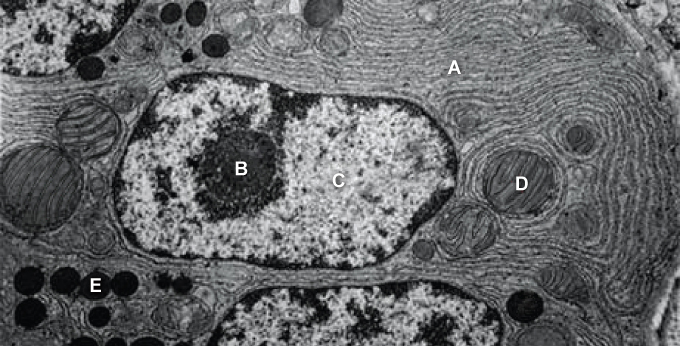
(Multiple Choice)
4.8/5 (80)
(80) A 6-year-old girl with chronic anemia requiring repeated blood transfusions is undergoing genetic testing. The patient's mother and older sibling have a history of mild anemia. Her peripheral blood smear shows hypochromic, microcytic red blood cells, and hemoglobin electrophoresis reveals a predominance of hemoglobins F and A2. Sequencing of the Beta-globin gene is performed using the patient's erythroblast DNA. A schematic representation of the gene and its transcribed RNA is shown in the image below. The base sequence indicated by the bold red arrow is responsible for which of the following functions?
The base sequence indicated by the bold red arrow is responsible for which of the following functions? (Multiple Choice)
4.8/5 (77)
(77) A 22-year-old male is being evaluated due to recent fatigue and anorexia. Laboratory tests show persistently elevated serum alanine aminotransferase (ALT) and aspartate aminotransferase (AST) levels. He is also positive for HBsAg. Which of the following best describes the mechanism of liver injury in this patient?
(Multiple Choice)
4.9/5 (75)
(75) A 19-year-old girl is being tested for new-onset generalized tonic-clonic seizures. She has also had unpredictable jerks of her arms and legs, as well as occasional muscular weakness, for several years. The girl has other family relatives who have identical symptoms. A neurological examination indicates a broad-based gait and diminished feeling in the lower limbs. A skeletal muscle biopsy reveals ragged, red-colored muscular fibers. Further investigation revealed that the patient's symptoms are caused by a mutation that affects extranuclear DNA. Which of the following pedigrees best describes this patient's family history? (The arrow points to the patient.)
(Multiple Choice)
4.8/5 (81)
(81) A pharmaceutical researcher develops a therapy to treat a protein misfolding disorder. Specifically, a mutation in this disorder leads to abnormal protein folding and subsequent intracellular degradation of the protein before it can reach the cell membrane. With the new combination drug therapy, the first drug corrects the processing and trafficking of the protein, enabling it to reach the cell surface membrane. Once the protein has reached the cell surface, its function is enhanced by the second drug. This therapy is most likely to be helpful in which of the following conditions?
(Multiple Choice)
4.9/5 (85)
(85) A 14-year-old boy experiences severe, prolonged bleeding following a tooth extraction. He also has a history of multiple episodes of painful joint swelling following minor trauma. His parents have no bleeding problems. Evaluation shows that the patient has an inherited disorder and that one of his parents is a genetic carrier. His older sister, who does not have this condition, is pregnant. She does not know the sex of her child. She asks about the risk that her child will be affected. Which of the following is the best estimate that this child will have the disease?
(Multiple Choice)
4.8/5 (87)
(87) A 26-year-old woman is being evaluated for a possible inherited disorder. She has a 6-year history of generalized tonic-clonic seizures, and a year ago, she had partial loss of vision due to an occipital infarction. Her mother has chronic intermittent muscle weakness and lactic acidosis, and her maternal uncle has hemiplegia. Skeletal muscle biopsy of the patient shows ragged-appearing muscle fibers. After further evaluation, all the affected family members are found to suffer from the same inherited disease. Pedigree analysis is shown in the image below. 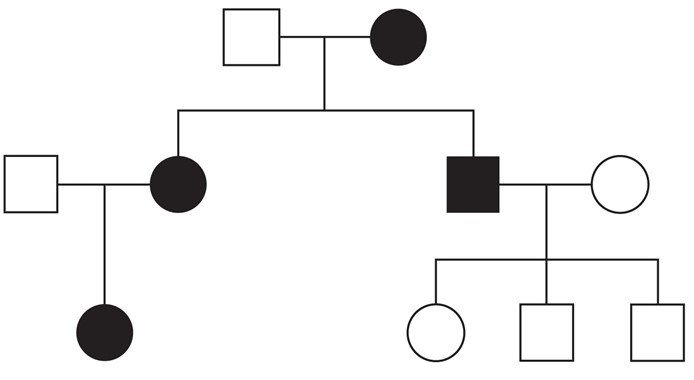 Which of the following is the most likely explanation for the variability of clinical manifestations in the affected family members?
 (Multiple Choice)
4.8/5 (71)
(71) A researcher is studying the Fas receptor (FasR), a protein widely expressed on cell surfaces. The signaling cascade of programmed cell death is initiated when FasR binds to its ligand (FasL), which is expressed on cytotoxic T cells. In an experiment, cancer cells that escaped elimination by the immune system were found to contain soluble Fas proteins that did not promote apoptosis. The soluble Fas proteins were shorter and lacked the transmembrane domain. DNA analysis of these cells revealed no FAS gene mutations. Which of the following is the most likely explanation for the formation of altered Fas proteins in these cancer cells?
(Multiple Choice)
4.9/5 (75)
(75) A pharmaceutical researcher performs preclinical testing on a novel chemotherapeutic drug. When rat embryos are exposed to this drug during an early stage of organogenesis, they develop severe skeletal malformations. Further genetic analysis reveals that the drug causes mutations in numerous homeobox genes containing highly conserved 180 base pair DNA sequences. The genes affected by this drug most likely code for which of the following proteins?
(Multiple Choice)
4.8/5 (74)
(74) In an experiment, cultured fibroblasts are mechanically lysed, and the membrane lipids and cellular proteins are chemically removed to isolate nucleic acids. The cellular extract containing the purified nucleic acids is incubated along with short sequences of repeated deoxythymidine residues fixed to latex beads. The solution is washed several times to remove unbound molecules. Which of the following types of nucleic acid is most likely to bind the strongest to the latex beads in this experiment?
(Multiple Choice)
4.9/5 (81)
(81) A 23-year-old previously healthy man comes to the office after noticing a painless, hard mass in the left testis. Scrotal ultrasound shows a solid testicular mass, and CT scan of the abdomen and pelvis shows left paraaortic lymphadenopathy. Left orchidectomy is performed and postoperative histopathology reveals seminoma of the testis. External beam radiotherapy is administered to the paraaortic metastatic area. Several weeks later, the retroperitoneal nodes are observed to have markedly decreased in size. Which of the following is the most likely effect of the therapy used on the metastatic cells in this patient?
(Multiple Choice)
4.8/5 (81)
(81) A non-coding DNA sequence mutation is thought to alter the expression of the gene coding for a particular fetal enzyme. The fetus and his parents' liver and bone marrow cells are collected. Which of the following is the best approach for determining if this gene is being transcribed in isolated cell cultures?
(Multiple Choice)
4.8/5 (75)
(75) A 35-year-old woman, gravida 1, para 0, comes to the office to discuss abnormal laboratory results. The patient is at 18 weeks gestation based on her last menstrual period. She drank wine during the first trimester, as she initially did not realize she was pregnant. The patient is otherwise healthy with no medical problems. She takes prenatal vitamins and no other medications. Her immunizations are up-to-date. Results of the quadruple screen performed yesterday are as follows: 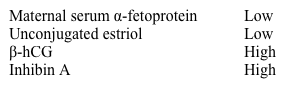 An ultrasound is scheduled to confirm the patient's gestational age and evaluate for fetal anomalies. Which of the following conditions is the most likely cause of this patient's analyte pattern?
 (Multiple Choice)
4.9/5 (87)
(87) A 43-year-old man is evaluated for progressive neuropsychiatric symptoms. A year ago, he began feeling depressed and having hallucinations. Five months later, he developed intermittent paresthesias and progressively worsening choreiform movements, myoclonus, and ataxia. These symptoms have not improved despite multiple hospitalizations; an extensive workup has been unrevealing. The patient is a slaughterhouse worker with extensive exposure to bovine offal. As part of the evaluation for prion disease, a tissue sample digested with protease is processed via gel electrophoresis and transferred to filter paper. Antibodies to a specific prion protein are added to the filter. Next, a marked protein that combines with the antibody-protein complex is used to determine whether the test is positive. Which of the following best describes this test?
(Multiple Choice)
4.9/5 (70)
(70) A 20-year-old man falls while strolling across a college campus. A passerby notices him to be unresponsive and pulseless. Despite the efforts of emergency medical experts, the man cannot be revived. In the weeks immediately up to the tragedy, his acquaintances claim he seemed weary and mentioned palpitations and dyspnea with exercise. He had no known medical history and did not smoke, drink, or use illegal substances. The man's three younger siblings are all ok. His parents confirm a paternal grandfather's history of "early cardiac illness" and want an autopsy and genetic tests for further study. A deficiency in a TTN gene exon results in a shortened titin protein, according to genetic research. Autopsy findings are most likely to show which of the following phenotypes?
(Multiple Choice)
4.9/5 (81)
(81) 
Filters
- Essay(0)
- Multiple Choice(0)
- Short Answer(0)
- True False(0)
- Matching(0)