Multiple Choice
A 26-year-old woman is being evaluated for a possible inherited disorder. She has a 6-year history of generalized tonic-clonic seizures, and a year ago, she had partial loss of vision due to an occipital infarction. Her mother has chronic intermittent muscle weakness and lactic acidosis, and her maternal uncle has hemiplegia. Skeletal muscle biopsy of the patient shows ragged-appearing muscle fibers. After further evaluation, all the affected family members are found to suffer from the same inherited disease. Pedigree analysis is shown in the image below. 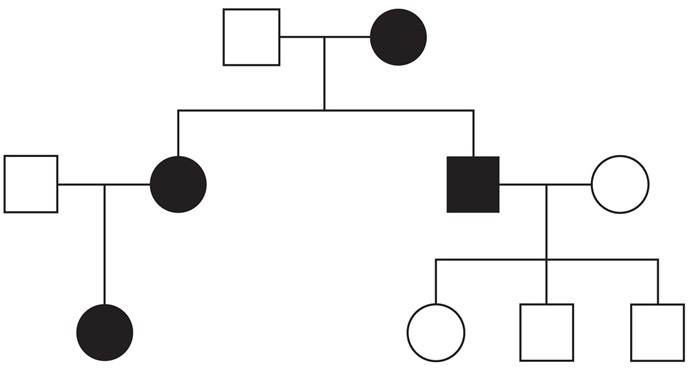 Which of the following is the most likely explanation for the variability of clinical manifestations in the affected family members?
A) Anticipation
B) Heteroplasmy
C) Incomplete penetrance
D) Mosaicism
E) Uniparental disomy
Correct Answer:

Verified
Correct Answer:
Verified
Q47: A 6-year-old girl with chronic anemia requiring
Q48: A 22-year-old male is being evaluated due
Q49: A 19-year-old girl is being tested for
Q50: A pharmaceutical researcher develops a therapy to
Q51: A 14-year-old boy experiences severe, prolonged bleeding
Q53: A researcher is studying the Fas receptor
Q54: A pharmaceutical researcher performs preclinical testing on
Q55: In an experiment, cultured fibroblasts are mechanically
Q56: A 23-year-old previously healthy man comes to
Q57: A non-coding DNA sequence mutation is thought