



 Chat with AI
Exam 11: Pharmacology and Toxicology

Exam 1: Anatomy265 Questions
Exam 2: Behavioral Sciences178 Questions
Exam 3: Biochemistry102 Questions
Exam 4: Embryology59 Questions
Exam 5: Epidemiology, Biostatistics, and Medical Informatics94 Questions
Exam 6: Genetics88 Questions
Exam 7: Histology46 Questions
Exam 8: Immunology147 Questions
Exam 9: Microbiology and Virology330 Questions
Exam 10: Pathology817 Questions
Exam 11: Pharmacology and Toxicology509 Questions
Exam 12: Physiology339 Questions
Exam 13: Psychiatry and Psychotherapy23 Questions
Select questions type


A 50-year-old woman comes to the physician because of a 5-month history of progressive numbness of her lower legs. She reports having difficulties sleeping because of a tingling sensation in her feet that keeps her awake. The symptoms began in the toes of both feet and have since progressed to her ankles and calves bilaterally. She was diagnosed with diabetes mellitus 8 years ago and hypertension 3 years ago. The patient quit smoking 8 years ago and does not use alcohol. Blood pressure is 126/70 mm Hg and pulse is 68/min. Lower extremity examination shows normal-appearing skin. Touching the feet elicits a sensation of burning pain. There is loss of vibration sensation in the toes, and the ankle reflex is absent bilaterally. Which of the following is the best initial pharmacotherapy for this patient's symptoms?
(Multiple Choice)
4.8/5  (79)
(79) A previously healthy 75-year-old woman is found agitated and confused in the surgical award. Four days ago she was admitted for hip joint fracture repair. She is cognitively intact, calm, and cooperative with the nursing staff Over the past 24 hours, she is unarousable during the day, but then is awake and impulsive during the night, requiring frequent reorientation. She usually drinks alcohol occasionally. Her only current medication is oxycodone for pain. Neurological examination is normal, but the patient is unable to attend to the conversation, is mildly disoriented, and cannot state the days of the week backwards. Urine dipstick is normal. which of the following medications is most appropriate to treat this patient's behavioral symptoms?
(Multiple Choice)
4.8/5 (84)
(84) A 60-year-old man with chronic atrial fibrillation visits the office for follow-up care. He complains sporadic palpitations and a low tolerance for activity. The patient's atrial fibrillation has been treated for the past 12 months with metoprolol as part of a rate-control approach. His metoprolol dosage was doubled three months ago for better rate control, but he reports to the doctor's office today that he was unable to accept the new dosage due to dizziness. The patient's pulse is 105/min and erratic, and their blood pressure is 110/70 mm Hg. The examination reveals no anomalies. The results of echocardiography show no substantial valvular disease, a 59 percent ejection fraction, and enlarged left atrium. The patient is instructed to continue taking the dose of metoprolol that has previously been tolerated, and digoxin is added to the drug schedule. Resting pulse is 84/min and irregular. Which of the following best explains digoxin's effect on heart rate in this patient?
(Multiple Choice)
4.8/5 (85)
(85) A 33-year-old woman comes to the physician because of a 4-month history of intermittent lower abdominal cramps associated with diarrhea, bloating, and mild nausea. During this period, she has had a 5-kg (11-lb) weight loss. She feels like she cannot fully empty her bowels. She has no history of serious illness. She has a high-fiber diet. Her father is of Ashkenazi Jewish descent. She has smoked 2 packs of cigarettes daily for 15 years. She appears well. Her temperature is 36.9°C (98.5°F), pulse is 90/min, and blood pressure is 130/90 mm Hg. The lungs are clear to auscultation. Cardiac examination shows no murmurs, rubs, or gallops. The abdomen is tender to palpation without rebound or guarding. Abdominal CT scan reveals inflammatory changes affecting the ascending colon, sigmoid colon, and terminal ileum. Intestinal biopsy reveals the following: 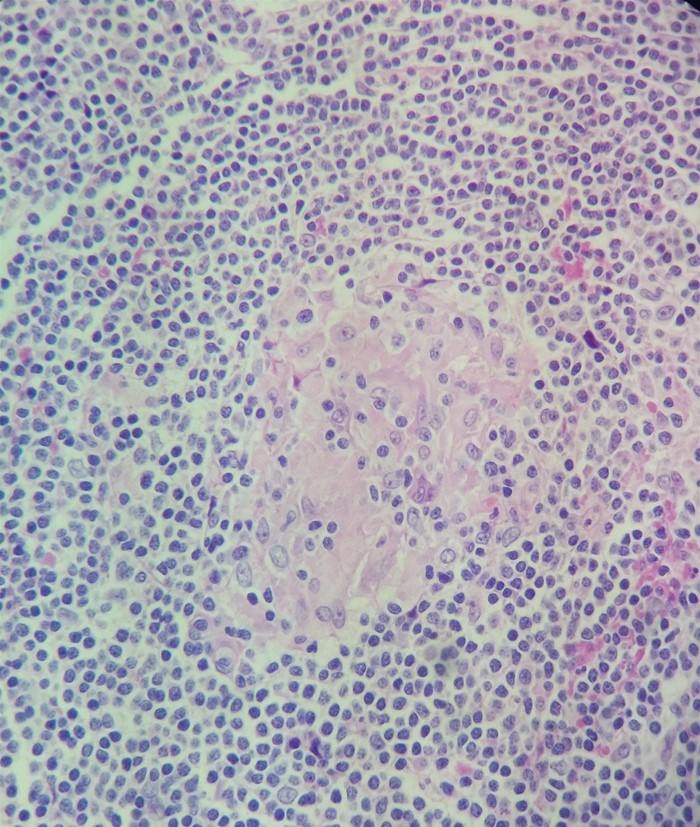 Effective treatment of this patient's condition could be achieved by targeting which of the following molecules?
 (Multiple Choice)
4.8/5 (72)
(72) After having a stroke, a 65-year-old man is receiving therapy. He arrived at the emergency room ten days ago with a sudden onset of left upper and lower extremities weakness. He has a history of hypothyroidism, hypertension, hypercholesterolemia, and gastroesophageal reflux disease. He doesn't use alcohol, cigarettes, or illegal substances. His pulse is 72 bpm and blood pressure is 140/90 mm Hg. His left upper and lower extremities are weakened and more toned. To lessen the spasticity in the affected extremities' muscles, you give this patient diazepam. This patient should primarily be cautioned to avoid which of the following drugs?
(Multiple Choice)
5.0/5 (75)
(75) A 42-year-old woman comes to the physician for a follow-up examination. She has a history of type 2 diabetes mellitus and coronary artery disease. Current medications include metformin, aspirin, pravastatin, and losartan. Her body mass index is 30 kg/m2. Physical examination shows no abnormalities. Laboratory studies show a fasting glucose level of 156 mg/dL, serum creatinine of 1.1 mg/dL, hemoglobin A1c of 8.1%, and urine albumin-creatinine ratio of 200 mg/g (normal: <30). Treatment with empagliflozin is initiated. Which of the following effects is most likely to be seen with this new treatment?
(Multiple Choice)
4.8/5 (84)
(84) A 58-year-old woman with type 2 diabetes mellitus comes to the office for a follow-up visit. Her hemoglobin A1c is 7.8% despite following a strict diet to controls her blood sugar level. Blood pressure is 140/90 mm Hg and pulse is 78/min. Serum creatinine is 1.0 mg/dL and serum potassium is 3.8 mEq/L. Urinalysis is normal but a mild urinary albumin is detected
In addition to starting antihyperglycemic treatment, which of the following is the best pharmacotherapy for this patient?
(Multiple Choice)
5.0/5 (75)
(75) A 76-year-old man arrives at the emergency department complaining of severe midsternal chest pain and diaphoresis. A history of hypertension, type 2 diabetes, and asymptomatic right carotid artery stenosis is significant. His blood pressure is 120/70 mm Hg, and his pulse rate is 75 beats per minute. Auscultation reveals that the lungs are clear. The ECG reveals ST segment elevations of more than 1 mm in leads II, III, and aVF. Aspirin is given to the patient immediately upon arrival, followed by alteplase and a low-dose beta blocker. For pain relief, a single intravenous dose of morphine is administered. The patient is discovered to be comatose several hours later, with asymmetric pupils and an irregular breathing pattern. What is the most likely cause of this patient's current condition?
(Multiple Choice)
4.9/5 (73)
(73) A 56-year-old man comes to the physician because of a 1-day history of sudden severe pain in his right great toe. He has never had such symptoms before. Four months ago, He has a history of nephrolithiasis and hypertension treated with hydrochlorothiazide. Examination shows erythema, swelling, warmth, and tenderness of the right metatarsophalangeal joint; range of movement is limited by pain. His serum uric acid is 12 mg/dL. Arthrocentesis yields cloudy fluid with a leukocyte count of 18,500/mm3 (80% segmented neutrophils). Polarized light microscopy of the synovial fluid is shown. Which of the following is the best initial treatment for this patient? 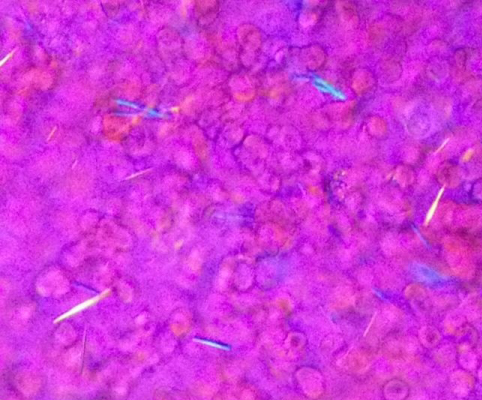
(Multiple Choice)
4.9/5 (77)
(77) A 68-year-old man comes to the physician because of severe muscle aches and fatigue for 2 days. Last week he was diagnosed with atypical pneumonia and treated with clarithromycin. He has hyperlipidemia and coronary artery disease with an acute myocardial infarction 2 years ago. Physical examination shows diffuse tenderness in the proximal muscles of the upper and lower extremities. Serum creatine kinase activity is elevated. Which of the following drug combinations is most likely responsible for this patient's condition?
(Multiple Choice)
4.8/5 (85)
(85) A 21-year-old man comes to the physician due to penile discharge. He has had a discomfort during urination for several days with no fever or hematuria. He has no prior medical conditions and takes no medications. On genitourinary examination, mucopurulent discharge is noted at the urethral meatus. Microscopy of the discharge shows numerous neutrophils, some of which contain intracellular gram-negative diplococci. He is given an intramuscular injection of ceftriaxone. Which of the following additional medications is recommended at this time?
(Multiple Choice)
4.7/5 (79)
(79) A 30-year-old man comes to the office due to several hours of severe right elbow pain. The patient has a history of peptic ulcer disease and gastroesophageal reflux disease. His right elbow is swollen, erythematous, and tender. Arthrocentesis is performed and synovial fluid analysis shows needle-shaped, negatively birefringent crystals with many neutrophils. The medication given to this patient selectively binds to an interleukin-1 inducible enzyme that is highly expressed by inflammatory cells and undetectable in the surrounding normal tissue. Which of the following is most likely the drug used in this patient's treatment?
(Multiple Choice)
4.8/5 (71)
(71) A 28-year-old woman, gravida 1, para 0, at 20 weeks' gestation comes to the physician with her husband for a prenatal visit. Her pregnancy has been uncomplicated. They are planning to travel to Ethiopia next month to visit the husband's family. Medications include folic acid and an iron supplement. Vital signs are within the normal range. Abdominal examination shows a uterus that is consistent with a 20-week gestation. Which of the following drugs is most suitable for pre-exposure prophylaxis against malaria?
(Multiple Choice)
4.7/5 (70)
(70) Eight weeks after starting a new weight-loss medication, a 43-year-old woman with obesity comes to the physician because of greasy diarrhea, excessive belching, and flatulence. She also complains of progressively worsening night-time vision. She has had no fever, chills, or vomiting. Physical examination shows dry, scaly skin on her extremities and face. Which of the following is the most likely mechanism of action of the drug she is taking?
(Multiple Choice)
4.8/5 (95)
(95) A 44-year-old woman comes to the physician because of diplopia and progressive weakness for the past month. She has noticed increasing difficulty performing household chores and walking her dog. Sometimes, she feels too fatigued to cook dinner. receiving low-dose pyridostigmine for treatment of her condition and claims good compliance without significant side effects. Physical examination reveals fatigable asymmetric ptosis and binocular horizontal diplopia. Infusion of edrophonium elicits a significant improvement in her symptoms. Which of the following is the best next step in management of this patient?
(Multiple Choice)
4.8/5 (75)
(75) A 43-year-old man arrives at the emergency room with a 3-day history of persistent headaches. The patient has a history of hypertension and has received inadequate medical care. The blood pressure is 224/115 mm Hg, and the pulse rate is 67 beats per minute. During the physical examination, he appears mildly confused, but no focal neurologic deficits are noted. A funduscopy reveals bilateral papilledema. Serum creatinine levels are 1.4 mg/dL. An intravenous medication that causes arteriolar dilation while improving renal perfusion and increasing natriuresis is started. Which of the following agents is most likely being used in this patient?
(Multiple Choice)
4.9/5 (81)
(81) During a follow-up office visit, a 68-year-old man complains of myalgia and fatigue. Since a recent acute myocardial infarction, the patient has been on high-intensity statin therapy. His other health issues include hypertension and type 2 diabetes. There is mild generalized muscle tenderness on examination. The level of creatine kinase in the blood is 456 U/L. TSH and vitamin D levels are within the normal range. The patient's statin therapy is stopped, and he is started on a medication that inhibits cholesterol absorption at the small intestine's brush border. Which of the following drugs was most likely started in this patient?
(Multiple Choice)
4.9/5 (79)
(79) A 12-month-old girl is brought to the physician because she is unable to sit and has not learned how to crawl. She keeps her hips and elbows flexed and her parents have to use considerable force to passively extend her joints. The patient was born preterm and has delayed developmental skills. Her vital signs are within normal limits. She is at the 25th percentile for length and 10th percentile for weight. Neurological examination shows increased muscle tone in all extremities. The ankle clonus and extensor plantar responses are present bilaterally. The Moro reflex is present. An MRI of the head shows periventricular leukomalacia. An oral medication is prescribed that reduces the extremity stiffness. Which of the following CNS drug effects most likely resulted in this patient's improvement?
(Multiple Choice)
4.8/5 (70)
(70) A 62-year-old man visits the office for a hypertension check-up. He was diagnosed with hypertension ten years ago and has been treated with various medications. However, due to side effects such as dizziness, palpitations, and headaches, the patient has had to discontinue several medications. He is currently taking ramipril and chlorthalidone and tolerates them well. His blood pressure is 160/92 mm Hg, up from 158/89 mm Hg at his most recent visit. The ECG shows sinus bradycardia (55 beats per minute) with PR interval prolongation (280 msec). Which of the following medications would be most effective for lowering this patient's blood pressure without worsening his ECG abnormalities?
(Multiple Choice)
4.8/5 (66)
(66) A 65-year-old man arrives at the emergency department complaining of substernal chest pain and intermittent palpitations that began this morning. The patient has a history of coronary artery disease and stable angina, both of which are medically managed. He takes metoprolol at high doses, atorvastatin, and aspirin at low doses. The patient reports that he has been traveling for the past week and that his medications ran out two days ago. The temperature is 37 degrees Celsius (98.6 degrees Fahrenheit), the blood pressure is 148/82 mm Hg, and the pulse rate is 112/min. The electrocardiogram shows sinus tachycardia with a 1-mm ST segment depression in the lateral leads. Which of the following is most likely responsible for this patient's presentation?
(Multiple Choice)
4.8/5 (79)
(79) 
Filters
- Essay(0)
- Multiple Choice(0)
- Short Answer(0)
- True False(0)
- Matching(0)