



 Chat with AI
Exam 11: Pharmacology and Toxicology

Exam 1: Anatomy265 Questions
Exam 2: Behavioral Sciences178 Questions
Exam 3: Biochemistry102 Questions
Exam 4: Embryology59 Questions
Exam 5: Epidemiology, Biostatistics, and Medical Informatics94 Questions
Exam 6: Genetics88 Questions
Exam 7: Histology46 Questions
Exam 8: Immunology147 Questions
Exam 9: Microbiology and Virology330 Questions
Exam 10: Pathology817 Questions
Exam 11: Pharmacology and Toxicology509 Questions
Exam 12: Physiology339 Questions
Exam 13: Psychiatry and Psychotherapy23 Questions
Select questions type


A 30-year-old man comes to the office for follow up after diagnosed with adrenal mass. he has no serious medical conditions. , his blood pressure is decreased to 130/70 mmHg and his heart rate is 75/min. . Laboratory evaluation reveals normal serum potassium, normal plasma renin activity . his previous testes were potassium 2.4 mEq/L and , severely depressed plasma renin activity Which of the following drugs was most likely used in this patient?
(Multiple Choice)
4.8/5  (68)
(68) A 68-year-old woman comes to the physician due to nausea and anorexia. Three months ago, she underwent heart transplantation for restrictive cardiomyopathy and she is treated with cyclosporine Her pulse is 76/min and blood pressure is 158/82 mm Hg. There is a well-healed scar on her chest. Serum creatinine is 3.4 mg/dL, and the serum cyclosporine level is markedly increased. A month ago, he had normal blood pressure and normal levels of cyclosporine and serum creatinine
Further questioning reveals that the patient has been drinking increased amounts of grapefruit juice lately as part of an attempt to improve his overall health. Which of the following mechanisms is most likely responsible for this patient's current condition?
(Multiple Choice)
4.8/5 (68)
(68) A 77-year-old man is brought to the physician by his daughter because he has become progressively forgetful. His daughter mentions that his symptoms have progressively worsened for the past one year. A month ago, the patient became lost while driving in the neighborhood where he has lived most of his adult life. On mental status examination, he is oriented to person, place, and time. Mental examination shows significant deficits in short-term memory. After discussion, an oral cholinesterase inhibitor is prescribed. Which of the following is the most likely effect of the drug prescribed for this patient?
(Multiple Choice)
4.8/5 (83)
(83) A 60-year-old woman comes to the physician because of a 7-month history of left knee pain and stiffness. The patient has attempted treatment with acetaminophen, but that has not provided adequate relief. Examination of the left knee shows tenderness to palpation along the joint line; there is crepitus with full flexion and extension. An x-ray of the knee shows osteophytes with joint-space narrowing. Arthrocentesis of the knee joint yields clear fluid with a leukocyte count of 120/mm3. Treatment with celecoxib therapy is planned. The presence of which of the following conditions in this patient's medical history would make this medication the preferred treatment?
(Multiple Choice)
4.8/5 (76)
(76) A 13-year-old girl is brought to the emergency department by her father because of a severe nosebleed. She takes no medications and has no history of serious medical illness but has had frequent nosebleeds in the past. Physical examination shows brisk bleeding from the right nare and pooled blood in the posterior pharynx. Laboratory studies show:
Hemoglobin 8 g/dL
Platelet count 195,000/mm3
Prothrombin time 12 sec
Partial thromboplastin time 49 sec
Fibrin split products negative
The bleeding time is 11 minutes (N = 2-7). Which of the following is the most appropriate pharmacotherapy?
(Multiple Choice)
4.9/5 (74)
(74) A 45-year-old man is brought to the physician by his wife for the evaluation of abnormal sleep patterns that began 10 days ago. She reports that he has a lot of energy despite hardly sleeping for the past 7 days, The patient has also been excessively talkative and has missed work on several occasions to write emails to his friends and relatives to convince them to invest in a new business idea that he has had. The patient's history is significant for epilepsy with generalized seizures since childhood and a psychiatric hospitalization a year ago for a major depressive episode. Mental status examination shows psychomotor agitation and pressured speech.Which of the following medications would be most helpful for long-term treatment of this patient's psychiatric condition as well as his seizure disorder?
(Multiple Choice)
4.7/5 (93)
(93) A researcher is trying to study the differences between multiple agents of anesthesia which be used in the operation room. If etomidate is administered for rapid sequence induction. Which of the following characteristics best describes etomidate as compared to propofol?
(Multiple Choice)
4.7/5 (85)
(85) A 22-year-old man arrives at the emergency department complaining of abdominal pain and vomiting. His symptoms started suddenly 24 hours ago, with nausea and a loss of appetite. His medical background is unremarkable. The patient consumes three to four beers per week and does not use tobacco or illegal drugs. The BMI is 37 kg/m22. The physical exam reveals moderate epigastric tenderness with decreased bowel sounds but no rebound tenderness, guarding, or abdominal rigidity. A serum triglyceride concentration of 1,500 mg/dL (normal: 200 mg/dL) was found in fasting laboratory studies. Once the patient is medically stable, which of the following medications would be most helpful in preventing recurrences of his condition?
(Multiple Choice)
4.8/5 (69)
(69) A 48-year-old woman comes to the emergency department due increase back pain. She is a marathon runner and 2 days agoo she felt down on her back during exercise session. she has no prior medical disease. The patient's last menstrual period was two years ago. Her diet consists mainly of vegetables and fruit, and she takes a daily multivitamin. Her mother died of breast cancer at age 50. Physical examination show back pain with tenderness and normal lower extremities findings. A vertebral stress fracture diagnosed via x-ray. Which of the following drugs is the most appropriate option for decreasing the risk of both bone fractures and breast cancer in this patient?
(Multiple Choice)
5.0/5 (87)
(87) A group of researchers is looking into why people who have had a gastrectomy lose more weight than can be explained by dietary changes alone. They recruit several subjects for a clinical study who have had distal gastrectomy for benign gastric-outlet obstruction. Control subjects with similar baseline weights are also enrolled and instructed to follow a diet similar to the postgastrectomy subjects during the study period. In both groups, plasma levels of several hormones are measured serially over a 24-hour period. Levels of one of the hormones are shown in the graph below: 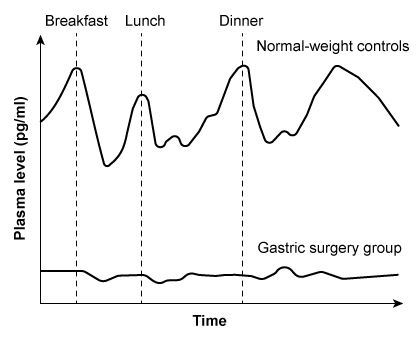 This profile most likely represents which of the following hormones?
 (Multiple Choice)
4.9/5 (70)
(70) A 24-year-old woman comes to the physician because of fatigue, muscle weakness, and muscle cramps for the past 2 hours. She has a medical history of bronchial asthma for which she uses nebulizer at home and used multiple doses of albuterol. She does not smoke, drink alcohol, or use illicit drugs. She is 165 cm (5 ft 5 in) tall and weighs 65 kg (143 lb); BMI is 24 kg/m2. Physical examination shows dry skin and decreased deep tendon reflexes in the lower extremities. An ECG shows prominent U waves and premature atrial contractions.Which of the following mechanisms is the most likely cause of this patient's hypokalemia?
(Multiple Choice)
4.7/5 (86)
(86) A 40-year-old man comes to the office because of an 8-month history of sleep disturbances and tension. The patient says she worries constantly about his family, the next day's meetings, and finances. Six months ago, he started a new job as an accountant. He can no longer concentrate on his tasks at work. The patient also describes frequent tension headaches, back pain, and fatigue. He does not feel depressed and says that her sleep and appetite are normal. He appears anxious. Physical examination shows no abnormalities. The physician recommends psychotherapy and buspirone medication. This medication is associated with which of the following properties?
(Multiple Choice)
5.0/5 (71)
(71) A 56-year-old man with type 2 diabetes mellitus comes to the physician for a follow-up examination. Three months ago, the patient was started on metformin therapy after counseling on diet, exercise, and weight reduction but it failed to reduce his hyperglycemia. A new medication has been added. In the next follow up, he reports a new episodes of headaches, nausea, sweating, and feeling like he is going to pass out. During the most recent episode, his fingerstick glucose was 50 mg/dL. Vital signs are within normal limits, and physical examination shows no abnormalities. Laboratory results show hemoglobin A1c is 6.7%. The medication most likely causing this patient's current symptoms works by targeting which of the following?
(Multiple Choice)
4.8/5 (83)
(83) A 35-year-old woman comes to the office due to recent depressed mood . She feels sad and unmotivated, sleeps 14 hours a day, and has poor concentration at work, and fleeting thoughts of suicide. The patient has no medical history and laboratory evaluation is unremarkable. She is diagnosed with major depression and treated with bupropion and psychotherapy. On next follow up visit, the patient's depressive symptoms are improved, but she is now distressed by a significant decrease in appetite. Further history suggests that the patient consumes very little food each day (a pattern that preceded her use of bupropion) and exercises excessively. her phhysician increased the medication dose Which of the following potential side effects of the increased dose would be of primary concern?
(Multiple Choice)
4.8/5 (75)
(75) A 58-year-old man is brought to the emergency department after a witnessed tonic-clonic seizure. the patient has worsening serum electrolyte disturbances. Further evaluation reveals the cause is inappropriate antidiuretic hormone secretion. Treatment with a vasopressin V2 receptor antagonist is initiated. Which of the following changes are most likely to occur as a direct result of the administered medication? 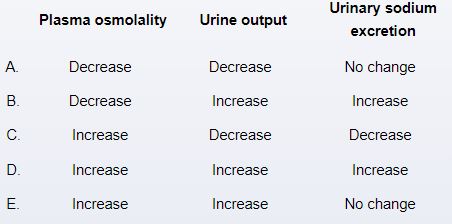
(Multiple Choice)
4.9/5 (73)
(73) A pharmacist is developing a new inhaled anesthetic whic has a characteristics of saftey with less side effect. It aslo has a relatively high potency compared to traditional fluorinated anesthetics. Which of the following parameters best correlates with the potency of an inhaled anesthetic?
(Multiple Choice)
4.7/5 (71)
(71) A 65-year-old woman arrives at the emergency department complaining of left leg pain and swelling that has been bothering her for the past day. She has not experienced any trauma or fever. The patient has a history of high blood pressure, congestive heart failure, type 2 diabetes, and osteoporosis. Her mother and sister both had breast cancer in their families. She is on several medications. The temperature is 37.8 ° C. (100 degrees F), the blood pressure is 130/80 mm Hg, and the pulse rate is 99 beats per minute. On ambient air, pulse oximetry shows 98 percent. Auscultation reveals clear lungs and normal heart sounds without murmur. Tenderness and edema are present in the left lower extremity up to the mid thigh. An occluding thrombus in the left femoral and popliteal veins is revealed by venous Doppler ultrasonography. Which of the following pharmacotherapies most likely contributed to this patient's current condition?
(Multiple Choice)
4.9/5 (87)
(87) A doctor is running a clinical trial for a new hemodynamic drug that has been developed for a variety of indications. According to the drug's pharmacodynamic profile, it is a pure adrenergic agonist with no significant antagonistic properties. It is injected into a volunteer, and the hemodynamic parameters are graphed below. 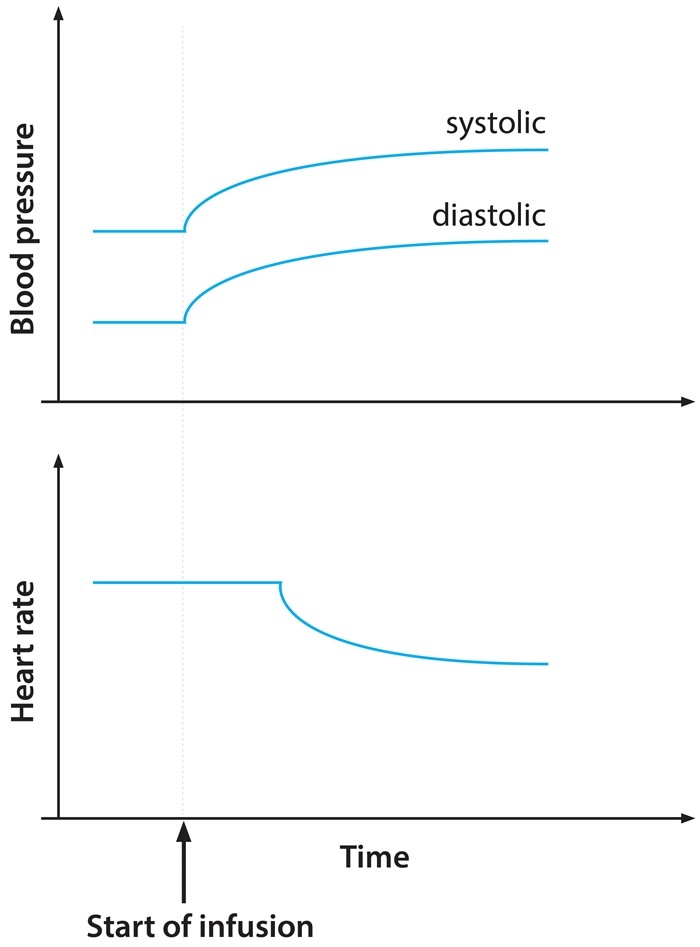 Administration of the drug to healthy individuals would most likely result in which of the following physiologic changes?
 (Multiple Choice)
4.9/5 (83)
(83) A male newborn is evaluated 24 hours after delivery for poor feeding, high-pitched crying, and diarrhea. He was born at 40 weeks' gestation at 2514 g (5.54 lb) to a 28-year-old woman, gravida 2, para 1, by an uncomplicated cesarean section. Apgar scores were 8 and 9 at 1 and 5 minutes, respectively. The mother did not receive prenatal care. The infant's temperature is 38.0°C (100.4°F), pulse is 170/min, and blood pressure is 71/39 mm Hg. On physical examination, the patient is irritable and has mildly increased tone in all extremities with occasional tremors of the arms and legs. Which of the following pharmacotherapies would most likely improve this patient's symptoms?
(Multiple Choice)
4.9/5 (92)
(92) A 27-year-old man comes to the physician because he has been hearing voices in his apartment during the past year. He also reports that he has been receiving warning messages in newspaper articles during this period. At night, he was unable to sleep and reported hearing the voices of demons threatening to kill him". He avoids meeting his family and friends because they do not believe him. He does not use illicit drugs. The patient was diagnosed with schizophrenia and initially treated with chlorpromazine. He now is reluctant to take the medication, saying, "I don't like how it makes me feel." His medication is subsequently changed to fluphenazine. Compared to the patient's initial treatment, fluphenazine is more likely to cause which of the following?
(Multiple Choice)
4.9/5 (76)
(76) 
Filters
- Essay(0)
- Multiple Choice(0)
- Short Answer(0)
- True False(0)
- Matching(0)