



 Chat with AI
Exam 11: Pharmacology and Toxicology

Exam 1: Anatomy265 Questions
Exam 2: Behavioral Sciences178 Questions
Exam 3: Biochemistry102 Questions
Exam 4: Embryology59 Questions
Exam 5: Epidemiology, Biostatistics, and Medical Informatics94 Questions
Exam 6: Genetics88 Questions
Exam 7: Histology46 Questions
Exam 8: Immunology147 Questions
Exam 9: Microbiology and Virology330 Questions
Exam 10: Pathology817 Questions
Exam 11: Pharmacology and Toxicology509 Questions
Exam 12: Physiology339 Questions
Exam 13: Psychiatry and Psychotherapy23 Questions
Select questions type


A 50-year-old man is brought to the hospital due to refuse to eat over the past 2 days. He states that he has mouth ulcers which are very painful. He has a history of chronic kideny disease and a recent psoriasis diagnosis for which he takes a methotrexate therapy. His therapy regimen is supposed to be every 3 days but he reports taking his medication every day. Temperature is 38.1 C (100.6 F). Examination reveals multiple aphthous ulcers in the oral pharynx. A complete blood cell count is as follows: 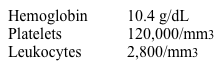 Which of the following is the best next step in management?
 (Multiple Choice)
4.8/5  (86)
(86) A 35-year-old woman comes to the physician accompanied by her husband after he started noticing strange behavior. He first noticed her talking to herself 8 months ago. For the past 6 months, she has refused to eat any packaged foods out of fear that the government is trying to poison her. She has no significant past medical history. She smoked marijuana in college but has not smoked any since. She appears restless. Mental status examination shows a flat affect. Her speech is clear, but her thought process is disorganized with many loose associations. The patient is diagnosed with schizophrenia and started on olanzapine. At this patient's 3-month checkup, which of the following studies should be obtained?
(Multiple Choice)
5.0/5 (77)
(77) A 64-year-old woman with osteoarthritis is brought to the emergency room because of a 2-day history of nausea and vomiting. Over the past few weeks, she has been taking acetaminophen frequently for worsening knee pain. Examination shows scleral icterus and tender hepatomegaly. She appears confused. Serum alanine aminotransferase (ALT) level is 845 U/L, aspartate aminotransferase (AST) is 798 U/L, and alkaline phosphatase is 152 U/L. Which of the following is the most likely underlying mechanism of this patient's liver failure?
(Multiple Choice)
5.0/5 (71)
(71) A 70-year-old man is brought to the physician by his daughter for evaluation of increasing forgetfulness during the past few months. The daughter reports that he has had difficulty remembering names of the people he meets and frequently misplaces household item. He also recently got lost while walking home from the grocery store. He has also been more irritable recently. On physical examination, the patient is alert and cooperative but disoriented to time and can recall only 1 of 3 items on a short-term memory test. MRI of the head reveals diffuse cortical atrophy. A medication with which of the following effects would be most beneficial for this patient?
(Multiple Choice)
4.8/5 (71)
(71) A 40-year-old man comes to the office for follow up. three months ago he is diagnosed with makor depressive disorder. an antidepressant medication was administred and he takes it regularly. The patient reports that the depressive symptoms are mildly improved, but he is now distressed by a significant decrease in libido and impaired sexual performance. He is asking to switch the current medication to an alternative treatment. Which of the following drugs is most appropriate for this patient?
(Multiple Choice)
4.9/5 (75)
(75) A 45-year-old woman comes to the office to discuss low bone density. The patient was diagnosed with a prolactinoma 4 years ago after she lost her menstrual period for 6 months, but she refused medical or surgical treatments Family history is unremarkable. Laboratory studies show an increased serum prolactin level, a normal TSH level, and an undetectable B-hCG concentration. A DEXA scan shows an osteopenia of her bone. The underlying mechanism for this patient's osteopenia is most likely to cause which of the following additional manifestations?
(Multiple Choice)
4.7/5 (92)
(92) A 55-year-old woman arrives at the emergency room complaining of nausea, fever, fatigue, and anorexia. She returned from a trip to Mexico a week ago, where she underwent an emergency cholecystectomy with no complications. Her temperature is 38.3 ° C. (101 degrees F), her blood pressure is 100/60 mm Hg, her pulse is 90 bpm, and her respirations are 12 /minute. The patient is awake and responding to questions, but she appears extremely weak and slightly icteric. She has no other medical issues and does not take any medications. She does not smoke, drink, or use illegal drugs. The patient is taken to the hospital, but her condition deteriorates and she dies two days later. Viral serologies performed after death are negative. The image below depicts a gross examination of the liver during an autopsy. 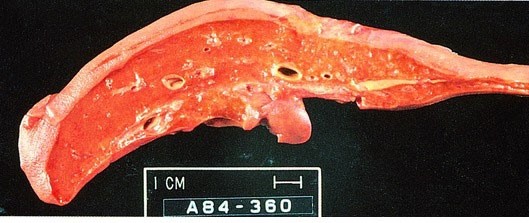 Which of the following additional findings would have most likely been found in this patient?
 (Multiple Choice)
4.8/5 (80)
(80) A 23-year-old man comes to the physician because of severe daytime sleepiness and random episodes of falling asleep during the day for short periods of time. When he wakes up from these episodes, he feels refreshed. He sleeps 6-7 hours at night. He reports that sometimes he is unable to move for a few minutes when he first wakes up in the morning. Last week, he suddenly "lost control" of his legs and neck for about 30 seconds after his classmate had told him a joke. Which of the following is the best treatment for this patient's condition?
(Multiple Choice)
4.7/5 (85)
(85) A 34-year-old man comes to the physician because of palpitations, shortness of breath, diarrhea, and abdominal cramps for 2 months. Physical examination shows cutaneous flushing of the face. Auscultation of the chest shows bilateral wheezing. A 24-hour urine collection shows increased 5-hydroxyindoleacetic acid (5-HIA A) concentration. A contrast-enhanced CT scan of the abdomen shows an intestinal tumor with extensive metastasis to the liver. A diagnosis of an inoperable disease is made and the patient is started on treatment with octreotide. Six weeks later, the patient's symptoms have improved except for his abdominal pain and frequent loose stools. The physician suggests enrolling the patient in a trial to test additional treatment with a new drug that has been shown to improve symptoms in other patients with the same condition. The expected beneficial effect of this new drug is most likely caused by inhibition of which of the following?
(Multiple Choice)
4.9/5 (88)
(88) An experiment is carried out to evaluate the effects of drug A on the hemodynamic effects of epinephrine. Two groups of fit volunteers are chosen. The first group only receives low-dose epinephrine, and its effects on diastolic blood pressure and heart rate are measured and shown below (epinephrine group). The second group is given drug A before being given low-dose epinephrine, resulting in a new set of curves (epinephrine + drug A group). 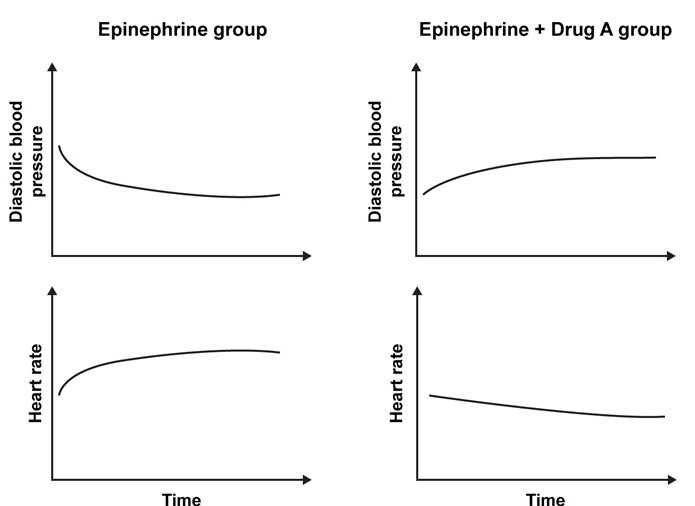 Which of the following medications is most likely to be drug A?
 (Multiple Choice)
4.8/5 (89)
(89) A 21-year-old man is brought to the emergency department by his roommate because of altered mental status. He found him covering his ears and shouting near an empty bottle of aspirin tablets. Upon questioning, he was unable to look directly at the physician and answer coherently., he reported feeling nauseous and vomited twice. His temperature is 38.2°C (100.8°F), pulse is 100/min, respirations are 28/min, and blood pressure is 110/77 mm Hg. Physical examination shows normal-sized reactive pupils and clear lungs. There is tenderness over the epigastric area. He is admitted to the hospital for evaluation. Which of the following sets of laboratory results is most likely to be found in this patient? 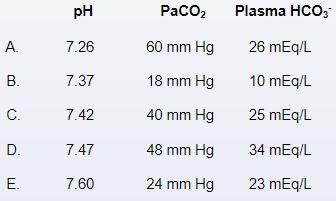
(Multiple Choice)
5.0/5 (75)
(75) A newborn is being evaluated due to low growth perecentile. the patient is delivered via elective cesarean section at 38 weeks gestation. APGAR scores are 8 and 9 at 1 and 5 minutes, respectively. Head circumference measures <10th percentile, and the placenta has numerous calcifications. Serology is consistent with congenital toxoplasmosis. As part of treatment, he is prescribed a combination of pyrimethamine and sulfadiazine. A medical student in the round has asked about the reason to use two different medications to treat this patient?
(Multiple Choice)
4.9/5 (87)
(87) A 44-year-old man visits the office for a check-up on his type 2 diabetes mellitus. He was diagnosed with diabetes four years ago and has been on metformin ever since. Due to suboptimal glycemic control, a new antidiabetic agent was added six months ago. Today, the patient is overjoyed because he has lost 7 kg (15.4 lb) without changing his diet or activity since beginning the new therapy. His only symptoms are nausea and vomiting on occasion, as well as a prolonged feeling of fullness after eating. Vital signs are normal, and there are no orthostatic changes. 34 kg/m2 is the BMI. Physical examination reveals normal heart and lung sounds, a nontender abdomen, normal deep tendon reflexes, and a normal sensory examination. Normal renal function studies and hemoglobin A1c of 7.2% are revealed by laboratory testing. If this patient's weight loss is due to the new medication, which of the following agents is most likely responsible?
(Multiple Choice)
4.8/5 (78)
(78) A 72-year-old man is brought to the emergency department after experiencing waxing and waning chest pressure for several hours. When the patient walks briskly up the stairs, he says he gets a similar sensation that lasts 5-10 minutes. He has a significant medical history for hypertension and hyperlipidemia; he has been noncompliant with prescribed medical therapy and follow-up visits. The patient has a smoking history of 25 packs per year. The blood pressure is 211/105 mm Hg, and the pulse rate is 88 beats per minute. A chest examination reveals no heart murmurs and clear lungs. The ECG demonstrates sinus rhythm and nonspecific ST-segment changes. When a medication is administered intravenously, the following hemodynamic effects are observed in comparison to baseline: 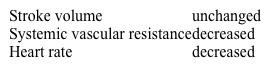 Which of the following medications was most likely used in this patient?
 (Multiple Choice)
4.8/5 (75)
(75) A 70-year-old man with a history of hypertension comes to the physician for shortness of breath with mild exertion, progressive weakness, and a dry cough that has persisted for 6 months. He has smoked a pack of cigarettes daily for 45 years. His medications include enalapril. His pulse is 85/min and irregularly irregular. Physical examination shows enlarged fingertips and markedly curved nails. A CT scan of the chest shows clustered air spaces and reticular opacities in the basal parts of the lung. The patient undergoes lung biopsy; histologic examination shows areas of interstitial inflammation, foci of proliferating fibroblasts, dense collagen fibrosis, and honeycomb change. Pharmacotherapy aimed at which of the following is most helpful in treating this patient's lung condition?
(Multiple Choice)
5.0/5 (86)
(86) A 66-year-old man is brought to the emergency department because of an hour history of dizziness and shortness of breath. After establishing the diagnosis, treatment with a drug is administered. Shortly after administration, the patient develops abrupt right eye pain and decreased vision of the right eye, along with nausea and vomiting. Ophthalmologic examination shows a fixed, mid-dilated pupil and a narrowed anterior chamber of the right eye and an elevated intraocular pressure. Which of the following is the most likely cause for this patient's eye pain?
(Multiple Choice)
4.9/5 (85)
(85) A 20-year-old man comes to the office due to lack of sexual interest. The patient is in a stable relationship with his fiancé and does not use tobacco, alcohol, or illicit drugs but he avoids any intersexual course due to erectlie dysfunction which becomes more embarassing. Height is 188 cm (6 ft 2 in) and weight is 88 kg (194 lb). Examination shows bilateral gynecomastia, sparse facial hair, and small, firm testes. The penis is normal in size and peripheral vision is normal on confrontation. This patient would most benefit from which of the following?
(Multiple Choice)
4.9/5 (75)
(75) A 34-year-old woman suffers from recurring throbbing headaches that cause significant distress. They come with nausea and photophobia. She has been to the emergency room 5 times in the last 6 months for these headaches. Her blood pressure ranges from 140/90 mm Hg to 150/95 mm Hg during office visits. The neurologic exam is unremarkable. The patient is given metoprolol and told that the medication will reduce the frequency of headaches as well as lower blood pressure in the long run. Which of the following best explains this medication's effect on blood pressure?
(Multiple Choice)
4.8/5 (71)
(71) A 10-year-old boy is brought to the emergency department because of violent jerky movements of his arms and legs that began 20 minutes ago. His father reports that the patient has a history of epilepsy. He is not responsive. Physical examination shows alternating tonic jerks and clonic episodes. There is blood in the mouth. Which of the following describes the mechanism of action of the most appropriate initial therapy for his seizures?
(Multiple Choice)
4.9/5 (70)
(70) A 10-year-old girl is brought to the emergency department after she ingested several theophylline tablest by mistake. The patient reports nausea and headache. She has no other prior medical problems and takes no medications. Her temperature is 37 C (98.6 F), blood pressure is 114/76 mm Hg, pulse is 88/min, and respirations are 16/min. This patient should be carefully monitored for which of the following?
(Multiple Choice)
4.9/5 (91)
(91) 
Filters
- Essay(0)
- Multiple Choice(0)
- Short Answer(0)
- True False(0)
- Matching(0)