



 Chat with AI
Exam 11: Pharmacology and Toxicology

Exam 1: Anatomy265 Questions
Exam 2: Behavioral Sciences178 Questions
Exam 3: Biochemistry102 Questions
Exam 4: Embryology59 Questions
Exam 5: Epidemiology, Biostatistics, and Medical Informatics94 Questions
Exam 6: Genetics88 Questions
Exam 7: Histology46 Questions
Exam 8: Immunology147 Questions
Exam 9: Microbiology and Virology330 Questions
Exam 10: Pathology817 Questions
Exam 11: Pharmacology and Toxicology509 Questions
Exam 12: Physiology339 Questions
Exam 13: Psychiatry and Psychotherapy23 Questions
Select questions type


A 29-year-old man comes to the physician for a follow-up examination. He has had numbness and tingling of his legs for the past 10 days. Three months ago, he was diagnosed with pulmonary tuberculosis and started on isoniazid and rifampin. . Neurologic testing demonstrates sensory ataxia and decreased pain sensation in the distal extremities. This patient's condition is most likely caused by:
(Multiple Choice)
4.9/5  (68)
(68) A 60-year-old man comes to the office for follow up appointment, he feels shortenss of breath while walking his dog around the block. He states that he is experiencing a dyspnea while sleeping therefor he uses 3 pillows or sleep on the recliner. The patient had an acute myocardial infarction 2 years ago and has been nonadherent with his medications. Temperature is 36.9 C (98 F), blood pressure is 125/74 mm Hg, pulse is 92/min, and respirations are 21/min. Physical examination shows bibasilar lung crackles, jugular venous distension, and bilateral pitting edema in the lower extremities. Chest x-ray reveals cardiomegaly and pulmonary venous congestion. Which of the following factors is most likely contributing to this patient's symptoms?
(Multiple Choice)
5.0/5 (75)
(75) A 24-year-old man come to the physician because of left-sided neck swelling that has slowly progressed over the past 4 weeks. He has a recurrent history of boils and skin abscesses. Temperature is 38.0°C (100.4°F). Physical examination shows a nontender, mobile mass in the left submandibular region with overlying erythema. A biopsy culture is performed to determine colonization by the culprit bacteria, which yields gram-positive cocci in clusters. The bacteria are able to grow in a media containing oxacillin. PCR testing reveals the pathogen has acquired the mecA gene. These bacteria are most likely to be resistant to which of the following antibiotics?
(Multiple Choice)
4.9/5 (79)
(79) A 68-year-old man comes to the physician because of severe muscle aches and fatigue for 2 days. Last week he was diagnosed with atypical pneumonia and treated with clarithromycin. He has hyperlipidemia and coronary artery disease with an acute myocardial infarction 2 years ago. Physical examination shows diffuse tenderness in the proximal muscles of the upper and lower extremities. Serum creatine kinase activity is elevated. Which of the following drug combinations is most likely responsible for this patient's condition?
(Multiple Choice)
4.8/5 (75)
(75) A 69-year-old man comes to the physician because of a 2-month history of urinary urgency, nocturia, and progressive pain in his lower back. The pain is worse at night and does not respond to ibuprofen. Rectal examination shows an enlarged, asymmetric prostate with a nodular surface. Prostate-specific antigen concentration is 9 ng/ml (N < 4). A biopsy of the prostate shows a high-grade adenocarcinoma. Flutamide was then added to his initial therapy and led to significant pain relief and a decrease in the size of the primary tumor. Which of the following mechanisms is the best explanation for the effects of flutamide in this patient?
(Multiple Choice)
4.8/5 (83)
(83) A 63-year-old man who is being treated in a hospital for an exacerbation of chronic obstructive pulmonary disease has hypercapnic respiratory failure. He is sent to the critical care unit, where he is premedicated with muscle relaxant X and the proper sedative before being intubated. The patient is subsequently placed on mechanical ventilation, however he lasts longer than anticipated while apneic. Anesthesiology is consulted, and the neuromuscular blockade in the patient is evaluated by electrically stimulating a peripheral nerve four times quickly and watching the muscle reaction. The findings are displayed below when the operation is repeated 30 minutes later. 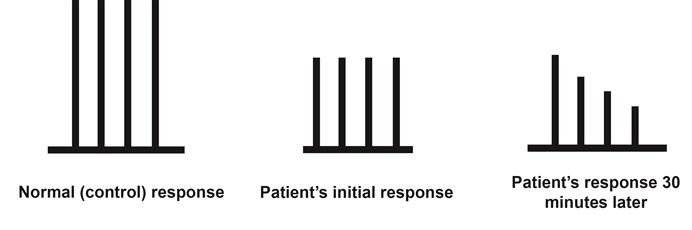 Muscle relaxant X is most likely to be which of the following medications?
 (Multiple Choice)
4.9/5 (71)
(71) A 27-year-old man comes to the emergency department with palpitations, sweating, and shortness of breath that began 10 minutes ago. He says, "Please help me, I don't want to die." He has experienced several similar episodes over the past 2 months, which occurred without warning in situations including open spaces or crowds and resolved gradually after 10 to 20 minutes. He has no history of serious illness and takes no medications. He drinks 2 bottles of beer daily. He appears anxious and has a flushed face. Physical examination, ECG, and laboratory evaluation are normal. The patient is diagnosed with panic disorder. After discussion of treatment options, he decides to pursue cognitive-behavioral therapy and start a short-term anxiolytic medication that also has muscle-relaxant and anticonvulsant properties. Which of the following best describes the mechanism of action of this medication?
(Multiple Choice)
4.9/5 (78)
(78) A 32-year-old woman is brought to the emergency department after ingestion of rat poison as a suicide attempt. Her vital signs are normal and physical examinaton shows unremarkable findings. After two days, she comes again after two episodes of bloody vomiting. she felt dizzy and lightheadness. Physical examination shows scattered ecchymoses. The abdomen is soft and nontender. Rectal examination shows maroon-colored, guaiac-positive stool. Immediate treatment of this patient should include which of the following?
(Multiple Choice)
4.9/5 (92)
(92) A 58-year-old woman comes to the office due to 2 days of lower back pain.. Last 2 days, she left heavy boxes during move to a new apartment. She does not drink alcohol or use illicit substances. Medical history includes hypertension and major depressive disorder currently treated with captopril and citalopram. A short course of medication is prescribed, and the patient is asked to monitor for development of diaphoresis, restlessness, tremors, and diarrhea. The patient was most likely prescribed which of the following medications?
(Multiple Choice)
4.8/5 (76)
(76) A 56-year-old man arrives at the emergency department after experiencing palpitations and lightheadedness for the past two hours. He has a history of hypertension but no other cardiac conditions, and he has never previously experienced similar symptoms. The patient consumes 1 to 2 alcoholic beverages per day but does not smoke or use illegal drugs. The blood pressure is 132/76 mm Hg, and the pulse rate is 116 bpm, which is irregular. Except for tachycardia, the cardiopulmonary examination is normal. The resting ECG reveals atrial fibrillation. Transesophageal echocardiography is performed on the patient, which reveals normal cardiac anatomy and no intracardiac thrombi. Electrical cardioversion is carried out. Sinus rhythm is restored following the intervention, and amiodarone therapy is started to maintain normal sinus rhythm. Which of the following cardiac electrophysiologic changes are most likely to occur in this patient due to the medication? 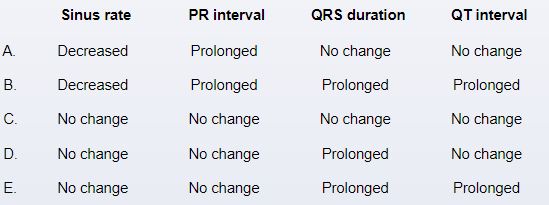
(Multiple Choice)
4.8/5 (76)
(76) An 18-year-old male is brought to the emergency department by his mother after she found him unresponsivenss. She reports that he has been diagnosed with depression after an admission to the psychiatric hospital a week ago. The patient's medications are unknown. Temperature is 38.3 C (100.9 F), blood pressure is 92/49 mm Hg, and pulse is 128/min. On examination, the patient is sedated and disoriented. The pupils are dilated and bowel sounds are decreased. She has 700 mL of urine return when a urinary catheter is placed. ECG reveals sinus tachycardia and a QRS duration of 130 msec. Which of the following is the most likely cause of this patient's symptoms?
(Multiple Choice)
4.8/5 (98)
(98) A 59-year-old woman comes to the physician because of left leg swelling that started after a long time flight. A duplex ultrasound of the left leg shows a noncompressible popliteal vein. A drug is prescribed that prolongs activated partial thromboplastin time and prothrombin time in a dose-dependent manner but has no effect on thrombin time. Which of the following agents was this patient most likely administered?
(Multiple Choice)
4.8/5 (74)
(74) An 82-year-old woman with dementia who resides in a nursing care facility is brought to the emergency department 1 hour after she was found to have ingested 20 diuretic pills of Her blood pressure is 94/58 mm Hg. Physical examination shows dry mucous membranes Laboratory results are as follows: 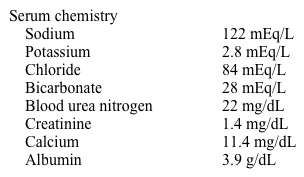 Which of the following medications did this patient most likely ingest?
 (Multiple Choice)
4.9/5 (82)
(82) A new aminoglycoside antibiotic is developed to treat resistent pseudomonas . The volume of distribution of the drug is measured in a group of volunteers and is determined to be 4.5 L. This new drug is most likely to have which of the following properties?
(Multiple Choice)
4.9/5 (82)
(82) A 79-year-old woman is brought to the hospital after falling down one hour ago. The patient reports frequent dizziness and a dizzy epiosde that leads to fall down. She has a medical history includes moderate dementia, hypertension, transient ischemic attack, depression, and chronic insomnia. In the ER she looks disoriented to time and place but otherwise is normal. Imaging shows no abnormalities. Blood pressure is 120/70 mm Hg, and pulse is 76/min and regular. The patient's medication schedule includes 10 different drugs that are used to manage her chronic conditions. Which of the following medications should be discontinued at this time?
(Multiple Choice)
4.8/5 (82)
(82) A 20-year-old woman is brought to the emergency department after being struck by a car while crossing the street. Vital signs are within normal limits. X-ray of the lower extremity shows a mid-shaft femur fracture. The patient is taken to the operating room for surgical repair of the fracture. As the surgeon begins the internal fixation, the patient shows diffuse muscle stiffness and profuse diaphoresis. Her temperature is 39°C (102.2°F), pulse is 130/min, respirations are 24/min, and the ECG tracing shows sinus tachycardia Hg. Inhibition of which of the following is most likely to improve this patient's condition?
(Multiple Choice)
4.8/5 (79)
(79) A 22-year-old man is brought to the emergency department 10 minutes after falling down a flight of stairs. An x-ray of the right wrist shows a distal radius fracture. Anesthesia was induced with propofol, succinylcholine was used for intubation, and anesthesia was maintained via propofol and fentanyl infusions. , and closed reduction of the fracture is performed. The patient has not had a return of neuromuscular function after several hours. His mother then discloses that she has also been "slow to wake up" from anesthesia. Which of the following is the most likely reason for this patient's prolonged paralysis?
(Multiple Choice)
4.8/5 (83)
(83) A physiologist is conducting an experiment to study a new medication that work in receptor X which treat a nueromuscular disorder. When the experimental drug is applied to cells expressing receptor X, there is an immediate change in transmembrane calcium, sodium, and potassium flow secondary to the opening of the receptor channel. Receptor X is most likely which type of receptor?
(Multiple Choice)
4.8/5 (78)
(78) An 81-year-old man with advanced-stage prostate cancer comes to the physician because of a 1-week history of worsening lower back and hip pain. The patient's analgesic regimen includes oxycodone, ibuprofen, and alendronic acid. Physical examination shows localized tenderness over the lumbar spine and right hip .Imaging studies reveal a vertebral compression fracture with cord compression. Surgical decompression is planned. Which of the following drugs may precipitate opioid withdrawal symptoms if used in this patient?
(Multiple Choice)
4.8/5 (73)
(73) A 38-year-old woman is being evaluated because of pain and stiffness in both of her hands for the past 2 weeks. The pain is most severe early in the day and does not respond to ibuprofen. She has no other medical problems. Family history is significant for hypertension on her maternal side. Vital signs are within normal limits. Examination shows swelling and tenderness of the wrists and metacarpophalangeal joints bilaterally. Range of motion is decreased due to pain. There are subcutaneous, nontender, firm, mobile nodules on the extensor surface of the forearm. Which of the following drugs would provide the most rapid relief of her symptoms?
(Multiple Choice)
4.8/5 (91)
(91) 
Filters
- Essay(0)
- Multiple Choice(0)
- Short Answer(0)
- True False(0)
- Matching(0)