



 Chat with AI
Exam 11: Pharmacology and Toxicology

Exam 1: Anatomy265 Questions
Exam 2: Behavioral Sciences178 Questions
Exam 3: Biochemistry102 Questions
Exam 4: Embryology59 Questions
Exam 5: Epidemiology, Biostatistics, and Medical Informatics94 Questions
Exam 6: Genetics88 Questions
Exam 7: Histology46 Questions
Exam 8: Immunology147 Questions
Exam 9: Microbiology and Virology330 Questions
Exam 10: Pathology817 Questions
Exam 11: Pharmacology and Toxicology509 Questions
Exam 12: Physiology339 Questions
Exam 13: Psychiatry and Psychotherapy23 Questions
Select questions type


A 27-year-old man comes to the physician because he has been hearing voices in his apartment during the past year. He also reports that he has been receiving warning messages in newspaper articles during this period. At night, he was unable to sleep and reported hearing the voices of demons threatening to kill him". He avoids meeting his family and friends because they do not believe him. He does not use illicit drugs. The patient was diagnosed with schizophrenia and initially treated with chlorpromazine. He now is reluctant to take the medication, saying, "I don't like how it makes me feel." His medication is subsequently changed to fluphenazine. Compared to the patient's initial treatment, fluphenazine is more likely to cause which of the following?
(Multiple Choice)
4.8/5  (87)
(87) A 56-year-old man visits the office for a check-up on his type 2 diabetes mellitus. The patient's glycemic control was inadequate with metformin monotherapy, so a new medication that inhibits dipeptidyl peptidase-4 was prescribed three months ago. He is in good health and reports no side effects from the new therapy. Ramipril is also used to treat the patient's hypertension. He does not smoke, drink, or use illegal drugs. The patient claims he follows dietary recommendations in general but occasionally indulges in fast food. The blood pressure is 126/74 mm Hg, and the pulse rate is 76 beats per minute. 31.4 kg/m2 is the BMI. A physical examination reveals no anomalies. Laboratory results show a hemoglobin A1c of 6.8%. The newly prescribed medication most likely improved this patient's glycemic control through which of the following direct mechanisms?
(Multiple Choice)
4.9/5 (82)
(82) A 45-year-old man with a history of recurrent gouty arthritis comes to the physician for a follow-up examination. Two months ago, he had an episode of big toe swelling and pain . Since then, he has had another acute gout attack, which resolved after treatment with ibuprofen. His temperature is 37.1°C (98.8°F). Physical examination shows painless, chalky nodules on the metatarsophalangeal joint of his right foot. Past medical history is notable for hypercholesterolemia, for which he takes atorvastatin. He also has a history of recurrent renal colic. Serum uric acid level is 9.8 mg/dL. Which of the following is the best agent for long-term management of this patient?
(Multiple Choice)
4.7/5 (85)
(85) A newborn boy is evaluated for tachypnea, immediately after birth. He was delivered at 31 weeks' gestation via spontaneous vaginal delivery. She did not receive prenatal care. She has a poor controlled hypertension and takes multiple medications. Examination of the infant shows an intubated and sedated boy whose weight is at the third percentile. The temporal, occipital, and parietal bones are underdeveloped, and the right lower limb is shortened and contracted. Which of the following mechanisms is the most likely cause of this neonate's abnormalities?
(Multiple Choice)
4.9/5 (76)
(76) A 30-year-old man is brought to the emergency department 1 hour after his neighbor found him collapsed on his front porch in a pool of vomitus. On arrival, he is oriented only to self. His pulse is 103/min and respirations are 30/min. Neurologic examination shows muscle spasms in the arms and jaw. Laboratory results are as follows: 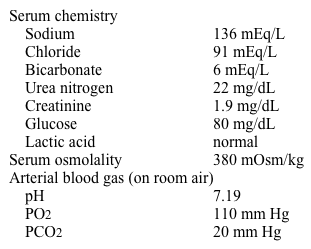 Acute poisoning is suspected and the patient is given an appropriate antidote. Which of the following is the most likely mechanism of action of the antidote?
 (Multiple Choice)
4.7/5 (77)
(77) A 64-year-old man visits the office after experiencing chest pain while working out for the past six months. He has smoked one pack of cigarettes a day for his whole life and has a history of type 2 diabetes and peripheral vascular disease. When the patient is put through a treadmill exercise stress test, they have substernal chest pain with moderate effort, along with alterations in their ECG, which disappear as soon as they stop. He rejects having an invasive heart test. The patient begins low-dose aspirin therapy for the secondary prevention of cardiovascular disease, but the medicine causes wheezing and shortness of breath. Which of the following is the best alternate therapy for this patient?
(Multiple Choice)
4.8/5 (72)
(72) A prospective observational study is carried out to determine the factors that influence bone mass and fracture risk. A large number of volunteers provide detailed demographic and clinical information, and bone mass is tracked over time. The data collected from two distinct groups of women are shown below. 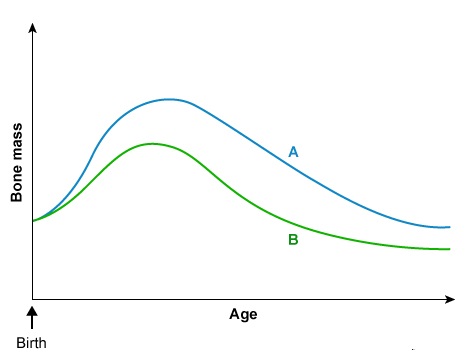 Which of the following factors is most likely present in group A?
 (Multiple Choice)
4.9/5 (76)
(76) A 7-year-old boy is brought to the physician by his mother due to bad school performance. The teacher has noticed him during the lesson he looks tostare into the upper corner of the class and he seems to ignore the teacher and doesn't pay attention during this episode. The sam thing occurs when he is watching television show. He eats a well-balanced diet and is at the 50th percentile for height and weight. Which of the following is the most appropriate pharmacotherapy for this patient?
(Multiple Choice)
4.7/5 (103)
(103) A medical student is watching a pharmacology experiment in which a pregnant dog is receiving medication A intravenously. Heart rate, blood pressure, pupil size, and uterine contractions are just a few of the variables being monitored during the trial. The diagrams below show the measured parameters and observed changes following medication A infusion. 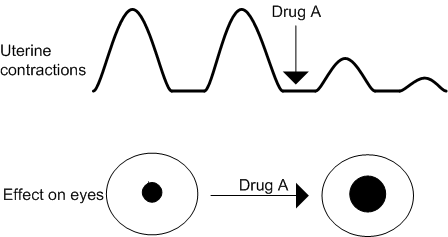 Which of the following best characterizes drug A?
 (Multiple Choice)
4.9/5 (76)
(76) A 22-year-old woman is brought to the emergency department because of a 2-day history of fever, intermittent rigors, and night sweats. She also has a 1-month history of progressive fatigue. The patient uses intravenous heroin and has been hospitalized several times due to skin and soft tissue infections. Cardiac auscultation shows a systolic ejection murmur, and subsequent echocardiography reveals a vegetative lesion of the aortic valve. Blood cultures from admission grow Enterococcus faecalis; subsequent testing reveals D-lactate rather than D-alanine as the terminal amino acid in the bacteria's pentapeptide peptidoglycan cell wall precursor. This substitution is likely to significantly decrease the efficacy of which of the following antibiotics?
(Multiple Choice)
4.8/5 (86)
(86) A 14-year-old boy is brought to the office by his father due to an erythema between his toes of both feet. He is a long-distante runner and he has no prior medical health and takes no medications. Examination shows erythema and excoriations between the toes of both feet. Microscopy of skin scrapings from the rash is shown in the exhibit. 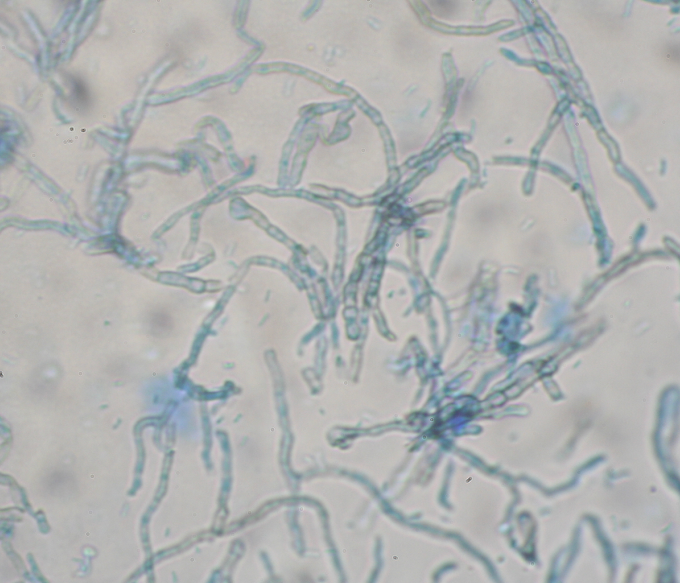 Which of the following antimicrobial drugs is likely to be the most effective against the pathogen causing this patient's condition?
 (Multiple Choice)
4.8/5 (78)
(78) A 50-year-old man is hospitalized after a planned repair inguinal hernia. One of his physicians administers a new drug whose mechanism of action you do not know. Shortly after administration of the drug the patient develops flushing, diaphoresis and nausea. His blood pressure is 100/70 mmHg and heart rate is 55/min. His pupils are constricted but reactive to light. This medication is most likely given for which of the following conditions?
(Multiple Choice)
4.8/5 (74)
(74) A 65-year-old Eastern European immigrant visits the doctor with a four-week history of low-grade fever, multiple joint pains, and a well-demarcated erythematous rash on his face and trunk. The patient denies having hair loss, mucosal ulcers, or being photosensitive. His serum test results show the presence of anti-nuclear antibody (AN A) in extremely high titers. The patient reports having had coronary artery disease, congestive heart failure, and "cardiac rhythm abnormalities" in the past. This patient should be specifically questioned about the intake of which of the following medications?
(Multiple Choice)
5.0/5 (87)
(87) A 25-year-old man is brought to the emergency department by his mother after an episode of unvolunterly jerky movement. The patient's clothes have been covered with urine and feces. He has a past medical history of epilepsy and is noncompliant with his antiseizure medications. In the hospital, he has several brief, back-to-back generalized tonic-clonic seizures and never fully regains consciousness between episodes. Intravenous lorazepam 2 mg is administered, and the seizures stop. Intravenous infusion of another drug is started simultaneously to prevent seizure recurrence. Which of the following is the most likely mechanism of action of the second drug infused in this patient?
(Multiple Choice)
4.8/5 (76)
(76) A 42-year-old woman is being evaluated because of urinary leakage over the several months. She reports involuntarily losing small amounts of urine after experiencing a sudden need to void. She has difficulty making it to the bathroom in time, these episodes occur almost every day and are very embarrassing. She also has begun to wake up at night to urinate. These symptoms have persisted despite 4 months of bladder training and weight loss, and reducing soda and coffee intake. Physical examination shows no abnormalities. A urinalysis is within normal limits. The most appropriate pharmacotherapy for this patient is a drug that has which of the following mechanisms of action?
(Multiple Choice)
4.7/5 (84)
(84) A 47-year-old woman with metastatic breast cancer who is undergoing chemotherapy comes to the physician for a follow-up exam. She reports extreme fatigue since beginning her chemotherapy regimen. Her pulse is 98/min, respirations are 16/min, and blood pressure is 132/84 mm Hg. Her hemoglobin is 10.4 g/dL, leukocyte count is 800/mm3 with 5% monocytes, and platelet count is 50,000/mm3. The patient is started on a new medication. One week later, serum studies show a hemoglobin of 10.6 g/dL, a leukocyte count of 2,000/mm3 with 2% monocytes, and a platelet count of 56,000/mm3. Which of the following drugs is the most likely cause of these findings?
(Multiple Choice)
4.9/5 (100)
(100) A 40-year-old man comes to the physician because of a 2-day history of progressively blurred vision. He also reports seeing flashing lights in his visual field. He does not have any pain.The patient was diagnosed with sexually acquired HIV infection 4 years ago. Examination shows right conjunctival injection. Visual acuity is 20/20 in the left eye and 20/100 in the right eye. Fundoscopic examination of the right eye is shown. 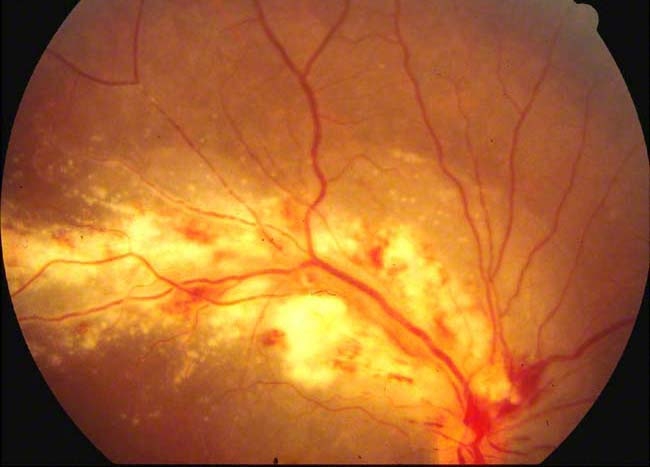 His CD4+ T-lymphocyte count is 46/mm3. Which of the following is the most appropriate pharmacotherapy for this patient's eye condition?
 (Multiple Choice)
4.7/5 (85)
(85) A 60-year-old woman comes to the hospital because of an episode of losing consciousness for several seconds. She appeared pale afterwards but was not confused, and fingerstick blood glucose was normal. Medical history includes hypertension, type 2 diabetes mellitus, renal calculas , and Alzheimer disease. Her blood pressure is 130/87 mm Hg in the supine position and 100/76 mm Hg 30 seconds after standing up. Cardiac examination shows no abnormalities. The patient is hospitalized for observation and is found to have an episodic bradyarrhythmia and atrioventricular block. If this patient's condition is due to a medication, which of the following is the most likely cause?
(Multiple Choice)
4.9/5 (87)
(87) A 35-year-old lady who is receiving bipolar illness treatment complains of having a lot of thirst and urinating often. Every night, she wakes up three to four times to go to the bathroom. Following an 8-hour fast without food and liquids, a urinalysis reveals the following: 11ec160b 3c6e d2f8 9249 f57b157fe8f1 MD0001 00 Which of the following nephron components in this patient is most likely damaged? 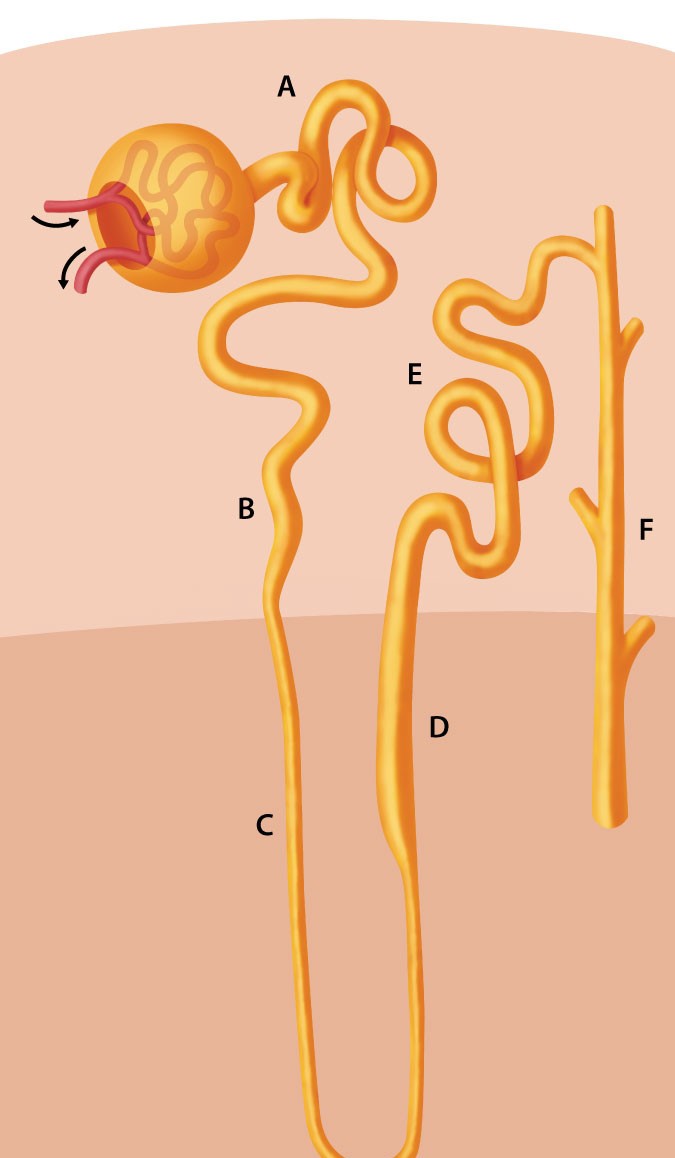
(Multiple Choice)
4.8/5 (71)
(71) A 5 year-old girl is brought to the office by her mother due to a right ear discharge for 2 days. The mother also reports that she has a fever and she doesn't eat well over the past 2 days. Her past medical history is significant for three episodes of otitis media over the last year. You prescribe amoxicillin with clavulanic acid. The mother is concerned regarding adding clavulanic acid. Adding clavulanic acid to this treatment regimen would serve which of the following purposes?
(Multiple Choice)
5.0/5 (87)
(87) 
Filters
- Essay(0)
- Multiple Choice(0)
- Short Answer(0)
- True False(0)
- Matching(0)