



 Chat with AI
Exam 11: Pharmacology and Toxicology

Exam 1: Anatomy265 Questions
Exam 2: Behavioral Sciences178 Questions
Exam 3: Biochemistry102 Questions
Exam 4: Embryology59 Questions
Exam 5: Epidemiology, Biostatistics, and Medical Informatics94 Questions
Exam 6: Genetics88 Questions
Exam 7: Histology46 Questions
Exam 8: Immunology147 Questions
Exam 9: Microbiology and Virology330 Questions
Exam 10: Pathology817 Questions
Exam 11: Pharmacology and Toxicology509 Questions
Exam 12: Physiology339 Questions
Exam 13: Psychiatry and Psychotherapy23 Questions
Select questions type


A 48-year-old man comes to the emergency department because of a 2-hour history of severe left-sided colicky flank pain that radiates towards his groin. The pain is similar to several previous episodes of kidney stones. He has vomited twice. He drinks 4-5 beers most days of the week. Examination shows left costovertebral angle tenderness. An upright x-ray of the abdomen shows no abnormalities. A CT scan of the abdomen and pelvis shows an 9-mm stone in the proximal ureter on the left after few hours he passes the stone with rapid relief of his symptoms Chemical analysis reveals that the stone is composed primarily of calcium oxalate. Which of the following medications is most likely to prevent recurrent stone formation in this patient?
(Multiple Choice)
4.8/5  (73)
(73) A 60-year-old woman is diagnosed with breast cancer following a routine mammogram. She also has a positive lymph node metastasis for which a treatment with systemic chemotherapy is started. After, Two weeks she comes with 4 days of frequent urination, suprapubic pain, dysuria, and progressive hematuria. She has had no fevers or chills. Temperature is 37.1 C (98.8 F). Suprapubic tenderness is present on abdominal examination. Hemoglobin is 9.8 g/dL. Urinalysis shows numerous red blood cells but no leukocyte esterase or bacteria. Which of the following could have prevented this patient's current condition?
(Multiple Choice)
4.9/5 (62)
(62) A 73-year-old woman is brought to the emergency department after she sustained a fall an hour ago. The patient was walking down the stairs when she lost her balance and fell onto the right side of her body. She is being treated for different medical conditions including hypertension, congestive heart failure, type 2 diabetes mellitus, and gastroesophageal reflux disease. She is 163 cm (5 ft 4 in) tall and weighs 50 kg (110 lb); BMI is 19 kg/m2. She appears pale. Vital signs are within normal limits. The right leg seems shorter than the left and is rotated externally. Pulses are intact in both lower extremities. Palpation of the right hip causes severe pain and the range of motion is limited. Her bone density, measured by quantitative x-ray densitometry, is consistent with osteoporosis. Which of the following drugs, had it been used as part of the medical regimen, would have had a beneficial effect on calcium homeostasis and reduced this patient's fracture risk?
(Multiple Choice)
4.7/5 (70)
(70) A 50-year-old man a known case of chronic kidney disease and has hemodialysis 2 times weekly. He is brough to the office due to recent muscle weakness. Lab testes show persistently elevated serum potassium level. He takes lisinopril. Blood pressure is 130/90 mm Hg. Physical examination shows no abnormalities. The patient is prescribed patiromer therapy. Which of the following best describes the mechanism of action of this medication?
(Multiple Choice)
4.8/5 (74)
(74) A 29-year-old man comes to the emergency department because of a 6-hour history of persistent, painful erection. He has a history of major depressive disorder and a new medication has been added recently to control his relapsing symptoms. The patient has had no trauma to the perineal or genital area. Temperature is 37 C (98.6 F), blood pressure is 124/82 mm Hg, pulse is 84/min, and respirations are 16/min. Examination shows an engorged corpora cavernosa and a rigid, tender penis. The testicles are normal, and the remainder of the examination shows no abnormalities. Penile injection with a medication having which of the following mechanisms would most likely relieve this patient's symptoms?
(Multiple Choice)
4.9/5 (102)
(102) A 60 year-old man who has diabetic nephropathy and undergoes hemodialysis 3 times weekly. He presents today due to progressive weakness and fatigue. He cannot walk a short distance due to feeling exhausted. Evaluation shows low hemoglobin level with low iron stores otherwise is normal. Iron supplements and recombinant erythropoietin are started. After few weeks, the patient comes and report feeling well with normal laboratory result. . he asks if he can continue the erythropoietin treatment, what should the physician inform this patient is at long term use this treatment leads to which complication ?
(Multiple Choice)
4.7/5 (77)
(77) A 30-year-old man comes to the emergency department because of a dry mouth and blurred vision for the past 30 minutes. Prior to this, he was on a road trip and started to feel nauseous, dizzy, and fatigued, so his friend gave him a drug that had helped in the past. The patient has no history of illicit drug use. Temperature is 38.9 C (102 F), blood pressure is 110/76 mm Hg, pulse is 120/min, and respirations are 16/min. He is disoriented to time, place, and person. Physical examination shows flushed skin and dry oral mucosa. Both pupils are dilated and nonreactive to light and accommodation. Bowel sounds are decreased. Which of the following drugs can potentially reverse this patient's condition?
(Multiple Choice)
4.9/5 (80)
(80) A 72-year-old man comes to the office for evaluation of constipation. His stools have been hard and pelletlike for as long as he can remember. The patient has a bowel movement every 3-4 days and frequently strains when using the bathroom. He has had associated abdominal discomfort but no hematochezia, melena, vomiting, or unexpected weight changes. The symptoms have not improved despite fiber supplementation. Vital signs are within normal limits. The abdomen is mildly distended with decreased bowel sounds. In addition to increasing water consumption, the patient is advised to try bisacodyl for constipation. What is the primary mechanism of action of this medication?
(Multiple Choice)
4.8/5 (81)
(81) A 22-year-old man arrives at the emergency department complaining of abdominal pain and vomiting. His symptoms started suddenly 24 hours ago, with nausea and a loss of appetite. His medical background is unremarkable. The patient consumes three to four beers per week and does not use tobacco or illegal drugs. The BMI is 37 kg/m22. The physical exam reveals moderate epigastric tenderness with decreased bowel sounds but no rebound tenderness, guarding, or abdominal rigidity. A serum triglyceride concentration of 1,500 mg/dL (normal: 200 mg/dL) was found in fasting laboratory studies. Once the patient is medically stable, which of the following medications would be most helpful in preventing recurrences of his condition?
(Multiple Choice)
4.9/5 (87)
(87) A 60-year-old woman with a seizure disorder is brought to the emergency department because of progressive lethargy over the past week. she has also a headache and nausea for several days. Her vital signs are within normal limits. She appears lethargic and is only oriented to person. Oral mucosa is moist. There is no jugular venous distention. A basic metabolic panel shows a serum sodium concentration of 117 mEq/L but is otherwise normal. Serum osmolality is low and urine osmolality is high X-ray of the chest shows no abnormalities Which of the following medications is the most likely cause of this patient's condition?
(Multiple Choice)
5.0/5 (83)
(83) A 17-year-old girl is brought to the physician by her mother for the evaluation of irregular menstrual bleeding. Menses have occurred at 60- to 90-day intervals since menarche at the age of 12 years. Her last menstrual period was 4 weeks ago. She is sexually active with one male partner, and they use condoms consistently. She reports that she currently has no desire to have children. She is 165 cm (5 ft 5 in) tall and weighs 85 kg (187 lb); BMI is 31 kg/m2. Examination shows scattered pustules on the forehead and oily skin. There is coarse hair on the chin and upper lip. Fingerstick blood glucose concentration is 190 mg/dL. A urine pregnancy test is negative. Which of the following is the most appropriate pharmacotherapy?
(Multiple Choice)
4.8/5 (84)
(84) A 17-year-old girl is brought to the emergency department after an episode of syncope. The patient was eating her breakfast when she suddenly passed out. She regained consciousness spontaneously after approximately 2 minutes. The patient was diagnosed with an microbial infection for which an antimicrobial agent is prescriped. Her uncle died suddenly 2 years ago. A detailed evaluation reveals a decrease-in-function mutation in the KCNH2 gene, which codes for a voltage-gated potassium channel that is active during the repolarization phase of cardiomyocyte action potential. The patient's medication was causing further impairment of the ion channel function, leading to the incident of syncope. This patient was most likely taking which of the following medications?
(Multiple Choice)
4.8/5 (76)
(76) A 34-year-old guy visits the office to have his opioid use disorder assessed. In his mid-20s, oxycodone was prescribed for a sports-related injury. He became dependent on medication and started injecting heroin to replace it. The patient has experienced many overdoses in the last few years that have necessitated the use of naloxone. He recently attempted to stop using heroin on his own, but kept relapsing. He has been abstaining for two days, yet he still has intense desires. The patient is given a prescription for buprenorphine after a review of alternative treatment options. Below is an illustration of this medication's dose-response curve: 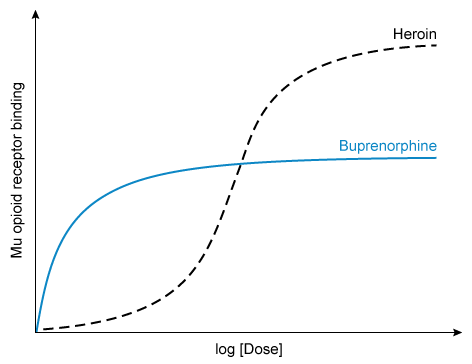 Which of the following clinical pharmacologic effects of buprenorphine is most likely?
 (Multiple Choice)
4.9/5 (79)
(79) A 27-year-old man comes to the emergency department with palpitations, sweating, and shortness of breath that began 10 minutes ago. He says, "Please help me, I don't want to die." He has experienced several similar episodes over the past 2 months, which occurred without warning in situations including open spaces or crowds and resolved gradually after 10 to 20 minutes. He has no history of serious illness and takes no medications. He drinks 2 bottles of beer daily. He appears anxious and has a flushed face. Physical examination, ECG, and laboratory evaluation are normal. The patient is diagnosed with panic disorder. After discussion of treatment options, he decides to pursue cognitive-behavioral therapy and start a short-term anxiolytic medication that also has muscle-relaxant and anticonvulsant properties. Which of the following best describes the mechanism of action of this medication?
(Multiple Choice)
4.8/5 (88)
(88) A 42-year-old woman visits the office complaining of nightly regurgitation and frequent episodes of burning in her chest. Hypertension is a medical history. Vital signs are in the normal range. 30 kg/m2 is the BMI. The rest of the physical examination is normal, and there is no abdominal pain. The woman displays an over-the-counter antacid that she has been using to treat her symptoms to the doctor which contains magnesium and aluminum hydroxide. Which of the following is the most likely rationale for combining both mineral salts in this antacid preparation?
(Multiple Choice)
4.8/5 (86)
(86) A 60-year-old man is brought to the emergency department by his wife because of swelling and facial pain over the past 3 days. His wife reports that he has a history of type 1 diabetes mellitus. His temperature is 38.8°C (101.8°F). He is confused and oriented only to person. Examination shows left periorbital swelling that is tender to palpation, mucopurulent nasal dischrage, and a black necrotic spot over the nose. The diagnosis of invasive mucormycosis is made, and surgical debridement is performed. He is started on an amphotericin B. Considering the adverse effects of this medication, which of the following should be routinely monitored in this patient?
(Multiple Choice)
4.9/5 (68)
(68) A pharmacist is trying to study a pharmacokinetic properties of a new discovered inhaled anesthetic. During one of the experiments, the anesthetic agent is administered at a constant partial pressure while arterial and venous concentrations are monitored. The study results show that the anesthetic has a very large arteriovenous concentration gradient shortly after beginning inhalation. Which of the following best describes the properties of the new anesthetic?
(Multiple Choice)
4.7/5 (88)
(88) A 48-year-old woman with a complicated medical history visits the clinic because her body habitus has changed. Her legs are "like sticks," she says, and her "belly is getting bigger." The patient is also becoming increasingly tired, but does not experience excessive daytime somnolence. She has been homeless for the majority of the last five years, but has been in a residential care facility for the past year. She is distractible and has an inappropriate affect on physical examination, but she is cooperative. Otherwise, the neurologic and mental status examination is normal. There is adipose tissue loss from the extremities and face, as well as an increase in abdominal girth. Which of the following types of medications is most likely to be responsible for this patient's symptoms?
(Multiple Choice)
4.8/5 (79)
(79) A 77-year-old man with type 2 diabetes mellitus is admitted to the hospital because of chest pain and dyspnea. Serum troponin levels are elevated and an ECG shows ST-segment depressions in the lateral leads. Percutaneous coronary angiography is performed and occlusion of the distal left anterior descending coronary artery is identified. Pharmacotherapy with eptifibatide is initiated and a drug-eluting stent is placed in the left anterior descending coronary artery. The mechanism by which eptifibatide acts is similar to the underlying pathophysiology of which of the following conditions?
(Multiple Choice)
4.9/5 (60)
(60) A 35-year-old women is brought to the hospital due to fever, chills and malaise. She has a history of reccurent urinary tract infection. The patient is febrile, tachycardic, and hypotensive. on exam, she has a costovertebral angle tenderness. urinalysis shows many white blood cell. An imaging reveales a nephrogenic abscess. The patient is prescribed an intravenous antibiotic administered every 12 hours. Calculation of the maintenance dose will most likely require which of the following parameters?
(Multiple Choice)
5.0/5 (83)
(83) 
Filters
- Essay(0)
- Multiple Choice(0)
- Short Answer(0)
- True False(0)
- Matching(0)