



 Chat with AI
Exam 11: Pharmacology and Toxicology

Exam 1: Anatomy265 Questions
Exam 2: Behavioral Sciences178 Questions
Exam 3: Biochemistry102 Questions
Exam 4: Embryology59 Questions
Exam 5: Epidemiology, Biostatistics, and Medical Informatics94 Questions
Exam 6: Genetics88 Questions
Exam 7: Histology46 Questions
Exam 8: Immunology147 Questions
Exam 9: Microbiology and Virology330 Questions
Exam 10: Pathology817 Questions
Exam 11: Pharmacology and Toxicology509 Questions
Exam 12: Physiology339 Questions
Exam 13: Psychiatry and Psychotherapy23 Questions
Select questions type


A brand-new class of aminoglycoside antibiotic with an elimination half-life of four hours is designed for intravenous administration. A clinical experiment compares two distinct dosage schedules: a lower dose administered three times per day and a greater dose administered once per day. In both regimens, the total daily dose per kilogram of body weight (mg/kg/day) is the same. The graph below shows the monitoring of serum medication levels in both groups: (extended interval) dosing, Green: multiple-daily dosing, MIC: minimum inhibitory concentration] ![A brand-new class of aminoglycoside antibiotic with an elimination half-life of four hours is designed for intravenous administration. A clinical experiment compares two distinct dosage schedules: a lower dose administered three times per day and a greater dose administered once per day. In both regimens, the total daily dose per kilogram of body weight (mg/kg/day) is the same. The graph below shows the monitoring of serum medication levels in both groups: (extended interval) dosing, Green: multiple-daily dosing, MIC: minimum inhibitory concentration] It is found that both regimens are effective against gram-negative pathogens, with clinical improvement occurring slightly earlier on average with once-daily dosing. Which of the following best explains the efficacy of once-daily dosing despite the short half-life of this antibiotic?](https://storage.examlex.com/MD0001/11ec160b_3bfa_b4ad_9249_dfd6e8e9f991_MD0001_00.jpg) It is found that both regimens are effective against gram-negative pathogens, with clinical improvement occurring slightly earlier on average with once-daily dosing. Which of the following best explains the efficacy of once-daily dosing despite the short half-life of this antibiotic?
It is found that both regimens are effective against gram-negative pathogens, with clinical improvement occurring slightly earlier on average with once-daily dosing. Which of the following best explains the efficacy of once-daily dosing despite the short half-life of this antibiotic? (Multiple Choice)
4.9/5  (100)
(100) A 44-year-old woman comes to the physician because of a 5-month history of lower extremity discomfort. When trying to fall asleep, she frequently experiences leg discomfort that is temporarily relieved by movement. Her husband tells her that she often flexes her ankles upward while she sleeps. She appears fatigued and anxious. Physical examination shows no abnormalities. Laboratory studies, including a complete blood count and iron studies, are within the reference range. Pharmacotherapy with which of the following mechanisms of action is most likely to relieve this patient's symptoms?
(Multiple Choice)
4.8/5 (86)
(86) A pharmacist is developing a new medication to treat a resistant psudomonaus infection. It has a volume of distribution of 11L. It is eliminated by first-order kinetics and has a half-life of 10 hours. If given by a continuous infusion, approximately how much time would it require for the drug to achieve a 95% plasma steady state concentration?
(Multiple Choice)
4.8/5 (80)
(80) A 30-year-old woman comes to the physician because of increasing fatigue, and irregular menstrual cycles for 4 months. The patient now has new-onset constipation, dry skin, and hair loss. She is also concerned about a weight gain of 2.27 kg (5 lb) over the last 3-4 months despite eating healthy, low-calorie foods She reports that she was prescribed a new medication by her psychiatrist 6 months ago but forgot its name. Her pulse is 51/min. Neurologic examination shows delayed relaxation of the deep tendon reflexes. Which of the following medications was most likely prescribed by the psychiatrist?
(Multiple Choice)
4.9/5 (71)
(71) A 60-year-old amn is being evaluated for occasional pain the chest which resolves with sublingual nirtoglycerin. He has a chronic stable angina and hypertesnion for which he takes multiple medications for his conditions.Blood pressure is 140/80 mm Hg and pulse is 68/min and regular. Examination reveals normal heart sounds. While discussing a plan to start isosorbide dinitrate therapy, the patient becomes concerned about the high dose of oral isosorbide dinitrate compared to sublingual nitroglycerin. Which of the following is the most likely reason for using a high dose of oral nitrate?
(Multiple Choice)
4.8/5 (87)
(87) A 44-year-old woman comes to the physician because she has not had her menses for 4 months. She has also had milky-white discharge from her nipples, frequent headaches, and blurry vision during the past 4 months. Menses had previously occurred at regular 30-day intervals and lasted for 4-5 days with moderate flow. She takes no medications. She has two children who are healthy and attend middle school. She is 163 cm (5 ft 4 in) tall and weighs 68 kg (145 lb); BMI is 26 kg/m2. Laboratory studies show an increased serum prolactin level, a normal TSH level, and an undetectable B-hCG concentration. MRI reveals a 6-mm pituitary adenoma. The patient refuses medical and surgical therapy as she is happy about not having menstrual periods. If left untreated, this patient is at greatest risk of developing which of the following?
(Multiple Choice)
4.9/5 (89)
(89) A 78-year-old man is discovered lifeless and sent to the medical room by ambulance. He has a complicated medical history and takes a number of drugs, but there are no known drug allergies, according to the family, who arrived first. Intracranial bleeding is discovered by non-contrast CT scanning of the head. The patient is given a recombinant biologic agent that has antigen homology with factor Xa but no catalytic effect. The agent is most likely to antagonize the effects of which of the following drugs?
(Multiple Choice)
5.0/5 (76)
(76) A 47-year-old man with known coronary artery disease arrives at the ER with chest pain, sweating, and palpitations. His symptoms started suddenly 2 hours ago while he was at work. The patient had right coronary artery percutaneous angioplasty six months ago. Anxiety and panic attacks are also part of the patient's medical history. The blood pressure is 180/90 mm Hg, and the pulse rate is 110 beats per minute with a regular rhythm. An esmolol infusion relieves symptoms quickly and slows the heart rate. with a regular rhythm. An esmolol infusion produces rapid symptom relief and heart rate slowing. Which of the following portions of the ECG will be affected most significantly by the medication? 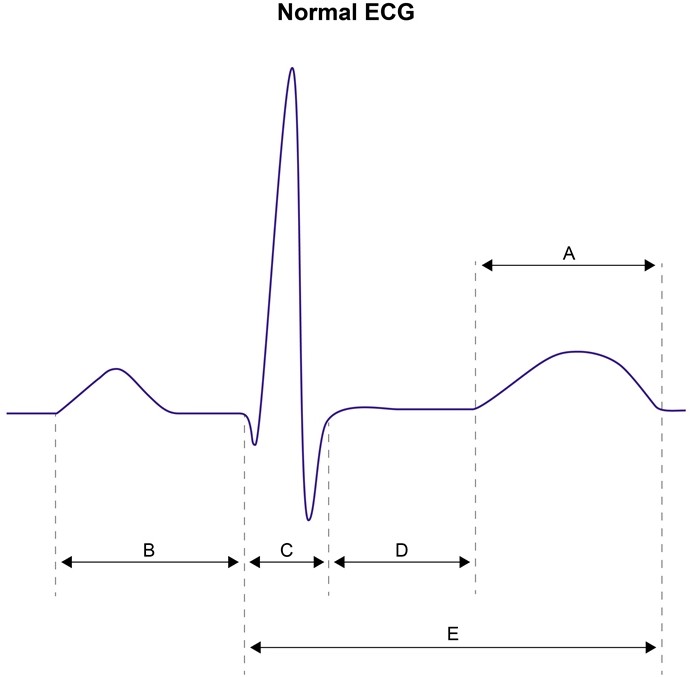
(Multiple Choice)
5.0/5 (96)
(96) A 72-year-old man comes to the physician because of involuntary shaking and gait abnormalities for the past year. He was diagnosed with Parkinson disease two years ago and has been treated with selegiline. He also reports depressed mood and diminished smell and taste. Examination shows a shuffling gait, resting tremor in the left hand, and rigidity in both arms You consider switching to levodopa to control this patient's symptoms adequately and discuss the adverse effect profile of levodopa with him. Which of the following adverse effects is most likely to persist after adding carbidopa to levodopa treatment?
(Multiple Choice)
4.8/5 (76)
(76) Two weeks after starting Ramipril , a 60-year-old woman with resistant hypertension and hyperlipidemia comes to the doctor because of decreased urination. She denies dysuria, fevers, or chills. Blood pressure is 133/67 mm Hg. Physical examination shows no abnormalities. Compared to measurements from one week ago, the glomerular filtration rate is markedly decreased and plasma renin activity is elevated. A duplex ultrasound of the kidneys shows increased systolic flow velocity in both renal arteries when compared to the aorta. Assuming the patient's baseline urinalysis is normal, a repeat urinalysis at this time would most likely reveal which of the following? 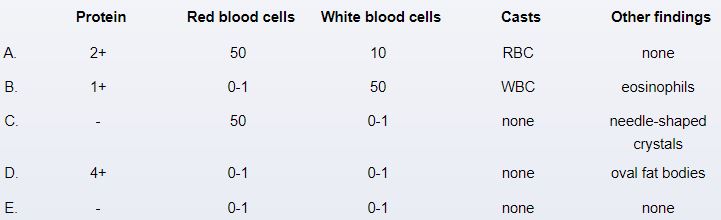
(Multiple Choice)
4.8/5 (78)
(78) A 55-year-old man is brought to the physician by his wife because of abnormal behavior. His wife reports he has been preoccupied with gambling at the local casino. He becomes restless and irritable when his wife attempts to restrict his gambling. Four months ago, he was diagnosed with Parkinson disease and treatment was initiated. His only other medical condition is major depressive disorder for which he takes sertraline. The patient does not use tobacco, alcohol, or illicit drugs. Vital signs are within normal limits. Physical examination shows a mild resting hand tremor and minimal rigidity. Which of the following is most likely responsible for this patient's recent change in behavior?
(Multiple Choice)
4.9/5 (94)
(94) A 27-year-old man visits the office to have a rash on both knees evaluated. The rash was first noticed by the patient two months ago. He has no other medical issues and does not take any medications. Every day, the patient smokes a half pack of cigarettes. Vital signs are typical. The image below shows his knee: 11ec160b 3ba6 a1a6 9249 23f25062731b MD0001 00 The removal of the scale causes minor bleeding points. A topical vitamin D analog is prescribed as part of the treatment regimen. This medication is most likely to improve this patient's condition via which of the following mechanisms?
(Multiple Choice)
4.9/5 (85)
(85) A 53-year-old man arrives at the office with uncontrolled type 2 diabetes. The patient was diagnosed with diabetes three years ago and started on metformin and lifestyle changes. His hemoglobin A1c level has been steadily rising over the last year. The reading is 145/90 mm Hg. The BMI is 37 kg/m22. Except for a fasting plasma glucose of 155 mg/dL and a hemoglobin A1c level of 8%, the laboratory results are normal. Additional treatment with canagliflozin is initiated. Over the next several days, which of the following changes are most likely to occur in this patient due to the new medication? 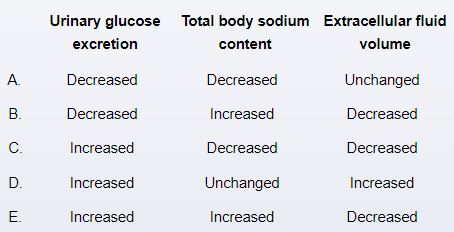
(Multiple Choice)
5.0/5 (93)
(93) An otherwise healthy 18-year-old girl is brought to the physician because she is very upset about the acne scarring, which involves her face, chest, and back. It has not improved with her current combination therapy of oral antibiotic and topical benzoyl peroxide. She is sexually active with one male partner, and they use condoms consistently. Physical examination shows nodulocystic acne with scarring on the face, chin, and upper back. The patient is interested in isotretinoin treatment. Which of the following is the best next step in management of this patient?
(Multiple Choice)
4.8/5 (73)
(73) A 50-year-old man experiences recurrent episodes of paroxysmal atrial fibrillation, which is accompanied by palpitations and chest pressure. The echocardiogram shows normal biventricular function and no evidence of valvular disease. Coronary angiography shows no evidence of obstructive coronary artery disease. To alleviate his symptoms, the patient is started on medication. He is seen in the emergency department two weeks later for lightheadedness, weakness, and presyncope. The ECG shows sinus bradycardia at a rate of 53 bpm, with QTc prolongation (508 msec). Telemetry monitoring. Which of the following medications was most likely used to treat this patient's palpitations?
(Multiple Choice)
4.8/5 (88)
(88) A 64-year-old man comes to the office due to worsening urinary symptoms over the past year that include hesitancy, straining during urination, poor urinary flow, and waking up once or twice a night to urinate. He feels the symptoms are bothersome but are not affecting his quality of life. The patient has no other medical conditions and does not use tobacco, alcohol, or illicit drugs. Blood pressure is 125/78 mm Hg and pulse is 70/min. Physical examination shows a mildly enlarged, smooth prostate but is otherwise unremarkable. Serum chemistry studies and urinalysis are normal. Prostate-specific antigen level is 3.5 ng/mL, The patient is started on a new medication. After 6 months of therapy, his urinary symptoms improve and prostate volume decreases by 20%. Which of the following medications is most likely responsible for the decreased prostate volume in this patient?
(Multiple Choice)
4.8/5 (97)
(97) A 40-year-old woman is brought to the emergency department for a 2-hour history of shortness of breath. She does not smoke or use drugs recreationally. Her temperature is 37.5°C (99.5 F) and respirations are 28/min. She appears anxious and is unable to speak in full sentences. Lung auscultation reveals bilateral wheezing. Prompt endotracheal intubation for respiratory support is planned. Prior to endotracheal intubation, intravenous ketamine is administered for induction of anesthesia. Which of the following characteristics is the most likely reason for use of this anesthetic agent in this patient?
(Multiple Choice)
4.9/5 (76)
(76) A 29-year-old woman is brought to the physician by her father because of a change in her behavior over the past 8 months. The father says that his daughter has become increasingly withdrawn; she has not answered any phone calls or visited her family and friends. The patient says that she has to stay at home because a foreign intelligence service is monitoring her. She thinks that they are using a magnetic field to read her mind. Mental status exam shows disjointed and perseverative thinking. She is anxious and has a flat affect. A medication with which of the following primary mechanisms of action is most appropriate for this patient's condition?
(Multiple Choice)
4.9/5 (87)
(87) A 60-year-old man is brought to the emergency department due to lower abdominal discomfort. In the ER he appears confused and disoriented. He didn't pass any urine for the past 24 hours. He has a medical history of benign prostatic hyperplasia, hypertension, hyperlipidemia, and type 2 diabetes mellitus complicated by neuropathy. He takes multiple medications but he does not know his current medications. A urinary catheter is placed and immediately drains 1000 mL of urine. Which of the following medications most likely has contributed to this patient's current condition?
(Multiple Choice)
5.0/5 (83)
(83) A 53-year-old woman is brought to the emergency department by her husband because of generalized tonic-clonic seizure. in the ER When she recovers, she tells the physician that she has difficulty sleeping and felt a chest palpitations before the episode. She has a history of insomnia and social anxiety disorder. She appears lethargic. Her temperature is 36.2°C (97.1°F), pulse is 88/min, respirations are 12/min, and blood pressure is 110/80 mm Hg. Neurologic examination shows normal pupils. There is diffuse hypotonia and decreased deep tendon reflexes. Withdrawal from which of the following medications is the most likely explanation for this patient's presentation?
(Multiple Choice)
4.7/5 (82)
(82) 
Filters
- Essay(0)
- Multiple Choice(0)
- Short Answer(0)
- True False(0)
- Matching(0)