



 Chat with AI
Exam 11: Pharmacology and Toxicology

Exam 1: Anatomy265 Questions
Exam 2: Behavioral Sciences178 Questions
Exam 3: Biochemistry102 Questions
Exam 4: Embryology59 Questions
Exam 5: Epidemiology, Biostatistics, and Medical Informatics94 Questions
Exam 6: Genetics88 Questions
Exam 7: Histology46 Questions
Exam 8: Immunology147 Questions
Exam 9: Microbiology and Virology330 Questions
Exam 10: Pathology817 Questions
Exam 11: Pharmacology and Toxicology509 Questions
Exam 12: Physiology339 Questions
Exam 13: Psychiatry and Psychotherapy23 Questions
Select questions type


A40-year-old man has been diagnosed with seizure 2 years ago, and an MRI of the brain revealed no structural lesions. She was started on phenytoin 4 since then. He is doing well with controlled seizure symptoms. On routine physical examination, you notice the findings shown in the photo below. 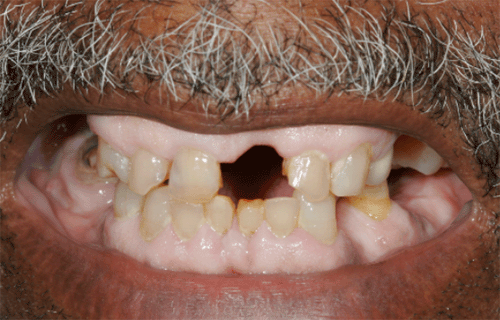 Which of the following is most likely responsible for the condition of this patient's teeth and gums?
 (Multiple Choice)
4.9/5  (84)
(84) A 4-year-old boy with acute lymphoblastic leukemia is admitted to the hospital to undergo allogeneic bone marrow transplantation. Two weeks after the conditioning regimen is started, he develops a temperature of 38.5°C (101.3°F). Laboratory studies show:
Hemoglobin 8 g/dL
Leukocyte count 1400/mm3
Segmented neutrophils 15%
Eosinophils 0.5%
Lymphocytes 84%
Monocytes 1%
Platelet count 110,000/mm3
Which of the following is the most appropriate pharmacotherapy for this patient?
(Multiple Choice)
4.9/5 (88)
(88) A 6-month-old boy is brought to the physician to establishe a health care after moving to a new city. Since birth, he has taken levothyroxine because he was diagnosed with congenital hypothyroidism. His mother states that he passes stools 3 to 4 times per week. He is exclusively breast fed and has not yet received any routine vaccinations. There is no family history of serious illness. He also takes daily vitamin D and iron supplements. . He is at the 40th percentile for length and the 60th percentile for weight. Thyroid function testing at age 4 months was normal. Results of routine follow-up laboratory testing are as follows:  Which of the following is the most likely mechanism for this patient's abnormal thyroid function tests?
 (Multiple Choice)
4.8/5 (81)
(81) A 6-year-old boy is brought to the physician by his father due progressive lethargy. He feels that he is out of the energy and he cannot play or do any outdoor activity due to fatigue and dyspnea. He has no prior medical conditions and takes no medications. During the auscultation, there is a holosystolic murmur at the lower sternal border. Echocardiography reveals apical displacement of the tricuspid valve leaflets, decreased right ventricular volume, and atrialization of the right ventricle. If this patient's diagnosis is due to a side effect of a drug taken during pregnancy, his biological mother most likely had which of the following conditions?
(Multiple Choice)
4.8/5 (81)
(81) A 65-year-old man with type 2 diabetes mellitus visits the office because his sexual performance has declined over the last six months. His libido, muscle strength, and energy level are normal, according to the patient, but his erections are inconsistent, weak, and of insufficient duration for sexual activity. Although he has a history of hypertension, he has no history of coronary artery disease and no suspicious chest pain. The results of bilateral ankle brachial index testing are within normal limits. The patient is given sildenafil, which significantly improves his sexual performance. The intracellular signaling of this drug is most similar to that of which of the following substances?
(Multiple Choice)
4.7/5 (72)
(72) A 35-year-old woman comes to the physician because of a progressive severe headaches, vomiting and nausea. The headaches are exacerbated by loud sounds or bright light. She has approximately two headaches per month with similar symptoms. Physical examination shows normal pupils and fundi, but the patient has discomfort to bright light. There is no facial droop, extremity weakness, or sensory loss. The patient is treated with metoclopramide and diphenhydramine. Which of the following is the most likely reason diphenhydramine was used in this patient?
(Multiple Choice)
4.9/5 (83)
(83) His daughter discovers a puzzled 60-year-old man at home. He is taken to the emergency room by ambulance after emergency medical services are contacted. The patient's daughter, who is with him, claims to have discovered an empty amitriptyline bottle next to his bed. He hasn't been using any more prescription drugs. The patient is delusional at the emergency room and claims to see little animals roaming about in the room's corner. He seemed to be flushed. After a short episode, the patient loses consciousness. Blood pressure is 90/62 mm Hg, the temperature is 37.2 C (99 F), and the pulse rate is 120. His skin and mucous membranes are dry, and his pupils are dilated and equally sensitive to light. Initial ECG shows QRS widening and QTc prolongation. He is transferred to the intensive care unit but dies despite resuscitation attempts. Which of the following pharmacological effects most likely contributed to the patient's death?
(Multiple Choice)
4.9/5 (81)
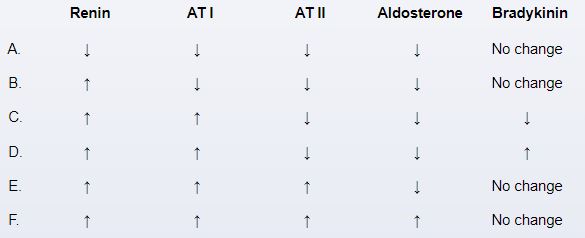
(81) An otherwise healthy 40-year-old woman comes to the physician for a follow-up visit for elevated blood pressure. Three months ago, her blood pressure was 160/80 mmHg. she reported episodic headaches due to migraines. Her blood pressure at that visit was 145/92 mm Hg. Antihypertensive therapy with a beta blocker was started due to its beneficial effect on migraine prophylaxis. On today's visit, her blood pressure is 122/80 mmHg. Physical examination shows no abnormalities. Laboratory studies, including thyroid function studies, serum electrolytes, and serum creatinine, are within normal limits. Which of the following is the most likely combination of changes in response to this patient's treatment (AT = Angiotensin)?
(Multiple Choice)
4.9/5 (79)
(79) A 50-year-old man comes to the office for regular follow up after recent diagnosis of hypercholesterolemia. He has history of hypertension and diabetes mellitus and takes his medications regularly. His serum creatinine was 1.1 mg/dL and potassium level was 4.7 mEq/L. on today's visit lab testes show an increase in the serum level of creatinine and potassium. Administration of which of the following drugs is most likely responsible for the change in this patient's renal function?
(Multiple Choice)
4.9/5 (73)
(73) A 26-year-old woman comes to the physician requesting advice regarding contraception. She previously used condoms but stopped using them a few weeks ago after a condom broke during intercourse. Today, she is interested in other contraceptive options and has asked for a "more reliable and uncomplicated contraceptive method." She was diagnosed with deep vein thrombosis 2 years ago. Her menses occur at regular 30-day intervals with normal flow. Medical history is otherwise unremarkable and she takes no medications. She does not smoke cigarettes. She is sexually active with one male partner and uses condoms inconsistently. Vital signs are within normal limits. Pelvic examination shows no abnormalities. A urine pregnancy test is negative. Which of the following is the most appropriate recommendation regarding contraception for this patient?
(Multiple Choice)
4.8/5 (85)
(85) A 20-year-old man is brought to the emergency department by his mother 20 minutes after being discovered unconscious at home. On arrival, he is unresponsive to painful stimuli. His pulse is 65/min, respirations are 8/min, and blood pressure is 110/70 mm Hg. Pulse oximetry shows an oxygen saturation of 75%. There was an empty bottle of hydrocodone-acetaminophen next to him, but she does not know how many pills were in it. A1 dose of intravenous naloxone is administered, and his vital signs, including respirations, are improved. One hour later, he has worsening lethargy, bradypnea, and miosis. Which of the following most likely accounts for this patient's current clinical deterioration?
(Multiple Choice)
4.8/5 (97)
(97) A 45-year-old woman comes to the office due to a depressed mood, disrupted concentration, increase in sleep and appetite, and energy loss. The previous symptoms are affecting her performance in her job as a programmer. She has been experiencing these symptoms for the last 6 months. She has received 3 multiple medications that did not work with her. The patient refused electroconvulsive therapy (ECT) and asks for medication instead. Phenelzine is now considered for the patient. Which of the following symptoms would indicate that the patient would respond to this medication?
(Multiple Choice)
4.8/5 (95)
(95) A 55-year-old man arrives at the emergency room complaining of progressive weakness and lethargy. The patient claims that he has been excessively thirsty and waking up several times at night to urinate for the past three months. Despite no change in appetite, he has also lost 5 kg (11 lb) during this time. The patient hasn't seen a doctor in a long time. His mother and father have a family history of type 2 diabetes mellitus. The blood pressure is 108/60 mm Hg, and the pulse rate is 98 beats per minute. The BMI is 38 kg/m22. A physical examination reveals dry mucous membranes and a lack of skin turgor. A blood glucose concentration of 600 mg/dL is revealed by laboratory testing. Serum beta-hydroxybutyrate levels are normal, and hemoglobin A1c is 14%. The next day, his symptoms significantly improve, and the blood glucose levels normalize. In preparation for discharge, his insulin infusion is changed to a subcutaneous regimen that closely mimics the physiologic pattern of insulin release. This patient's insulin therapy was most likely transitioned to which of the following regimens?
(Multiple Choice)
4.8/5 (71)
(71) A 57-year-old woman with non-small cell lung cancer comes to the physician 4 weeks after her tumor was resected. She takes no medications. The physician starts her on a treatment regimen that includes vinblastine. This treatment puts the patient at highest risk for which of the following?
(Multiple Choice)
4.9/5 (89)
(89) Healthy adult volunteers are enrolled in a phase I clinical trial investigating the properties of a newly developed oral antimicrobial agent. The drug is administered in different amounts to the volunteers over the course of several weeks to determine the best dosage that minimizes toxicity while maintaining trough levels above the minimum inhibitory concentration. While reviewing the data, the researchers note that the drug's half-life seems to vary amongst the study participants. An increase in which of the following pharmacologic parameters is most likely responsible for the longer half-life seen in certain individuals?
(Multiple Choice)
4.7/5 (71)
(71) A 25-year-old man comes for a follow-up examination 6 weeks after beginning sertraline therapy for major depressive disorder. He takes the medication as prescribed but his mood has barely improved. The patient appears anxious and reports that he still feels sad and hopeless most of the time. He denies suicidal ideation. He is more tired than usual and often feels drowsy during the day. The patient has difficulty concentrating at work and has missed two important deadlines; he worries that he might soon lose his job. Which of the following is the most likely explanation for this patient's lack of response?
(Multiple Choice)
4.8/5 (86)
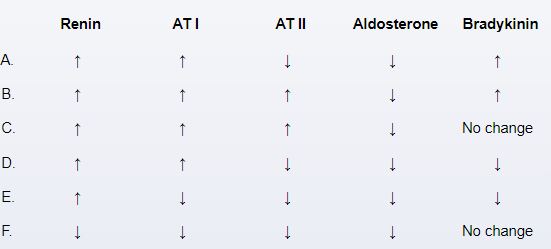
(86) A 50-year-old man comes to the office for medical health follow up. He is diagnosed with essential hypertension and a ramipril is prescribed for that. He has no other medical conditions. Physical examination shows unremarkable findings. Vital sings are normal and blood pressure is 123/75. Which of the following is the most likely combination of changes in response to this patient's treatment (AT = angiotensin)?
(Multiple Choice)
4.7/5 (86)
(86) A 20-year-old male comes to the physician because of a 1-week-history of a painless ulceration on his penis. The patient is sexually active with multiple partners and does not use barrier protection. He underwent testing for sexually transmitted infections and was found to have a positive VDRL and fluorescent treponemal antibody absorption test. The patient received an intramuscular injection of benzathine penicillin G. Several hours later, he comes to the hopsital due to fever, chills, headache, and myalgias. Which of the following is the most likely cause of this patient's current symptoms?
(Multiple Choice)
4.8/5 (74)
(74) A 28-year-old man is hospitalized for fever, headache, and confusion. He does not use tobacco or illicit drugs and is monogamous with his wife. The patient's cerebrospinal fluid analysis reveals lymphocytic pleocytosis, and a PCR is positive for herpesvirus. The patient is treated with intravenous high-dose acyclovir. Fever and mental status gradually improve, but on the third day of hospitalization the patient's serum creatinine level increases to 3.4 mg/dL from a baseline of 0.9 mg/dL at admission. The observed finding could have been prevented by which of the following?
(Multiple Choice)
4.9/5 (73)
(73) A researcher is deveolping a new medication to treat a severe kidney infection, which is desired to be non-renal clearance to decrease the side effect on the kidenys at the same time to be metabolised and cleared in the liver hepatic metabolism. Which of the following characteristics should the antibiotic also have if hepatic metabolism and clearance is desired?
(Multiple Choice)
4.9/5 (83)
(83) 
Filters
- Essay(0)
- Multiple Choice(0)
- Short Answer(0)
- True False(0)
- Matching(0)