



 Chat with AI
Exam 11: Pharmacology and Toxicology

Exam 1: Anatomy265 Questions
Exam 2: Behavioral Sciences178 Questions
Exam 3: Biochemistry102 Questions
Exam 4: Embryology59 Questions
Exam 5: Epidemiology, Biostatistics, and Medical Informatics94 Questions
Exam 6: Genetics88 Questions
Exam 7: Histology46 Questions
Exam 8: Immunology147 Questions
Exam 9: Microbiology and Virology330 Questions
Exam 10: Pathology817 Questions
Exam 11: Pharmacology and Toxicology509 Questions
Exam 12: Physiology339 Questions
Exam 13: Psychiatry and Psychotherapy23 Questions
Select questions type


A 60-year-old man cis brought to the hospital 40 minutes after a sudden loss of vision in his right eye and numbness of his left arm. He was eating dinner with his wife when he abruptly dropped his knife and felt what he describes as "like a curtain falling over my right eye." These symptoms resolved spontaneously 15 minutes later and he says that he feels well now. Medical history is significant for hypertension and a 30-pack-year smoking history. Temperature is 36.9 C (98.4 F), blood pressure is 140/84 mm Hg, pulse is 82/min and regular, and respirations are 14/min. Physical examination shows no extremity weakness or sensory loss. There is a right carotid bruit; the remainder of the examination shows no abnormalities. Noncontrast CT scan of the head is normal. Which of the following pharmacotherapies is most appropriate in management of this patient?
(Multiple Choice)
4.9/5  (86)
(86) A 77-year-old man arrives at the office after being discovered to have high blood pressure at a health fair. The patient denies having any medical issues and is pleased that he hasn't needed to see a doctor in many years. His blood pressure is 170/70 mm Hg, and his pulse rate is 74 bpm. The rest of the physical examination findings are normal. To treat his hypertension, the patient is started on medication. He reports bilateral leg swelling at his three-week follow-up visit. He is not experiencing any chest pain, shortness of breath, or abdominal discomfort. His blood pressure is 135/65 mm Hg, and his pulse rate is 80 bpm. Although the cardiopulmonary exam is normal, there is bilateral, symmetrical, 2+ pitting lower extremity edema. Laboratory studies show serum creatinine of 0.8 mg/dL, and urinalysis is negative for proteinuria. Which of the following was most likely prescribed to treat this patient's hypertension?
(Multiple Choice)
4.9/5 (71)
(71) A 55-year-old woman is brought to the emergency department for a severe, abrupt-onset headache, light-sensitivity, and confusion that began 30 minutes ago. Neurological examination shows no meningeal signs or focal neurological deficits. A CT scan of the head shows hyperdensity between the arachnoid mater and the pia mater. The patient is admitted to the critical care unit for further management. On the fourth day after admission, he experiences new-onset weakness in the right arm and leg. Which of the following medications could have most likely prevented the neurological complications this patient developed in the hospital?
(Multiple Choice)
4.7/5 (80)
(80) A 40-year-old woman with a history of depression and hypertension is taken to the emergency room after being discovered obtunded in her apartment. On physical examination, she is hypotensive and bradycardic. Her condition improves after receiving intravenous glucagon. Which of the following intracellular changes is most likely responsible for the improvement in her condition?
(Multiple Choice)
4.8/5 (56)
(56) A 45-year-old man is brought to the emergency department due to altered mental status. His wife found him lying on the couch with difficult to arouse and anxious. His temprature is 39.5 C , pulse is 105/min, respirations are 20/min. He has a dry oral mucosal membrane with flushed skin. The pupils are dilated and poorly responsive to light. He has been diagnosed with depression and takes medications regularly, his wife thinks he might that he ingested a high dose of his medications. Which of the following drugs, if taken in overdose, would most likely cause this clinical presentation?
(Multiple Choice)
4.8/5 (79)
(79) A researcher is working to develop a newly developed synthetic opioid that has twice the analgesic capability of morphine. After oral ingestion of a fixed dose by several volunteers, the plasma concentration of the drug is measured and determined to be subtherapeutic. Rectal administration of the same dose of the drug shows a plasma concentration well within the therapeutic range, almost double the level measured after oral intake. Which of the following best accounts for the observed difference in drug concentration following rectal administration when compared to oral administration?
(Multiple Choice)
4.8/5 (71)
(71) A 34-year-old man comes to the office with his girlfriend for a type 1 diabetes mellitus check-up. He was diagnosed with diabetes 15 years ago and is currently on a combination of basal and rapid-acting insulin injections. The patient has had intermittent episodes of hypoglycemia, with blood glucose levels ranging from 35 to 54 mg/dL. He was taken to the emergency room two weeks ago after passing out due to low glucose levels. When hypoglycemia is associated with impaired consciousness, the patient is prescribed an injectable medication to be administered at home by a caregiver. This medication rapidly improves hypoglycemia by which of the following mechanisms?
(Multiple Choice)
4.8/5 (82)
(82) A previously healthy 25-year-old man arrives at the office with penile lesions. The patient first noticed a nontender papule on his penis a month ago, and it has grown in size and number since then. He claims he has no fever, dysuria, or penile discharge. The patient has multiple sexual partners and uses condoms inconsistently. Three soft, flesh-colored papillary lesions measuring 1 cm on the dorsum of the penis are discovered during a physical examination. The inguinal lymph nodes are not enlarged, and the rest of the exam is normal. Treatment is started with a topical agent that acts as a toll-like receptor agonist to increase antiviral cytokine production. Which of the following medications was most likely prescribed to this patient?
(Multiple Choice)
4.8/5 (86)
(86) A 69-year-old man comes to the physician because of a history of difficulty initiating urination. The patient also reports worsening urinary symptoms over the past year that include hesitancy, straining during urination, poor urinary flow, and waking up once or twice a night to urinate. Digital rectal examination shows a symmetrically enlarged, nontender prostate with a rubbery consistency. Laboratory studies show a prostate-specific antigen level of 2.1 ng/mL (N < 4). Blood pressure is 142/88 mm Hg and pulse is 70/min. Serum chemistry studies and urinalysis are normal. Which of the following medications would be most effective for treating both of this patient's medical issues?
(Multiple Choice)
4.9/5 (73)
(73) A 67-year-old woman comes to the office suffering from polymyalgia rheumatica. She was diagnosed a year ago and has had to take prednisone at supraphysiologic doses to control her symptoms. The patient has no other medical conditions. She gets enough calcium and vitamin D through her diet and supplements. The patient does not use tobacco or alcohol. The physical examination is unremarkable. Serum creatinine, 25-hydroxyvitamin D, and calcium levels are normal, according to laboratory results. When compared to her bone density at age 65, her bone density as measured by dual x-ray absorptiometry (DX A) shows a significant decline. Which of the following is most likely contributing to this patient's bone loss?
(Multiple Choice)
4.9/5 (82)
(82) A 70-year-old woman is brought to the emergency department due to persistent fever and increase confusion. The patient has a history of Alzheimer dementia and lives in a nursing home. Temperature is 38.4 C (101.1 F), blood pressure is 104/74 mm Hg, pulse is 110/min, and respirations are 18/min. Suprapubic tenderness is present on physical examination. Urinalysis shows numerous bacteria and leukocytes, and urine culture grows Pseudomonas aeruginosa. Further analysis reveals that the isolated organism produces an enzyme that is located on the cytoplasmic surface of the cell membrane and that catalyzes the transfer of acetyl groups to exogenous substances. The bacteria are most likely resistant to which of the following antibiotics?
(Multiple Choice)
4.8/5 (74)
(74) A 30-year-old women is brought to the emergency department due to multiple episodes of vomiting with lower abdominal pain. She also reports that she hasn't have menstrual cycle for 7 weeks . A urine pregnancy test is positive. The patient has idiopathic pulmonary hypertension complicated by Eisenmenger syndrome. She is aware that pregnancy poses a major mortality risk to herself and the fetus due to the hemodynamic changes of gestation, labor, and delivery. The patient consents to pregnancy termination with a mifepristone and misoprostol regimen. Which of the following is the mechanism of action for mifepristone in this clinical situation?
(Multiple Choice)
4.7/5 (69)
(69) A 50-year-old man comes to the physician for his annual health maintenance examination. The patient feels well. He has a history of hypertension, for which he currently takes lisinopril. He has smoked a pack of cigarettes daily for 20 years. He drinks five to six beers on weekends. He is 181 cm tall (5 ft 11 in) and weighs 80 kg (176 lb); BMI is 25 kg/m2. His pulse is 75/min, respirations are 18/min, and blood pressure is 140/85 mm Hg. Physical examination is unremarkable. Laboratory studies show: current LDL level of 190 mg/dL. Which of the following should be obtained before starting statin therapy in this patient?
(Multiple Choice)
4.9/5 (79)
(79) Three weeks after starting a new medication for hyperlipidemia, a 54-year-old man comes to the physician because of pain and swelling in his left great toe. Examination shows swelling and erythema over the metatarsophalangeal joint of the toe. Analysis of fluid from the affected joint shows needle-shaped, negatively-birefringent crystals. Which of the following best describes the mechanism of action of the drug he is taking?
(Multiple Choice)
4.9/5 (84)
(84) A 43-year-old woman visits the clinic because she has occasionally experienced chest pain during the previous 12 months. She describes the discomfort as a 10-15 minute-long midline pressure or squeezing sensation that occasionally includes perspiration. The patient smokes but has no history of diabetes or high blood pressure. During a nighttime chest pain episode, ambulatory ECG monitoring detects transient ST-segment increases in the anteroseptal leads. Despite the absence of atherosclerotic stenosis on coronary angiography, acetylcholine injection causes identical chest discomfort and ECG abnormalities. Which of the following best explains the coronary intervention findings in this patient?
(Multiple Choice)
4.9/5 (83)
(83) A 50 year-old woman is brought to the emergency department due to a sudden back pain after lefting a heavy box. She has no weakness in the lower extremities. during evaluation, she reports an irregular menses and episodes of hot flashes. she has a history of hypothyroidsim and takes levothyroxin. She recently has been diagnosed with rheumatoid arthritis so methotrexate accompined with predinslone are prescribed. The patient does not use tobacco, alcohol, or illicit drugs, and she consumes a balanced diet. Physical examination shows point tenderness over the midthoracic spine. The straight-leg raising test is negative, and neurologic examination of the lower extremities shows no abnormalities. Spine imaging is shown below: 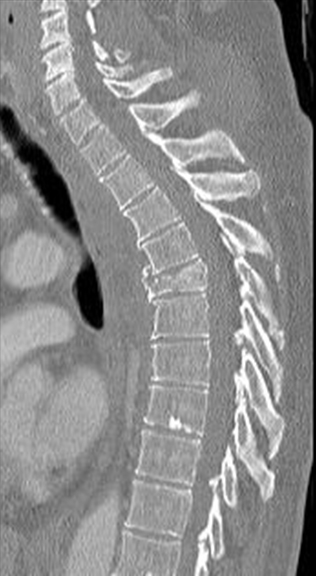 Which of the following contributed most to this patient's current condition?
 (Multiple Choice)
4.9/5 (91)
(91) A 60-year-old man arrives at the emergency department complaining of dizziness and palpitations. This morning, he awoke with a pounding sensation in his chest. The patient had previously experienced a similar sensation but did not consider it serious. He later became lightheaded while mowing the lawn and had to sit down to avoid passing out. Following a thorough examination, the patient is diagnosed with a cardiac arrhythmia and begins treatment with a medication known to prolong the QT interval. However, compared to other QT-prolonging agents, the drug is associated with a lower incidence of torsade de pointes. Which of the following medications was most likely used in this patient?
(Multiple Choice)
5.0/5 (81)
(81) A 35-year-old woman that is currently being treated for chronic hepatitis C comes to the physician because of progressive fatigue for 10 days. Previous attempts to treat her hepatitis C infection have been unsuccessful. Examination shows pale conjunctivae. Her hemoglobin concentration is 10.1 g/dL, serum total bilirubin concentration is 1.9 mg/dL, and LDH is 259 U/L. A Coombs test is negative. Assuming her current condition is an adverse drug effect, which of the following mechanisms most likely contributes to the pharmacologic efficiency of this drug?
(Multiple Choice)
4.9/5 (78)
(78) A 57-year-old man is brought to the emergency department due to lethargy and altered mental status. His family suspects a suicide attempt. He takes medications for anxiety, depression, and chronic lower back pain. On arrival, the patient is somnolent and difficult to arouse. Temperature is 36.7 C (98 F), blood pressure is 100/60 mm Hg, pulse is 75/min, and respirations are 16/min. Physical examination is unremarkable. Which of the following drugs is most likely to reverse this patient's symptoms?
(Multiple Choice)
4.9/5 (84)
(84) A 72-year-old man arrives at the office due to constipation. His stools have been harder, smaller, and more challenging to pass. Bloating has been linked to this, but not vomiting. Despite fiber supplements, polyethylene glycol, and bisacodyl, symptoms have not subsided. The patient received palliative chemotherapy two months ago after being recently diagnosed with metastatic pancreatic cancer. His malignancy produces excruciating stomach discomfort that requires to be treated with high-dose oxycodone. Vital indicators are in the expected range. The abdomen is mildly distended with decreased bowel sounds. Which of the following medications acts as a mu-opioid receptor antagonist that could alleviate this patient's constipation without inducing withdrawal symptoms?
(Multiple Choice)
4.8/5 (101)
(101) 
Filters
- Essay(0)
- Multiple Choice(0)
- Short Answer(0)
- True False(0)
- Matching(0)