



 Chat with AI
Exam 11: Pharmacology and Toxicology

Exam 1: Anatomy265 Questions
Exam 2: Behavioral Sciences178 Questions
Exam 3: Biochemistry102 Questions
Exam 4: Embryology59 Questions
Exam 5: Epidemiology, Biostatistics, and Medical Informatics94 Questions
Exam 6: Genetics88 Questions
Exam 7: Histology46 Questions
Exam 8: Immunology147 Questions
Exam 9: Microbiology and Virology330 Questions
Exam 10: Pathology817 Questions
Exam 11: Pharmacology and Toxicology509 Questions
Exam 12: Physiology339 Questions
Exam 13: Psychiatry and Psychotherapy23 Questions
Select questions type


An episode of nausea and episodic abdominal pain that has been present for several months, especially after a fatty meal, brings a 52-year-old postmenopausal woman to the physician's office for evaluation. She does not use tobacco, alcohol, or illegal substances, and she has no history of diseases. 33 kg/m2 is her BMI. Upon physical examination, the abdomen is soft and non-tender, and the bowel sounds normally. It has an 8 centimeter liver span. Murphy's sign is negative. While an abdominal ultrasound reveals a small, non-obstructing gallstone, an abdominal x-ray shows no calcifications. The patient prefers nonoperative management. Which of the following would best treat this patient's condition?
(Multiple Choice)
4.9/5  (82)
(82) A 9-year-old boy is brought to the physician for recurrent 3-4 minutes episodes of sudden, brief jerking movements involving both arms. He is nonresponsive during these episodes and does not remember them afterward. The patient has never lost consciousness and has no known medical conditions. Family history includes a seizure disorder in his uncle. One week ago, his brother witnessed an episode where he woke up, stared, and made hand gestures. After the incident, he felt lethargic and confused. Examination shows no abnormalities. Which of the following is the best initial treatment for this patient?
(Multiple Choice)
4.8/5 (77)
(77) A 52-year-old woman with hypertension and a history of peptic ulcer disease comes to the physician because of a 1-day history of severe pain and swelling of her right great toe. She has had similar episodes sporadically over the past 3 years. She drinks 6 beers daily. She does not smoke or use illicit drugs. She is allergic to hydrochlorothiazide and glipizide. Her current medications are amlodipine and metformin. Examination shows erythema, warmth, and tenderness of the right first metatarsophalangeal joint and a nodule over the right elbow. The most appropriate next step in treatment is the administration of a drug that has which of the following mechanisms of action?
(Multiple Choice)
4.9/5 (62)
(62) A 46-year-old man visits the office for a check-up on his mixed hyperlipidemia. His lipid levels have worsened over the last ten years as a result of gradual weight gain. The patient has tried to change his diet and exercise routine over the last six months, but his lipid levels have not improved. His medical history is unremarkable, and he is not currently on any medications. The patient does not smoke, drink alcohol, or use illegal drugs. The blood pressure is 130/86 mm Hg, the pulse rate is 76/min, and the BMI is 28 kg/m2. Cardiovascular testing is normal. Which of the following drugs, when used as monotherapy, would be most likely to increase triglyceride levels in this patient?
(Multiple Choice)
4.8/5 (80)
(80) A 24-year-old woman comes to the physician to establish care after moving to a new city. She reports that she has a history of epilepsy. She takes valproate regularly. She planning to conceive next month but her physician inform her about the teratogenic of the medication. The patient takes no other medications and does not use tobacco, alcohol, or illicit drugs. Blood pressure is 120/80 mm Hg. Physical examination is normal. If the patient conceives now, her fetus is at increased risk for which of the following anomalies?
(Multiple Choice)
4.9/5 (78)
(78) A 20-year-old woman comes to the physician because of a 2-day history of dysuria, increased urinary frequency, and urgency. The patient has no fever, flank pain, nausea, or vomiting. She has no chronic medical conditions and no known drug allergie. She is sexually active with her new boyfriend, and they use condoms inconsistently. Her temperature is 37.2°C (99.0°F). Examination shows suprapubic tenderness to palpation. Pelvic examination shows normal-appearing external genitalia. Which of the following is the most appropriate pharmacotherapy for this patient?
(Multiple Choice)
4.8/5 (70)
(70) A 70-year-old man with chronic myopia comes to the physician because of a 4-month history of difficulty seeing distant objects, especially at night, despite wearing glasses. Vision testing shows moderate loss of peripheral vision in both eyes. Results of the funduscopic examination are shown in the image below. 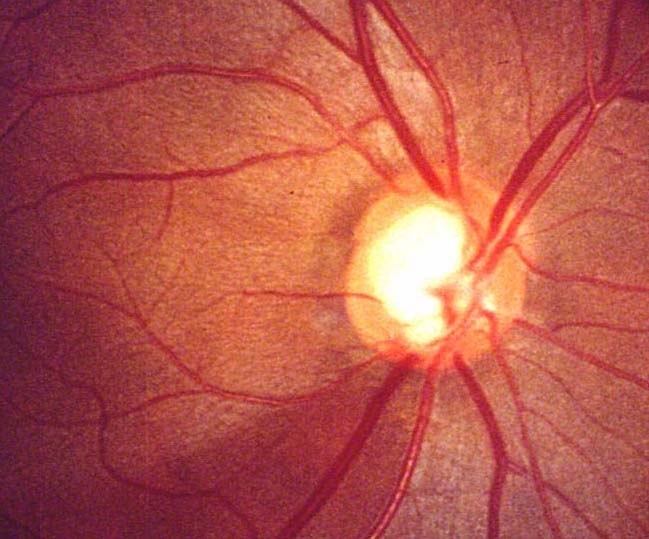 Other neurologic and cardiopulmonary examination findings are unremarkable. He is started on latanoprost eyedrops. The medication is most likely to improve this patient's condition through which of the following mechanisms?
 (Multiple Choice)
4.9/5 (88)
(88) A 65-year-old man is taken to the emergency department after experiencing central chest pain for the past two hours. The pain is described as "very severe" and "going all the way back to my spine" by the patient. He has never experienced such agony. For hypertension, the patient's medical history is important; the patient has been noncompliant with prescribed medical therapy and follow-up visits. He has a smoking history of 20 packs per year. The blood pressure is 195/101 mm Hg, and the pulse rate is 93 beats per minute. A chest examination reveals that the lungs are clear. The electrocardiogram demonstrates sinus rhythm and voltage criteria for left ventricular hypertrophy. A portable x-ray of the chest reveals a widened mediastinum. The patient is given intravenous esmolol right away. Which of the following is the most likely purpose of this patient's current therapy?
(Multiple Choice)
4.9/5 (93)
(93) A 50-year-old man is brought to the emergency room complaining of severe dizziness and confusion. He claims to have experienced chest pain and took several nitroglycerin tablets. His current medications include a daily aspirin for heart attack prevention, acetaminophen for headaches, and tadalafil for erectile dysfunction on occasion. He has a blood pressure of 50/20 mmHg and a heart rate of 120 beats per minute. Which of the following cellular changes is most likely responsible for this patient's symptoms?
(Multiple Choice)
4.7/5 (79)
(79) A 42-year-old woman with Graves disease is admitted to the hospital for an elective total thyroidectomy. Methimazole and propranolol have helped her hyperthyroid symptoms, but she still has a goiter. There are no other medical issues with the patient. She has a total thyroidectomy with no immediate complications and feels fine the next day. Laboratory results are as follows: 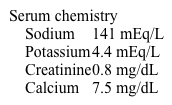 Preoperative electrolyte values were within normal limits. Which of the following medications should be started in this patient?
 (Multiple Choice)
4.9/5 (78)
(78) Three days after starting a new drug for malaria prophylaxis, a 19-year-old college student comes to the physician because of dark-colored urine and fatigue. He has not had any fever, dysuria, or abdominal pain. He has no history of serious illness. Physical examination shows scleral icterus. Laboratory studies show a hemoglobin of 9.7 g/dL and serum lactate dehydrogenase of 284 U/L. Peripheral blood smear shows poikilocytes with bite-shaped irregularities. Which of the following drugs has the patient most likely been taking?
(Multiple Choice)
4.8/5 (78)
(78) A 19-year-old man comes to the physician because of a 2-day history of burning pain during urination with purulent penile discharge . He has been sexually active with different female partners and did not use condoms. He has not had any fever, chills, or pelvic pain. Physical examination shows thick, purulent discharge from the urethra. Urine dipstick shows leukocyte esterase, urinalysis shows 10 WBCs/hpf, and Urine nucleic acid amplification test results are pending, and urethral Gram stain is shown in the exhibit. 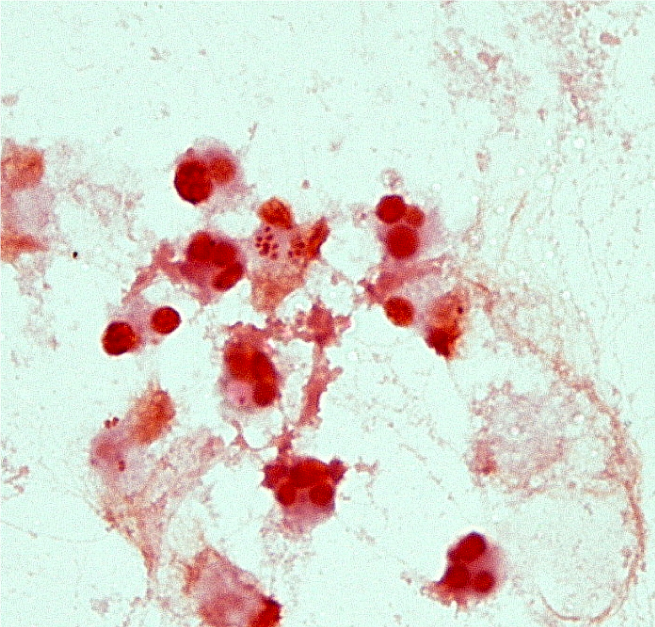 Appropriate treatment of this patient's condition involves antibiotics from which of the following drug classes?
 (Multiple Choice)
4.9/5 (81)
(81) A novel vancomycin-like glycopeptide antibiotic is being developed by researchers. The novel medication is bactericidal against gram-positive pathogens at serum concentrations higher than 15 g/mL, according to susceptibility tests. To reach the desired serum trough concentration of 15-20 g/mL, two distinct dose regimens are established. One is supplied as 1 gram every 6 hours, and the other as 2 grams every 12 hours. In an early-stage clinical study, the two regimens are evaluated on healthy volunteers, and the following pharmacokinetic characteristics are discovered. 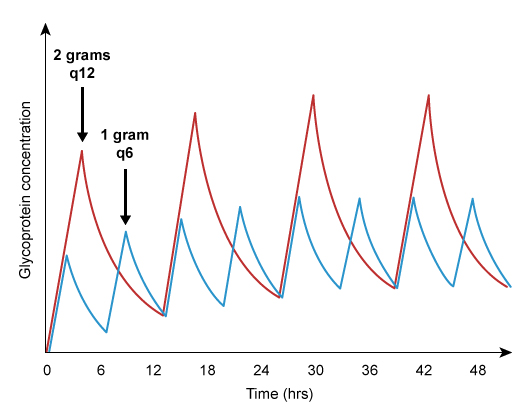 Compared to the 12-hour dosing regimen, the 6-hour regimen is most likely to exhibit which of the following features?
 (Multiple Choice)
4.9/5 (86)
(86) A 58-year-old man is brought to the physician by his wife because of a 10-day history of progressively worsening diarrhea and bloating. He has been having 8-10 episodes of loose, watery stools each day, including during the night. He does not have nausea, vomiting, or blood in his stool. He has a history of metastatic colon cancer and started chemotherapy 2 weeks ago. He also has Wolff-Parkinson-White syndrome, for which he takes procainamide. He smoked one pack of cigarettes daily for 25 years and drank 2-3 beers daily but quit both last year when his grandson was born. His temperature is 37.3°C (99.1°F), pulse is 114/min, respirations are 22/min, and blood pressure is 105/68 mm Hg. Physical examination shows pale skin with a decreased turgor; capillary refill time is 2 seconds. His abdomen is distended and tender on palpation; bowel sounds are hyperactive. Laboratory studies show:
Hematocrit 55%
Leukocyte count 18,000/mm3
Serum
Na+ 149 mEq/L
K+ 3.3 mEq/L
Cl- 117 mEq/L
Magnesium 1.8 mg/dL
HCO3- 20 mEq/L
Glucose 78 mg/dL
Creatinine 1.0 mg/dL
Blood and stool cultures are negative. A test for Clostridioides difficile toxins is negative. In addition to oral rehydration, which of the following is the most appropriate initial step in management?
(Multiple Choice)
5.0/5 (80)
(80) A 45-year-old man comes to the emergency department because of a 1-day history of black, tarry stools. He has also had upper abdominal pain that occurs immediately after eating. Three weeks ago, he developed lower back pain with stiffness and was started on naproxen and cyclobenzaprine. He has no prior medical conditions. He has an allergy to penicillin that causes a rash and pruritus. Upper gastrointestinal endoscopy reveals gastric mucosal erythema and erosions. Which of the following best explains this patient's current symptoms?
(Multiple Choice)
4.9/5 (69)
(69) A 23-year-old asian female is brought to the ER after having a progressive jerky body movement. She has a history of seizures and takes phenytoin. She does not use tobacco, alcohol or illicit drugs. A new medication recently is prescribed after evaluation of pre-employment skin test result.An imaging shows no abnormalities. On physical examination, no focal abnormalities are noted. Blood tests reveal her plasma phenytoin level to be low. She states that she has been compliant with her medication. Which of the following drugs may be responsible for this patient's condition if co-administered with phenytoin?
(Multiple Choice)
4.8/5 (77)
(77) Researchers looked at how various muscarinic agonists and antagonists affected the bladder's musculature. The curves shown below were created after various chemicals were applied. The impact of bethanechol, a pure cholinergic agonist, is shown by Curve A. 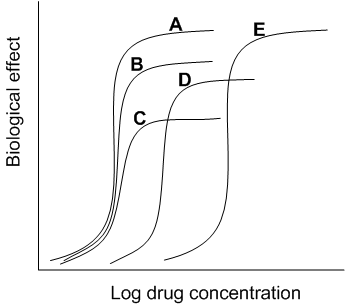 Which of the curves most likely represents the effect of bethanechol after application of a reversible competitive antagonist?
 (Multiple Choice)
4.9/5 (97)
(97) A 55-year-old woman comes to the physician because of progressively worsening coordination and involuntary movements in her left hand for the past 6 months. She is oriented to time, place, and person. Examination shows a bimanual, rhythmic, low-frequency tremor that is more prominent in the left hand. There is normal range of motion in the arms and legs; active movements are very slow. Muscle strength is normal, and there is increased resistance to passive flexion and extension in the limbs. The patient is started on therapy with pramipexole. Which of the following best describes the mechanism of action of this medication?
(Multiple Choice)
4.9/5 (83)
(83) A previously healthy 50-year-old woman comes to the physician because of progressive dyspnea, fatigue, and chest pain during exercise for the last 5 months. She does not smoke. Her maternal uncle had similar symptoms. Cardiac examination shows wide splitting of S2. The second component of S2 is loud and best heard at the 2nd left intercostal space. Further evaluation indicates no evidence of obstructive or interstitial lung disease or venous thromboembolism. Cardiac catheterization results are as follows:  Pharmacotherapy blocking the effects of which of the following substances is most likely to benefit this patient?
 (Multiple Choice)
4.9/5 (79)
(79) A 43-year-old woman agrees to participate in a clinical trial for a medication for type 2 diabetes mellitus. She was diagnosed with diabetes mellitus 5 years ago, and despite taking the maximum tolerated dose of metformin, her blood sugar has recently been uncontrolled. The subject's medical history is otherwise unremarkable, and she is not taking any medications that would preclude her from participating in the trial. According to preliminary laboratory findings, fasting glucose is 155 mg/dL and hemoglobin A1c is 8.2 percent. Other screening tests are normal, and a urine pregnancy test is negative. The research drug stimulates the nuclear receptor and transcription factor peroxisome proliferator-activated receptor gamma. Activation of this receptor would most likely result in which of the following metabolic changes?
(Multiple Choice)
4.7/5 (92)
(92) 
Filters
- Essay(0)
- Multiple Choice(0)
- Short Answer(0)
- True False(0)
- Matching(0)