



 Chat with AI
Exam 11: Pharmacology and Toxicology

Exam 1: Anatomy265 Questions
Exam 2: Behavioral Sciences178 Questions
Exam 3: Biochemistry102 Questions
Exam 4: Embryology59 Questions
Exam 5: Epidemiology, Biostatistics, and Medical Informatics94 Questions
Exam 6: Genetics88 Questions
Exam 7: Histology46 Questions
Exam 8: Immunology147 Questions
Exam 9: Microbiology and Virology330 Questions
Exam 10: Pathology817 Questions
Exam 11: Pharmacology and Toxicology509 Questions
Exam 12: Physiology339 Questions
Exam 13: Psychiatry and Psychotherapy23 Questions
Select questions type


A 46-year-old woman comes to the physician for a follow-up examination. She had a blood pressure recording of 148/94 mm Hg on her previous visit five weeks ago. Her home blood pressure log shows readings of 151/97 and 146/92 mm Hg in the past week. She has no history of serious illness and takes no medications. She is 160 cm (5 ft 3 in) tall and weighs 52 kg (115 lb); BMI is 20 kg/m2. Her pulse is 88/min and blood pressure is 150/96 mm Hg. Cardiopulmonary examination is unremarkable. Abdominal examination shows no abnormalities. Losartan is now prescribed. When compared with no treatment at all, this patient's current therapy is most likely to result in which of the following changes? 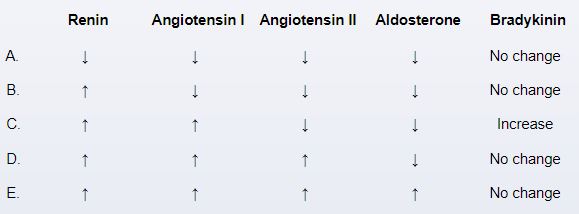
(Multiple Choice)
4.8/5  (88)
(88) A 58-year-old man arrives at the office complaining of progressive fatigue, dyspnea with exertion, and orthopnea. Medical history is significant for hypertension, hyperlipidemia, and a 2 year ago myocardial infarction. The patient claims he hasn't taken his medications in months because he's been "feeling well." The blood pressure is 160/95 mm Hg, and the pulse rate is 94 beats per minute. The physical examination reveals bilateral lung crackles as well as lower extremity edema. The maximal impulse point is shifted toward the axilla, and an S3 is heard. Serum creatinine levels are 0.9 mg/dL, and serum potassium levels are 4.2 mEq/L. After this patient's condition has stabilized, long-term use of which of the following medications will most likely reduce mortality?
(Multiple Choice)
4.8/5 (72)
(72) A 32-year-old woman, gravida 2 para 1, has a spontaneous vaginal delivery. Immediately after delivery of the placenta, the patient has a large amount of vaginal bleeding with passage of fist-sized clots, findings consistent with postpartum hemorrhage. A dose of tranexamic acid is administered. Which of the following is the most likely mechanism of action of this drug?
(Multiple Choice)
4.7/5 (91)
(91) A 25-year-old woman presented to the office due to fatigue. The patient has been sleeping poorly, with difficulty getting out of bed for the last month. She complains of less productivity at work. She has been feeling out of the mood, with a loss of interest in most of her activities. Her appetite has decreased over the same period. The patient has no significant medical or psychiatric history. Laboratory studies including thyroid studies and B12 levels are normal. Physical examination is unremarkable. A mental examination shows depressed mood and affect. No delusions are elicited. She has no suicidal thoughts. The drug of choice for this patient, has which of the following mechanisms of action?
(Multiple Choice)
4.9/5 (81)
(81) A pharmaceutical firm creates two distinct oral formulations of a novel nonsteroidal anti-inflammatory medicine that is currently under development. Average plasma drug levels are tracked throughout the course of the following 12 hours after two groups of volunteers have received a different formulation. The outcomes are displayed below. 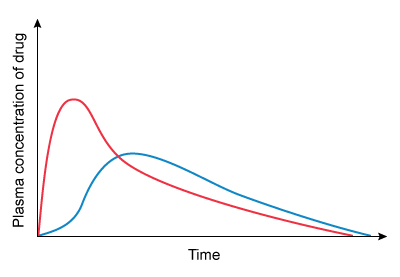 Compared to the red curve, the formulation represented by the blue curve is most likely to have which of the following characteristics?
 (Multiple Choice)
4.8/5 (79)
(79) A 57-year-old woman arrives at the office complaining of left breast pain, fatigue, nausea, and unexplained weight loss. Mammography is ordered for her, and it reveals a 3-cm dominant mass in her left breast. Adenocarcinoma is confirmed by biopsy, and subsequent studies reveal that the tumor is estrogen receptor-positive and human epidermal growth factor receptor 2- (HER2) negative. The patient went through menopause at the age of 52, and her medical history is otherwise unremarkable. Anastrozole treatment is started, which results in a significant reduction in the size of the primary tumor. Which of the following is the best explanation for the therapeutic effect of this agent?
(Multiple Choice)
4.9/5 (79)
(79) A 58-year-old woman is brought to the emergency department for shortness of breath and chest pain. Pulmonary angiography shows a large saddle embolus in the pulmonary arteries. Emergency drug therapy is administered and she is admitted to the hospital for observation. A follow-up CT scan of the chest shortly after admission shows that the thrombus has disappeared. Five hours later, the patient is found to be lethargic with slurred speech. Physical examination shows decreased consciousness, dysarthria, and optic disc swelling bilaterally. Which of the following is the most likely cause of her neurological symptoms?
(Multiple Choice)
5.0/5 (73)
(73) A 6-year-old girl is taken to the clinic because she has an itchy rash on her face. According to the patient's mother, the rash began about three weeks ago as dry skin on both of her cheeks. It has progressed over the last few days, with areas of weeping and increased redness, and the patient has had to wear mittens to avoid irritation from constant scratching. The patient has a history of similar rashes involving the flexural areas of her elbows and knees that resolved after topical corticosteroids were applied. Vital signs are typical. Physical examination reveals bilateral erythema of the cheeks and chin, with crusting and oozing. A course of topical tacrolimus is prescribed for the patient. Which of the following is the most likely mechanism of action of this drug?
(Multiple Choice)
4.8/5 (82)
(82) A 50-year-old man comes to the physician for his annual health maintenance examination. The patient feels well. He has a history of hypertension, for which he currently takes lisinopril. He has smoked a pack of cigarettes daily for 20 years. He drinks five to six beers on weekends. He is 181 cm tall (5 ft 11 in) and weighs 80 kg (176 lb); BMI is 25 kg/m2. His pulse is 75/min, respirations are 18/min, and blood pressure is 140/85 mm Hg. Physical examination is unremarkable. Laboratory studies show: 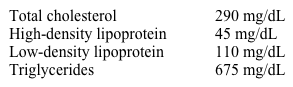 Lifestyle modification with a balanced diet, regular exercise, and reduced alcohol intake is advised. He is also started on fenofibrate therapy. This medication is most likely to help the patient by which of the following mechanisms?
 (Multiple Choice)
4.9/5 (68)
(68) A 61-year-old woman comes to the emergency department because of a 2-hour history of headache, nausea, blurred vision for the last 2 days. She has had similar symptoms in the past. Her vital signs are within normal limits. he starts taking diphenhydramine several days ago for seasonal allergies. On physical examination, there is edema and clear drainage affecting the nasal mucosa. Funduscopic examination is normal. This patient's visual symptoms are most likely due to blockade of which of the following mediators?
(Multiple Choice)
4.8/5 (83)
(83) A 47-year-old man with gastroesophageal reflux disease comes to the physician because of severe burning chest pain and belching after meals. He has limited his caffeine intake and has been avoiding food close to bedtime. Esophagogastroduodenoscopy shows erythema and erosions in the distal esophagus. Which of the following is the mechanism of action of the most appropriate drug for this patient?
(Multiple Choice)
4.9/5 (67)
(67) An investigator is conducting a phase 1 trial for a novel epoxide reductase inhibitor with favorable pharmacokinetic properties for cerebrovascular accident prophylaxis. Two days after the trial starts, a subject begins to notice pain and erythema over the right thigh. It rapidly progresses to a purpuric rash with the development of necrotic bullae over the next 24 hours. Laboratory studies show a partial thromboplastin time of 29 seconds, prothrombin time of 28 seconds, and INR of 2.15. Which of the following best describes the pathogenesis of the disease process in the patient?
(Multiple Choice)
4.9/5 (90)
(90) A 22-year-old female college student with a history of anxiety is brought to the physician for evaluation of progressive fatigue and difficulty losing weight despite intensive exercise. Over the past year, she has had extreme fluctuations in her weight and has become more distant from her friends. She admits to binge eating and induced vomiting. She appears tired and pale. Her BMI is 18.7 kg/m2. Examination shows poor dentition. Pregnancy test is negative. Which of the following medications would be most effective in treating this patient?
(Multiple Choice)
4.9/5 (75)
(75) A 52-year-old man arrives at the office complaining of bruising and muscle weakness. The patient's medical history is unremarkable, but he has smoked a pack of cigarettes every day for 30 years. The blood pressure is 160/110 mm Hg, and the pulse rate is 80 beats per minute. 29 kg/m2 is the BMI. Facial plethora, a slight centripetal distribution of body fat, diffuse skin pigmentation, and bilateral peripheral edema are all visible on physical examination. The fasting blood glucose level is 160 mg/dL, and the creatinine level is 1.2 mg/dL. A lung mass is discovered on a chest x-ray. Which of the following is the most likely cause of this patient's elevated blood pressure?
(Multiple Choice)
4.7/5 (84)
(84) A 60-year-old man with known coronary artery disease visits the office because he has been experiencing exertional chest tightness for the last 6 months. The symptoms appear when he walks more than three blocks, particularly in cold weather. Three years ago, the patient underwent coronary artery bypass graft surgery for progressive angina. Asthma, benign prostate hyperplasia, and peripheral artery disease have all been mentioned in the past. The doctor suggests that the patient add isosorbide dinitrate to his current therapy, but the patient is concerned about the side effects. Which of the following is most likely to occur in this patient with the add-on therapy?
(Multiple Choice)
4.8/5 (69)
(69) A 23-year-old asian female is brought to the ER after having a progressive jerky body movement. She has a history of seizures and takes phenytoin. She does not use tobacco, alcohol or illicit drugs. A new medication recently is prescribed after evaluation of pre-employment skin test result.An imaging shows no abnormalities. On physical examination, no focal abnormalities are noted. Blood tests reveal her plasma phenytoin level to be low. She states that she has been compliant with her medication. Which of the following drugs may be responsible for this patient's condition if co-administered with phenytoin?
(Multiple Choice)
4.8/5 (97)
(97) A 44-year-old woman comes to the physician because of a 3-month history of anxiety, difficulty falling asleep, heat intolerance, and a 6-kg (13.2-lb) weight loss. she also reports a double vision and worsening eye irritation. . The patient has no prior medical problems and takes no medications. Her pulse is 115/min and blood pressure is 140/60 mm Hg . Ophthalmologic examination shows swelling of the eyelids and proptosis bilaterally. Appropriate therapy is begun. On a follow-up visit 4 weeks later, her eye symptoms have improved, and examination reveals a small decrease in proptosis with no redness. The drug that improved her ocular symptoms most likely did so by affecting which of the following?
(Multiple Choice)
4.9/5 (85)
(85) A 45-year-old man arrives at a rural emergency department complaining of severe chest pain, sweating, and nausea. The symptoms started abruptly an hour ago. He has no notable medical history. His father died at the age of 50 from sudden onset chest pain. Every day, the patient smokes a pack of cigarettes. He does not take any medications and is not allergic to any drugs. The examination reveals normal heart and breathing sounds. Leads II, III, and aVF show sinus tachycardia with ST segment elevation. The patient's acute condition is being managed medically. Following initial treatment, the chest pain subsides and a reperfusion complex ventricular arrhythmia develops. The arrhythmia is asymptomatic and goes away on its own. Which of the following drugs is most likely responsible for rapid reperfusion in this patient?
(Multiple Choice)
4.8/5 (90)
(90) A 40-year-old woman arrives to the clinic with intermittent abdominal bloating and diarrhea that has lasted for four weeks. Although she has observed mucus in her stools, she has not seen any blood. Occasionally, the patient also has slight heartburn. She doesn't have chills, a fever, or weight loss. Additionally, the patient has detected a bad taste in dairy products, thus they are no longer consumed. Past medical history is significant for chronic allergic rhinitis. Current medications include only a multivitamin supplemen. Physical examination and vital signs are normal. After a basic evaluation, the patient is started on a trial of diphenoxylate therapy. Which of the following is the primary target of this drug?
(Multiple Choice)
5.0/5 (75)
(75) A 13-year-old girl is brought to the emergency department because of severe s cough and shortness of breath. The symptoms started while she participated in a soccer tournament at her school. Her father was diagnosed with asthma as a child. Her pulse is 133/min and respirations are 35/min. Treatment with inhaled albuterol is initiated. A physician administers inhaled corticosteroid to achieve better symptom control. In addition to an anti-inflammatory effect, which of the following effects also directly occurs as a result of this therapy?
(Multiple Choice)
4.9/5 (72)
(72) 
Filters
- Essay(0)
- Multiple Choice(0)
- Short Answer(0)
- True False(0)
- Matching(0)