



 Chat with AI
Exam 11: Pharmacology and Toxicology

Exam 1: Anatomy265 Questions
Exam 2: Behavioral Sciences178 Questions
Exam 3: Biochemistry102 Questions
Exam 4: Embryology59 Questions
Exam 5: Epidemiology, Biostatistics, and Medical Informatics94 Questions
Exam 6: Genetics88 Questions
Exam 7: Histology46 Questions
Exam 8: Immunology147 Questions
Exam 9: Microbiology and Virology330 Questions
Exam 10: Pathology817 Questions
Exam 11: Pharmacology and Toxicology509 Questions
Exam 12: Physiology339 Questions
Exam 13: Psychiatry and Psychotherapy23 Questions
Select questions type


A 60-year-old hospitalized woman is evaluated for high temperature. Four days ago, she was admitted to the hospital for sepsis, for which she has received broad-spectrum empiric intravenous antibiotic therapy. Her temperature is 38.9 C (102 F), blood pressure is 110/80 mm Hg, pulse is 98/min, and respirations are 18/min. Cardiac examination reveals a new diastolic murmur. Multiple blood cultures drawn at different times grow Enterococcus. Echocardiogram reveals mitral valve vegetation suggestive of endocarditis. An intravenous antibiotic is added to the patient's treatment regimen for synergy. Several days later, she develops tinnitus and hearing loss attributed to this antibiotic. The additional antibiotic most directly affects which of the following processes?
(Multiple Choice)
4.9/5  (77)
(77) A-60-year-old man is brought to the hospital after a sudden hand drop during breakfas meal and slurred speach which resolved after 20 minutes. The patient has had no shaking movements, headache, nausea, photophobia, or anxiety. He has a history of hypertension and hypercholesterolemia and takes amlodipine and rosuvastatin, respectively. His blood pressure is 120/75 mm Hg and pulse is 72/min and regular. Neurologic examination is unremarkable. Fingerstick glucose is within normal limits. ECG shows normal sinus rhythm. Carotid Doppler reveals mild left common carotid artery stenosis. MRI of the brain and echocardiogram are unremarkable. If the patient is started on an additional medication that is indicated for her condition, which of the following adverse effects is most likely to occur?
(Multiple Choice)
4.9/5 (72)
(72) A 32-year-old man is seen for recurring nausea and vomiting. After meals, the patient experiences nausea and upper abdominal discomfort and feels full even after eating a small amount of food. He has also had several episodes of vomiting of undigested food particles, but no fever or diarrhea. The patient has a family history of type 1 diabetes and diabetic neuropathy. The oropharynx is clear on physical examination. There is no organomegaly and the abdomen is soft, nondistended, and nontender. Bowel sounds are not abnormal. Occult blood testing in the stool is negative. Endoscopy of the upper gastrointestinal tract reveals no abnormalities. Treatment with an oral medication is initiated, but it is stopped after the patient experiences abnormal involuntary movements. A macrolide antibiotic is prescribed, which improves his symptoms. Which of following mechanisms is most likely responsible for the improvement in this patient's symptoms?
(Multiple Choice)
4.8/5 (75)
(75) A 62-year-old man is admitted to the hospital with palpitations and chest pain. His prior medical history is important for hypertension, paroxysmal atrial fibrillation, ischemic cardiomyopathy, and coronary artery disease. At the time of admission, both blood pressure and pulse were 135/78 mm Hg. The patient experiences two instances of short unconsciousness while in the hospital. When the events are recorded, the ECG reveals polymorphic QRS complexes, which vary in amplitude and cycle duration. His ECG is unremarkable save from the QT interval lengthening between the episodes. Which of the following medications is most likely responsible for this patient's condition?
(Multiple Choice)
4.8/5 (79)
(79) A 56-year-old man comes to the physician for evaluation of gradually worsening fatigue, increased urinary frequency, and blurry vision for 5 months. The patient was diagnosed 4 years ago and was initially managed with metformin. Physical examination shows decreased vibratory sense and proprioception in the lower extremities. His hemoglobin A1c is 10.4%. he patient does not want to take insulin or other injectable diabetic medications. After discussing various treatment options, canagliflozin is added to his current regimen. Which of the following tests should be ordered prior to initiating the new therapy in this patient?
(Multiple Choice)
4.8/5 (92)
(92) A 29-year-old woman comes to the office with a 2-month history of right lower quadrant pain and intermittent diarrhea. Vital signs are normal. The examination is unremarkable except for right lower quadrant tenderness. After confirmatory testing, the patient is given a delayed ileal-release medication that works by binding to a cytosolic receptor, translocating to the nucleus, and inhibiting nuclear factor-kappa-B (NF-B). The patient is most likely being treated with which of the following medications?
(Multiple Choice)
4.8/5 (87)
(87) The insulin concentration in the pancreatic veins is measured after various agents are administered in a series of animal experiments. Insulin levels are reduced when epinephrine is administered. However, following pretreatment with Drug A, epinephrine injection results in an unexpected increase in insulin concentration. Which of the following receptors does Drug A most likely block?
(Multiple Choice)
4.7/5 (90)
(90) A 36-year-old woman comes to the physician because of intermittent episodes of stabbingright-sided facial pain for 6 weeks. The pain is severe, sharp, and lasts for a few seconds and is usually instigated by a meal or teeth brushing. She does not have visual disturbances, weakness of her facial muscles, or hearing loss. She drinks alcohol socially and does not use tobacco. She has no family history of facial pain. Her vital signs are within normal limits, and physical examination shows no rash. Which of the following is the best initial treatment for this patient?
(Multiple Choice)
4.9/5 (76)
(76) A 66-year-old man comes to the physician because of tingling in his feet and difficulty walking for the past 2 months. He says he has been tripping on sidewalks recently. He found a cut on his foot a month ago but has no knowledge of when it occurred. The patient has a 6-year history of HIV infection. He was not adherent to treatment initially but now takes antiretroviral therapy regularly. His most recent CD4 cell count was 550/mm3. Vital signs are within normal limits. Foot examination shows There is reduced proprioception, sensation to touch and loss of reflexes in both feet and ankles. There are no other focal neurologic deficits. Medication review shows no neurotoxic drugs and laboratory studies are within normal limits. Treatment with duloxetine is planned. This medication is most likely to improve this patient's symptoms via which of the following mechanisms?
(Multiple Choice)
4.8/5 (73)
(73) A 40-year-old man is seen in the surgical department due to behavioral changes. He is confused and agitated. Two days ago, he is admitted to the hospital due to acute appendicitis. Today, the patient becomes irritable, severely agitated, and verbally abusive to the nursing staff. The patient does not use tobacco or illicit drugs but admits to drinking 6-8 beers daily for the last several years. Blood pressure is 165/90 mm Hg and pulse is 115/min. Examination shows hand tremors bilaterally. Which of the following is the most appropriate pharmacotherapy for this patient?
(Multiple Choice)
5.0/5 (83)
(83) A 29-year-old man comes to the physician for describing restlessness in his legs over the past week. Three weeks ago, he was started on trifluoperazine for the treatment of schizophrenia. He reports that, since then, he has often felt compelled to pace around his house and is unable to sit or stand still. Vital signs are normal. The patient is alert, oriented, fidgety, and anxious. Which of the following is the most likely diagnosis in this patient?
(Multiple Choice)
4.9/5 (79)
(79) A 50-year-old man is brought to the emergency department after an episode of myoclonic jerking movements and urinary incontinence. After regaining consciousness, the patient has no recollection of what happened and seems confused. He has bipolar disorder, which has been controlled with maintenance therapy for the past 11 years, as well as hypertension, Over the past week, the patient started taking several daily doses of a new medication following an ankle trauma.. His pulse is 92/min and blood pressure is 135/87 mm Hg.. Coarse tremors are noted in the upper extremities. Deep tendon reflexes are 2+ in the bilateral extremities. Gait is mildly ataxic. A drug interaction involving which of the following medications is most likely causing this patient's symptoms?
(Multiple Choice)
4.9/5 (85)
(85) A 50-year-old woman with stage IV chronic kidney disease comes to the office due to persistent high phosphorus level, she tried to restrict phosphorus diet intake but didn't help. Laboratory results are as follows: 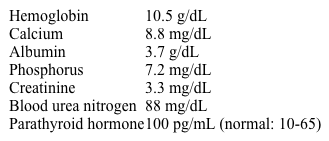 Treatment with sevelamer is initiated. This medication reduces the serum phosphorus level by which of the following mechanisms?
 (Multiple Choice)
4.9/5 (86)
(86) A 37-year-old man with no significant medical history visits the office complaining of palpitations. He leads a healthy lifestyle, exercises on a daily basis, and does not use tobacco, alcohol, or illegal drugs. The ECG demonstrates atrial fibrillation with a rapid ventricular response. An echocardiogram reveals normal heart function and no evidence of valvular disease. The patient is put on an antiarrhythmic medication that has been shown to be effective in both atrial and ventricular arrhythmias. This medication causes QRS prolongation with only a minor increase in QT interval duration on ECG. Which of the following action potential curve regions is most affected by this drug? 
(Multiple Choice)
5.0/5 (70)
(70) Recurrent syncope is being evaluated in a 66-year-old man. Over the last 6 months, he has experienced three episodes of dizziness and palpitations, followed by a brief loss of consciousness. He is not experiencing any chest pain or dyspnea. The patient has a history of high blood pressure and hyperlipidemia. There is no history of sudden death in the family. The initial evaluation reveals that the ECG and echocardiogram are normal. An electrophysiologic study of the heart is performed. During the study, an intravenous infusion of a medication is given, resulting in the responses shown below. 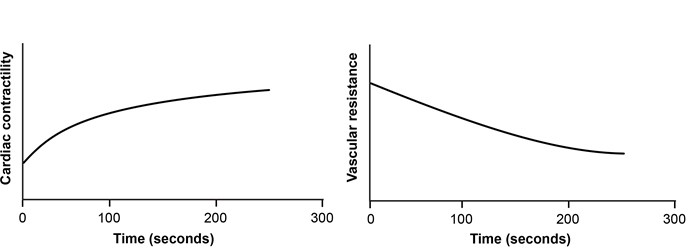 Which of the following medications was most likely administered to this patient?
 (Multiple Choice)
4.8/5 (69)
(69) A 70-year-old man is being evaluated due to hearing impairment. He states that he doesn't hear sounds very well and needs be closer to hear his wife or listen to TV. He has a history of hypertension, diabetes mellitus and heart failure, last week, he was admitted to the hospital because of heart failure exacerbation and a new adjustment to his medication was done. He says I was feeling well before admission. Examination shows moderate bilateral sensorineural hearing loss. Which of the following medications most likely contributed to this patient's hearing impairment?
(Multiple Choice)
4.8/5 (90)
(90) A 45-year-old man comes to the emergency department with progressive dyspnea. The patient has a history of uncontrolled hypertension. Blood pressure is 210/115 mm Hg and pulse is 105/min. Chest examination demonstrates bibasilar crackles. There are no heart murmurs. Serum creatinine is 1.6 mg/dL. Intravenous furosemide and continuous nitroprusside infusion are started, along with noninvasive positive pressure ventilation, and he experiences improvement in his symptoms. The next morning, the patient is confused and lethargic, and he suffers a generalized tonic-clonic seizure. The skin appears flushed, and serum lactic acid level is elevated. The nitroprusside infusion rate is found to be higher than recommended. Which of the following mechanisms is most likely responsible for the drug toxicity seen in this patient?
(Multiple Choice)
5.0/5 (83)
(83) A 22-year-old woman comes to the emergency department because of daily headaches for 3 weeks. Yesterday, the patient had blurry vision in both eyes and a brief episode of double vision. She has been taking ibuprofen with only mild improvement of her symptoms. She has not had any trauma, weakness, or changes in sensation. Medical history is remarkable facial acne for which she takes vitamin A and obesity but no other chronic conditions. Brain imaging is normal, and blood cell counts and serum chemistry studies are within normal limits. Lumbar puncture reveals elevated opening pressure, and idiopathic intracranial hypertension is diagnosed. Weight loss is advised, and the patient is prescribed acetazolamide therapy. Which of the following changes are most likely to occur in this patient over the next several days due to the medication? 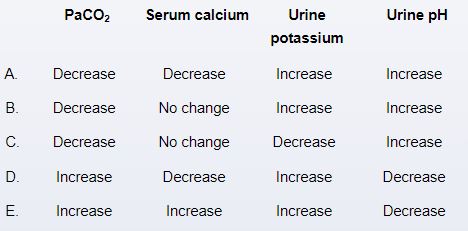
(Multiple Choice)
4.7/5 (75)
(75) A 40-year-old man to the physician because of severe pain and swelling in both knees for the past day. He has a history of end-stage renal disease for which he underwent a renal transplant 10 weeks ago. The patient takes an immunosuppressive regimen that includes cyclosporine and low-dose prednisone His temperature is 37.4°C (99.4°F). serum creatinine level is within normal range with no proteinuria. Physical examination shows swelling and erythema of both knees and the base of his left big toe. . Microscopic examination of joint fluid from the knee shows numerous neutrophils as well as both intra- and extracellular crystals as shown in the exhibit. 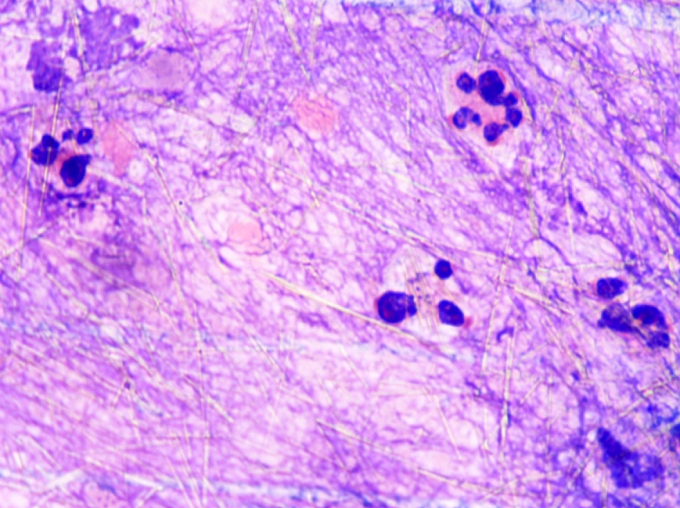 Which of the following mechanisms is most likely responsible for this patient's acute symptoms?
 (Multiple Choice)
4.8/5 (68)
(68) A 72-year-old woman comes to the physician for difficulty swallowing and a burning sensation in her throat for the past 4 weeks. She has increased her fluid consumption to help with swallowing when eating. She reports having used new medication for osteoprosis. She uses a daily low-dose inhaled corticosteroid and an albuterol inhaler as needed for allergic asthma. She is 170 cm (5 ft 6 in) tall and weighs 75 kg (165 lbs); her BMI is 26 kg/m2. Her vital signs are within normal limits. Physical examination shows no abnormalitie. It is determined that the patient's current symptoms are caused by one of her medications, which is discontinued. Her symptoms subsequently resolve. The medication responsible for this patient's presentation is also associated with which of the following side effects?
(Multiple Choice)
4.7/5 (72)
(72) 
Filters
- Essay(0)
- Multiple Choice(0)
- Short Answer(0)
- True False(0)
- Matching(0)