



 Chat with AI
Exam 11: Pharmacology and Toxicology

Exam 1: Anatomy265 Questions
Exam 2: Behavioral Sciences178 Questions
Exam 3: Biochemistry102 Questions
Exam 4: Embryology59 Questions
Exam 5: Epidemiology, Biostatistics, and Medical Informatics94 Questions
Exam 6: Genetics88 Questions
Exam 7: Histology46 Questions
Exam 8: Immunology147 Questions
Exam 9: Microbiology and Virology330 Questions
Exam 10: Pathology817 Questions
Exam 11: Pharmacology and Toxicology509 Questions
Exam 12: Physiology339 Questions
Exam 13: Psychiatry and Psychotherapy23 Questions
Select questions type


A 24-year-old nulligravid woman comes to the physician for the evaluation of an abnormal hair growth on her face. She is 161 cm (5 ft 3 in) tall and weighs 80 kg (176 lb); BMI is 31 kg/m2. Examination shows moderate obesity with mild hirsutism on the face and chest. The patient is initiated on a combination oral contraceptive. Which of the following describes the primary mechanism by which this agent reduces hirsutism?
(Multiple Choice)
4.8/5  (76)
(76) A 72-year-old man is taken to the hospital after experiencing severe substernal chest pain and shortness of breath for several hours. The pain began unexpectedly while he was outside working in the garden. Diabetes mellitus controlled by diet and hypertension are among the medical history. A physical exam reveals bilateral crackles as well as a third heart sound. The ECG shows ST elevation in several leads. The patient has an acute myocardial infarction that is complicated by acute severe heart failure. He has begun dobutamine infusion and is being prepared for coronary catheterization. Which of the following is most likely to be increased due to the medication used in this patient?
(Multiple Choice)
4.8/5 (77)
(77) A 25-year-old woman presents to the office complaining of an irregular menstrual cycle for the last 6 months. She also noticed bilateral whitish nipple discharge. Since her menarche at age 13, the patient has had regular menses, lasting 5-6 days, every 30 days. She has been prescribed a new medication for stopping voices in her head. BMI is 30 kg/m2. Urine beta-hCG testing is negative. Disruption of which of the following pathways describe the patient's symptoms?
(Multiple Choice)
4.7/5 (70)
(70) A 54-year-old woman comes to the emergency department because of sharp chest pain and shortness of breath for 1 day. Her temperature is 37.8°C (100.0°F), pulse is 110/min, respirations are 30/min, and blood pressure is 86/70 mm Hg. CT angiography of the chest shows a large embolus at the right pulmonary artery. Pharmacotherapy with a tissue plasminogen activator is administered. Six hours later, she develops right-sided weakness and slurred speech. Laboratory studies show elevated prothrombin and partial thromboplastin times and normal bleeding time. A CT scan of the head shows a large, left-sided intracranial hemorrhage. Administration of which of the following is most appropriate to reverse this patient's acquired coagulopathy?
(Multiple Choice)
4.9/5 (84)
(84) A 23-year-old man comes to the physician because of a 1-year history of episodic shortness of breath. Physical examination shows no abnormalities. Laboratory studies show elevated serum IgE levels. Microscopic examination of the sputum shows eosinophilic, hexagonal, double-pointed crystals. Physical examination reveals scattered expiratory wheezes in both lungs. Peak expiratory flow rate is decreased from baseline. The treatment regimen is expanded to include a monoclonal antibody that binds circulating IgE, with the resulting complexes being subsequently cleared by reticuloendothelial cells. This medication is most likely to help this patient through which of the following mechanisms?
(Multiple Choice)
4.8/5 (71)
(71) A 36-year-old man is brought to the emergency department by his girlfriend because of increasing confusion for the past 6 hours. He drinks large amounts of alcohol daily and occasionally uses illicit drugs. He is lethargic and oriented only to person. Physical examination shows jaundice, hepatomegaly, and scattered petechiae over the trunk and back. Neurologic examination shows normal, reactive pupils and a flapping tremor when the wrists are extended. A drug with which of the following mechanism of action would be most appropriate for this patient's condition?
(Multiple Choice)
4.7/5 (91)
(91) A 54-year-old woman with knee osteoarthritis comes to the physician for a follow-up examination. She reports significantly improved pain control since starting celecoxib 1 month ago. A history involving which of the following conditions is most likely to explain the administration of this drug instead of another nonsteroidal anti-inflammatory drug?
(Multiple Choice)
4.7/5 (75)
(75) A 64-year-old man arrives at the office with a 6-month history of urinating difficulties, including frequent straining and dribbling. His symptoms have worsened over time and have a significant impact on his quality of life. The doctor prescribes a medication that provides the patient with moderate symptom relief. He does, however, have a decrease in libido and impaired erectile function. Which of the following is the most likely mechanism of action of this patient's medication?
(Multiple Choice)
4.8/5 (73)
(73) A 27-year-old woman comes to the physician because of a 2-month history of palpitations, diaphoresis, and a 5-kg (11-lb) weight loss. Her pulse is 101/min and blood pressure is 141/84 mm Hg. On physical examination, there is lid lag, moderate exophthalmos, and fine tremors of the outstretched hands. After the diagnosis is made, she is prescribed propranolol for immediate symptom control. Which of the following findings is most likely to persist in this patient despite this therapy?
(Multiple Choice)
4.9/5 (67)
(67) A 62-year-old woman with a history of subarachnoid hemorrhage is brought to the emergency department because of shortness of breath and sharp chest pain that worsens on inspiration. She underwent surgery for a hip fracture 3 weeks ago. Her pulse is 110/min, respirations are 20/min, and blood pressure is 112/74 mm Hg. Pulse oximetry on room air shows an oxygen saturation of 92%. The lungs are clear to auscultation and there is no jugular venous distention. A ventilation and perfusion scan shows a small perfusion defect in the left lower lung. A drug with which of the following mechanisms of action is most appropriate for this patient?
(Multiple Choice)
4.8/5 (75)
(75) A 44-year-old man complains of shortness of breath and palpitations after exertion. He has a systolic murmur at the left sternal border and cardiac apex that becomes louder when he stands up. He is diagnosed with obstructive hypertrophic cardiomyopathy and paroxysmal atrial fibrillation and begins treatment. The image below depicts changes in the action potential of ventricular muscle cells before and after medication administration. 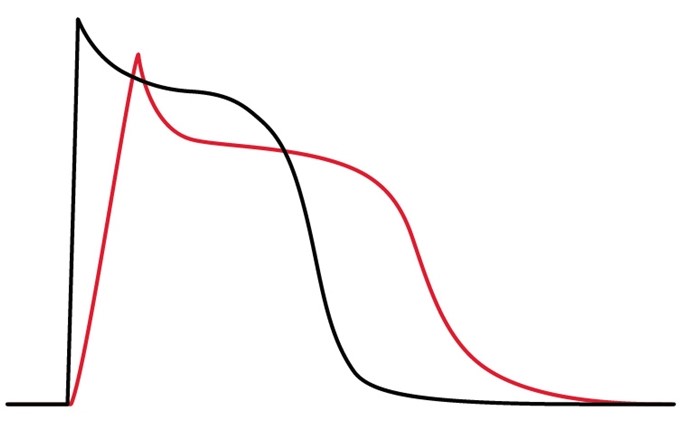 Black curve = Before administration of medication Red curve = After administration of medicationThe patient is most likely being treated with which of the following medications?
 (Multiple Choice)
4.9/5 (79)
(79) A 76-year-old woman with type 2 diabetes is brought to the hospital after her family discovered her unresponsive in the morning. Her daughter reports that they had a full day of activities that required a lot of walking the day before. Because she was tired, the patient ate less dinner than usual. She had previously discontinued several diabetes medications due to medication intolerance, but has recently had good glycemic control with a single medication. The blood pressure is 140/80 mm Hg, and the pulse rate is 102/min. The patient is diaphoretic and only reacts to pain. Pupils are equal, round, and light reactive. The cardiopulmonary exam is normal. The blood glucose level is 34 mg/dL. Following the administration of an intravenous bolus of dextrose, the patient's condition rapidly improves. but she becomes confused again several hours later. Repeat blood glucose is 39 mg/dL. Which of the following medications is the most likely cause of this patient's current condition?
(Multiple Choice)
4.9/5 (95)
(95) A 34-year-old man is brought to the emergency department because of increasing confusion for the past 6 hours. He drinks large amounts of alcohol daily and occasionally uses illicit drugs. He is lethargic and oriented only to person. Physical examination shows jaundice, hepatomegaly, and scattered petechiae over the trunk and back. Laboratory results are as follows:  The patient is given intramuscular vitamin K. Two days later, his laboratory results are unchanged. Which of the following is the most likely cause of this patient's laboratory abnormality?
 (Multiple Choice)
4.8/5 (89)
(89) A 35-year-old man visits the doctor with a 2-week history of nasal congestion. Since his symptoms began, he has used a topical decongestant every few hours. He felt better for nearly a week, but then his nasal congestion returned. The patient has a history of allergic rhinitis and has previously experienced rhinorrhea, but none of these episodes lasted more than a few days. He denies experiencing fever, throat pain, headaches, coughing, or lymph node enlargement. The patient has no other medical issues besides his allergic rhinitis. Physical examination reveals edematous and red nasal mucosa with a few areas of punctate bleeding. The rest of the examination shows no abnormalities. Which of the following is the most appropriate next step in the management of this patient?
(Multiple Choice)
4.8/5 (73)
(73) A 54-year-old woman comes to the physician for a follow-up examination. She has a hsitory of hypertension and takes her medication regularly. Her temperature is 37.3°C (99.1°F), pulse is 93/min, and blood pressure is 142/93 mm Hg. Examination shows no abnormalities. She does yoga and pilates two times a week. She is sexually active with her husband and uses condoms inconsistently. Serum laboratory results are as follows: 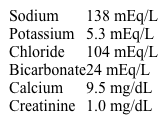 Review of the patient's medical records shows similar serum laboratory results 6 months ago. Which of the following medications should be avoided in this patient?
 (Multiple Choice)
4.9/5 (79)
(79) A 54-year-old man is brought to the emergency department by his wife because of burning oral mucosal pain, chest pain, and shortness of breath that began after ingestion of an unknown substance one hour ago. The patient reports that the pain is worse when swallowing. Two years ago, he was diagnosed with major depressive disorder but does not adhere to his medication regimen. The patient does not answer questions about suicidal ideation and the substance he ingested. He works as a farmer. His wife reports that he smokes one pack of cigarettes and drinks 6 oz of homemade vodka daily. The patient is oriented to person, place, and time. His pulse is 95/min, respirations are 18/min, and blood pressure is 130/85 mm Hg. Pulse oximetry on room air shows an oxygen saturation of 95%. Examination of the oropharynx shows profuse salivation with mild erythema of the buccal mucosa, tongue, and epiglottis area. The remainder of the examination shows no abnormalities. Which of the following is the most likely cause of this patient's clinical findings?
(Multiple Choice)
4.9/5 (90)
(90) A 20-year-old man is brought to the emergency department 20 minutes after collapsing while playing basketball. There is no personal or family history of serious illness. On arrival, there is no palpable pulse and no respiratory effort is seen. Blood pressure is 125/75 mm Hg and pulse is 55/min. Echocardiography shows interventricular septal hypertrophy and increased left ventricular mass. The patient is started on high-dose beta blocker therapy. On follow-up 2 weeks later, he reports significant improvement in his shortness of breath. Physical examination reveals no murmurs supine or with Valsalva. Which of the following best accounts for improvement of this patient's symptoms?
(Multiple Choice)
4.9/5 (80)
(80) A 59-year-old woman comes to the physician because of left leg swelling that started after a transcontinental flight. A duplex ultrasound of the left leg shows a noncompressible popliteal vein. A drug is prescribed that inhibits the coagulation cascade. Two weeks later, laboratory studies show: Platelet count 210,000/mm3
Partial thromboplastin time 53 seconds
Prothrombin time 20 seconds
Thrombin time 15 seconds (control: 15 seconds)
Which of the following drugs was most likely prescribed?
(Multiple Choice)
4.8/5 (82)
(82) Police transport a 32-year-old guy to the emergency room following a fight at a nearby bar. He claims that his chest hurts and is upset. Pulse is regular at 130 beats per minute and blood pressure is 170/100 mm Hg. The patient is aggressive and uncooperative throughout the physical assessment. There are no indications of any bodily harm. He reacts to light and has dilated, reactive pupils. Nasal perforation is visible on examination. Myocardial ischemia is shown on the ECG. Inhibition of which of the following processes is most likely responsible for this patient's presentation? 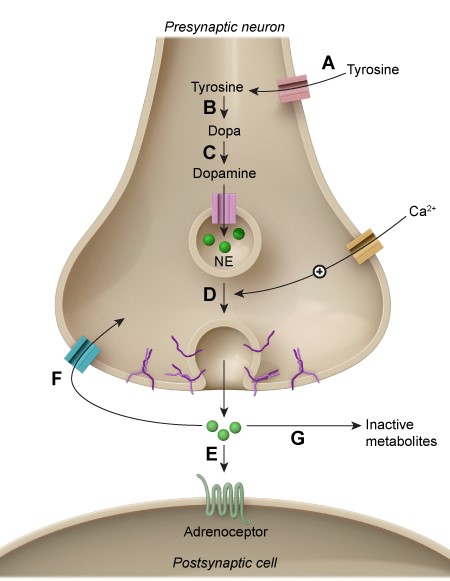
(Multiple Choice)
4.8/5 (91)
(91) A 18-year-old man suffers from chronic atopic dermatitis. For several years, he has applied a corticosteroid cream to the flexural areas of his skin on a daily basis, and the treated areas have been free of pruritus, papules, vesicles, and scales. Asthma and allergic rhinitis are notable medical histories. Which of the following findings would a punch biopsy of the treated skin most likely reveal?
(Multiple Choice)
4.8/5 (93)
(93) 
Filters
- Essay(0)
- Multiple Choice(0)
- Short Answer(0)
- True False(0)
- Matching(0)