



 Chat with AI
Exam 11: Pharmacology and Toxicology

Exam 1: Anatomy265 Questions
Exam 2: Behavioral Sciences178 Questions
Exam 3: Biochemistry102 Questions
Exam 4: Embryology59 Questions
Exam 5: Epidemiology, Biostatistics, and Medical Informatics94 Questions
Exam 6: Genetics88 Questions
Exam 7: Histology46 Questions
Exam 8: Immunology147 Questions
Exam 9: Microbiology and Virology330 Questions
Exam 10: Pathology817 Questions
Exam 11: Pharmacology and Toxicology509 Questions
Exam 12: Physiology339 Questions
Exam 13: Psychiatry and Psychotherapy23 Questions
Select questions type


An otherwise healthy 10-year-old boy with a history of mild, persistent asthma is brought to the office because asthma attacks that have been increasing in frequency and severity. His asthma symptoms are controlled with an inhaled beta-agonist. His physician adds inhaled glucocorticoid therapy to control his symptoms effectively. What measure should this patient take to prevent oropharyngeal complication due to the new medication?
(Multiple Choice)
4.8/5  (80)
(80) A 57-year-old patient comes to the physician for progressive cough with a large amounts of yellow sputum. He has a history of mild upper respiratory illness which resolved spontaneously. The patient has had no shortness of breath or chest pain. She took unexpired, leftover dextromethorphan for 2 days. The patient's only other medical condition is major depression, for which she takes sertraline. She does not use tobacco, alcohol, or illicit drugs. Vital signs and physical examination show no abnormalities. Use of dextromethorphan is most concerning for which of the following in this patient?
(Multiple Choice)
4.8/5 (68)
(68) A 45-year-old man who has recently begun treatment for paroxysmal atrial fibrillation is subjected to stress ECG testing. The patient exercises for 9 minutes on a treadmill and achieves 98 percent of the age-predicted maximal heart rate without experiencing chest pain or ST-segment changes. His pre-test resting QRS complex duration is 95 milliseconds (normal: 80-120 milliseconds) and his corrected QT (QTc) interval duration is 410 milliseconds (normal: 440 milliseconds). His ECG findings at his maximum heart rate show a QRS complex duration of 125 msec and a QTc interval duration of 400 msec. Based on the patient's test results, which of the following medications is most likely being used to treat his atrial fibrillation?
(Multiple Choice)
4.9/5 (75)
(75) A 22-year-old man is brought to the emergency department by his roommate 20 minutes after being discovered unconscious at home. On arrival, he is unresponsive to painful stimuli. His pulse is 65/min, respirations are 8/min, and blood pressure is 110/70 mm Hg. Pulse oximetry shows an oxygen saturation of 75%. his pupils are constricted and minimally responsive to light. Resuscitation efforts are initiated. The patient receives intravenous medication and regains consciousness 2 minutes later. The drug most likely used to treat this patient has the greatest affinity for which of the following receptors?
(Multiple Choice)
4.9/5 (76)
(76) A 22-year-old man is brought to the emergency department 10 minutes after falling down a flight of stairs. An x-ray of the right wrist shows a distal radius fracture. Anesthesia was induced with propofol, succinylcholine was used for intubation, and anesthesia was maintained via propofol and fentanyl infusions. , and closed reduction of the fracture is performed. The patient has not had a return of neuromuscular function after several hours. His mother then discloses that she has also been "slow to wake up" from anesthesia. Which of the following is the most likely reason for this patient's prolonged paralysis?
(Multiple Choice)
4.8/5 (82)
(82) A 60-year-old man comes to the office due to erectile dysfunction and lack of sexual desire. Medical history is unremarkable. The patient is in a stable relationship with his wife and does not use tobacco, alcohol, or illicit drugs. The patient has coronary artery disease and heart failure with reduced ejection fraction and was prescribed spironolactone therapy several months ago. Other medications include aspirin, lisinopril, furosemide, and metoprolol. Blood pressure is 110/70 mm Hg and pulse is 70/min. Examination shows a left ventricular S3 and trace pitting ankle edema. Breast examination demonstrates bilateral enlargement with mild tenderness. Which of the following is the most likely cause of this patient's current symptoms?
(Multiple Choice)
4.8/5 (87)
(87) In a series of experiments, a new antiarrhythmic medication (drug A) is tested by measuring the flow of ions responsible for producing an action potential in cardiac muscle cells. Ion flow is measured before and after administration of the drug, and the results are shown in the chart below (each colored line represents a different type of ion). 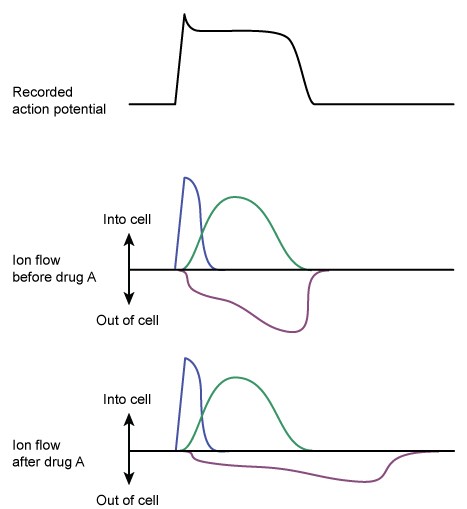 Drug A has an antiarrhythmic effect most similar to which of the following drugs?
 (Multiple Choice)
5.0/5 (92)
(92) A 50-year-old man arrives at the office after having a growth hormone-secreting pituitary adenoma transsphenoidally removed. The patient was diagnosed with acromegaly three months ago. A 14-mm sellar mass pressing on the optic chiasm and extending into the right cavernous sinus was discovered on MRI of the pituitary. Because of the extension into the right cavernous sinus, the surgeon was only able to partially resect the pituitary mass. Acromegaly will be treated medically with octreotide. Which of the following changes are likely to occur following octreotide treatment in this patient? 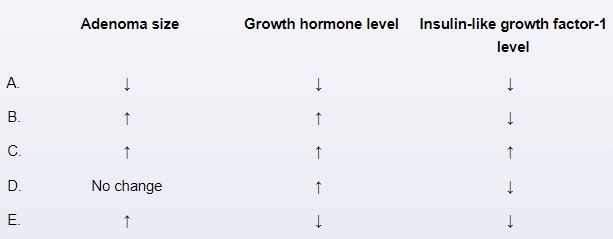
(Multiple Choice)
4.9/5 (91)
(91) A 56-year-old man is brought to the emergency department by his neighbor 2 hours after they found him unresponsive in the garden. He is confused and unable to provide further history.Temperature is 36.6 C (98 F), blood pressure is 110/60 mm Hg, pulse is 58/min, and respirations are 42/min. On examination, the patient is lethargic and salivating. The pupils are constricted. His clothes are soaked with vomit, urine, and feces. Which of the following medications should be administered first during treatment of this patient's current condition?
(Multiple Choice)
4.9/5 (75)
(75) A 5-year-old girl is brought to the emergency department because of a severe nosebleed 3 days after her grandmother found her next to an empty bottle that contained warfarin. The girl's pulse is 134/min, and blood pressure is 87/44 mm Hg. Physical examination shows brisk, bilateral epistaxis that persists despite compression and nasal packing. Laboratory studies show normocytic anemia and increased prothrombin and partial thromboplastin times. Which of the following is the most appropriate therapy to immediately reverse her current condition?
(Multiple Choice)
4.8/5 (69)
(69) A 31-year-old woman comes to the physician for evaluation of worsening pain, swelling, and erythema in her left leg for the past 4 hours. She returned from a trip to Taiwan to celebrate her sister's wedding 2 days ago. She has no history of serious illness. She is sexually active with one male partner and uses a combined oral contraceptive pill. She does not smoke cigarettes, drink alcohol, or use illicit drugs. Her only other medication is a multivitamin. Her temperature is 37.2°C (99°F), pulse is 67/min, respirations are 16/min, and blood pressure is 90/60 mm Hg. Examination shows swelling in her left calf and pain behind her left knee when she is asked to dorsiflex her left foot. Laboratory results show elevated D-dimer. Which of the following is the most likely cause of this patient's clinical presentation?
(Multiple Choice)
4.8/5 (81)
(81) A 64-year-old man comes to the physician because of a history of progressively worsening back pain that wakes him up at night. He also reports symptoms of urinary urgency and a weak urine stream. He has no history of serious illness and takes no medications. Rectal examination shows an enlarged and hardened prostate with a nodular surface. Spinal imaging reveals multiple lesions suspicious for metastatic cancer. Biopsy of a bone lesion shows well-differentiated adenocarcinoma. Treatment with a medication that does which of the following would most likely reduce the spread of this patient's cancer?
(Multiple Choice)
4.8/5 (81)
(81) A 4-year-old boy with acute lymphoblastic leukemia is admitted to the hospital to undergo allogeneic bone marrow transplantation. Two weeks after the conditioning regimen is started, he develops a temperature of 38.5°C (101.3°F). Laboratory studies show:
Hemoglobin 8 g/dL
Leukocyte count 1400/mm3
Segmented neutrophils 15%
Eosinophils 0.5%
Lymphocytes 84%
Monocytes 1%
Platelet count 110,000/mm3
Which of the following is the most appropriate pharmacotherapy for this patient?
(Multiple Choice)
4.8/5 (66)
(66) A 53-year-old man arrives at the emergency room complaining of shortness of breath and chest tightness. When the patient's symptoms first appeared, he was participating in a poker tournament. He has a history of hypertension and is not taking his medications as prescribed. His last medical check-up was over a year ago. The blood pressure is 195/115 mm Hg, and the pulse rate is 90 beats per minute. Bibasilar crackles are discovered during a lung examination. A nitroglycerin infusion is started, which results in significant symptom relief. The repeat blood pressure reading is 165/90 mm Hg. Which of the following intracellular events is most likely responsible for the beneficial effects of this patient's treatment?
(Multiple Choice)
4.7/5 (87)
(87) A clinical trial is being conducted to evaluate the safety and efficacy of a novel therapy to treat refractory Crohn disease. The medication is a monoclonal antibody against the a4B7 integrin, which inhibits migration of T-lymphocytes into the intestinal parenchyma and produces a gut-selective anti-inflammatory effect. Patients who have active, moderate to severe Crohn disease and have failed conventional therapy are enrolled in the study. Many of these patients have renal or hepatic dysfunction, and some take other medications that affect cytochrome P450 enzymes. Which of the following is the most appropriate dose adjustment in this patient population to decrease drug toxicity?
(Multiple Choice)
4.7/5 (92)
(92) A group of scientists is working on new osteoporosis drugs. They are testing Substance X, a new drug that exhibits the following metabolic effects when administered via infusion in varying doses (as shown in the graphs below). 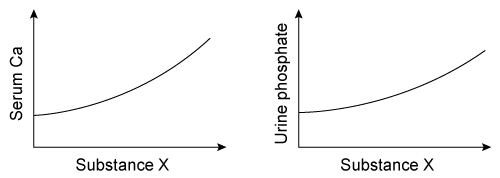 Which of the following most closely resembles the metabolic effects of Substance X?
 (Multiple Choice)
4.8/5 (84)
(84) A large, multinational drug corporation conducts a phase I clinical trial to evaluate the safety profile and pharmacokinetic properties of a new drug designed to treat refractory epilepsy. Initial studies in animals showed that the drug undergoes extensive metabolism by the liver into glucuronidation byproducts that are primarily excreted by the kidneys. The curve below demonstrates the glucuronidation rate of the drug over a wide range of doses. 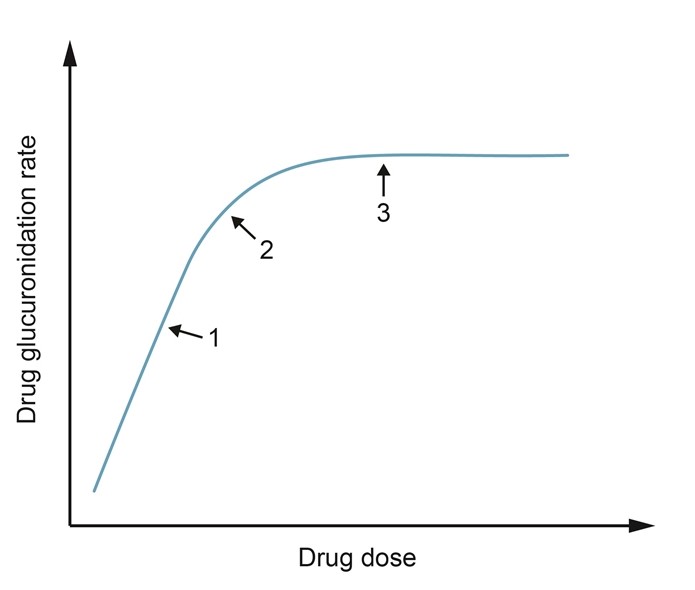 Which of the following is the most accurate statement about this drug's metabolism?
 (Multiple Choice)
4.7/5 (76)
(76) A 67-year-old woman is admitted to the hospital because of a 2-day history of fever, headache, jaw pain, and decreased vision in the right eye. Her temperature is 38.1°C (100.6°F). Examination shows normal muscle strength in bilateral upper and lower extremities; range of motion of the shoulder and hip is mildly limited by pain. Her erythrocyte sedimentation rate is 84 mm per hour. Which of the following is the most appropriate treatment for this patient's condition?
(Multiple Choice)
4.8/5 (72)
(72) A 16-year-old girl is being evaluated in the emergency department because of lethargy and headache for the past one hour. Her pulse is 115/min and respirations are 12/min. she had a peritonsillar abscess and a topical anesthetic was applied for incision and drainage. Physical examination shows bluish discoloration of the lips and nail beds. A venous blood sample appears chocolate-colored and does not change color when exposed to oxygen. Which of the following is the most likely cause of this patient's hypoxemia?
(Multiple Choice)
4.8/5 (96)
(96) An 11-year-old boy is brought to the physician by his mother because of teacher complaints regarding his poor performance at school for the past 8 months. He has difficulty sustaining attention when assigned school-related tasks, does not follow the teachers' instructions, and makes careless mistakes in his homework. He often blurts out answers in class and has difficulty adhering to the rules during soccer practice. His mother reports that he is easily distracted when she speaks with him and that he often forgets his books at school. Physical examination shows no abnormalities. A drug with which of the following mechanisms of action is most appropriate for this patient?
(Multiple Choice)
4.8/5 (69)
(69) 
Filters
- Essay(0)
- Multiple Choice(0)
- Short Answer(0)
- True False(0)
- Matching(0)