



 Chat with AI
Exam 11: Pharmacology and Toxicology

Exam 1: Anatomy265 Questions
Exam 2: Behavioral Sciences178 Questions
Exam 3: Biochemistry102 Questions
Exam 4: Embryology59 Questions
Exam 5: Epidemiology, Biostatistics, and Medical Informatics94 Questions
Exam 6: Genetics88 Questions
Exam 7: Histology46 Questions
Exam 8: Immunology147 Questions
Exam 9: Microbiology and Virology330 Questions
Exam 10: Pathology817 Questions
Exam 11: Pharmacology and Toxicology509 Questions
Exam 12: Physiology339 Questions
Exam 13: Psychiatry and Psychotherapy23 Questions
Select questions type


A 58-year-old woman comes to the emergency room with chest pain. She describes the pain as a squeezing sensation in her chest with radiation to the left shoulder. The episode began about 15 minutes ago when she was sitting reading a book. She has had this pain before, typically in the evenings, though prior episodes usually resolved after a couple of minutes. An ECG shows ST-segment elevations in the inferior leads and undergoes an urgent coronary intervention with stent placement into the right coronary artery. She is also started on high-intensity atorvastatin therapy, along with antiplatelet therapy and appropriate medications to control blood pressure. Four weeks later, the patient's total cholesterol level is 140 mg/dL, down from 200 mg/dL before discharge. Which of the following has most likely increased as the result of the therapy?
(Multiple Choice)
4.9/5  (88)
(88) A 52-year-old man visits the emergency room (ED) after experiencing substernal burning pain for two hours. He took several antacid tablets at home before visiting the ED, but they did not provide any relief. Other medical issues for the patient include hypertension and hyperlipidemia. His blood pressure is 160/90 mm Hg, his temperature is 36.7 C (98 F), and his pulse is 92 beats per minute. A cardiovascular examination reveals murmur-free S1 and S2, which are also normal. No abdominal soreness is present. ST-segment depression is visible on the ECG in leads II, III, and aVF. Troponin is 0.06 ng/mL (normal <0.01 ng/mL). As part of this patient's treatment, enoxaparin therapy is initiated. This drug is expected to bind to which of the following substances in this patient's blood?
(Multiple Choice)
4.9/5 (93)
(93) A 52-year-old lady with a history of locally advanced breast cancer visits the office for follow-up. The patient has not received radiation therapy but is getting chemotherapy with trastuzumab as the main ingredient. She doesn't have any symptoms other than a little weariness. The heart rate is regular at 85 beats per minute and blood pressure is 120/72 mm Hg. The patient is afebrile. A 40% left ventricular ejection fraction is seen on transthoracic echocardiography, with no signs of valvular disease. Prior to the start of chemotherapy, a cardiac evaluation was performed and found to be normal. Which of the following pathologic findings is most likely to be present in this patient's heart?
(Multiple Choice)
4.8/5 (86)
(86) Dyslipidemia is diagnosed in a 34-year-old man. He also has other medical conditions, like a myocardial infarction about a week ago. At the age of 48, his father suffered a myocardial infarction and passed away. Other family members have experienced hypertension and myocardial infarctions. After suffering a myocardial infarction, the patient gave up smoking and drinking. Simvastatin and cholestyramine have been started for him. Which of the following best describes the independent effects of simvastatin and cholestyramine, respectively, on hepatic cholesterol synthesis?
(Multiple Choice)
4.9/5 (96)
(96) A 42-year-old woman comes to the office because of a difficulty initiating sleep and she is exhausted during the day. She avoids consuming alcohol and caffeine before bedtime and has begun to exercise every other afternoon. She also does not watch TV or use her phone shortly before she goes to bed. She has a family history of heart disease and depression. The patient has failed a number of nonpharmacological approaches, including cognitive-behavioral therapy for insomnia. She requests pharmacologic treatment and is prescribed a short course of zolpidem. Which of the following is the most likely mechanism of action of this medication?
(Multiple Choice)
4.8/5 (79)
(79) A 48-year-old man comes to the emergency department because of a 1-day history of weakness, shortness of breath, and blue discoloration of his lips. Medical history is remarkable for dermatitis herpetiformis, for which treatment with dapsone was started 10 days ago. He also has major depressive disorder treated with fluoxetine. He has smoked ten cigarettes daily for the past 32 years. His mother has celiac disease. The patient appears distressed. Temperature is 36.9°C (98.4°F), pulse is 120/min, and respirations are 24/min. Pulse oximetry on room air shows an oxygen saturation of 85%. Cardiopulmonary examination discloses no abnormalities. Arterial blood gas analysis on room air shows:
PH 7.7
PCO2 17 mm Hg
PO2 99 mm Hg
Which of the following is the most appropriate next step in the treatment of this patient's current condition?
(Multiple Choice)
4.8/5 (88)
(88) A 50-year-old woman is diagnosed with metastatic cervical cancer. The patient is treated with an opioid analgesic for bone pain that is well controlled . and recently she feel that the dose is ineffective and reports nausea, itching, and constipation. Her physician suggests to increase the opioid dose. The patient is concerned about side effects with higher dosages, noting that her son has a history of opioid dependence, and "I watched him suffer a lot of bad reactions." The physician explains the concept of tolerance to opioids and that high doses are commonly required to control pain. Over the next few weeks, the patient would likely experience which of the following?
(Multiple Choice)
5.0/5 (84)
(84) A 65-year-old woman comes to the physician because of a 3-month history of intermittent palpitations and shortness of breath. Cardiopulmonary examination shows no other abnormalities. An ECG shows an absence of P waves, an oscillating baseline, and irregular RR intervals at a rate of approximately 95 beats per minute. she is diagnosed with atrial fibrillation and started the appropirate drugs includes warfarin. In the follow up she did well with no complians till yesterday when she presented with sudden-onset right-side weakness and difficulty speaking. Her son adds that she started taking a new drug 2 weeks ago, but he does not remember its name. Physical examination shows right hemiplegia, right hemisensory loss, expressive aphasia, and right homonymous hemianopia. MRI of the head shows a left middle cerebral artery territory infarct. Transesophageal echocardiogram reveals a small thrombus in the left atrium. This patient most likely started taking which of the following drugs recently?
(Multiple Choice)
4.9/5 (77)
(77) A 51-year-old woman comes to the physician because of several-month history of fatigue and increased thirst. She has no history of serious medical illness and takes no medications. She is 163 cm (5 ft 4 in) tall and weighs 72 kg (160 lb); BMI is 28 kg/m2. Physical examination shows no abnormalities. Hemoglobin A1c is 8.5% and fasting plasma glucose level is 196 mg/dL. Recommendations for dietary modification and exercise are provided, and pharmacotherapy with metformin is planned. Which of the following laboratory tests should be obtained prior to starting this medication?
(Multiple Choice)
4.9/5 (76)
(76) A 31-year-old woman comes to the physician for palpitations, and anxiety. During this time, she has had a 2-kg (4.4-lb) weight loss. The patient has no prior medical problems and takes no medications. Blood pressure is 140/70 mm Hg and pulse is 120/min. Physical examination shows a diffusely enlarged, warm thyroid gland. There is a fine tremor in her outstretched hands. ECG shows sinus tachycardia. Serum TSH is decreased and free thyroxine (T4) is increased. The patient is treated with multiple drugs, including propranolol. In addition to its beta-adrenergic receptor-blocking activity, this drug is likely to decrease which of the following?
(Multiple Choice)
5.0/5 (89)
(89) A 47-year-old woman comes to the physician because of easy bruising and fatigue. She appears pale. Her temperature is 38°C (100.4°F). Examination shows a palm-sized hematoma on her left leg. Abdominal examination shows an enlarged liver and spleen. Her hemoglobin concentration is 9.5 g/dL, leukocyte count is 12,300/mm3, platelet count is 55,000/mm3, and fibrinogen concentration is 120 mg/dL (N = 150-400). Cytogenetic analysis of leukocytes shows a reciprocal translocation of chromosomes 15 and 17. Which of the following is the most appropriate treatment for this patient at this time?
(Multiple Choice)
4.9/5 (84)
(84) A 54-year-old man comes to the physician for a routine health maintenance examination. He was diagnosed with type 2 diabetes mellitus 1 year ago. His only medication is metformin. His serum glucose is 186 mg/dL and his hemoglobin A1c is 7.6%. After discussing various medication options, it is decided to add pioglitazone to her current regime. Before starting this medication, this patient should be educated about which of the following adverse drug effects?
(Multiple Choice)
4.8/5 (77)
(77) A 63-year-old man comes to the physician because of a 2-day history of a painful rash on his right flank. Two years ago, he underwent cadaveric renal transplantation. Current medications include tacrolimus, mycophenolate mofetil, and prednisone. Examination shows an erythematous rash with grouped vesicles in a band-like distribution over the patient's right flank. He is diagnosed with an acute shingles and given an appropriate treatment. On follow up after 4 weeks, he reports persistent burning and stabbing pain in the same region that has now become severe. he is started on topical capsaicin cream, and his pain improves markedly over the next several days. Decreased activity of which of the following neurotransmitters is most likely associated with pain relief in this patient?
(Multiple Choice)
4.9/5 (76)
(76) A 50-year-old man is being evaluated in the office for medication adujstment due to recent finiding in last echocardiogram. He has a history of systolic heart failure. He reports a new feeling fatigue after short distances. The physician decides to add spironolactone to the treatment regimen. The addition of this medication is most likely to cause a decrease in which of the following?
(Multiple Choice)
4.8/5 (90)
(90) An 72-year-old man is brought to the emergency department after a syncopal episode. He has had no chest pain or dyspnea but he has constipation of recent onset. He was hospitalized 3weeks ago for atrial fibrillation was discharged home with oral medications after appropriate management. Medical history is also significant for hypertension. Blood pressure is 105/60 mm Hg and pulse is 50/min. Examination reveals bilaterally decreased breath sounds, no wheezing, and normal heart sounds. ECG shows new-onset second-degree atrioventricular block. Which of the following drugs is the most likely cause of his current condition?
(Multiple Choice)
4.8/5 (77)
(77) A 60-year-old man comes to the physician because of urinary frequency and perineal pain for the past 2 days. His temperature is 39.1°C (102.3°F). His penis and scrotum appear normal. Digital rectal examination shows a swollen, exquisitely tender prostate. Evaluation revealed acute prostatitis, and urine culture was positive for Escherichia coli that was sensitive to fluroquinolones. He strarted on oral ciprofloxacin. He has a history of intermitent of heartburn for which he takes an over-the-counter antacid. After two days, he comes back to the office for recurrent fever and dysuria. Physical examination shows a mildly enlarged and tender prostate. Repeat urine culture grows E coli. Which of the following is the most likely cause of this patient's recurrent symptoms?
(Multiple Choice)
4.9/5 (87)
(87) A 39-year-old lady arrives at the emergency room after experiencing multiple episodes of acute upper abdominal discomfort. Her discomfort is caused by fatty meals and disappears on its own. The symptoms began a few months earlier, following an uneventful pregnancy. The patient's previous medical history is remarkable for hypertension, which is treated with a calcium channel blocker, and hypertriglyceridemia, which is managed with a fibrate. The temperature is 37.2 degrees Celsius (98.9 degrees Fahrenheit), and the blood pressure is 143/76 mm Hg. The patient is 173 cm (5 ft 8 in) tall and weighs 95 kg (210 lb). Ultrasound demonstrates gallbladder wall thickening, with discomfort provoked by placing the ultrasound probe directly over the gallbladder. She has a laparoscopic cholecystectomy, and numerous stones are found in the gallbladder contents. Decreased activity of which of the following enzymes would most likely have contributed to this patient's condition?
(Multiple Choice)
4.7/5 (73)
(73) A 34-year-old man with type 1 diabetes mellitus visits the office because he has been experiencing achy pain in his shoulders, elbows, and thighs for several months. The patient was diagnosed with diabetes 15 years ago and has struggled to keep it under control. He currently receives multiple insulin injections per day. The vital signs are within normal ranges. A physical exam reveals mild pedal edema. Serum creatinine has increased to 2.2 mg/dL from 1.6 mg/dL six months ago. Additional tests reveal low serum calcium and elevated parathyroid hormone levels. Which of the following enzymatic steps is most likely causing this patient's current symptoms? 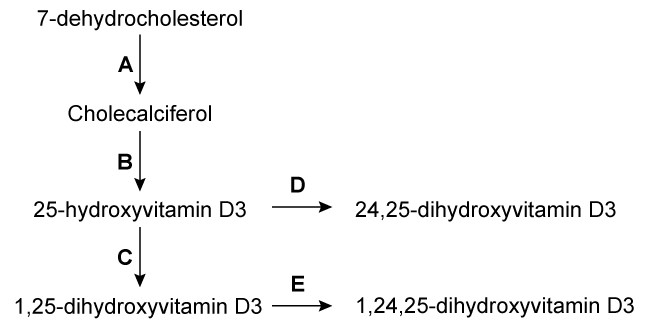
(Multiple Choice)
4.9/5 (70)
(70) A 71-year-old man is brought to the emergency department by his wife because of increasing confusion, weakness, and vomiting for 1 day. He has had 5 episodes of vomiting and blurry vision; he told his wife that "everything appears in different colors." His wife reports that his drug regimen was adjusted because of worsening tibial edema 1 week ago. He has congestive heart failure, hypothyroidism, and osteoarthritis. Current medications include metoprolol, digoxin, levothyroxine, spironolactone, and furosemide. His temperature is 36.7°C (98°F), pulse is 56/min, and blood pressure is 98/68 mm Hg. He is confused and oriented only to person. Neurologic examination shows no focal findings. The abdomen is soft, and there is tenderness to palpation of both lower quadrants without guarding or rebound. Age-related changes in which of the following factors most likely accounts for this patient's symptoms?
(Multiple Choice)
4.8/5 (87)
(87) A 40-year-old woman is brought to the emergency department for a 2-hour history of shortness of breath. She does not smoke or use drugs recreationally. Her temperature is 37.5°C (99.5 F) and respirations are 28/min. She appears anxious and is unable to speak in full sentences. Lung auscultation reveals bilateral wheezing. Prompt endotracheal intubation for respiratory support is planned. Prior to endotracheal intubation, intravenous ketamine is administered for induction of anesthesia. Which of the following characteristics is the most likely reason for use of this anesthetic agent in this patient?
(Multiple Choice)
4.7/5 (98)
(98) 
Filters
- Essay(0)
- Multiple Choice(0)
- Short Answer(0)
- True False(0)
- Matching(0)