



 Chat with AI
Exam 11: Pharmacology and Toxicology

Exam 1: Anatomy265 Questions
Exam 2: Behavioral Sciences178 Questions
Exam 3: Biochemistry102 Questions
Exam 4: Embryology59 Questions
Exam 5: Epidemiology, Biostatistics, and Medical Informatics94 Questions
Exam 6: Genetics88 Questions
Exam 7: Histology46 Questions
Exam 8: Immunology147 Questions
Exam 9: Microbiology and Virology330 Questions
Exam 10: Pathology817 Questions
Exam 11: Pharmacology and Toxicology509 Questions
Exam 12: Physiology339 Questions
Exam 13: Psychiatry and Psychotherapy23 Questions
Select questions type


A 60-year-old man comes to the hospital with chest pain. He has had intermittent, squeezing substernal pain over the last 3 days that is now sustained. The patient has no associated palpitations, lightheadedness, or shortness of breath. Medical history is notable for moderate chronic obstructive pulmonary disease with a recent admission for an exacerbation. Blood pressure is 145/90 mm Hg and pulse is 93/min. Oxygen saturation by pulse oximetry is 98% on room air. Physical examination shows no heart murmurs, and lungs are clear to auscultation. ECG shows sinus rhythm with 2-mm anterior ST segment elevation. Cardiac troponin I levels are elevated Which of the following is the most appropriate treatment for this patient?
(Multiple Choice)
4.8/5  (75)
(75) A 65-year-old man who missed a follow-up appointment for congestive heart failure visits the doctor. Due to a persistent stomach ache, he missed his appointment. A thorough review of the past two weeks' worth of symptoms indicates anorexia, diarrhea, nausea, vomiting, and color perception issues that have gotten worse. His congestive heart failure has so far been successfully managed with a number of drugs. . If the cause of this patient's current symptoms is not corrected, which of the following complications is most likely to develop?
(Multiple Choice)
4.9/5 (85)
(85) A 22-year-old woman comes to the physician to discuss the prescription of an oral contraceptive. She has no history of major medical illness and takes no medications. She does not smoke cigarettes. She is sexually active with her boyfriend and has been using condoms for contraception. Physical examination shows no abnormalities. She is prescribed combined levonorgestrel and ethinylestradiol tablets. Which of the following is the most important mechanism of action of this drug in the prevention of pregnancy?
(Multiple Choice)
4.9/5 (80)
(80) A 62-year-old man comes to the physician because of tremors in both hands for the past few months. He has had difficulty buttoning his shirts and holding a cup of coffee without spilling its content. A couple of weeks ago, he has noticed that his symptoms improved after drinking a glass of whiskey. Family history is significant for similar problems in her mother. Vital signs are normal. Neurologic examination shows bilateral tremor in the upper extremities. Which of the following is the best treatment for this patient?
(Multiple Choice)
4.9/5 (73)
(73) A 25-year-old male visits the office complaining of recent bilateral hip pain. He had trouble walking as a result of the discomfort, which crept up on him slowly at first. The patient has never experienced trauma. His medical history is important because he has taken phenytoin for the past five years to treat a seizure disorder. The patient stays away from alcohol and tobacco use. An X-ray of the hip joint reveals diffuse cortical thinning and bilateral, symmetric, narrow radiolucent lines that are 2-3 mm wide with sclerotic borders as well as diffuse cortical thinning. Which of the following is the most likely cause of this patient's current condition?
(Multiple Choice)
4.8/5 (92)
(92) A medical student is carrying out a pharmacology experiment to ascertain the effects of a specific drug. She administers this drug intravenously in various dose ranges while measuring several important hemodynamic parameters. The graphs below show the observed changes in renal blood flow and cardiac output. A medical student is carrying out a pharmacology experiment to ascertain the effects of a specific drug. She administers this drug intravenously in various dose ranges while measuring several important hemodynamic parameters. The graphs below show the observed changes in renal blood flow and cardiac output. 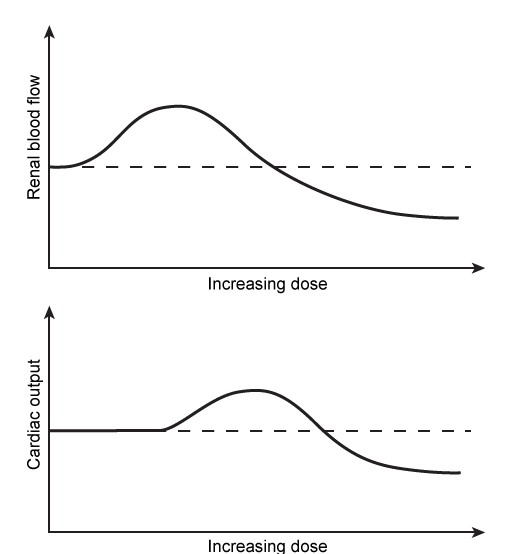 Which of the following drugs was most likely used in this experiment?
 (Multiple Choice)
4.7/5 (76)
(76) A 54-year-old man comes to the emergency department because of episodic palpitations for the past 12 hours. He has no chest pain. He has coronary artery disease and type 2 diabetes mellitus. His current medications include aspirin, insulin, and atorvastatin. His pulse is 155/min and blood pressure is 116/77 mm Hg. Physical examination shows no abnormalities. An ECG shows monomorphic ventricular tachycardia. An amiodarone bolus and infusion are given, and the ventricular tachycardia converts to normal sinus rhythm. He is discharged home with oral amiodarone. Which of the following should be tested before initiating this medication?
(Multiple Choice)
4.9/5 (85)
(85) Exertional angina is diagnosed in a 60-year-old Caucasian male. Metoprolol, isosorbide dinitrate, and aspirin are part of his treatment plan. He takes isosorbide dinitrate in the morning and again in the afternoon, but not in the evening. Such a pattern of drug administration is intended to decrease which of the following?
(Multiple Choice)
4.9/5 (86)
(86) A 56-year-old man comes to the emergency department because of a 4-day history of fever and shortness of breath. He has a history of COPD treated with inhaled albuterol. His temperature is 39.0°C (102.2°F), pulse is 95/min, respirations are 20/min, and blood pressure is 130/80 mm Hg. Cardiopulmonary examination shows decreased breath sounds and poor air movement over the left lung. Chest radiograph shows a moderate-sized loculated pleural effusion on the left side. Ultrasonography reveals multiple separate fluid pockets within the pleural space. Chest tube placement produces only a small amount of thick pus. Intrapleural administration of a medication with which of the following effects would most likely improve chest tube drainage in this patient?
(Multiple Choice)
4.9/5 (84)
(84) 
Filters
- Essay(0)
- Multiple Choice(0)
- Short Answer(0)
- True False(0)
- Matching(0)