



 Chat with AI
Exam 11: Pharmacology and Toxicology

Exam 1: Anatomy265 Questions
Exam 2: Behavioral Sciences178 Questions
Exam 3: Biochemistry102 Questions
Exam 4: Embryology59 Questions
Exam 5: Epidemiology, Biostatistics, and Medical Informatics94 Questions
Exam 6: Genetics88 Questions
Exam 7: Histology46 Questions
Exam 8: Immunology147 Questions
Exam 9: Microbiology and Virology330 Questions
Exam 10: Pathology817 Questions
Exam 11: Pharmacology and Toxicology509 Questions
Exam 12: Physiology339 Questions
Exam 13: Psychiatry and Psychotherapy23 Questions
Select questions type


A 19-year-old man is brought to the emergency department following a high-speed motor vehicle collision in which he was a restrained passenger. he has femoral fracture. he undergoes femoral stabilization. Postoperatively, he complains of difficulty voiding Bladder catheterization shows a post-void residual of 300cc of urine. This patient would most likely benefit from which of the following medications?
(Multiple Choice)
4.8/5  (87)
(87) A 65-year-old man comes to the hospital due to severe left eye pain and decreased vision of the left eye, along with nausea and vomiting.t. Past medical history is notable for hypertension and type 2 diabetes mellitus, for which he takes appropriate medications. Ophthalmologic examination shows a fixed, mid-dilated pupil and a narrowed anterior chamber of the left eye. After discussion of treatment options, the patient is initiated on timolol ophthalmic drops. Which of the following structures is the most likely target of this medication?
(Multiple Choice)
4.9/5 (86)
(86) A 56-year-old man comes to the physician because of a 1-day history of sudden severe pain in his right great toe. Four months ago, he had an episode of severe joint pain involving his left knee that lasted several days and resolved with over-the-counter analgesics. He has a history of nephrolithiasis and hypertension treated with hydrochlorothiazide. Examination shows erythema, swelling, warmth, and tenderness of the right metatarsophalangeal joint; range of movement is limited by pain. His serum uric acid is 12 mg/dL. Arthrocentesis yields cloudy fluid with a leukocyte count of 18,500/mm3 (80% segmented neutrophils). Polarized light microscopy of the synovial fluid is shown. Which of the following drugs is most likely to have precipitated this patient's condition?
(Multiple Choice)
4.8/5 (83)
(83) A 48-year-old woman comes to the physician because of a 4-month history of lightheadedness, intermittent headaches, and easy bruising. Five months ago, she was treated for an episode of thrombophlebitis. Physical examination shows multiple bruises on her limbs. Laboratory studies show a platelet count of 900,000/mm3 and elevated levels of serum lactate dehydrogenase and uric acid. Treatment with a medication is begun that is also used in the treatment of sickle cell disease. Which of the following mechanisms is most likely responsible for the beneficial effect of this drug in sickle cell disease?
(Multiple Choice)
4.8/5 (86)
(86) A 47-year-old man with gastroesophageal reflux disease comes to the physician because of severe burning chest pain and belching after meals. He has limited his caffeine intake and has been avoiding food close to bedtime. Esophagogastroduodenoscopy shows erythema and erosions in the distal esophagus. Which of the following is the mechanism of action of the most appropriate drug for this patient?
(Multiple Choice)
4.8/5 (84)
(84) A 68-year-old man arrives at the clinic after experiencing several weeks of progressive exertional dyspnea and lower extremity edema. Medical history is important for non-Hodgkin lymphoma, which is in remission after 8 years of chemotherapy. The blood pressure is 126/76 mm Hg, and the pulse rate is 88 bpm. Physical examination reveals bilateral lower extremity edema and bibasilar lung crackles. Echocardiography reveals biventricular dilation and a 35% left ventricular ejection fraction. A stress myocardial perfusion scan ruled out inducible ischemia. After initial stabilization, long-term use of which of the following medications will most likely improve survival in this patient?
(Multiple Choice)
4.9/5 (81)
(81) A 35-year-old woman comes to the emergency department because of a 3-day history of pain in the left cheek. The pain occurs every few hours, lasts 30-60 seconds, and is aggravated by chewing and brushing her teeth. She has a history of pain with a vesicular rash in the right axillary area 1 year ago. She had an upper respiratory infection 2 weeks ago. Family history is unremarkable. Physical examination shows no abnormalities. The patient is started on a single drug therapy. On a follow-up visit 3 months later, She reports symptom improvement but is found to have the following blood counts: 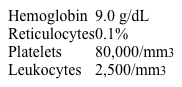 Which of the following is the most likely mechanism of action of the drug used in this patient?
 (Multiple Choice)
4.7/5 (64)
(64) A 32-year-old man is being evaluated in the surgical department altered mental status. He was admitted to the hospital 3 days ago after a motor vehicle collision. He has no history of serious illness. He has experimented with intravenous illicit drugs. He drinks 3 beers and 2 glasses of whiskey daily during the week and more on the weekends with his college fraternity. On physical examination, the patient is diaphoretic, tremulous, and disoriented. There are mild hand tremors but no other neurologic abnormalities. Increased activity of which of the following central nervous system receptors is the most likely cause of this patient's condition?
(Multiple Choice)
4.9/5 (89)
(89) A 70-year-old man with metastatic prostatic cancer is brought to the hospital due to worsining fatigue for the past several days. A year ago, the patient was diagnosed with prostatic cancer, which has progressed despite chemotherapy treatment and metastasized to the bone. The patient is receiving palliative care, and her pain has been adequately controlled with a stable dose of oral morphine. Temperature is 36.7 C (98 F), blood pressure is 110/62 mm Hg, pulse is 92/min, and respirations are 8/min. On physical examination, the patient is somnolent and responds to painful stimuli only. The pupils are small and sluggish to react. The lungs are clear to auscultation, and heart sounds are normal. The abdomen is soft and nondistended. Arterial blood gas analysis shows respiratory acidosis. Which of the following medication-related events most likely precipitated her current condition?
(Multiple Choice)
4.8/5 (82)
(82) A 60-year-old man comes to the office for follow up appointment, he feels shortenss of breath while walking his dog around the block. He states that he is experiencing a dyspnea while sleeping therefor he uses 3 pillows or sleep on the recliner. The patient had an acute myocardial infarction 2 years ago and has been nonadherent with his medications. Temperature is 36.9 C (98 F), blood pressure is 125/74 mm Hg, pulse is 92/min, and respirations are 21/min. Physical examination shows bibasilar lung crackles, jugular venous distension, and bilateral pitting edema in the lower extremities. Chest x-ray reveals cardiomegaly and pulmonary venous congestion. Which of the following factors is most likely contributing to this patient's symptoms?
(Multiple Choice)
4.9/5 (83)
(83) A 55-year-old man arrives at the emergency department after experiencing an hour of intense substernal chest burning and sweating. He has a history of obesity as well as diet-controlled type 2 diabetes. On initial examination, the blood pressure is 110/70 mm Hg, and the pulse rate is 60 beats per minute and regular. On room air, oxygen saturation is 98 percent. The patient is lying flat and there are no heart murmurs heard. Auscultation reveals that the lungs are clear. The initial ECG reveals a normal sinus rhythm with a 2-mm ST-segment elevation in leads II, III, and aVF. Aspirin and morphine are given. The patient becomes dizzy as he is about to be transported to the catheterization lab for an urgent percutaneous coronary intervention, and the telemetry monitor shows sinus bradycardia at 40 beats per minute. The patient appears pale and diaphoretic and peripheral pulses are faint. Blood pressure is 70/40 mm Hg. Which of the following is the best immediate step for managing this patient's condition?
(Multiple Choice)
4.9/5 (81)
(81) A 6-year-old boy is brought to the office by his mother due to behavioral difficulties at school. His teacher has said, "He interrupts the class, doesn't listen, and cannot sit still for more than a few minutes." He has been sent home on a few occasions for hitting other children and taking their toys. The patient was adopted at age 6 months and his birth history is unknown. He runs around the office playing with various toys and is easily distracted. Vital signs are within normal limits. Weight and height are tracking on the 10th percentile, and head circumference is below the 5th percentile for age and sex. Physical examination reveals short palpebral fissures, a smooth philtrum, thin upper lip, and difficulty with both gross and fine motor coordination. Which of the following is the likely cause of this patient's condition?
(Multiple Choice)
4.9/5 (70)
(70) A 44-year-old woman who was previously healthy arrives to the emergency room complaining of left flank discomfort, dysuria, a fever, and chills. Blood pressure is 80/40 mm Hg, the temperature is 38.9 C (102 F), and the pulse is regular at 140 bpm. Tenderness at the left costovertebral angle is visible on physical examination. Laboratory tests show pyuria, bacteriuria, and leukocytosis. Intravenous fluids and empiric broad-spectrum antibiotics are given. A phenylephrine infusion is started because the patient's prolonged hypotension cannot be treated with oral medication. Her heart rate drops to 100/min after some time. Which of the following intracellular alterations is anticipated in this patient in comparison to right before the infusion? 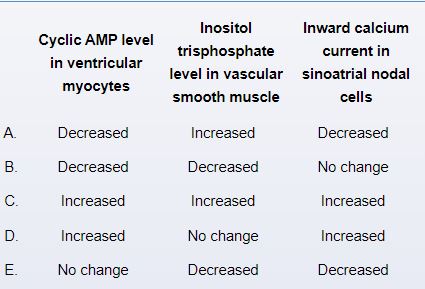
(Multiple Choice)
4.9/5 (96)
(96) A 65-year-old man is brought to the emergency department because of the sudden onset of severe right eye pain, blurred vision, nausea, and vomiting. He has had an upper respiratory tract infection for the past 2 days which developd an allergic eye symptoms for which he used over-the-counter eye drop to treat his symptoms,. Examination shows a rock-hard, injected right globe and a fixed, mid-dilated pupil on the right. Gonioscopy shows that the iris meets the cornea at an angle of 10° (N = 20-45°). Which of the following medications was most likely used by this patient?
(Multiple Choice)
4.7/5 (68)
(68) A 33-year-old woman is brought to the emergency department 30 minutes after being rescued from a fire in her apartment. She reports nausea, headache, and dizziness. Physical examination shows black discoloration of her oral mucosa. Pulse oximetry shows an oxygen saturation of 99% on room air. The substance most likely causing symptoms in this patient primarily produces toxicity by which of the following mechanisms?
(Multiple Choice)
4.9/5 (86)
(86) A14-year-old girl is brought to the physician by her mother because of episodic shortness of breath and a dry cough that is worse at night. She had an upper respiratory tract infection 4 weeks ago. Lungs are clear to auscultation. Pulmonary function tests are as follows:  . The physician administers a drug, after which repeat spirometry shows a reduced peak expiratory flow rate. Which of the following drugs was most likely administered?
 (Multiple Choice)
4.8/5 (86)
(86) A 55-year-old man visits the clinic owing to sporadic chest tightness, coughing, and shortness of breath over the previous three months. The patient's childhood asthma improved around puberty, and he hasn't used steroids or inhalers since. He believes that his present symptoms and his previous asthma problems are related. The patient has no other ongoing medical illnesses; he was recently identified as having essential tremor, which has improved with medical treatment. He has never smoked and abstains from using alcohol or illegal substances. Pulse: 58 bpm; respirations: 16/ minute; blood pressure: 125/75 mm Hg. Upon physical inspection, there are scattered wheezes on both sides. There is no extremities edema, and heart sounds are normal. Most of this patient's symptoms have returned. This patient's symptom recurrence is most likely attributable to a medication that affects which of the following steps? 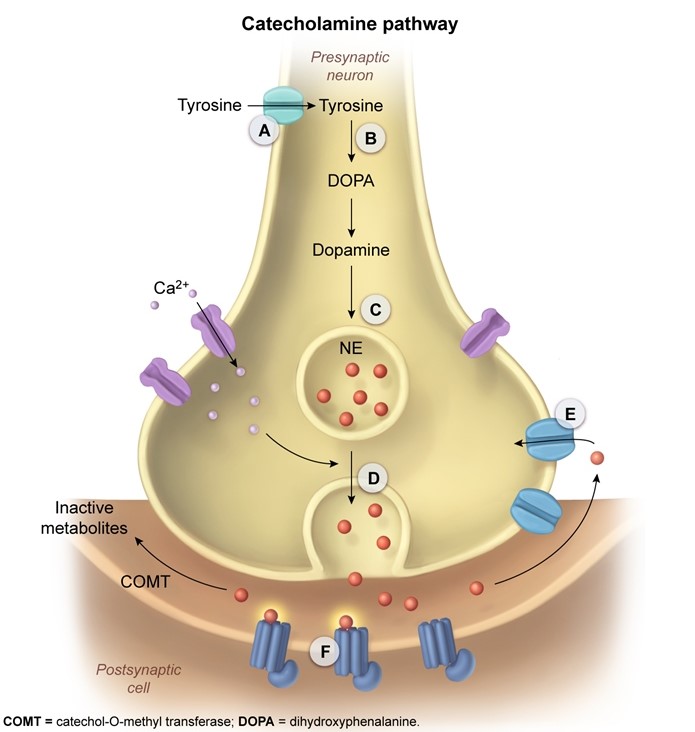
(Multiple Choice)
4.8/5 (69)
(69) A 53-year-old man comes to the office as a new patient. He feels well. He has type 2 diabetes mellitus treated with metformin. Routine colonoscopy screening from 2 months ago showed diverticulosis. His maternal aunt died from myocardial infarction at the age of 63 years. He does not smoke cigarettes and drinks three to four 12-oz beers weekly. He is 170 cm (5 ft 7 in) tall and weighs 70 kg (154 lb); BMI is 24 kg/m2. His blood pressure is 120/68 mm Hg. Physical examination shows no abnormalities. Laboratory studies show: Serum Total cholesterol 185 mg/dL
HDL cholesterol 45 mg/dL
LDL cholesterol 122 mg/dL
Triglycerides 140 mg/dL
Which of the following lipid-lowering agents would be most effective for preventing future cardiovascular events in this patient?
(Multiple Choice)
4.7/5 (82)
(82) Researchers create a cohort of experimental rats with anthracycline-induced heart failure to study the impact of heart failure on the pharmacokinetics of anti-diabetic drugs. Then, a dosage of metformin is given orally to the test animals, and blood levels are tracked over time. The experiment is repeated in control animals with healthy hearts, and the outcomes are displayed below: 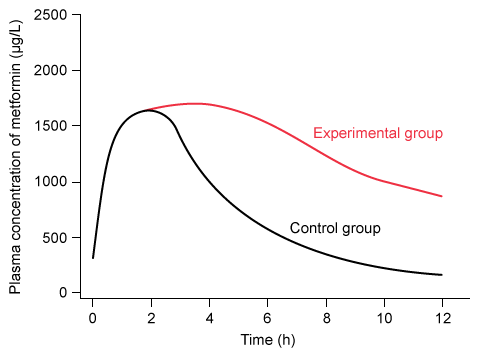 Which of the following best explains the change in serum metformin levels seen in the experimental animals?
 (Multiple Choice)
4.8/5 (78)
(78) A 20-year-old man comes to the clinic for a routine physical examination. The patient has no medical problems and takes no medication. He does not use tobacco, alcohol, or illicit drugs. He plays on his college football team and participates in intense training sessions and weekly games. Review of systems is unremarkable. Blood pressure is 120/76 mm Hg, pulse is 68/min, and respirations are 15/min. BMI is 28 kg/m. Blood pressures in the upper and lower extremities are equal. There is no jugular venous distension. Carotid upstrokes are brisk. There is a grade 2/6 early systolic murmur along the left sternal border. The murmur decreases in intensity with hand grip and passive leg elevation. Which of the following medications should be avoided while treating this patient's condition?
(Multiple Choice)
4.7/5 (83)
(83) 
Filters
- Essay(0)
- Multiple Choice(0)
- Short Answer(0)
- True False(0)
- Matching(0)