



 Chat with AI
Exam 11: Pharmacology and Toxicology

Exam 1: Anatomy265 Questions
Exam 2: Behavioral Sciences178 Questions
Exam 3: Biochemistry102 Questions
Exam 4: Embryology59 Questions
Exam 5: Epidemiology, Biostatistics, and Medical Informatics94 Questions
Exam 6: Genetics88 Questions
Exam 7: Histology46 Questions
Exam 8: Immunology147 Questions
Exam 9: Microbiology and Virology330 Questions
Exam 10: Pathology817 Questions
Exam 11: Pharmacology and Toxicology509 Questions
Exam 12: Physiology339 Questions
Exam 13: Psychiatry and Psychotherapy23 Questions
Select questions type


A 54-year-old woman comes to the physician because of abdominal distention and mild diffuse abdominal discomfort for the past week. She has not had nausea, vomiting, fever, or chills. She was diagnosed with alcoholic liver cirrhosis 2 years ago. Examination shows a protruding, distended abdomen that is dull to percussion with a positive fluid wave. Ultrasonography shows mild to moderate ascites. Appropriate treatment of the patient's condition is started. Four days later, the patient experiences palpitations and chest pain at home. She is brought to the emergency department, where her temperature is 37.3°C (99.1°F), pulse is 182/min, respirations are 18/min, and blood pressure is 82/50 mm Hg. An ECG shows ventricular tachycardia. Initial laboratory studies show:
Serum
Na+ 131 mEq/L
K+ 2.9 mEq/L
Cl- 92 mEq/L
Bicarbonate 34 mEq/L
Urea nitrogen 42 mg/dL
Creatinine 4.8 mg/dL
Glucose 90 mg/dL
Ca2++ 8.1 mg/dL
Mg2++ 1.3 mEq/L
Phosphate 4.7 mg/dL
Arterial Blood Gas
PH 7.52
PCO2 45 mm Hg
PO2 90.2 mm Hg
She is successfully cardioverted to normal sinus rhythm. Which of the following treatments is most likely responsible for this patient's presentation?
(Multiple Choice)
4.8/5  (79)
(79) A 29-year-old nulligravid woman comes to the office complaining of increasing bilateral nipple discharge that has been staining her bra for the past two months. The patient has not experienced any breast pain, headaches, or changes in eyesight, nor has she felt any breast mass. Three months have passed since her last period, and home pregnancy tests have come back negative. She used to have normal 28-day menstrual periods in the past. The patient is healthy and does not take any drugs. Vital signs are in the expected range. Visual fields are intact by confrontation upon evaluation. On nipple compression, a yellowish fluid can be expressed bilaterally. Neither lymphadenopathy nor breast lumps exist. An examination of the pelvis reveals no abnormality. Testing of serum beta-hCG is negative. Brain imaging shows a 0.6-cm pituitary mass. Pharmacotherapeutic treatment is begun, and on a follow-up visit the patient reports that her symptoms are improving. Which of the following is the most likely mechanism of action of this medication?
(Multiple Choice)
4.8/5 (75)
(75) A 64-year-old man with a long history of hypertension arrives at the emergency department complaining of a dry cough and shortness of breath. For the past two days, the patient has been unable to sleep in a flat position. The blood pressure is 192/102 mm Hg, and the pulse rate is 92 beats per minute. An S4 and bibasilar crackles are discovered during a physical examination. He begins receiving intravenous nitroglycerin infusions and soon reports significant symptom relief. Which of the following physiologic changes are most likely to occur following administration of this medication? 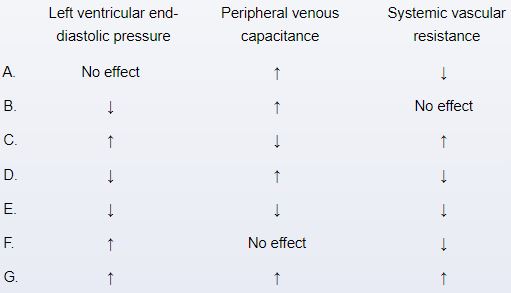
(Multiple Choice)
5.0/5 (93)
(93) A 27-year-old woman comes to the office with fatigue, fever, and extremely painful genital lesions. She has never had such symptoms before. She is sexually active with a new partner. On examination, the patient has several tiny, thin-walled vesicles on an erythematous base and exquisitely tender, shallow ulcers on the labia. Tender inguinal lymphadenopathy is present. Tzanck smear of the genital lesions shows multinucleated giant cells. A drug is prescribed that can be used to manage this acute episode and prevent future episodes of this patient's condition. This drug most likely works by which of the following mechanisms?
(Multiple Choice)
4.7/5 (81)
(81) Seven days after undergoing bilateral total knee arthroplasty, a 65-year-old man comes to the physician with a dark discoloration and blisters on his abdomen. Current medications include simvastatin, aspirin, and low molecular weight heparin. His vital signs are within normal limits. Examination of the skin shows multiple coalescing blisters with areas of necrosis around the umbilicus. Laboratory studies show a platelet count of 32,000/mm3. Which of the following is the most likely underlying cause of this patient's symptoms?
(Multiple Choice)
5.0/5 (71)
(71) A 50-year-old man has been seen in the office a month ago for new hypertension diagnosis. His blood pressure was 158/89 mmHg and pulse is 87/min. on follow up today, he reports a muscle weakness with cramping in the lower extremities. He also has these symptoms during sleeping. He is an active swimmer but 2 days ago he couldn't swim due to symptoms . Which of the following is the most likely cause of this patient's muscular symptoms?
(Multiple Choice)
4.8/5 (87)
(87) A 32-year-old woman comes to the physician because of a 3-month history of recurrent headaches and nausea. The headaches occur a few times a month and alternately affect the right or left side. The headaches are exacerbated by loud sounds or bright light. Physical examination reveals no abnormalities. A medication is prescribed to treat her condition and the patient is instructed to take it immediately at the onset of a headache. This medication most likely decreases the severity and duration of this patient's headache through which of the following mechanisms?
(Multiple Choice)
4.9/5 (74)
(74) A 63-year-old man comes to the physician because of sudden severe pain in the right knee. He has a long history of gouty arthritis, and his current symptoms are similar to previous flares of the disease. he has been diagnosed with peptic ulcer disease His temperature is 38.0°C (100.4°F). Examination shows erythema, edema, and warmth of the right knee; range of motion is limited by pain. Arthrocentesis of the knee joint yields cloudy fluid with a leukocyte count of 24,000/mm3 (74% segmented neutrophils). Polarized light microscopy shows needle-shaped, negatively birefringent crystals. The patient is started on a new medication for gout that provides significant relief of his symptoms, but he returns to the clinic a week later with diarrhea and persistent nausea. The drug used in this patient most likely affects which of the following cell structures?
(Multiple Choice)
4.8/5 (86)
(86) A 55-year-old man with HIV on antiretroviral therapy comes to the physician for a follow-up examination. His HIV viral load is 559 copies/mL (N<49). His physician is concerned about the development of drug resistance. Thus, his physician added a drug that is structurally unrelated to nucleosides and is not phosphorylated intracellularly. The drug acts within the cytoplasm of infected cells to inhibit the synthesis of viral DNA from the RNA template. Which of the following agents was most likely used in this patient?
(Multiple Choice)
4.8/5 (94)
(94) A 50 year-old male is brought to the emergency department due to sudden sharp pain at right ankle joint. It's started this morning. He has no prior medical conditions and takes no medications. He doesn't use tobacco but drinks heavily a night before. He is treated with oral colchicine and experiences significant relief of symptoms within 12 hours. The drug used in this patient most likely affects which of the steps shown in the diagram below? 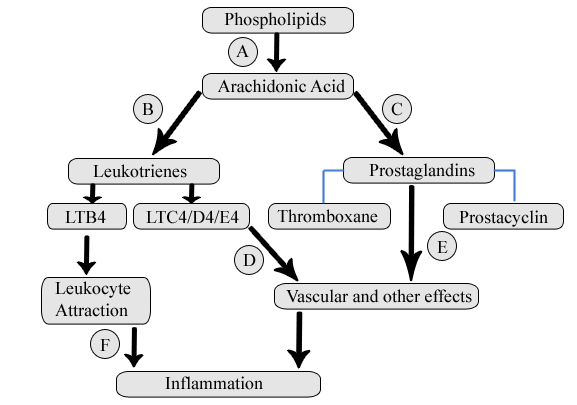
(Multiple Choice)
4.9/5 (89)
(89) A 56-year-old man comes to the physician because of a painless blistering rash on his hands, forearms, and face for 2 weeks. The rash is itchy and seems to get worse a few days after prolonged sun exposure. He has also noticed that his urine is darker than usual. His aunt and sister have a history of similar skin lesions. Examination of the skin shows multiple fluid-filled blisters and oozing erosions on the forearms, dorsal side of both hands, and forehead. There are areas of hyperpigmented scarring and patches of bald skin along the sides of the blisters. Which of the following is the most appropriate pharmacotherapy to treat this patient's condition?
(Multiple Choice)
4.8/5 (68)
(68) A 49-year-old homeless man comes to the emergency department because of fatigue,abdominal pain, and worsening diarrhea. He was diagnosed with HIV-infection 5 years ago but has never had any symptoms. He has always refused to take antiretroviral medication. on physical examination, there is a tender abdomen. Laboratory results show a CD4 cell count of 38/mm3, leukopenia, and thrombocytopenia. A CT scan of the abdomen reveals colitis. Colonoscopy reveals areas of erosions and ulcerations; pathology demonstrates cells with viral intranuclear and intracytoplasmic inclusions. Antiviral therapy is initiated to treat the colitis with an intravenous agent that does not require intracellular activation and is known to bind in vitro with viral-encoded enzymes such as DNA polymerase, RNA polymerase, and reverse transcriptase. Which of the following agents did this patient most likely receive?
(Multiple Choice)
4.8/5 (89)
(89) A 65-year-old man comes to the office due to worsening urinary symptoms over the past year. he reports a poor urinary flow and straining during urination. He feels the symptoms are bothersome but are not affecting his quality of life. Examination shows a smooth, symmetrically enlarged prostate without nodules or tenderness. There is no suprapubic tenderness. Prostate-specific antigen level is 2.5 ng/mL and normal urinalysis. A finasteride is prescribed. After 7 months of priscribing the medication his symptoms improve and his prostate has regressed in size. Which of the following histological patterns was most likely present at the time of initiation of treatment?
(Multiple Choice)
4.8/5 (84)
(84) Researchers are conducting an experiment to evaluate genetic diversity in medication biotransformation. Four hours after administering a set dosage of isoniazid to a group of volunteers, the plasma drug concentration is assessed. These participants' plasma drug concentrations are distributed as follows. 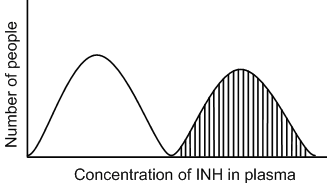 Variation of which of the following processes provides the best explanation for the shaded area of the curve?
 (Multiple Choice)
4.8/5 (79)
(79) A 57-year-old woman is brought to the emergency department because of crampy abdominal pain and foul-smelling, watery diarrhea. One week ago, she underwent treatment of cellulitis with clindamycin. Her temperature is 38.4°C (101.1°F). Abdominal examination shows mild tenderness in the left lower quadrant. Her leukocyte count is 12,800/mm3. An enzyme immunoassay is positive for glutamate dehydrogenase antigen and toxins A and B. Treatment is begun with a drug that inhibits the sigma subunit of the RNA polymerase. The patient was most likely treated with which of the following drugs?
(Multiple Choice)
4.8/5 (78)
(78) A 54-year-old man's paroxysmal atrial fibrillation is being assessed. The patient feels palpitations, pressure in the chest, dizziness, and shortness of breath during the episodes. For diabetes mellitus under diet management and hypertension, medical history is important. Prior tests revealed no valvular disease, no obstructive coronary artery disease, and a normal left ventricular ejection fraction. The decision is made to continue dofetilide medication. Initiation of this therapy increases this patient's risk for which of the following?
(Multiple Choice)
4.9/5 (98)
(98) A 71-year-old woman comes to the physician because of palpitations and shortness of breath that started 3 days ago. She has hypertension and congestive heart failure. Her pulse is 124/min, and blood pressure is 130/85 mm Hg. Cardiac examination shows an irregularly irregular rhythm without any murmurs. An ECG shows a narrow-complex tachycardia without P waves. The patient is prescribed a prophylactic medication that can be reversed with idarucizumab. The expected beneficial effect of the prescribed drug is most likely due to which of the following effects?
(Multiple Choice)
4.8/5 (75)
(75) A 82-year-old woman is seen in the emergency department due to increased headache and abdominal pain. She also vomitted twice and feels nauseated. She has a history of chronic obstructive pulmonary disease and despite taking her medication regulary, her symptoms were worsening for which a thyeophylline is added. Temperature is 37 C (98.6 F), blood pressure is 115/75 mm Hg, pulse is 116/min, and respirations are 23/min. On physical examination, the patient appears agitated and restless. There is a coarse tremor of the outstretched arms. Chest auscultation reveals mild expiratory wheezing. Serum theophylline levels are markedly elevated. Treatment with which of the following agents most likely precipitated this patient's current symptoms?
(Multiple Choice)
4.8/5 (69)
(69) A 50-year-old woman comes to the physician for the evaluation of fatigue over the past 6 months. During this period, the patient has also had a 5 kg (11-lb) weight loss. She has a history of Hashimoto thyroiditis. She does not smoke. She drinks one glass of wine per day. She does not use illicit drugs. Her only medication is levothyroxine. Temperature is 37°C (98.6°F), pulse is 70/min, and blood pressure is 110/70 mm Hg. Abdominal examination shows tenderness in the right upper quadrant with no rebound or guarding. Laboratory studies show a serum alanine aminotransferase level of 190 U/L, serum aspartate aminotransferase level of 250 U/L, and serum total bilirubin level of 0.6 mg/dL. an autoimmune hepatitis diagnosis is done If zathioprine is prescribed for continued management of autoimmune hepatitis. Which of the following should be periodically monitored while the patient is taking this new medication?
(Multiple Choice)
4.9/5 (90)
(90) Parents of a 16-year-old child who has tremors and trouble walking bring him to the office. His academic performance has dropped over the past year, and he has become moodier and more aggressive. His parents also observe that he has been sleeping more than normal, and that for the past two months, he hasn't been eating well. The patient's tremor in both hands started around three weeks ago, and it is most noticeable when he reaches for something or tries to write. Over the past week, the tremor has dramatically deteriorated, and he has started to walk with an uneven, wide-based gait. Elevated serum transaminases and 24-hour urine copper excretion are seen in laboratory tests. Therapy with penicillamine is indicated for the patient. This medication primarily works through which of the following mechanisms?
(Multiple Choice)
4.8/5 (87)
(87) 
Filters
- Essay(0)
- Multiple Choice(0)
- Short Answer(0)
- True False(0)
- Matching(0)