



 Chat with AI
Exam 11: Pharmacology and Toxicology

Exam 1: Anatomy265 Questions
Exam 2: Behavioral Sciences178 Questions
Exam 3: Biochemistry102 Questions
Exam 4: Embryology59 Questions
Exam 5: Epidemiology, Biostatistics, and Medical Informatics94 Questions
Exam 6: Genetics88 Questions
Exam 7: Histology46 Questions
Exam 8: Immunology147 Questions
Exam 9: Microbiology and Virology330 Questions
Exam 10: Pathology817 Questions
Exam 11: Pharmacology and Toxicology509 Questions
Exam 12: Physiology339 Questions
Exam 13: Psychiatry and Psychotherapy23 Questions
Select questions type


An otherwise healthy 40-year-old man comes to the office due to an enlarging lipoma. The patient has had a lipoma on his upper back for the past three years, and it has rapidly increased in size over the past 6 months. Physical examination shows an 8-mm raised lesion with well-defined borders on the upper back. Excisional biopsy of the lesion is planned. Local anesthesia is administered via an infiltrating injection of lidocaine mixed with epinephrine. Which of the following is the most likely impact of mixing the latter medication with the anesthetic agent?
(Multiple Choice)
4.7/5  (86)
(86) A 48-year-old guy visits the clinic because he is worried about his very dry, red, and cracked skin. The patient states that he always washes his hands after touching anything out of concern for possible infection. He washes his hands for three to four hours every day and takes several showers. He just lost his job because he wouldn't use keyboards that were shared by coworkers, and he's scared that he won't be able to get another one. Physical examination reveals erythematous palms with skin that is flaking. Treatment of this patient's disorder is most likely to involve a medication affecting which of the following neurotransmitters?
(Multiple Choice)
4.8/5 (73)
(73) A 23-year-old man with a history of schizophrenia is brought to the emergency department following a suicide attempt. He swallowed several of his father's pills after an intense argument with his parents a few hours ago. On examination, the patient responds to painful stimuli but is somnolent. Respiratory rate is 6/min and after naloxone bolus infusion increases to 14/min. Lungs are clear to auscultation. Which of the following additional findings were most likely present in this patient on initial assessment?
(Multiple Choice)
4.7/5 (69)
(69) A 78-year-old man with severe dementia is brought to the emergency department after experiencing lethargy, fever, and vomiting for the previous day. The patient is in a nursing home, and his caregivers report that his oral intake has been poor over the last week. Emphysema, heart failure with reduced ejection fraction, hypertension, and type 2 diabetes are all risk factors. The patient is lethargic but arousable on physical examination. The blood pressure is 60/30 mm Hg, and the pulse rate is 120 beats per minute. The extremities are comfortable. Over the right lower lung, coarse rhonchi can be heard. Following a series of intravenous fluid boluses, the patient receives an intravenous infusion of an agent that increases peripheral vascular resistance, blood pressure, and heart rate. Which of the following agents is most likely being described?
(Multiple Choice)
4.8/5 (72)
(72) Resistant hypertension has been diagnosed in a 46-year-old man. He had a thorough workup for secondary hypertension, which revealed nothing. The patient has tried several antihypertensive medications with no success. Otherwise, the patient's medical history is unremarkable. He agrees to participate in a study of a new long-acting medication that causes selective direct relaxation of arteriole smooth muscle but has no effect on veins. Which of the following adverse effects is most likely to be caused by the drug during the clinical trial?
(Multiple Choice)
4.9/5 (88)
(88) A72-year-old man with a history of prostatic cancer comes to the office due to persistent back pain. The patient was recently started on radiation treatment for several vertebral metastases. He has taken acetaminophen and nonsteroidal anti-inflammatory drugs but continues to have severe pain. On physical examination, he has tenderness over several lumbar vertebrae. Neurologic examination is unremarkable. The patient is started on oral morphine therapy. Which of the following is the most likely direct effect of this medication on the spinal cord neurons of this patient?
(Multiple Choice)
4.8/5 (85)
(85) A 54-year-old woman comes to the physician because of fatigue, difficulty falling asleep, and night sweats for the past 6 months. Thyroid hormone levels were normal, and the patient was subsequently diagnosed with menopausal hot flashes. Treatment with estrogen-containing hormone replacement therapy was begun with significant symptom improvement. She has no other medical conditions and takes no other medications. Which of the following most likely occurred in this patient as a result of her medication use?
(Multiple Choice)
4.9/5 (92)
(92) A 26-year-old pregnant woman in her 16th week of pregnancy visits the office for a prenatal check-up. The patient has had mild hyperthyroidism for two years due to Graves disease and began taking propylthiouracil when she decided to start to be pregnant. There has been no tremor, palpitations, diarrhea, or heat intolerance in the patient. She has no other medical issues or drug allergies. She supplements her diet with prenatal vitamins. The patient does not smoke, drink alcohol, or use illegal drugs. The temperature is 36.7 C (98 F), the blood pressure is 110/60 mm Hg, and the pulse rate is 88 beats per minute. There is no evidence of lid lag, exophthalmos, or hand tremors on physical examination. Thyroid gland palpation is normal. The heart rate of the fetus is normal. Thyroid hormone levels are within the lab's normal ranges. During this visit, her thyroid treatment is changed from propylthiouracil to methimazole. Switching the patient's therapy at this time is aimed at decreasing which of the following complications?
(Multiple Choice)
5.0/5 (85)
(85) A 68-year-old man undergoes successful mechanical prosthetic aortic valve replacement for severe aortic valve stenosis. After the procedure, he is started on an oral medication and instructed that he should take it for the rest of his life and avoid consuming large amounts of dark-green, leafy vegetables. Which of the following laboratory parameters should be regularly monitored to guide dosing of this drug?
(Multiple Choice)
4.8/5 (86)
(86) A 67-year-old man is admitted to the hospital with right lower lobe pneumonia and later develops hypotension and lactic acidosis. He is starting an intravenous drip of norepinephrine. After a few hours, the antecubital vein used for the infusion blanches, and the tissues around the IV site become cold, hard, and pale. Which of the following agents is most likely to be beneficial when injected locally into the affected tissues?
(Multiple Choice)
4.8/5 (86)
(86) Due to fever and confusion, an 85-year-old man is transferred from a nursing home to the hospital. When the patient arrives, he is immediately admitted to the intensive care unit with a presumptive diagnosis of septic shock. Antibiotic therapy is begun. The patient is unable to provide a history, but his caregivers report that he has been experiencing nonspecific symptoms, including fever, for a few days. There is a history of cardiovascular disease, diverticulitis, and dementia in the patient. Despite aggressive intravenous hydration, blood pressure is 60/40 mm Hg. In response to the patient's hypotension, intravenous norepinephrine is administered. Which of the following cellular changes is most likely to occur in direct response to the medication?
(Multiple Choice)
4.9/5 (82)
(82) A 48-year-old man is brought to the emergency department 20 minutes after being rescued from a house fire. He reports headache, metallic taste, abdominal pain, and nausea. He appears confused and agitated. His pulse is 125/min, respirations are 33/min, and blood pressure is 100/65 mm Hg. Pulse oximetry on room air shows an oxygen saturation of 98%. Physical examination shows a bright red color of the skin. His breath smells of bitter almonds. Hyperbaric oxygen therapy and appropriate pharmacotherapy are initiated. The expected beneficial effect of this drug is most likely due to which of the following mechanisms?
(Multiple Choice)
4.8/5 (70)
(70) During a follow-up office visit, a 68-year-old man complains of myalgia and fatigue. Since a recent acute myocardial infarction, the patient has been on high-intensity statin therapy. His other health issues include hypertension and type 2 diabetes. There is mild generalized muscle tenderness on examination. The level of creatine kinase in the blood is 456 U/L. TSH and vitamin D levels are within the normal range. The patient's statin therapy is stopped, and he is started on a medication that inhibits cholesterol absorption at the small intestine's brush border. Which of the following drugs was most likely started in this patient?
(Multiple Choice)
4.9/5 (85)
(85) A 19-year-old woman is brought to the emergency department by her rommate after she found her unconscious. Her rommate reports that she has been training for a marathon since the beginning of the summer. She is alert and oriented but becomes irritable when realizing that she is at a hospital and refuses to answer questions. She appears tired. She is 170 cm (5 ft 7 in) tall and weighs 51 kg (112 lb). Her temperature is 35.5°C (96°F), pulse is 44/min, respirations are 20/min, and blood pressure is 84/48 mm Hg. Examination shows dry, scaly skin and dry mucous membranes. Urine screening for diuretics reveals a large amount of furosemide. Which of the following sets of laboratory findings would most likely suggest that this patient is abusing furosemide to lose weight? 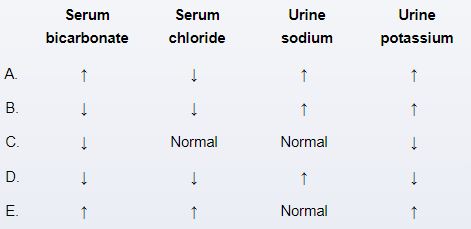
(Multiple Choice)
4.8/5 (86)
(86) A 42-year-old woman comes to the physician because of a month history of diffuse weakness. There is no cervical or axillary lymphadenopathy. Cardiopulmonary and abdominal examination shows no abnormalities. A lateral x-ray of the chest shows an anterior mediastinal mass. A surgical remova; of anterior mass is planned. Preoperative nerve conduction studies revealed a decremental response to repetitive motor nerve stimulation. She has no other medical conditions and does not use tobacco, alcohol, or illicit drugs. The patient has no drug allergies. Compared to a healthy individual, which of the following anesthesia-related medications is most likely to have increased potency in this patient?
(Multiple Choice)
4.7/5 (75)
(75) A 52-year-old woman comes to the physician because of a 1-day history of severe pain and swelling of her left great toe. Medical history is significant for kidney transplant due to focal segmental glomerulosclerosis. The patient is diagnosed with gout and treated with an appropriate drug. Six weeks later, the patient is seen at follow-up. She has no foot pain and the swelling has subsided. Serum uric acid level is 13.5 mg/dL and creatinine level is 0.9 mg/dL. Allopurinol is prescribed. Initiation of this drug would most likely increase the activity of which of the following medications?
(Multiple Choice)
4.8/5 (73)
(73) A 25-year-old man comes to the office due to difficulty walking and muscle stiffness. Medical history is notable for schizophrenia. The last hospitalization for acute psychosis was 3 weeks ago. Current medications include fluphenazine, which was started during her recent hospitalization. Examination shows a shuffling gait, rigidity in the upper extremities, and a low-amplitude tremor of her hands that improves with activity. On mental status examination, he is alert and oriented with mild paranoia but no auditory hallucinations. Which of the following is the best treatment for this patient's current symptoms?
(Multiple Choice)
4.9/5 (86)
(86) Due to altered mental status, a 78-year-old woman is admitted to the hospital. A history of pyelonephritis, type 2 diabetes mellitus, coronary artery disease, and heart failure with a reduced ejection fraction is significant. The temperature is 36.2 C (97.2 F), the blood pressure is 80/50 mm Hg, the pulse rate is 120 beats per minute, and the respirations rate is 24/ minute. On room air, oxygen saturation is 90%. The examination reveals bilateral crackles. Her blood pressure rises and her heart rate falls after she begins appropriate treatment, which includes the administration of norepinephrine infusions. This patient's change in heart rate is most likely due to norepinephrine's effect on which of the following receptors?
(Multiple Choice)
4.7/5 (77)
(77) A 50-year-old man is brought to the emergency department 30 minutes after his farmhand found him on the ground sweating profusely. On arrival, he is lethargic and unable to provide any history. His temperature is 37.5°C (99.5°F), pulse is 42/min, and blood pressure is 95/60 mm Hg. Physical examination shows diaphoresis and excessive salivation. The pupils are pinpoint and unreactive, and significant tearing is noted. Diffuse rhonchi and wheezing are present in the lungs bilaterally. First-line therapy is administered, but the patient remains weak. Treatment with which of the following is most likely to improve this patient's current condition?
(Multiple Choice)
4.7/5 (84)
(84) A 22-year-old woman is evaluated in the office due to progressive acne on her face, chest and back. Although, she takes oral doxycyclin regularly, her acne has worsened over last month. The patient was recently diagnosed with iron deficiency anemia due to abnormal uterine bleeding and began taking a combined oral contraceptive and an iron supplement. Physical examination shows comedones and pustules on her face and upper back. The remainder of the examination shows no abnormalities. Which of the following is the most likely cause of this patient's worsening symptoms?
(Multiple Choice)
5.0/5 (87)
(87) 
Filters
- Essay(0)
- Multiple Choice(0)
- Short Answer(0)
- True False(0)
- Matching(0)