



 Chat with AI
Exam 11: Pharmacology and Toxicology

Exam 1: Anatomy265 Questions
Exam 2: Behavioral Sciences178 Questions
Exam 3: Biochemistry102 Questions
Exam 4: Embryology59 Questions
Exam 5: Epidemiology, Biostatistics, and Medical Informatics94 Questions
Exam 6: Genetics88 Questions
Exam 7: Histology46 Questions
Exam 8: Immunology147 Questions
Exam 9: Microbiology and Virology330 Questions
Exam 10: Pathology817 Questions
Exam 11: Pharmacology and Toxicology509 Questions
Exam 12: Physiology339 Questions
Exam 13: Psychiatry and Psychotherapy23 Questions
Select questions type


A 26-year-old woman is brought to the emergency department by her husband 1 hour after the onset of chest palpitations. Her symptoms began suddenly while she was drinking coffee and have persisted since then. She has not had shortness of breath, chest pain, dizziness, or loss of consciousness. She has experienced these palpitations before, but they typically resolve spontaneously within a few minutes. She has no history of serious illness and takes no medications. Her temperature is 36.8°C (98.2°F), pulse is 155/min, respirations are 18/min, and blood pressure is 130/82 mm Hg. Pulse oximetry on room air shows an oxygen saturation of 97%. Rapid intravenous administration of a medication to this patient results in instantaneous resolution of the arrhythmia but is accompanied by short-lived flushing, burning in the chest, and shortness of breath. Which of the following medications was used to treat this patient's condition?
(Multiple Choice)
4.9/5  (94)
(94) A 56-year-old woman arrives at the clinic for a check-up on her heart failure with reduced ejection fraction. The patient has been hospitalized twice in the last three months due to acute decompensation of heart failure that required intravenous furosemide treatment. She has been taking high doses of oral furosemide since her most recent discharge, but she still has progressive lower extremity edema and weight gain. Serum creatinine levels are 1.2 mg/dL and serum potassium levels are 4.1 mEq/L. Metolazone is being administered to the patient. Because of which of the following effects of furosemide is the addition of metolazone likely to aid in the treatment of this patient?
(Multiple Choice)
4.8/5 (80)
(80) A 14-year-old boy is brought to the hospital by his mother after an episode of generalized body shaking. He looks confused and lethargic. Physical examination shows a tongue laceration , otherwise unremarkable. His seizures have been refractory to various antiepileptic medications, and he is started on lamotrigine. The patient should be instructed to see his physician immediately if which of the following symptoms occurs?
(Multiple Choice)
4.9/5 (77)
(77) A 21-year-old man is brought to the emergency department by his roommate because of altered mental status. He found him covering his ears and shouting near the house . . Upon questioning, he was unable to look directly at the physician and answer coherently., he reported feeling nauseous and vomited twice. His temperature is 38.2°C (100.8°F), pulse is 100/min, respirations are 28/min, and blood pressure is 110/77 mm Hg. Physical examination shows normal-sized reactive pupils and clear lungs. There is tenderness over the epigastric area. He is admitted to the hospital for evaluation. Three hours after admission, he has a tonic-clonic seizure. Laboratory studies show:
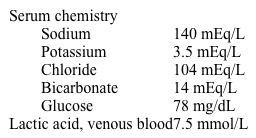 Which of the following is the most likely cause of this patient's findings?
 (Multiple Choice)
5.0/5 (78)
(78) A 28-year-old woman, gravida 1, para 0, at 32 weeks' gestation is evaluated for vaginal bleeding. Five days ago, she was admitted to the hospital and started on treatment for a deep vein thrombosis in the right leg. Her pulse is 125/min and blood pressure is 95/67 mm Hg. Physical examination shows large hematomas on the upper limbs and swelling in the right calf. There is a large amount of bright red blood in the vaginal vault. Laboratory studies show a hemoglobin of 8.9 mg/dL, platelet count of 185,000/mm3, and activated partial thromboplastin time of 160 seconds. Which of the following is the most appropriate pharmacotherapy to rapidly reverse this patient's coagulopathy?
(Multiple Choice)
4.9/5 (81)
(81) A 67-year-old woman comes to the physician for a routine health maintenance examination. She has a history of hypertension and has smoked a pack of cigarettes daily for 30 years. BMI is 20.1 kg/m2. Physical examination is unremarkable.. A screening DEXA scan shows a low bone density at the femur. The patient is prescribed risedronate. Repeat bone densitometry 2 years later reveals no further loss of bone mineral density. Which of the following mechanisms most likely explains the drug's effect on bone mineral density?
(Multiple Choice)
4.9/5 (80)
(80) A pharmacist is trying to study the effect of tamoxifen on treatment of patient with recurrent breast cancer. He also detects that the serum level of the active tamoxifen metabolites are low between the relapsed patients. Which of the following is the most likely cause of the drug's ineffectiveness in this subset of patients?
(Multiple Choice)
4.9/5 (78)
(78) A 56-year-old man visits the emergency room after experiencing significant sudden widespread stomach discomfort. Epigastric pain that the patient has been dealing with for three months has responded to treatment with proton-pump inhibitors. A stiff abdomen with rebound tenderness is apparent on physical examination. Abdominal radiographs reveal free air under the diaphragm. Therapy for support is started. A massive, perforated stomach ulcer with characteristics indicative of malignancy is discovered during an exploratory laparotomy. He undergoes partial gastrectomy with gastrojejunostomy. Long-term supplementation with which of the following is most important in this patient?
(Multiple Choice)
4.7/5 (87)
(87) A 69-year-old man with a history of Parkinson disease comes to the physician for evaluation of his symptoms. Since his last visit one year ago, he has had increased tremor and bradykinesia up to an hour before his next scheduled dose and sometimes feels like he does not respond to some doses at all. One week ago, he was entirely unable to move for about a minute when he wanted to exit an elevator. What should the physician inform the patient regarding his symptoms?
(Multiple Choice)
4.9/5 (80)
(80) A15-year-old boy is brought to the emergency department after ingestion of unkown medication. On arrival, he is lethargic and confused, his blood pressure is 76/46 mm Hg, pulse is 38/min, and respirations are 16/min. Pupils are 3 mm and reactive. Oropharynx is normal. Examination shows bilateral wheezing. There is no peripheral edema. Capillary refill is 3 seconds. There is no diaphoresis. Which of the following categories of medication did this patient most likely ingest?
(Multiple Choice)
4.8/5 (89)
(89) An otherwise healthy 13-year-old boy is brought to the physician because of asthma attacks that have been increasing in frequency and severity with running over the past 4 weeks. Medical history includes childhood asthma that has not required treatment for the past 5 years. The patient is prescribed a medication that reduces bronchoconstriction by inhibiting the interaction of inflammatory mediators with cell surface receptors. Which of the following drugs was most likely used in this patient?
(Multiple Choice)
4.9/5 (66)
(66) Repeatitive Idea A 42-year-old man arrives at the emergency department after experiencing syncope. He was standing in his kitchen this morning when he felt palpitations for about 3 seconds and then woke up on the floor. For the past few weeks, the patient has experienced intermittent palpitations, sometimes accompanied by lightheadedness. He has no significant medical history other than chronic lower back pain that began three years ago after falling from a ladder. In that fall, the patient fractured several lumbar vertebrae, necessitating surgical lumbar fusion. His back pain was uncontrollable with conservative measures, so he has been on escalating methadone doses for the past year. He does not smoke or consume alcoholic beverages. The patient has a remote history of intravenous heroin abuse but has not used it for 20 years. He has no family history of early-onset heart disease, blood clots, or sudden death. Blood pressure is 120/70 mm Hg when supine and 125/75 mm Hg when standing. Physical examination is unremarkable. Which of the following ECG findings is most likely in this patient?
(Multiple Choice)
4.8/5 (78)
(78) A 78-year-old male nursing home resident is brought to the physician because of abdominal pain and discomfort. He has a history of advanced dementia and is only partially able to verbalize his symptoms. He has had intermittent abdominal discomfort for years, with no other related symptoms. He denies diarrhea and rectal bleeding but has not had a bowel movement in approximately 5 days. The patient is largely bed-bound, and only has minimal activity with the help of nurses and physical therapists. Past regular colonoscopies have shown only benign lesions. His other medical problems include dementia, coronary artery disease, hypertension, spinal stenosis, and osteoarthritis of his hips and knees. Abdominal examination does not show tenderness, masses, or hepatosplenomegaly, although fullness is appreciated. The remainder of the examination shows no abnormalities. Polyethylene glycol is administered and produces a bowel movement within 24 hours. The mechanism of action of polyethylene glycol in this patient is most similar to the pathophysiology of which of the following disorders?
(Multiple Choice)
4.8/5 (86)
(86) A 36-year- old man comes for regular follow up. An erythropoiesis-stimulating agent was prescribed for his low hemoglobin level due chronic kidney disease 3 months ago. His hemoglobin level today is 10.5 mg/dL . Which of the following complications is most likely to be seen with the agent used to treat this patient's anemia?
(Multiple Choice)
4.8/5 (81)
(81) A 50-year-old woman comes to the physician for the evaluation of fatigue over the past 6 months. During this period, the patient has also had a 5 kg (11-lb) weight loss. She has a history of Hashimoto thyroiditis. She does not smoke. She drinks one glass of wine per day. She does not use illicit drugs. Her only medication is levothyroxine. Temperature is 37°C (98.6°F), pulse is 70/min, and blood pressure is 110/70 mm Hg. Abdominal examination shows tenderness in the right upper quadrant with no rebound or guarding. Laboratory studies show a serum alanine aminotransferase level of 190 U/L, serum aspartate aminotransferase level of 250 U/L, and serum total bilirubin level of 0.6 mg/dL. an autoimmune hepatitis diagnosis is done If zathioprine is prescribed for continued management of autoimmune hepatitis. Which of the following should be periodically monitored while the patient is taking this new medication?
(Multiple Choice)
5.0/5 (80)
(80) Two isolated samples of porcine artery arteries are examined in an experiment to study vasoconstriction of the arterial wall. As norepinephrine is infused in increasing amounts, the control vessel's vascular tone is gauged. Prior to the infusion of norepinephrine, experimental medication A is used to pre-treat the other vessel. The graph below shows the study's findings. 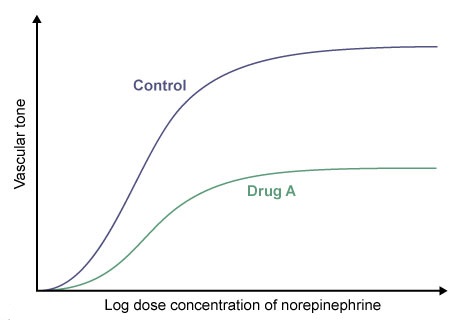 Drug A is most similar to which of the following agents?
 (Multiple Choice)
4.8/5 (77)
(77) An emergency room visit is made for a 42-year-old male who is experiencing nausea, vomiting, and impaired vision. After tasting the first few ounces of the distillate while manufacturing his own whiskey in a home moonshine still, he began to feel nauseous. Optic disc hyperemia is discovered via funduscopy. Results from the lab indicate a metabolic acidosis with a substantial anion gap. It is discovered that the patient's symptoms are brought on by alcohol dehydrogenase's enzymatic conversion of methanol into formate. Fomepizole, a drug that momentarily binds to alcohol dehydrogenase and stops methanol from reaching the enzyme's active site, is begun in his treatment. Which of the following graphs most accurately portrays the change in enzyme kinetics after administration of the antidote?(Black curves = before treatment)
(Multiple Choice)
4.8/5 (71)
(71) A 22-year-old woman comes to the physician for a follow-up examination. She had a spontaneous abortion 3 months ago. Her last menstrual period was 3 weeks ago. She reports feeling sad occasionally but has continued working and attending social events. She does not have any suicidal ideation or tendencies. She does not smoke. Vital signs are within normal limits. Physical examination including pelvic examination shows no abnormalities. A urine pregnancy test is negative. She wants to avoid becoming pregnant for the foreseeable future and is started on combined oral contraceptive pills. Which of the following is the patient at risk of developing?
(Multiple Choice)
4.7/5 (70)
(70) A 40-year-old woman is being evaluated due to absence of menstrual cycle for 4 months. Previously, her periods occurred at regular 28-day intervals and lasted 4-5 days with moderate flow. She has also noticed breast tenderness and scant nipple discharge. She has type 2 diabetes mellitus and refractory bipolar I disorder. Current medications include metformin, glipizide, lithium, and risperidone. Physical examination shows no abnormalities. A urine pregnancy test is negative. Which of the following is the most likely explanation for this patient's amenorrhea?
(Multiple Choice)
4.8/5 (83)
(83) A 28-year-old woman comes to the physician for recurrent headaches. The headaches are unilateral, throbbing, and usually preceded by blurring of vision. The symptoms last between 12 and 48 hours and are only relieved by lying down in a dark room. She has approximately two headaches per month and has missed several days of work because of the symptoms. Physical examination is unremarkable. She has no other medical conditions and no drug allergies. Vital signs are within normal limits, and physical examination shows no abnormalities. A recent brain imaging study was normal. Which of the following pharmacotherapies would be most helpful to prevent recurrences of this patient's headache?
(Multiple Choice)
4.9/5 (74)
(74) 
Filters
- Essay(0)
- Multiple Choice(0)
- Short Answer(0)
- True False(0)
- Matching(0)