



 Chat with AI
Exam 11: Pharmacology and Toxicology

Exam 1: Anatomy265 Questions
Exam 2: Behavioral Sciences178 Questions
Exam 3: Biochemistry102 Questions
Exam 4: Embryology59 Questions
Exam 5: Epidemiology, Biostatistics, and Medical Informatics94 Questions
Exam 6: Genetics88 Questions
Exam 7: Histology46 Questions
Exam 8: Immunology147 Questions
Exam 9: Microbiology and Virology330 Questions
Exam 10: Pathology817 Questions
Exam 11: Pharmacology and Toxicology509 Questions
Exam 12: Physiology339 Questions
Exam 13: Psychiatry and Psychotherapy23 Questions
Select questions type


A 60-year-old man visits the office with low back discomfort that has persisted for two months and is unresponsive to over-the-counter medications. Sleeping is disrupted by the discomfort because it is worse at night. On examination, the prostate is indurated and hard, and the lumbar vertebrae are painful to the touch. Leuprolide therapy is initiated following a thorough assessment. Which of the following changes in testosterone (solid line) and dihydrotestosterone (dashed line) levels are most likely to occur in this patient after initiation of therapy?
(Multiple Choice)
4.7/5  (80)
(80) An otherwise healthy 13-year-old boy is brought to the physician because of asthma attacks that have been increasing in frequency and severity with running over the past 4 weeks. Medical history includes childhood asthma that has not required treatment for the past 5 years. The patient is prescribed a medication that reduces bronchoconstriction by inhibiting the interaction of inflammatory mediators with cell surface receptors. Which of the following drugs was most likely used in this patient?
(Multiple Choice)
4.8/5 (82)
(82) The anesthetic medication propofol's pharmacokinetic characteristics are being investigated by a team of researchers. Adult guinea pigs are given a single bolus of a medication formulation that has been radiolabeled. Following that, blood and tissue samples are taken at predefined intervals. Liquid scintillation counting is used to determine how much of the radioactive substance is present in the samples. The connection between drug concentration and time in different tissues is shown in the graph below. 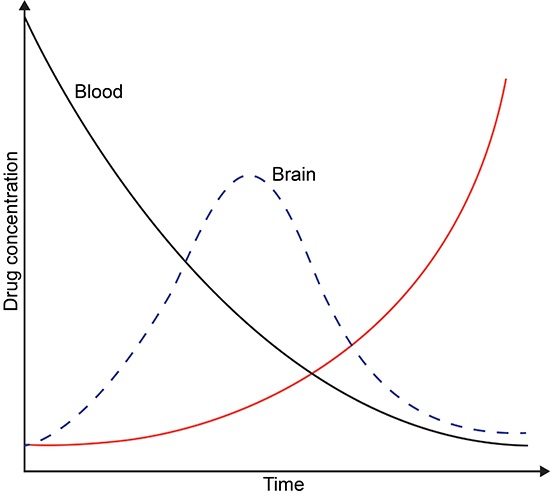 The red line on the graph most likely corresponds to which of the following tissues?
 (Multiple Choice)
4.9/5 (68)
(68) A 73-year-old woman is brought to the emergency department after she sustained a fall an hour ago. The patient was walking down the stairs when she lost her balance and fell onto the right side of her body. She is being treated for different medical conditions including hypertension, congestive heart failure, type 2 diabetes mellitus, and gastroesophageal reflux disease. She is 163 cm (5 ft 4 in) tall and weighs 50 kg (110 lb); BMI is 19 kg/m2. She appears pale. Vital signs are within normal limits. The right leg seems shorter than the left and is rotated externally. Pulses are intact in both lower extremities. Palpation of the right hip causes severe pain and the range of motion is limited. Her bone density, measured by quantitative x-ray densitometry, is consistent with osteoporosis. Which of the following drugs, had it been used as part of the medical regimen, would have had a beneficial effect on calcium homeostasis and reduced this patient's fracture risk?
(Multiple Choice)
5.0/5 (95)
(95) A 23-year-old man comes to the emergency department because of a 3-day history of painful swelling of the right thigh. There is no associated recent trauma. Physical examination shows a 4 × 3-cm area of induration that is fluctuant and warm to the touch, consistent with an abscess. The patient consents to incision and drainage of the abscess in the emergency department. Prior to laceration repair with suture, lidocaine is injected in the subcutaneous tissue around the laceration. The patient reports immediate relief of pain, and there is loss of sensation to touch in the area infiltrated with the medication. These effects are most likely due to which of the following changes within the affected neurons?
(Multiple Choice)
4.7/5 (80)
(80) A pharmaceutical researcher is researching a brand-new asthma medication that reverses irritant-induced bronchoconstriction. A postvagotomy (total transection of the vagus nerve) group of laboratory guinea pigs and a normal research group are both used. Without receiving the study drug, irritants are administered to both groups, and changes in bronchial diameter are noted. Both groups are then exposed to the irritants once more while simultaneously receiving the research medicine. 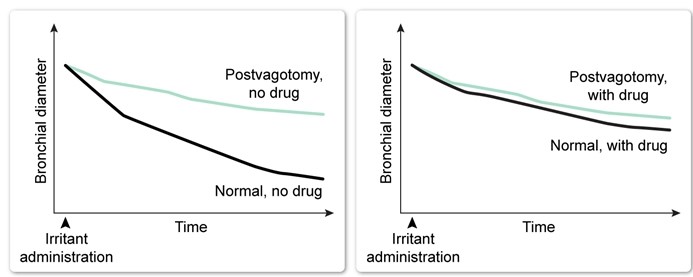 The study drug is most likely similar to which of the following medications?
 (Multiple Choice)
4.9/5 (83)
(83) A 47-year-old man visits the office for a check-up on his high blood pressure. The medical history of the patient is significant for stable angina pectoris, for which he takes sublingual nitroglycerin as needed. He does not have orthopnea, nocturnal dyspnea, or lower extremity swelling. His blood pressure is 154/107 mm Hg, and his pulse rate is 86 beats per minute. A physical examination reveals no anomalies. The patient is given a low dose of atenolol to begin with. Which of the following cellular changes will most likely occur as a direct effect of this medication? 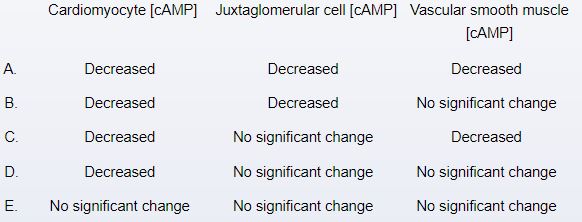
(Multiple Choice)
4.9/5 (99)
(99) A 30-year-old woman comes to the physician with fever and malaise. For the past two days, she has felt fatigued and weak and has had chills. Last night, had a temperature of 40.8°C (104.2°F). She has had a sore throat since this morning. The patient was recently diagnosed with Graves disease and started on an antithyroid medication. Physical examination shows an erythematous pharynx and a normal-sized thyroid. There is no tremor of the outstretched hands. Which of the following is the most likely cause of this patient's current condition?
(Multiple Choice)
4.8/5 (75)
(75) A 32-year-old woman is brought to the emergency department after motor vehicle collision. Imaging shows tension pneumothorax and despite management her, her condition deteriorates and she is emergently intubated due to acute respiratory failure. Temperature is 36.7 C (98 F), blood pressure is 132/81 mm Hg, pulse is 102/min, and respirations are 30/min. Shortly after intubation, she goes into cardiac arrest and dies despite resuscitation efforts. Review of the patient's medical records shows that she had been diagnosed with asthma and she had been prescribed multiple medications but had a history of noncompliance. Autopsy shows hyperinflated lungs, airway mucus plugging, and cellular infiltration of the bronchial wall. Long-term use of which of the following drugs would have best prevented the cellular reaction in this patient's airways?
(Multiple Choice)
4.8/5 (78)
(78) A 60-year-old man is brought to the emergency department due to persistent dyspnea. He has a history of heart failure with reduced ejection fraction. He has had no lightheadedness or chest pain. Blood pressure is 128/72 mm Hg and pulse is 81/min. After stabilization of the patient condition and medications are modified, he is discharged with the addition of a combination pill that inhibits neprilysin and blocks angiotensin II receptors. Which of the following is the most likely effect of this medication?
(Multiple Choice)
4.9/5 (65)
(65) A pharmacist is trying to study the effect of aminoglycoside antibiotic on some disease and trying to calculate the theraputic dose for them. He finds in some cases, While calculating the appropriate dosage, he uses an adjusted body weight that is lower than the patient's actual body weight. Which of the following best explains the use of this adjusted parameter?
(Multiple Choice)
5.0/5 (81)
(81) A 45-year-old man is brought to the emergency room because of fever and increasing confusion for the past 2 days. He has paranoid schizophrenia treated with chlorpromazine. He appears diaphoretic. His temperature is 40.6 C (105.1 F), blood pressure is 157/90 mm Hg, pulse is 102/min, and respirations are 20/min. Neurologic examination shows psychomotor agitation and incoherent speech. There is generalized muscle rigidity. His deep tendon reflexes are decreased bilaterally. Serum laboratory analysis shows a leukocyte count of 11,300/mm3 and serum creatine kinase concentration of 945 U/L. Which of the following is the most likely explanation for this patient's current symptoms?
(Multiple Choice)
4.9/5 (83)
(83) A 15-year-old girl comes to the physician for a follow-up evaluation. She has multiple erythematous pustules and nodules over her face, for which she has received erythromycin and topical benzoyl peroxide. She is concerned that the therapy is ineffective. The physician recommends a drug on the condition that the patient agrees to use oral contraceptives. The molecular structure of the drug most likely recommended by the physician closely resembles a drug used to treat which of the following conditions?
(Multiple Choice)
4.7/5 (85)
(85) A 60-year-old man has been seen for medication adjustment i due to recent admission of exacerbation of the heart failure. The patient has a history of pulmonary hypertension and cor pulmonale from advanced chronic obstructive pulmonary disease.The patient is hospitalized and intravenous loop diuretic therapy is begun. Two days later, acetazolamide is added to his treatment regimen. Which of the following most likely prompted the additional therapy in this patient?
(Multiple Choice)
4.9/5 (79)
(79) A 45-year-old woman comes to the office to discuss low bone density. The patient was diagnosed with a prolactinoma 4 years ago after she lost her menstrual period for 6 months, but she refused medical or surgical treatments Family history is unremarkable. Laboratory studies show an increased serum prolactin level, a normal TSH level, and an undetectable B-hCG concentration. A DEXA scan shows an osteopenia of her bone. The underlying mechanism for this patient's osteopenia is most likely to cause which of the following additional manifestations?
(Multiple Choice)
4.8/5 (79)
(79) A 55-year-old woman comes for evaluation of persistent joints pain. She was diagnosed with rheumatoid arthritis 5 months ago and was prescribed methotrexate. She reports a morning stiffness despite taking the maximum tolerated dose, along with folic acid and as-needed naproxen. She has no other medical conditions. On examination, swelling, tenderness, and pain on range of motion are found at the metacarpophalangeal and proximal interphalangeal joints and wrists bilaterally. Treatment with etanercept is considered. Which of the following tests should be performed before beginning treatment with this agent?
(Multiple Choice)
4.9/5 (85)
(85) A 24-year-old woman comes to the emergency department because of abdominal pain, fever, nausea, and vomiting for 12 hours. Her abdominal pain was initially dull and diffuse but has progressed to a sharp pain on the lower right side. she is diagnosed with acute appendicitis and she is taken to surgical theater. During preparing to the surgery a general anesthesia is used. A fluorinated inhaled anesthetic (isoflurane) is used to achieve the desirable depth of central nervous system depression. An increase in which of the following parameters is most likely to happen during the anesthesia in this patient?
(Multiple Choice)
4.8/5 (71)
(71) A 50-year-old man comes to the hospital due to recurrent left lower leg pain, and erythema. The patient's medical history includes type 2 diabetes mellitus and depression. His medications include metformin, paroxetine, and a multivitamin. The patient is diagnosed with cellulitis, admitted to the hospital, and started on antibiotics. He is continued on her home medications. Three days later, the patient becomes agitated and delirious with severe abdominal cramps and diarrhea. Her temperature is 39.2 C (102.6 F), blood pressure is 180/100 mm Hg, and heart rate is 120/min and regular. On examination, the patient is diaphoretic and tremulous, and his pupils are dilated. Bilateral hyperreflexia and ankle clonus are present. He begins to have seizures. Which of the following antibiotics was the patient most likely given to treat the cellulitis?
(Multiple Choice)
4.9/5 (92)
(92) A 58-year-old man is seen in the clinic six months after receiving a right coronary artery stent for unstable angina. His father died of coronary artery disease at the age of 50. The patient maintains a healthy diet and exercise regimen while adhering to his current medication regimen. 29 kg/m2 is the BMI. The physical exam is unremarkable. After extensive discussion with the patient, evolocumab is added to his treatment plan. Which of the following is expected as an immediate result of this treatment?
(Multiple Choice)
5.0/5 (86)
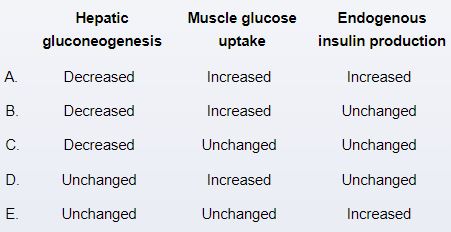
(86) A 52-year-old woman visits the office for a check-up on her type 2 diabetes mellitus. The patient was diagnosed with diabetes 6 months ago and began an intensive lifestyle modification program that included increased exercise and a calorie-restricted diet; she has felt better subjectively since then but has lost only 2 kg (4.4 lb). Vital signs are typical. 35 kg/m2 is the BMI. The fasting glucose level is 155 mg/dL, and the hemoglobin A1c level is 8.0 percent. The levels of renal and liver function markers in the blood are normal. Metformin therapy is started after a discussion with the patient. Which of the following physiologic changes are most likely to result as a direct effect of this medication?
(Multiple Choice)
4.7/5 (68)
(68) 
Filters
- Essay(0)
- Multiple Choice(0)
- Short Answer(0)
- True False(0)
- Matching(0)