



 Chat with AI
Exam 11: Pharmacology and Toxicology

Exam 1: Anatomy265 Questions
Exam 2: Behavioral Sciences178 Questions
Exam 3: Biochemistry102 Questions
Exam 4: Embryology59 Questions
Exam 5: Epidemiology, Biostatistics, and Medical Informatics94 Questions
Exam 6: Genetics88 Questions
Exam 7: Histology46 Questions
Exam 8: Immunology147 Questions
Exam 9: Microbiology and Virology330 Questions
Exam 10: Pathology817 Questions
Exam 11: Pharmacology and Toxicology509 Questions
Exam 12: Physiology339 Questions
Exam 13: Psychiatry and Psychotherapy23 Questions
Select questions type


A 32-year-old man comes to the physician because he feels depressed, has difficulty sleeping, a poor appetite, and low concentration for the past 3 months. During this time, he has also had low energy and lost interest in playing the guitar. During high school, the patient went through similar episodes of low mood and poor sleep. There is no evidence of suicidal ideation. a sertaline drug is prescribed Which of the following is the most likely side effect of the treatment prescribed for this patient's depression?
(Multiple Choice)
4.9/5  (80)
(80) A 31-year-old woman comes to the physician for palpitations, and anxiety. During this time, she has had a 2-kg (4.4-lb) weight loss. The patient has no prior medical problems and takes no medications. Blood pressure is 140/70 mm Hg and pulse is 120/min. Physical examination shows a diffusely enlarged, warm thyroid gland. There is a fine tremor in her outstretched hands. ECG shows sinus tachycardia. Serum TSH is decreased and free thyroxine (T4) is increased. The patient is treated with multiple drugs, including propranolol. In addition to its beta-adrenergic receptor-blocking activity, this drug is likely to decrease which of the following?
(Multiple Choice)
4.9/5 (80)
(80) A 66-year-old man arrives at the emergency department after experiencing several bouts of lightheadedness and a recent fall. The symptoms are most noticeable when he first gets out of bed in the morning. The patient is on medication for high blood pressure, stable angina pectoris, gout, and benign prostate hyperplasia. He also has right knee osteoarthritis and uses nonsteroidal anti-inflammatory drugs on occasion. In the supine position, his blood pressure and pulse rate are 120/80 mm Hg and 70/min, respectively, and 90/60 mm Hg and 87/min when standing. The cardiopulmonary exam is normal. Blockade of which of the following receptors is most likely contributing to this patient's current condition?
(Multiple Choice)
4.8/5 (85)
(85) A 22-year-old woman comes to the emergency department because of daily headaches for 3 weeks. Yesterday, the patient had blurry vision in both eyes and a brief episode of double vision. She has been taking ibuprofen with only mild improvement of her symptoms. She has not had any trauma, weakness, or changes in sensation. Medical history is remarkable facial acne for which she takes vitamin A and obesity but no other chronic conditions. Brain imaging is normal, and blood cell counts and serum chemistry studies are within normal limits. Lumbar puncture reveals elevated opening pressure, and idiopathic intracranial hypertension is diagnosed. Weight loss is advised, and the patient is prescribed acetazolamide therapy. Which of the following changes are most likely to occur in this patient over the next several days due to the medication? 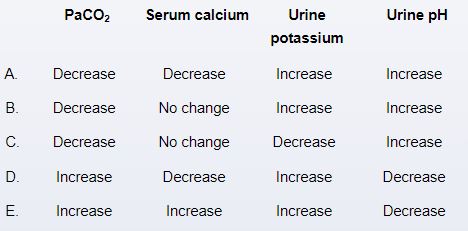
(Multiple Choice)
4.8/5 (92)
(92) A 16-year-old girl is brought to the physician by her father because of a dry cough, and intermittent wheezing during the past 3 months. Since birth, she has had four upper respiratory tract infections that resolved without treatment and one episode of acute otitis media treated with antibiotics. She has a history of eczema. She is diagnosed with asthma and she is started on inhaled beta-agonist and inhaled glucocorticoid therapy. On next follow up visit, her father is concerned about glucocorticoid side effects and growth retardation and he asks to stop use it and switch to another medication. She is started on a trial of inhaled cromolyn. Which of the following is the most likely site of action of this new medication? 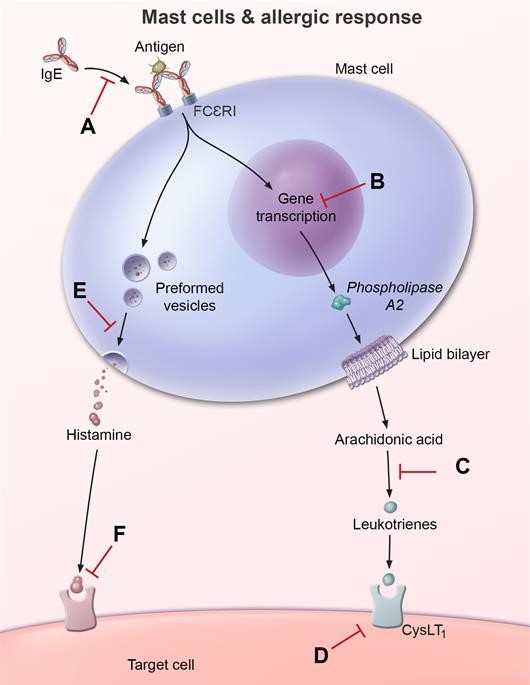
(Multiple Choice)
4.9/5 (74)
(74) A 27-year-old woman comes to the physician because of a 2-month history of palpitations, diaphoresis, and a 5-kg (11-lb) weight loss. Her pulse is 101/min and blood pressure is 141/84 mm Hg. At times, her symptoms make her worry that she may be having a heart attack. . Examination shows warm, moist skin and a fine tremor of the fingers. Which of the following would most likely provide the fastest relief of this patient's symptoms?
(Multiple Choice)
4.7/5 (82)
(82) A 64-year-old woman comes to the emergency department due to intractable nausea and vomiting. She has not been able to keep anything down and feels weak and tired. The patient has had no diarrhea, constipation, or abdominal pain. She was diagnosed with breast cancer 4 weeks ago and received her first cycle of chemotherapy 1 week ago. Vital signs are within normal limits. Mucous membranes are dry. Cardiopulmonary examination is normal. Bowel sounds are normal. Which of the following agents would be most helpful in treating this patient's symptoms?
(Multiple Choice)
4.9/5 (78)
(78) A 29-year-old woman with a history of schizophrenia is brought to the physician by her father because of a recent change in her behavior over the past two weeks The father says that his daughter has become increasingly withdrawn; she has not answered any phone calls or visited her family and friends. The patient says that she has to stay at home because a foreign intelligence service is monitoring her. She thinks that they are using a magnetic field to read her mind. She first developed symptoms at age 23 and has had 7 previous psychiatric hospitalizations despite trials of haloperidol, risperidone, and olanzapine. Mental status exam shows disjointed and perseverative thinking. She is anxious and has a flat affect. Medication therapy with clozapine is initiated. Which of the following should be regularly monitored in this patient?
(Multiple Choice)
4.8/5 (79)
(79) A 75-year-old man comes to the office due to abnormal findings during physical examination last week. An abdominal bruit was discoverd and in further evaluation reveals bilateral renal artery stenosis. He has a long term hypertension for which he takes amlodipine but blood pressure reading shows uncontrolled blood pressure. Therefore, a daily lisinopril is added and the patient is advised to follow up in a few days. The close follow-up is recommended due to which of the following anticipated effects in this patient's kidney function?
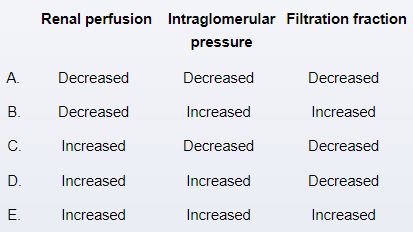
(Multiple Choice)
4.9/5 (60)
(60) As possible vasoconstrictors, three alpha-agonist medications are investigated. By measuring the cross-sectional area of a single, isolated vessel following medication administration, the degree of vasoconstriction may be ascertained. The obtained curves are as follows: 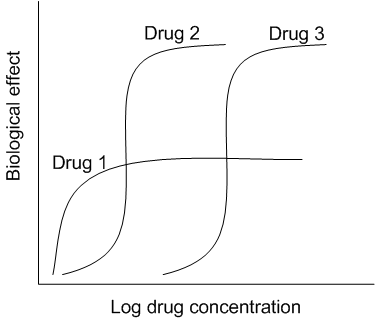 Which of the following is the best statement concerning the effects of these drugs?
 (Multiple Choice)
4.8/5 (79)
(79) Due to a rash, a 28-year-old male visits the office. He has taken phenytoin for six years and has a history of seizure disorder. Upon examination, lymphadenopathy and a generalized, macular rash are seen. In the display, a lymph node underwent a biopsy. 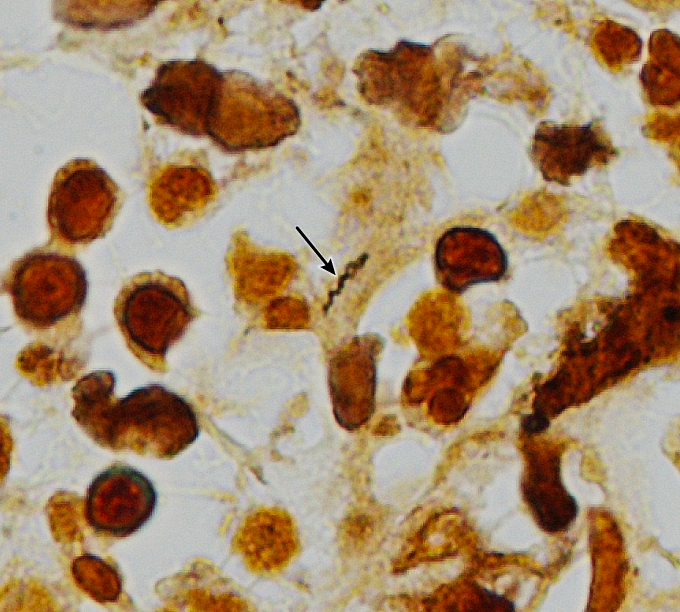 Treatment of this patient's condition is most likely to involve which of the following?
 (Multiple Choice)
4.8/5 (73)
(73) A 44-year-old woman arrives at the clinic complaining of tiredness, nausea, and weight loss during the past three to four months. She feels frequent dizziness while rising up and that her freckles are darkening. Blood pressure is 120/80 mm Hg while you're sitting down and 95/65 mm Hg when you're standing up, and the temperature is 36.8 C (98.2 F). Your pulse is 77 beats per minute. The vermillion border of the lips has been seen to be hyperpigmented. The physical examination continues without incident. Idiopathic primary adrenal insufficiency is the result of a thorough diagnostic evaluation. Hydrocortisone and fludrocortisone are first administered to the patient. Fludrocortisone is most likely to cause which of the following effects in this patient? 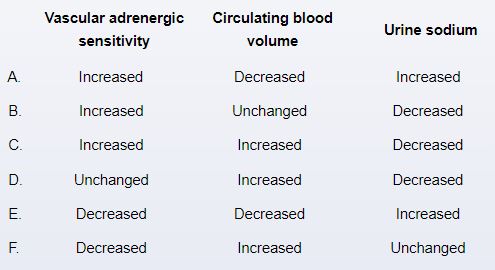
(Multiple Choice)
4.9/5 (87)
(87) A 48-year-old woman who has type 2 diabetes mellitus visits the office for follow-up care. She has had diabetes for ten years, and despite using numerous oral antidiabetic medications, her glycemic control has gradually gotten worse. The patient stopped taking her oral medications three months ago (with the exception of metformin) and began receiving daily injections of insulin glargine; she has since visited with the diabetes educator several times to go through proper injection technique and titrate up the dosage. However, since initiating insulin, the patient reports gaining 4.5 kg (10 lb) of weight. She claims, "I think I should eat more. I don't want to continue it if that's how insulin will be." Which of the following is the most appropriate response to this patient's statement?
(Multiple Choice)
4.9/5 (92)
(92) A 34-year-old woman visits the office because she is unable to lose weight despite diet and exercise. She claims she gained a significant amount of weight after quitting smoking four years ago. In the previous year, the patient tried several commercial weight-loss diet programs without success. She hopes to lose at least 4.5 kg (10 lb) in the next few months before her wedding. The patient has no other medical conditions and is not on any medications. The blood pressure is 122/80 mm Hg, and the pulse rate is 78 beats per minute. The BMI is 33 kg/m22. Physical examination reveals an obese habitus but nothing else notable. Laboratory testing for secondary causes of weight gain is unrevealing. In addition to encouraging continued efforts at lifestyle change, the physician prescribes a short course of oral phentermine for weight loss. The weight loss induced by this medication is caused by which of the following mechanisms?
(Multiple Choice)
4.9/5 (74)
(74) A 60-year-old amn is being evaluated for occasional pain the chest which resolves with sublingual nirtoglycerin. He has a chronic stable angina and hypertesnion for which he takes multiple medications for his conditions.Blood pressure is 140/80 mm Hg and pulse is 68/min and regular. Examination reveals normal heart sounds. While discussing a plan to start isosorbide dinitrate therapy, the patient becomes concerned about the high dose of oral isosorbide dinitrate compared to sublingual nitroglycerin. Which of the following is the most likely reason for using a high dose of oral nitrate?
(Multiple Choice)
4.8/5 (77)
(77) Due to her deteriorating lethargic state, a 45-year-old woman with a history of opiate use disorder and HIV infection is taken to the emergency room. The patient has recently resumed her methadone maintenance medication after being admitted to the hospital for an HIV-related illness. After receiving inpatient treatment, her illness became better, and she's still taking the right antibiotics as an outpatient. Her body temperature is at 37 C (98.6 F), blood pressure is 116/68 mm Hg, her pulse is 90 beats per minute, and her respirations are 10 beats per minute. During a physical examination, the patient is drowsy and withdraws all of his or her extremities in response to discomfort. The pupils are tiny and slow to respond. Renal function tests come back normal, and brain MRI shows no new abnormalities. Use of which of the following medications most likely contributed to this patient's current condition?
(Multiple Choice)
4.9/5 (84)
(84) A 6-year-old girl with polycystic kidney disease is started on a new medication after receiving a kidney transplant from a matched, unrelated donor. Two days after starting the medication, laboratory studies show a leukocyte count of 17,500/mm3 (90% segmented neutrophils, 4% bands, 1% eosinophils, 3% lymphocytes, and 1% monocytes). Which of the following drugs is the most likely cause of these laboratory findings?
(Multiple Choice)
4.8/5 (70)
(70) A 13-year-old boy is brought to the emergency department due to a skin swelling. Temperature is 38.4 C (101.1 F). Physical examination shows an area of erythema, warmth, and tenderness on his right distal leg. Laboratory results are notable for leukocytosis. He has a recurrent history of skin infection. The patient is started on intravenous nafcillin. Three days later, his symptoms haven't improved. A pus culture is obtained and shows gram-positive cocci in clusters, and sensitivity testing showed resistent to nafcillin but sensitive to vancomycin. Which of the following is the most likely explanation for nafcillin treatment failure in this patient?
(Multiple Choice)
4.7/5 (78)
(78) A 35-year-old woman undergoes diagnostic laparoscopy under general anesthesia for evaluation of chronic pelvic pain. The patient receives succinylcholine and propofol prior to the procedure. The intraoperative course is uneventful. Postoperatively, the patient requires prolonged intubation. Which of the following is the most likely underlying cause of this patient's postoperative complications?
(Multiple Choice)
4.9/5 (85)
(85) A 42-year-old man comes to the physician because of a 4-month history of increased fatigue and exertional shortness of breath. Cardiac examination shows a loud S2 in the 2nd left intercostal space. She does not use tobacco, alcohol, or illicit drugs. Her mother had similar symptoms and died at age 42. Right heart catheterization shows a pulmonary artery pressure of 32 mm Hg. Which of the following is the most appropriate pharmacotherapy for this patient's current condition?
(Multiple Choice)
5.0/5 (69)
(69) 
Filters
- Essay(0)
- Multiple Choice(0)
- Short Answer(0)
- True False(0)
- Matching(0)