



 Chat with AI
Exam 10: Pathology

Exam 1: Anatomy265 Questions
Exam 2: Behavioral Sciences178 Questions
Exam 3: Biochemistry102 Questions
Exam 4: Embryology59 Questions
Exam 5: Epidemiology, Biostatistics, and Medical Informatics94 Questions
Exam 6: Genetics88 Questions
Exam 7: Histology46 Questions
Exam 8: Immunology147 Questions
Exam 9: Microbiology and Virology330 Questions
Exam 10: Pathology817 Questions
Exam 11: Pharmacology and Toxicology509 Questions
Exam 12: Physiology339 Questions
Exam 13: Psychiatry and Psychotherapy23 Questions
Select questions type


A 29-year-old African American woman is being evaluated for exertional dyspnea and dry cough. She has no significant medical history and takes no medications. The patient works part-time as a bird keeper at a zoo. She smokes 4 packs daily. CT-guided lung biopsy is performed; findings are shown in the image below. 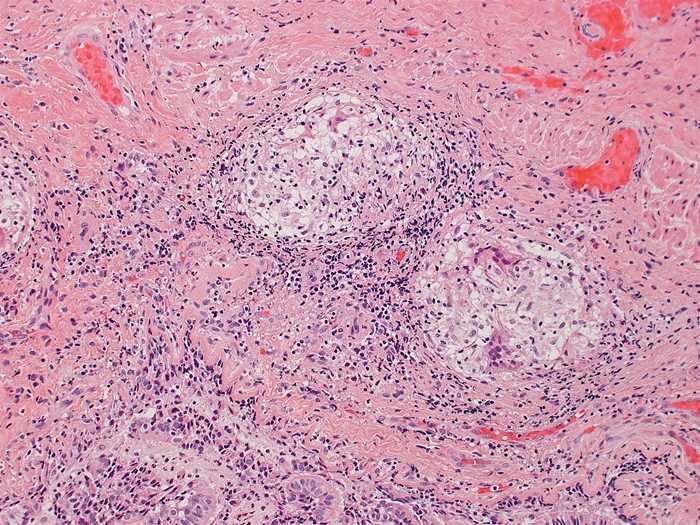 This patient most likely has which of the following conditions?
 (Multiple Choice)
4.9/5  (86)
(86) A 27-year-old man comes to the physician because of a 4-month history of recurrent episodes of headaches, palpitations, and sweating. He does not know his biological parents because he was adopted. His pulse is 103/min and blood pressure is 160/105 mm Hg. Physical examination shows multiple soft, yellow papules on the tip of the tongue. There is a 2-cm, firm thyroid nodule. The patient is also found to be positive for a germline RET mutation. A total thyroidectomy is planned. Prior to the surgery, additional testing should be performed to evaluate for an abnormality in which of the following organs?
(Multiple Choice)
4.8/5 (84)
(84) A 72-year-old woman presented to the emergency department with a myocardial infarction. She underwent coronary angiography through the radial approach. A stent was placed in the right coronary artery, and she was discharged after stabilization. 3 days later, she presented to the emergency department complaining of blue discoloration of the left toe. She complains of pain and numbness in the left toe. Physical examination shows cyanosis over the left toe, with livedo reticularis affecting the left leg. Peripheral pulses are palpable. Serum creatinine is 3.8 mg/dL (preoperatively it was 1.0 mg/dL). Histological examination of this patient's kidney would show which of the following?
(Multiple Choice)
4.9/5 (80)
(80) An 8-year-old boy is brought to the physician by his parents for short stature. Neither his clothing nor his shoe size has changed over the past year. He also frequently bumps into obstacles such as furniture and has headaches at night. He is always thirsty for cold water and has been urinating more frequently. Three years ago, he had an asthma attack that was treated with albuterol and a one-week course of steroids. His mother has Hashimoto's thyroiditis and had precocious puberty. His mother's height is 147 cm (4 ft 10 in) and his father's height is 160 cm (5 ft 3 in). He is at the 5th percentile for height and 5th percentile for weight. His temperature is 37°C (98.6°F), pulse is 98/min, respirations are 16/min, and blood pressure is 100/64 mm Hg. Examination shows a soft and nontender abdomen. The genitals and pubic hair are both Tanner stage 1. Axillary hair is absent. Patellar reflexes are 1+ bilaterally. From which of the following structures is this mass most likely derived?
(Multiple Choice)
4.9/5 (74)
(74) A 54-year-old lady visits her doctor because she has many hard violaceous nodules on her right upper arm. Twelve years ago, she was diagnosed with right-sided breast cancer and underwent a radical mastectomy. At the time, extensive axillary lymph node dissection revealed no lymph node metastases. The patient acquired persistent lymphedema in her right arm following surgery. Which of the following is most likely to be the cause of her present skin lesions?
(Multiple Choice)
5.0/5 (88)
(88) A 38-year-old primigravid woman at 34 weeks' gestation comes to the emergency department because of sudden-onset visual changes and headache. At a prenatal visit 2 weeks earlier, she was diagnosed with gestational hypertension. Amniocentesis with chromosomal analysis was performed at 16 weeks' gestation and showed no abnormalities. Her current medications include methyldopa and a multivitamin. She appears anxious. Her pulse is 90/min, respirations are 24/min, and blood pressure is 170/100 mm Hg. Crackles are heard over both lung bases. Uterine examination shows a fundal height consistent in size with a 34 week gestation. Examination of the heart, abdomen, and extremities shows no abnormalities. Visual field testing shows partial loss of vision bilaterally. Which of the following is the most likely cause of this patient's symptoms?
(Multiple Choice)
4.8/5 (69)
(69) A 43-year-old man comes to the emergency department because of nausea, abdominal discomfort, diarrhea, and progressive numbness around the mouth for the past 24 hours. His only medication is a multivitamin supplement. The patient reports a history of "high blood pressure and a thyroid disorder." He appears fatigued. While measuring the patient's blood pressure, the nurse observes a spasm in the patient's hand. Further discussion with this patient is most likely to reveal which of the following?
(Multiple Choice)
4.9/5 (79)
(79) An 87-year-old nursing home resident arrives at the ER with a 2-day history of fever, vomiting, and progressive lethargy. The patient's past medical history is significant for advanced dementia and stroke. . The temperature is 38.3 ° C. (101 degrees F), the blood pressure is 88/62 mm Hg, and the pulse rate is 120 bpm. On examination, he appears to be lethargic but arousable. Over the right midlung, coarse rhonchi can be heard. Laboratory results are as follows: 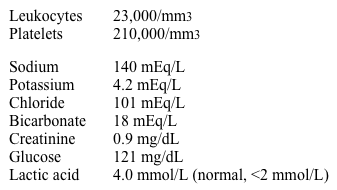 Which of the following is the most likely cause of this patient's increased anion gap?
 (Multiple Choice)
5.0/5 (81)
(81) A 62-year-old man comes to the physician because of a 5-day history of swelling in his left arm. Physical examination shows erythema and a tender, palpable cord-like structure along the medial arm. A superficial thrombophlebitis is daignosed. During further evaluation, a palpable, nontender mass below the right costal margin is found. Abdominal imaging shows a malignant mass in the pancreas. The patient subsequently undergoes an uncomplicated subtotal pancreatectomy and returns for a postoperative nutritional assessment following hospital discharge. Which of the following tests will most likely be normal in this patient after surgery?
(Multiple Choice)
4.7/5 (77)
(77) Question: A 4-month-old girl is brought to the routine check-up by her father. It was found that she has left-sided absent red pupillary reflex. Her father was found to have retinal neoplasm in his right eye, and it was enucleated. This patient is at the greatest risk of developing which of the following neoplasms?
(Multiple Choice)
4.9/5 (87)
(87) A 40-year-old woman comes to the physician because of a 2-week history of episodic abdominal discomfort and fullness. She works with her husband in the farm. Physical examination shows hepatomegaly. Abdominal ultrasound shows a 4-cm calcified cyst with several daughter cysts in the liver. She undergoes CT-guided percutaneous aspiration under general anesthesia. The patient suffers from a procedural complication and dies. Which of the following is the most likely cause of this patient's death?
(Multiple Choice)
4.8/5 (66)
(66) A 28-year-old man is brought to the emergency department because of a 2-day history of fever and pain in the left knee. His temperature is 39.3°C (102.7°F), pulse is 115/min, respirations are 19/min, and blood pressure is 105/70 mm Hg. Examination of the left hip shows tenderness; range of motion is limited. Minimal attempts to rotate the hip cause severe discomfort. The remainder of the examination shows no abnormalities. Arthrocentesis is performed, and synovial fluid analysis shows a white blood cell count of 110,000/mm3. Which of the following would provide the best treatment for this patient's condition?
(Multiple Choice)
4.9/5 (90)
(90) A 46-year-old man comes to the physician for a follow-up examination. Two weeks ago, he underwent laparoscopic cholecystectomy. During the procedure, a black liver was noted. He has a history of intermittent scleral icterus that resolved without treatment. Complete blood count is within normal limits. Liver function studies are as follows: 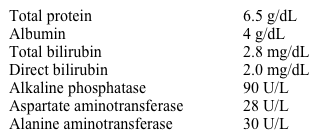 Which of the following is the most likely cause of this patient's finding?
 (Multiple Choice)
4.9/5 (86)
(86) A 38-year-old man is admitted to the hospital 12 hours after the onset of severe abdominal pain and vomiting. He has a history of alcohol use disorder, with several previous admissions for intoxication and acute pancreatitis. Ten hours after admission, he has worsening dyspnea. His temperature is 38.3°C (100.9°F), pulse is 120/min, respirations are 30/min, and blood pressure is 100/60 mm Hg. Pulse oximetry on room air shows an oxygen saturation of 85%. The patient is intubated and mechanically ventilated. Physical examination shows diffuse lung crackles, marked epigastric tenderness. Chest x-ray reveals new bilateral opacities. Which of the following parameters is most likely to be normal in this patient?
(Multiple Choice)
4.7/5 (73)
(73) A 45-year-old woman is evaluated in the office due to abnormal gait for the past two weeks. This patient's presentation has resulted in multiple falls. When she is asked to stand with her feet close together, eyes closed and her arms to the sides. The patient could not stand steady. This test is done to test which of the following functions?
(Multiple Choice)
4.7/5 (80)
(80) A 38-year-old woman gravida 2 para 1, at 30 weeks gestation comes to the emergency department because of progressive swelling in her face and hands. At a prenatal visit 2 weeks earlier, she was diagnosed with gestational hypertension. Her current medications include methyldopa and a multivitamin. The patient has not urinated in the last 12 hours despite an increase in fluid intake. She appears anxious. Her pulse is 95/min, and blood pressure is 160/102 mm Hg. Bladder catheterization yields a total of 15 mL of dark urine. Which of the following pathologic factors is the most likely cause of this patient's decreased urine output?
(Multiple Choice)
4.8/5 (83)
(83) A 38-year-old lady arrives at an urgent care clinic complaining of a sore throat that has been bothering her for two days. Fever and cervical lymphadenopathy are connected with it, but not rhinorrhea, sneezing, or coughing. On examination, there is erythema and edema affecting the posterior pharynx, as well as a purulent tonsillar effusion. The patient is treated on oral penicillin V after rapid bedside streptococcal antigen testing comes back positive. She returns the next day with a pruritic skin rash that appeared unexpectedly after beginning the medication. The picture below depicts the skin lesions discovered after a physical examination. 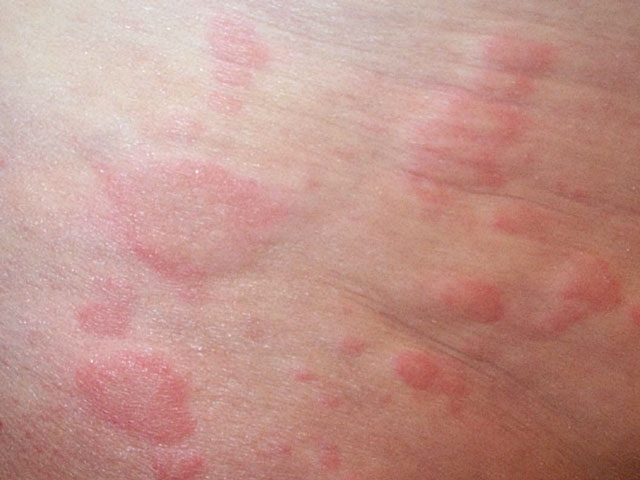 What is the most likely finding on biopsy of these lesions?
 (Multiple Choice)
4.9/5 (78)
(78) An hour ago, during a lecture, a 60-year-old professor started experiencing right-sided weakness and numbness. She was sent to the emergency room. He also feels queasy and disoriented. For 20 years, the patient smoked a pack a day, but he stopped 10 years ago. He doesn't consume alcohol. At the age of 70, his father suffered a myocardial infarction. Both the blood pressure and the pulse are 190/100 mm Hg. There are no indications of brain trauma during physical examination. Right-side strength is reduced (1/5) and the plantar reflex is active. A brain CT without contrast is quickly acquired. The photo is displayed below. 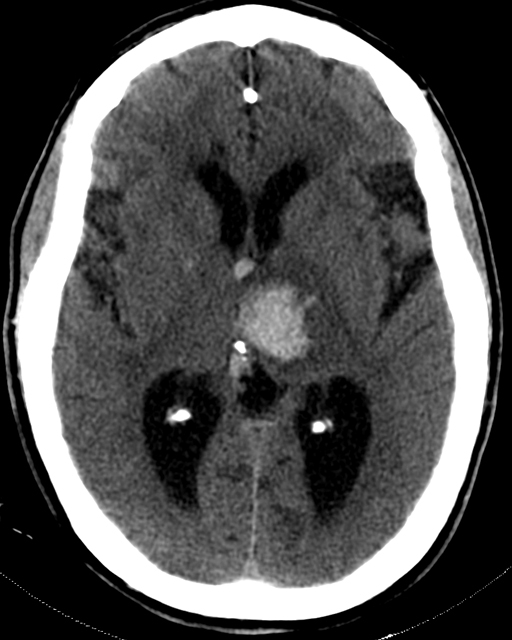 Which of the following is the most likely cause of this patient's condition?
 (Multiple Choice)
4.7/5 (73)
(73) A 77-year-old man is sent to the emergency room because of syncope, shortness of breath, and severe chest discomfort. When it comes to coronary artery disease, which was treated with right coronary artery stenting five years ago, medical history is important. The patient experiences a cardiac arrest, and attempts to revive him or her fail. At autopsy, the pulmonary trunk was completely blocked by a sizable bilateral pulmonary embolism. He has experienced ongoing back discomfort for the previous few months, according to further information gleaned from the patient's wife. The photograph below depicts an autopsy of the vertebrae: 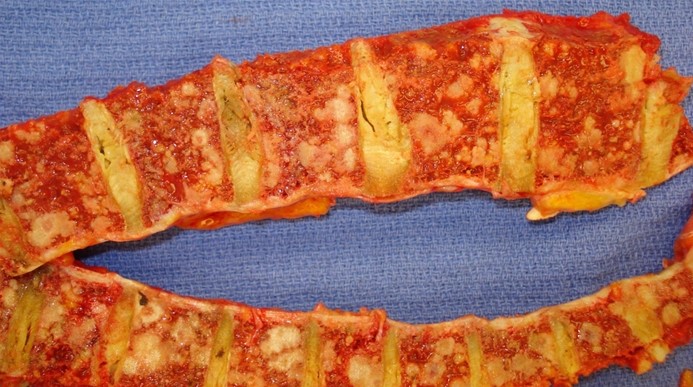 Which of the following would the histologic analysis of the bone lesions in this patient most likely reveal?
 (Multiple Choice)
4.8/5 (84)
(84) A 28-year-old nulliparous woman comes to the clinic for an infertility evaluation. The patient has had unprotected intercourse with her husband for the past 12 months without conceiving and often experiences pain with deep vaginal penetration. The patient also reports episodic pelvic and back pain accompanied by painful diarrhea for 5 years. She has about one such episode on average per month that lasts 4-6 days. The pain has persisted despite medical therapy and is suspected to be due to endometriosis. Exploratory laparoscopy is performed, and multiple flesh-colored nodules are present on the pelvic organs, along with thin, filmy adhesions. In addition to having endometrial glands with hemosiderin pigment, one of the biopsies contains simple cuboidal epithelial cells. Which of the following is the most likely site of the biopsy?
(Multiple Choice)
4.9/5 (88)
(88) 
Filters
- Essay(0)
- Multiple Choice(0)
- Short Answer(0)
- True False(0)
- Matching(0)