



 Chat with AI
Exam 10: Pathology

Exam 1: Anatomy265 Questions
Exam 2: Behavioral Sciences178 Questions
Exam 3: Biochemistry102 Questions
Exam 4: Embryology59 Questions
Exam 5: Epidemiology, Biostatistics, and Medical Informatics94 Questions
Exam 6: Genetics88 Questions
Exam 7: Histology46 Questions
Exam 8: Immunology147 Questions
Exam 9: Microbiology and Virology330 Questions
Exam 10: Pathology817 Questions
Exam 11: Pharmacology and Toxicology509 Questions
Exam 12: Physiology339 Questions
Exam 13: Psychiatry and Psychotherapy23 Questions
Select questions type


A 34-year-old man comes to the physician because of fatigue and shortness of breath with moderate exertion for the past 2 months. Over the past 10 days, he has had low-grade fevers and night sweats. He has no history of serious illness except for a bicuspid aortic valve diagnosed 5 years ago. He has smoked one pack of cigarettes daily for 10 years and drinks 3-5 beers on social occasions. He does not use illicit drugs. The patient takes no medications. He appears weak. His temperature is 37.7°C (99.9°F), pulse is 70/min, and blood pressure is 128/64 mm Hg. The lungs are clear to auscultation. A grade 2/6 systolic murmur is heard best at the right sternal border and second intercostal space. Laboratory evaluation shows leukocytosis, and chest x-ray reveals nodular opacities. Echocardiography of this patient is most likely to reveal which of the following findings?
(Multiple Choice)
4.9/5  (85)
(85) A 40-year-old man comes to the physician because of weight gain over the past 3 months. During this period, he has gained 10 kg (22 lb) unintentionally. He also reports decreased sexual desire, oily skin, and sleeping difficulties. There is no personal or family history of serious illness. The patient appears lethargic. His temperature is 37°C (98.6°F), pulse is 80/min, and blood pressure is 150/90 mm Hg. Physical examination shows central obesity, acne, and thin, easily bruisable skin with stretch marks on the abdomen. Fasting plasma glucose level is 135 mg/dL and 24-hour urinary cortisol is increased. Further evaluation reveals that high-dose, but not low-dose, dexamethasone suppresses serum cortisol levels. Serum ACTH levels are high-normal. Which of the following is the most likely cause of this patient's symptoms?
(Multiple Choice)
4.8/5 (79)
(79) A 65-year-old man visits the clinic after experiencing itching, ulceration, and crusting of a skin lesion on his upper chest for two months. The patient was diagnosed with squamous cell carcinoma with perineural invasion at the lesion location a year ago. The tumor was surgically resected with clean margins, and adjuvant radiation was administered to the location. He has no additional symptoms. The exhibit depicts the patient's lesion. 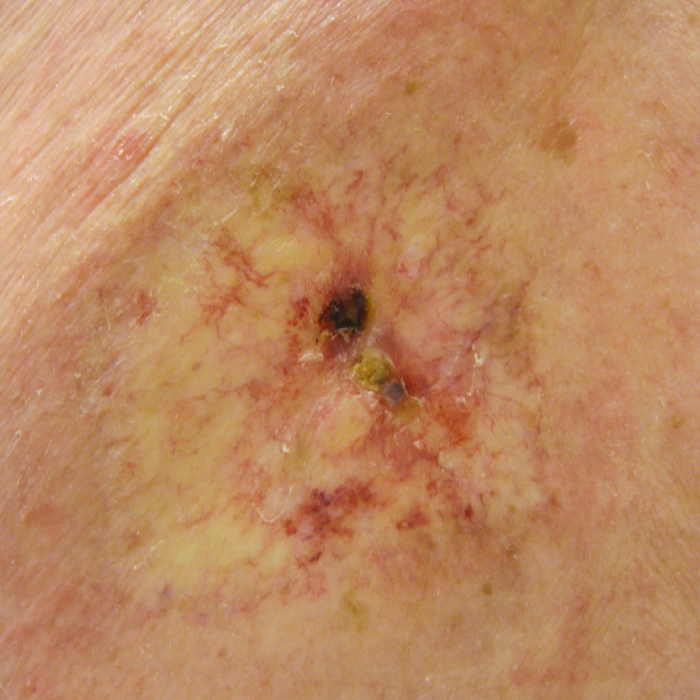 If a biopsy is performed at the periphery of the lesion, which of the following histologic changes is most likely to be seen?
 (Multiple Choice)
4.9/5 (77)
(77) A 36-year-old woman, gravida 2 para 1, at 30 weeks gestation comes to the office for a prenatal visit. The patient has noticed some ankle swelling at the end of the day that is relieved with elevating her legs, but she has no other concerns. The pregnancy has been uncomplicated, and her only medications are a prenatal vitamin and iron supplement. The patient has no chronic medical conditions. She does not use tobacco or alcohol. Blood pressure is 118/78 mm Hg and pulse is 72/min. BMI is 30 kg/m2. Fetal heart tones are normal. There is trace bilateral pedal edema to the shins. Physical examination is otherwise unremarkable. Urinalysis shows no protein. Compared to a nonpregnant state, which of the following cardiac changes are most likely to be found in this patient? 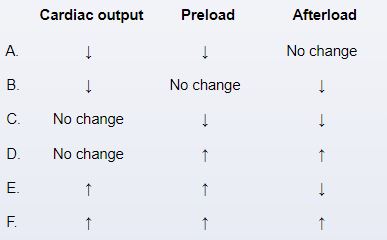
(Multiple Choice)
4.8/5 (76)
(76) A 40-year-old man comes to the hospital because of a 2-hour history of severe epigastric pain, nausea, and vomiting. Abdominal examination shows guarding and rigidity. The patient is admitted to the hospital and treated with intravenous fluids and pain medication, but his condition fails to improve Ultrasonography of the abdomen shows diffuse enlargement of the pancreas; no gallstones are visualized. The inappropriate activation of which of the following most likely initiated this patient's condition?
(Multiple Choice)
4.8/5 (87)
(87) A 24-year-old man comes to the office for an exercise evaluation. He is an avid long-distance runner. One of his team members recently died suddenly in his sleep, which made the patient worried about his health. He has no medical history, takes no medications, and does not use illicit drugs. His maternal grandfather had a heart attack at age 40 and underwent coronary artery bypass surgery. Blood pressure is 122/70 mm Hg and pulse is 49/min. Transthoracic echocardiogram shows the following: 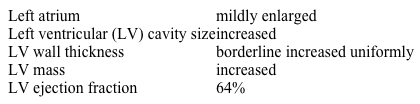 The right ventricular cavity is slightly enlarged and there are no valvular lesions. Which of the following best explains this patient's echocardiogram findings?
 (Multiple Choice)
4.9/5 (93)
(93) A 60-year-old man comes to the physician because of progressive pain in his right hip and lower back over the past 4 weeks. He describes the pain as dull and constant. It is worse with exertion and at night. Over the past 2 months, he has helped his son with renovating his home, which required heavy lifting and kneeling. His father died of prostate cancer. He drinks 2-3 beers daily. Vital signs are within normal limits. Examination shows localized tenderness over the right hip and groin area; range of motion is decreased. Hearing is mildly decreased on the right side. The remainder of the examination shows no abnormalities. Serum testing for which of the following would most likely help establish a diagnosis in this patient?
(Multiple Choice)
4.8/5 (66)
(66) A 72-year-old man arrives at the clinic complaining of deteriorating weakness, exhaustion, anorexia, and a 10-kg (22-lb) weight loss during the previous four months. He states that he feels satisfied with only a tiny bit of food since it doesn't taste as wonderful as it used to. The patient had blood streaks in his sputum two weeks ago and has had a morning cough for a number of years. His smoking history spans 50 packs. When examined, the patient shows signs of bitemporal wasting and a sunken face. His arms show obvious muscular atrophy and are quite slender. Right-sided wheeze is discovered during a lung examination. Chest x-ray reveals an irregular right perihilar mass. Which of the following is most likely contributing to this patient's muscle wasting?
(Multiple Choice)
4.8/5 (78)
(78) A 55-year-old woman with type 1 diabetes mellitus comes to the physician because of a 2-month history of frequent involuntary loss of urine. She has been having difficulty starting and maintaining a urinary stream. . She has multiple daytime episodes of uncontrolled voiding without any sensation of a full bladder. Her only medication is insulin. Physical examination shows a palpable suprapubic mass. Urinalysis is unremarkable. Which of the following additional findings would most likely be present in this patient?
(Multiple Choice)
4.9/5 (71)
(71) 74-year-old man comes to the physician because of a trouble climbing one flight of stairs due to lower extremity pain. The pain feels dull and achy and is worsened by movement, causing him to have difficulty bearing weight and ambulating. He has hypertension and takes hydrochlorothiazide. Physical examination shows tenderness to palpation over the lower extremity. There is pedal edema. Laboratory studies show a hemoglobin concentration of 8.7 g/dL, a serum creatinine concentration of 2.3 mg/dL, and a serum calcium concentration of 12.6 mg/dL. Urine dipstick is negative for blood and protein. A radiograph of the right lower extremity is shown in the exhibit. 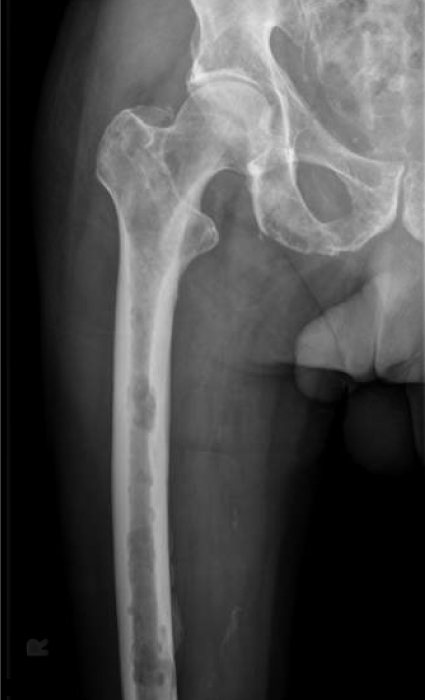 Which of the following is the most likely explanation for this patient's bone changes?
 (Multiple Choice)
4.7/5 (68)
(68) A 55-year-old man comes to the office due to dull abdominal pain during last6 months ago. He also reports weight loss despite no dietary changes and feels fatigue all the time and anorexic. Vital signs are normal and physical examinations show no abnormalities. The liver function tests are normal and normal serum level of lipase. Upper endoscopy shows a gastric mass for which the patient underwent an uncomplicated total gastrectomy without any postoperative complications. The physician counsels the patient that he must receive lifelong administration of which of the following substances?
(Multiple Choice)
5.0/5 (81)
(81) A 25-year-old man comes to the physician because of right-sided painless scrotal swelling that he noticed yesterday while taking a shower. He is currently sexually active with two female partners and uses condoms inconsistently. He has smoked one pack of cigarettes daily for the last 5 years. He is 170 cm (5 ft 7 in) tall and weighs 70 kg (154 lb); BMI is 24 kg/m2. He appears healthy and well-nourished. His temperature is 37.0°C (98.6°F), pulse is 72/min, and blood pressure is 125/75 mm Hg. On examination, the thyroid is mildly enlarged. Testicular examination reveals an enlarged, nontender right testicle. Laboratory testing shows elevated serum thyroxine and triiodothyronine levels. Scrotal ultrasonography demonstrates a hypoechoic mass within the right testicle. Elevated levels of which of the following substances would most likely explain this patient's symptoms?
(Multiple Choice)
4.8/5 (68)
(68) A 62-year-old man is brought to the emergency department after his wife found him unresponsive 1 hour ago. He had fallen from a flight of stairs the previous evening. He has hypertension and coronary artery disease. Current medications include aspirin, enalapril, metoprolol, and atorvastatin. On arrival, he is unconscious. His temperature is 37.3°C (99.1°F), pulse is 89/min, and blood pressure is 150/92 mm Hg. CT scan of the head without contrast demonstrates an acute hemorrhage in the left temporal lobe with compression of the anterior medial temporal lobe against the free margin of the tentorium cerebelli. Which of the following cranial nerves is most likely to be compromised in this patient?
(Multiple Choice)
4.9/5 (71)
(71) A 35-year-old woman was brought to the emergency department after a severe motor vehicle collision. The patient is complaining of severe headaches and neck pain. She is not complaining of disturbed vision, dizziness, sensory or motor changes, or slurred speech. Imaging shows left transverse foramina fracture at the level of C2. During transportation, the patient suddenly developed left-sided facial tingling, hoarseness, and dizziness. . Temperature is 36.7 C (98.1 F), blood pressure is 160/90 mm Hg, the pulse is 82/min, and respirations are 13/min. Physical examination shows left-sided ptosis and miosis with nystagmus. The pain and temperature sensation is lost on the right side of the body and the left side of the face. The patient is ataxic, with an abnormal finger-to-nose test. This patient most likely has dissection in which of the following arteries?
(Multiple Choice)
4.9/5 (82)
(82) A 5-day-old infant is examined due to decreased arousal for the last day. The patient was delivered prematurely at 31-weeks of gestational age. On examination, he has bulging fontanelle. The nurse witnessed several episodes of seizures. Brain imagines shows hemorrhage in the lateral ventricle. Which of the following structures is the source of the bleeding?
(Multiple Choice)
5.0/5 (82)
(82) A 40-year-old man comes to the emergency department 30 minutes after experiencing a seizure. Over the past 3 months, the patient has had several episodes of brief twitching of the right hand, but today the abnormal movement gradually progressed to involve the entire right upper extremity, followed by shaking of the whole body for about a minute. He also lost consciousness and urinated involuntarily during the event. The patient feels groggy and has a mild headache. He has no other medical conditions but reports several concussions from playing football in college. Vital signs are within normal limits. Physical examination shows mild weakness of right hand grip but is otherwise normal. This patient's seizure presentation is most suggestive of which of the following etiologic processes?
(Multiple Choice)
4.9/5 (77)
(77) A 69-year-old man comes to the hospital for worsening shortness of breath and cough. He has sharp right-sided chest pain that worsens on inspiration and coughing. He has coronary artery disease and hypertension and takes his medications regularly. He drinks 4 cans of beer daily and has smoked 2 packs of cigarettes daily for 20 years. His temperature is 38.5°C (101.3° F), pulse is 110/min, respirations are 29/min, and blood pressure is 110/65 mmHg. On physical examination, heart sounds are regular. Lung examination reveals decreased tactile fremitus over the lower right lung along with dullness to percussion. Which of the following is the most likely diagnosis?
(Multiple Choice)
4.7/5 (84)
(84) A 47-year-old woman comes to the physician with progressive joint pain and swelling in her hands for the past several months. She also has easy fatigability that has gradually worsened over the same period. Morning activities are especially difficult due to stiffness lasting 1 to 2 hours after waking. Examination shows warmth, swelling, and tenderness involving the proximal interphalangeal joints, metacarpophalangeal joints, and wrists bilaterally. Plain radiographs of the symptomatic joints show joint space narrowing and marginal erosions. Which of the following cytokines are primarily involved in the pathogenesis of this patient's joint destruction?
(Multiple Choice)
4.8/5 (81)
(81) A 30-year-old woman comes to the physician because of severe headaches and lightheadedness for 2 months. She appears anxious. She is 155 cm (5 ft 1 in) tall and weighs 77 kg (170 lb); BMI is 32 kg/m2. Her temperature is 37.0°C (98.6°F), pulse is 96/min, respirations are 14/min, and blood pressure is 168/96 mm Hg. The pupils are equal and reactive. There is a bruit on the left side of the neck. The lungs are clear to auscultation. Cardiac examination shows no murmurs, rubs, or gallops. The abdomen is soft and nontender. Neurologic examination shows no focal findings. Left carotid artery appear tortuous distally with alternating areas of fibrotic webs and aneurysmal dilation. Further evaluation of this patient is most likely to show which of the following?
(Multiple Choice)
4.8/5 (75)
(75) A 24-year-old guy visits the doctor complaining of hearing loss, dizziness, and tinnitus. Below is a contrast-enhanced, T1-weighted picture of his brain. 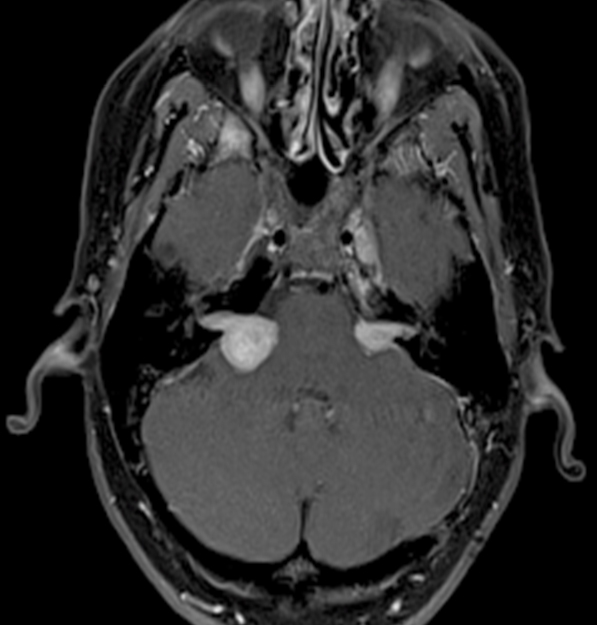 This patient's condition is most likely associated with a mutation involving which of the following genes?
 (Multiple Choice)
4.8/5 (79)
(79) 
Filters
- Essay(0)
- Multiple Choice(0)
- Short Answer(0)
- True False(0)
- Matching(0)