



 Chat with AI
Exam 10: Pathology

Exam 1: Anatomy265 Questions
Exam 2: Behavioral Sciences178 Questions
Exam 3: Biochemistry102 Questions
Exam 4: Embryology59 Questions
Exam 5: Epidemiology, Biostatistics, and Medical Informatics94 Questions
Exam 6: Genetics88 Questions
Exam 7: Histology46 Questions
Exam 8: Immunology147 Questions
Exam 9: Microbiology and Virology330 Questions
Exam 10: Pathology817 Questions
Exam 11: Pharmacology and Toxicology509 Questions
Exam 12: Physiology339 Questions
Exam 13: Psychiatry and Psychotherapy23 Questions
Select questions type


A 60-year-old woman is being evaluated for abnormal renal function. She is found to have a serum creatinine of 2.2 mg/dL on routine laboratory monitoring; her creatinine level a year ago was 1.2 mg/dL. The patient has a history of nonischemic cardiomyopathy and systolic heart failure and has been on a stable medical regimen for the past 2 years. She has no dyspnea, fever, rash, or lower extremity swelling but has been taking ibuprofen for 2 weeks due to left knee osteoarthritis. Urinalysis reveals the following: 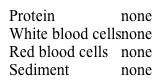 Ibuprofen is discontinued, and her kidney function returns to normal in a week. Which of the following best explains this patient's transient deterioration in renal function?
 (Multiple Choice)
5.0/5  (80)
(80) A 5-year-old boy is brought to the physician because of facial swelling that started 5 days ago. Two weeks ago, he had a sore throat that resolved spontaneously. His temperature is 37.0°C (98.6°F), pulse is 107/min, and blood pressure is 94/67 mm Hg. Examination shows pitting edema of the upper and lower extremities as well as periorbital edema. The abdomen is mildly distended. Urinalysis shows 4+ protein and negative blood. Multiple regions of the kidney are biopsied, and a representative image is shown below: 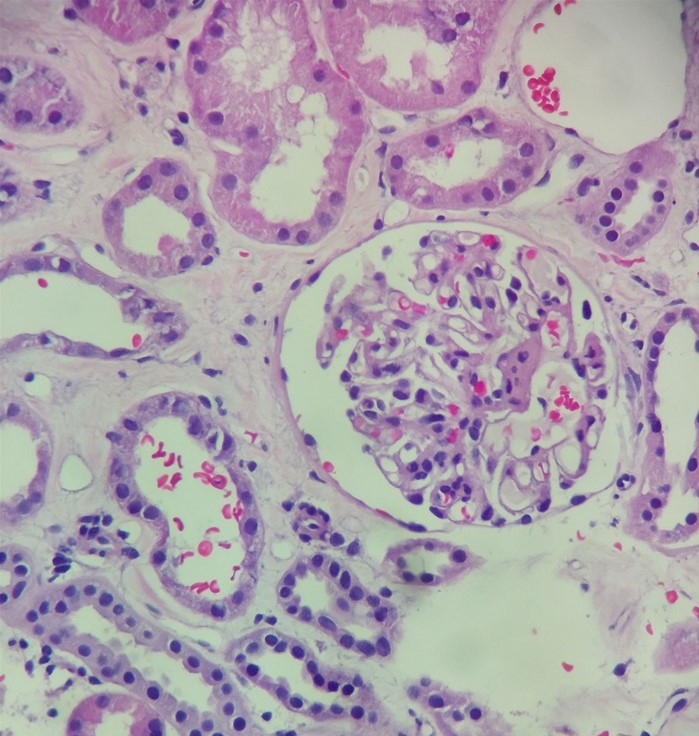 Which of the following is the most likely diagnosis?
 (Multiple Choice)
4.9/5 (91)
(91) A 34-year-old man comes to the physician because of foul-smelling diarrhea, fatigue, and bloating for 6 months. During this time, he has had a 5-kg (11-lb) weight loss without a change in diet. He has type 1 diabetes mellitus that is well-controlled with insulin. Examination shows conjunctival pallor and inflammation of the corners of the mouth. The abdomen is soft, and there is diffuse tenderness to palpation with no guarding or rebound. Rectal examination reveals brown stool that is negative for fecal occult blood. Laboratory results are as follows: 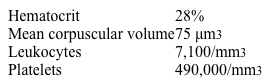 C-reactive protein level is normal. Which of the following pathologic gastrointestinal tract findings is most likely to be present in this patient?
 (Multiple Choice)
5.0/5 (81)
(81) A 22-year-old woman is being evaluated for low hemoglobin level. She has a history of heavy menstrual periods since menarche and also recalls frequent nosebleeds as a child. She has insignificant medical condition and she takes no medications. Laboratory studies show a hemoglobin level of 9.2 g/dL, a mean corpuscular volume of 72 fL, and decreased levels of ferritin. Which of the following is the most likely diagnosis?
(Multiple Choice)
4.9/5 (89)
(89) A 48-year-old woman is brought to the emergency department because of a 1-hour history of sudden-onset headache associated with nausea and vomiting. A CT scan of the head without contrast shows characteristics of subarachnoid hemorrhage. Over the next several hours, the patient gradually becomes somnolent and less responsive. She responses to painful stimuli only and does not follow commands. Repeat imaging of the brain shows no new hemorrhage, but there is enlargement of the entire ventricular system compared to the previous CT scan. Which of the following is the most likely cause of this patient's neurologic deterioration in the hospital?
(Multiple Choice)
4.9/5 (90)
(90) A 4800 g (10.6 lb) male newborn is delivered at term to a 35-year-old woman, gravida 1, para 1. The pregnancy was complicated by gestational diabetes treated with insulin. However, glycemic control remained suboptimal due to maternal noncompliance with insulin treatment and poor adherence to dietary recommendations. His blood glucose concentration was found to be 30 mg/dL. Examination of the neonate is unremarkable. Which of the following is the most likely primary mechanism responsible for this patient's low blood glucose concentration?
(Multiple Choice)
4.7/5 (90)
(90) A 42-year-old lady arrives at the clinic complaining of a lesion on the left side of her chest. The lesion formed some months ago and is gradually growing in size, occasionally seeping blood. The patient had a living-donor kidney transplant five years ago for end-stage renal illness caused by IgA nephropathy. She is also hypothyroid as a result of Hashimoto thyroiditis. Tacrolimus, mycophenolate, low-dose prednisone, and levothyroxine are among the medications used. Vital indicators are typical. A 1 2 cm crusty lesion over the midsternum is discovered on physical examination. The lesion is biopsied, and the histopathology findings are shown in the exhibit. 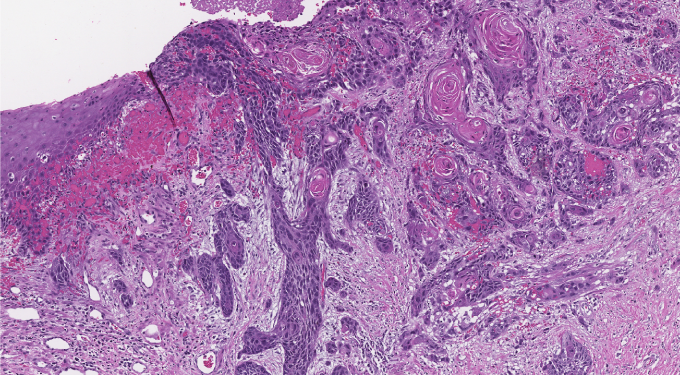 Which of the following most likely contributed to the development of this patient's skin lesion?
 (Multiple Choice)
4.8/5 (85)
(85) A 55-year-old lady visits the doctor after experiencing gradual hearing loss in her right ear for four months. Vital indicators are in the expected range. There are no anomalies visible upon examination of the tympanic membranes or external ear canals. A neurological examination reveals diminished hearing in the right ear; normal hearing is seen in the left ear. In the picture below, an MRI of the head with contrast is displayed: 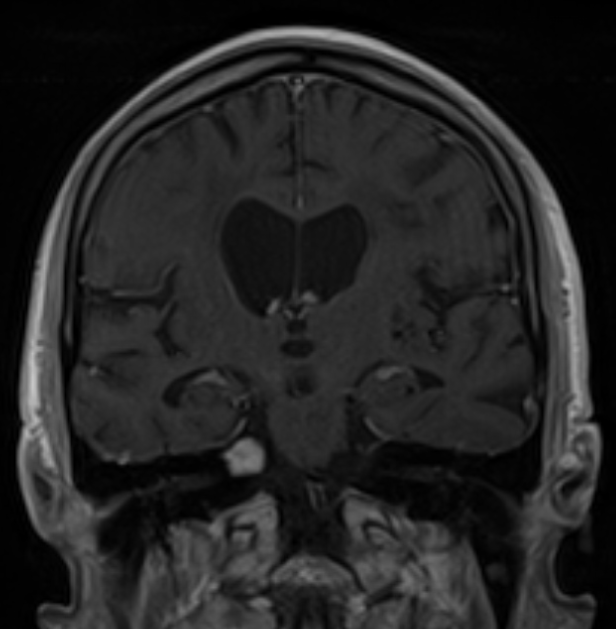 Which of the following is the most likely diagnosis?
 (Multiple Choice)
4.9/5 (75)
(75) A 48-year-old woman comes to the emergency room with chest pain. She describes the pain as a squeezing sensation in her chest with radiation to the left shoulder. The episode began about 15 minutes ago when she was sitting reading a book. She has had this pain before, typically in the evenings, though prior episodes usually resolved after a couple of minutes. Her pulse is 112/min, blood pressure is 121/87 mm Hg, and respiratory rate is 21/min. An ECG shows ST-segment elevations in the inferior leads. The patient is given nitroglycerin, which improves her symptoms. Percutaneous coronary angiography is performed, and no obstructive lesions are observed. Which of the following is most likely to be involved in the pathogenesis of this patient's chest pain?
(Multiple Choice)
4.9/5 (74)
(74) A 69-year-old man comes to the physician because of a cough for the past 3 months. The cough is mostly dry, but the patient recalls a recent episode in which he coughed up mucus with dark red streaks. He has felt tired for the past few months. Over the past month, he has had poor appetite and a 5-kg (11-lb) weight loss. He also has occasional back pain, which has worsened in recent weeks. He has no recent travel history. He has smoked a pack of cigarettes daily for 30 years. Physical examination shows scattered wheezes bilaterally. Chest CT scan reveals a mass in the right lung. Light microscopy of the mass is shown below: 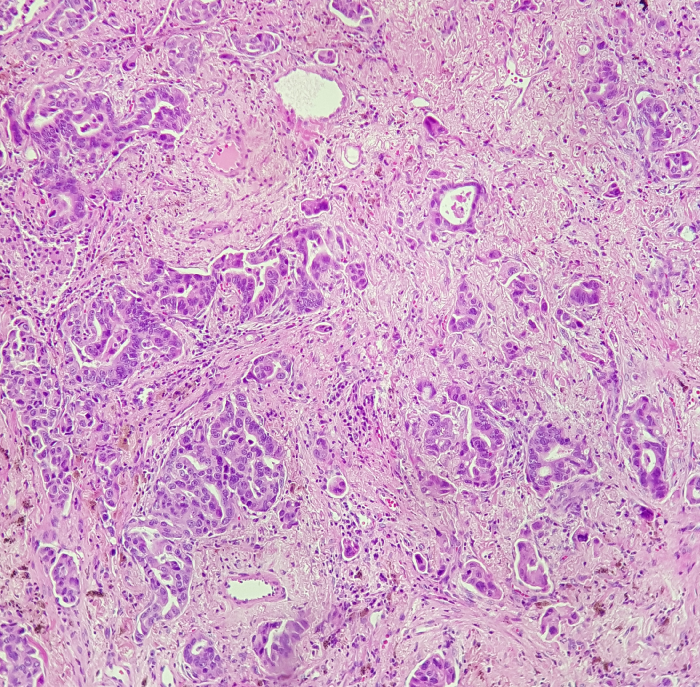 Which of the following is the most likely diagnosis?
 (Multiple Choice)
4.8/5 (59)
(59) A 30-year-old woman comes to the office due to a 4 days history of anterior neck pain. The patient had an upper respiratory infection a month ago, during which she experienced nasal congestion, rhinorrhea, and a cough productive of clear sputum; her respiratory symptoms lasted for 5 days and resolved spontaneously. She has no history of serious illness On examination, mild fever, palpitations, and excessive sweating. Pulse is 110/min. The thyroid gland is tender to palpation and diffusely enlarged. Laboratory studies show suppressed TSH and elevated free thyroxine levels. Erythrocyte sedimentation rate is 70 mm/hr.
Thyroid scan is performed and reveals diffusely decreased radioiodine uptake. Which of the following pathological changes would be most likely on biopsy of this patient's thyroid gland?
(Multiple Choice)
4.7/5 (76)
(76) A 3-year-old boy who recently emigrated from Ghana is brought to the physician for health care follow up. He has had episodes of pain and swelling in his hands in the past. His family history is significant for an older brother who died of pneumococcal sepsis at age 5. His hemoglobin electrophoresis results are consistent with sickle cell disease (hemoglobin SS). Further laboratory evaluation shows a mean corpuscular volume of 113 µm3 Which of the following is the most likely cause of this patient's macrocytosis?
(Multiple Choice)
4.8/5 (78)
(78) Six days after being admitted to the intensive care unit because of acute myocardial infarction, an 80-year-old man is evaluated for acute substernal chest pain and dyspnea. Coronary angiography on admission showed an occlusion in the left anterior descending artery, and a drug-eluting stent was placed successfully. The patient has a history of hypertension and type 2 diabetes mellitus. Current medications include aspirin, clopidogrel, metoprolol, lisinopril, and atorvastatin. His temperature is 37.2°C (99°F), pulse is 112/min, respirations are 21/min, and blood pressure is 72/50 mm Hg. During evaluation, the patient becomes unresponsive and goes into cardiac arrest. Despite appropriate lifesaving measures, there is no return of spontaneous circulation and she is pronounced dead. Autopsy examination is performed, and the myocardial findings are shown in the image below. 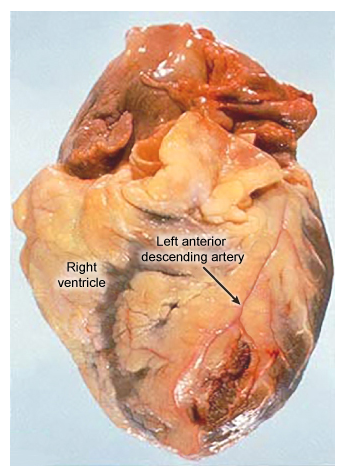 Which of the following most likely predisposed this patient to the observed cardiac findings?
 (Multiple Choice)
5.0/5 (83)
(83) A 2-year-old girl is brought to the physician because of abdominal distention and twitching of her feet, which her mother noticed a week ago. The patient has also had a low-grade fever for 5 days. She has not had a bowel movement in 3 days. She was born at term and has been healthy since. She is at the 40th percentile for height and 20th percentile for weight. Her temperature is 38.1°C (100.6°F), pulse is 128/min, and blood pressure is 135/82 mm Hg. Examination shows an irregular palpable mass that crosses the midline of the abdomen. The liver is palpated 3 cm below the right costal margin. There are erratic movements of the eyes. A 24-hour urine collection shows elevated homovanillic acid and vanillylmandelic acid levels. Which of the following is the most likely diagnosis?
(Multiple Choice)
4.8/5 (74)
(74) A 19-year-old woman is brought to the physician by her parents because of an irritable mood that started 5 days ago. Since then, she has been staying up late at night working on an art project. She is enrolled in community college and has been able to complete her daily schoolwork and look after her younger brother at home without issues. She feels rested despite sleeping less than 4 hours per night. Her parents also report that she seems easily distracted and more talkative than usual. She has never had similar symptoms before. In the past, she has had episodes where she felt too tired to go to school and slept until 2 PM every day for 2 weeks at a time. During those episodes, her parents noticed that she cried excessively, was very indecisive, and expressed feelings of worthlessness. Which of the following is the most likely diagnosis?
(Multiple Choice)
5.0/5 (76)
(76) A 75-year-old woman is brought to the hospital following sustained burns on her face, arms, and body during cooking. She has no prior medical conditions and takes no medications. Temperature is 37.4 C (99.3 F), blood pressure is 140/84 mm Hg, pulse is 110/min, and respirations are 18/min. Oxygen saturation is 95% on room air. On examination, the patient is anxious. There are partial- to full-thickness burns involving the lower face, neck, both arms, and anterior chest and abdomen. Which of the following age-related cardiopulmonary changes is most likely to increase this patient's mortality risk?
(Multiple Choice)
4.9/5 (80)
(80) A 62-year-old woman who discovered a lump in her breast visits the doctor. A hard, immovable, irregularly shaped lump is discovered during a physical examination. A spiculated, calcified lesion that was not visible on earlier investigations is revealed by mammography. The diagnosis of infiltrating ductal carcinoma is made by tissue biopsy. Various degrees of aberrant differentiation and maturation are often linked to malignant tumors, such as infiltrating ductal carcinoma. Which of the following findings is most characteristic of an anaplastic tumor?
(Multiple Choice)
4.8/5 (77)
(77) A 53-year-old woman arrives at the office complaining of leg pain. She works as a hair stylist and has reduced her work hours due to her discomfort. The patient has a migraine history as well as untreated chronic hepatitis C. She smokes one pack of cigarettes per day but does not consume alcohol or illegal drugs. The results of the physical examination are depicted in the image below. 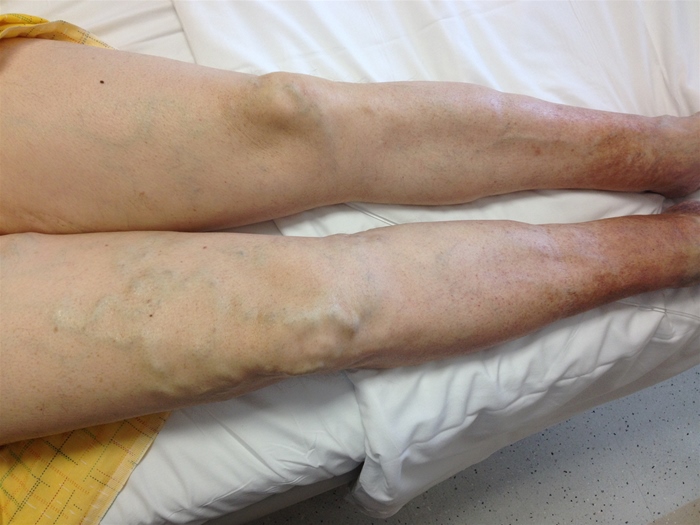 An abnormality of which of the following is the most likely cause of this patient's symptoms?
 (Multiple Choice)
4.8/5 (66)
(66) A 39-year-old woman comes to the physician because of a progressive fatigue. She has no history of serious illness. Seven weeks before this visit, she delivered a healthy male baby without complications. Her vital signs are normal. The thyroid gland is enlarged, firm, and non-tender to palpation. Laboratory evaluation shows low serum TSH and elevated serum thyroxine (T4) and triiodothyronine (T3). Thyroid ultrasound with Doppler flow reveals a mildly enlarged gland with decreased blood flow. Which of the following is the most likely cause of this patient's symptoms?
(Multiple Choice)
4.8/5 (77)
(77) A 61-year-old man arrives at the emergency room after experiencing fever, chills, and a productive cough with thick, blood-tinged sputum for several days. His temperature is 38.8 degrees Celsius (102 degrees Fahrenheit), his blood pressure is 90/60 mm Hg, and his pulse rate is 110 beats per minute. On examination, the patient appears lethargic and ill. The right lung has bronchial breath sounds and crackles. Klebsiella pneumoniae grows in blood and sputum cultures. The bacteria are found to express a lipopolysaccharide on their outer membrane surface, which stimulates toll-like receptors in inflammatory cells. This, in turn, causes the IB inhibitor protein to degrade, which normally binds to a latent transcription factor found in the cytoplasm. Which of the following factors is most likely to be directly activated by the removal of this inhibitor protein?
(Multiple Choice)
5.0/5 (93)
(93) 
Filters
- Essay(0)
- Multiple Choice(0)
- Short Answer(0)
- True False(0)
- Matching(0)