



 Chat with AI
Exam 10: Pathology

Exam 1: Anatomy265 Questions
Exam 2: Behavioral Sciences178 Questions
Exam 3: Biochemistry102 Questions
Exam 4: Embryology59 Questions
Exam 5: Epidemiology, Biostatistics, and Medical Informatics94 Questions
Exam 6: Genetics88 Questions
Exam 7: Histology46 Questions
Exam 8: Immunology147 Questions
Exam 9: Microbiology and Virology330 Questions
Exam 10: Pathology817 Questions
Exam 11: Pharmacology and Toxicology509 Questions
Exam 12: Physiology339 Questions
Exam 13: Psychiatry and Psychotherapy23 Questions
Select questions type


A 62-year-old man comes to the office for decreased exercise tolerance. Over the past six months, he has noticed progressively worsening shortness of breath while mild exertion. He also becomes short of breath when lying in bed at night. His temperature is 36.4°C (97.5°F), pulse is 85/min, respirations are 18/min, and blood pressure is 156/55 mm Hg. Cardiac examination shows a high-pitched, decrescendo murmur that occurs immediately after S2 and is heard best along the left sternal border. There is an S3 gallop. Carotid pulses are strong. Which of the following is the most likely diagnosis?
(Multiple Choice)
4.9/5  (77)
(77) A 20-year-old woman comes to the office due to dysuria, urgency and frequency. This symptoms started 2 days ago. She denied any fever or chills. She has recurrent episodes of cystitis and one epiosde of acute pyelonephritis over the past eight months. The symptoms tend to occur a few days following sexual intercourse. The patient has no other medical problems and takes no medications. Her temperature is 36.7 C (98 F), blood pressure is 110/70 mm Hg, respirations are 16/min, and pulse is 65/min. Abdominal and genitourinary examinations are normal. Which of the following is the most likely predisposing factor for pyelonephritis in this patient?
(Multiple Choice)
4.9/5 (90)
(90) A 67-year-old woman presented to the office complaining of urinary urgency. For the past 6 months, the patient has had urinary urgency associated with increased straining during urination. In addition, she has had multiple urinary tract infections that have been treated well. She has 5 children, all of whom were delivered via vaginal delivery. BMI is 35 kg/m2. On examination, a bulge is shown in the vaginal introitus during straining. The perineal sensation is intact. Urinalysis has no significant abnormalities. Which of the following is the cause of this patient's presentation?
(Multiple Choice)
4.9/5 (78)
(78) A 3-year-old boy who recently emigrated from Ghana is brought to the physician because of a 5-hour history of pain and swelling in his hands. He has had similar episodes in the past. The boy attends day care, but his parents are unsure about any sick contacts. His family history is significant for an older brother who died of pneumococcal sepsis at age 5. The patient appears distressed. His temperature is 38.1°C (100.5°F). Physical examination shows pallor. The dorsum of his hands and fingers are swollen, warm, and tender to palpation. Which of the following is most likely abnormal in this patient?
(Multiple Choice)
4.8/5 (78)
(78) A 42-year-old man is brought to the physician because of progressive memory loss. His wife reports that he often misplaces his possessions and has begun writing notes to remind himself of names and important appointments. He was diagnosed with HIV 7 years ago, but his medical follow-up and treatment compliance have been poor. His temperature is 37.8°C (100°F), pulse is 82/min, respirations are 16/min, and blood pressure is 144/88 mm Hg. Examination shows confluent white plaques on the posterior oropharynx. Neurologic examination shows mild ataxia and an inability to perform repetitive rotary forearm movements. After couples of week, the patient dies due to motor accident. Which of the following histopathologic findings would most likely be found on biopsy of this patient's brain?
(Multiple Choice)
4.9/5 (79)
(79) A 65-year-old woman is brought to the emergency department due to progressive lethargy and generalized weakness. She has also had loss of appetite, constipation, muscle weakness, and increased thirst and urination. The patient's medical history is unremarkable. She takes no prescription medications. The patient does not use tobacco, alcohol, or illicit drugs. On physical examination, she is stuporous and has dry mucous membranes. Laboratory testing shows serum calcium of 14.0 mg/dL and normal serum glucose and urinalysis. Imaging studies reveal an 8-cm right lung mass with enlarged mediastinal lymph nodes but no focal bony lesions. Serum levels of which of the following substances are most likely to be elevated in this patient?
(Multiple Choice)
4.9/5 (89)
(89) Cellular physiologists are looking into the mechanisms of cardiomyocyte contraction cessation in response to ischemic injury. The left anterior descending coronary artery is ligated at time zero in an animal experiment, and changes in ATP levels within the affected myocardial cells are measured. When does the affected portion of the myocardium stop contracting on the graph? 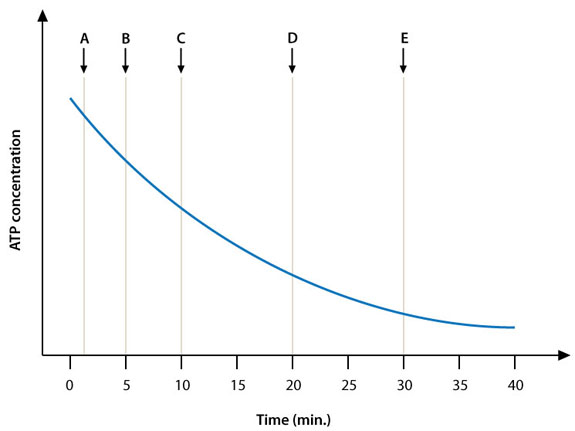
(Multiple Choice)
4.9/5 (75)
(75) A 53-year-old man comes to the physician because of a 3-month history of noproductive cough. He has also had a 4.6-kg (10-lb) weight loss over the past 6 months. He has smoked one pack of cigarettes daily for 35 years. He recently developed left shoulder pain. Examination shows dry mucous membranes. The pupils are equal and react sluggishly to light. An x-ray of the chest shows a pulmonary nodule in the left lung. Compression of a nerve arising from which of the following locations is most likely causing this patient's recent symptoms?
(Multiple Choice)
4.9/5 (74)
(74) A 62-year-old man is brought to the emergency department by a friend due to severe shortness of breath. He is agitated and gasping for air and is unable to provide history. His friend says the patient has a history of chronic alcohol use and attends Alcoholics Anonymous meetings. He is unaware of any other medical history. Temperature is 36.7 C (98 F), blood pressure is 110/70 mm Hg, pulse is 104/min, and respirations are 32/min. Due to worsening respiratory distress, immediate endotracheal intubation is performed and mechanical ventilation is begun. The patient is admitted to the intensive care unit and, despite appropriate therapy, dies several hours later. Autopsy examination is performed, and histopathology of the lungs reveals engorged pulmonary capillaries and intraalveolar, acellular, pink material that is more prominent at the bases. This patient most likely had which of the following conditions?
(Multiple Choice)
4.8/5 (88)
(88) A 28-year-old woman comes to the physician because of progressive facial hair growth and deepening of her voice that started 3 months ago. Six months ago, menses occurred at regular 28-day intervals with moderate flow. Menses now occur at irregular 35- to 45-day intervals and last 2 to 3 days. Her last menstrual period was 2 weeks ago. She takes no medications. The patient's mother died from infiltrating lobular breast carcinoma at age 60. Vital signs are within normal limits. Physical examination shows dark terminal hair on the chin and upper lip. Pelvic examination shows a normal-appearing vagina, cervix, and uterus. There is a palpable adnexal mass on the right side. Pelvic ultrasonography confirms a large ovarian mass. Which of the following is the most likely diagnosis?
(Multiple Choice)
5.0/5 (70)
(70) A 68-year-old woman comes to the office due to a history of progressive dyspnea, and dry cough. The patient has symptoms that worsen with exertion and when lying flat. She has had no chest pain, palpitations, or lightheadedness. The patient has a history of hypertension and breast cancer that is in remission after surgery and doxorubicin-based chemotherapy 15 years ago. She does not use tobacco, alcohol, or illicit drugs. Blood pressure is 110/62 mm Hg and pulse is 94/min. Physical examination shows crackles at the lung bases and bilateral pedal edema. Which of the following sets of findings are most likely present in this patient? 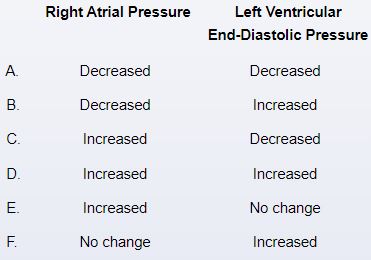
(Multiple Choice)
4.8/5 (76)
(76) A 61-year-old farmer comes to the physician because of a 3-month history of progressively worsening cough and shortness of breath. He has had a 7.5-kg (16.5-lb) weight loss during this period. He smokes occasionally and does not drink alcohol. Physical examination shows clubbing of the fingers. End-inspiratory crackles are heard in both lower lung fields. An x-ray of the chest shows bilateral reticulonodular densities with interstitial fibrosis. Bronchioalveolar lavage reveals >50% of cells being lymphocytes. Which of the following is the most likely diagnosis?
(Multiple Choice)
5.0/5 (82)
(82) A 64-year-old man arrives at the office exhausted. He has high blood pressure and poorly controlled diabetes, which is exacerbated by nephropathy and peripheral neuropathy. His renal function has steadily deteriorated over the last few years. His conjunctivae are pale, and he has bilateral 1+ peripheral edema. The following are the laboratory results: 11ec160b 3a2e f5c4 9249 eb513667f5c6 MD0001 00 The normal relationship between serum concentrations of free calcium and parathyroid hormone is depicted in area "C" of the graph below. Which of the following areas most likely represents this patient's current metabolic state? 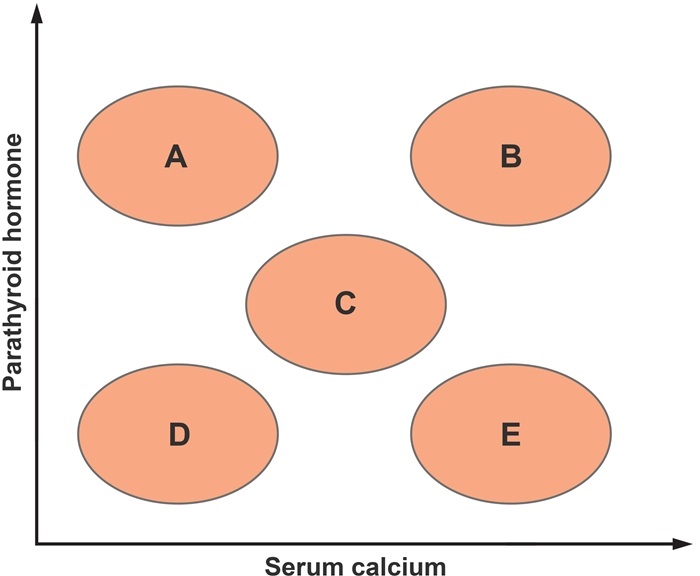
(Multiple Choice)
4.8/5 (72)
(72) A 34-year-old man comes to the physician because of palpitations, shortness of breath, diarrhea, and abdominal cramps for 2 months. Physical examination shows cutaneous flushing of the face. Auscultation of the chest shows bilateral wheezing. A 24-hour urine collection shows increased 5-hydroxyindoleacetic acid (5-HIA A) concentration. Abdominal imaging shows a tumor in the small intestine. Which of the following is most likely responsible for this patient's condition?
(Multiple Choice)
4.9/5 (71)
(71) A 67-year-old man comes to the physician because of a 6-month history of increasing shortness of breath on exertion, dry cough, and fatigue. He has not had any fevers or night sweats. He worked in a glass manufacturing factory for 15 years and retired 2 years ago. Pulmonary examination shows diffuse crackles bilaterally. An x-ray of the chest shows well-defined calcification of the rims of hilar lymph nodes and scattered nodules in both upper lung fields. Bronchoscopy with transbronchial biopsy of a calcified node is performed, and polarized microscopy shows birefringent particles surrounded by dense collagen fibers. This patient most likely has a history of exposure to which of the following substances?
(Multiple Choice)
4.8/5 (80)
(80) A 39-year-old woman comes to the physician because of a progressive fatigue. She has no history of serious illness. Seven weeks before this visit, she delivered a healthy male baby without complications. Her vital signs are normal. The thyroid gland is enlarged, firm, and non-tender to palpation. Laboratory evaluation shows low serum TSH and elevated serum thyroxine (T4) and triiodothyronine (T3). Thyroid ultrasound with Doppler flow reveals a mildly enlarged gland with decreased blood flow. Which of the following is most likely responsible for this patient's disorder?
(Multiple Choice)
4.9/5 (97)
(97) A 44-year-old man is brought to the hosiptal after his wife found him unresponiveness. He has a history of opioid and alcohol intoxication. While unconscious, he vomited profusely and then rapidly developed hypoxia and shortness of breath that has continued to worsen. Temperature is 38.4 C (101.1 F), blood pressure is 108/74 mm Hg, pulse is 120/min, and respirations are 26/min. Diffuse crackles are heard on auscultation. The extremities are warm, well perfused, and without edema. Chest x-ray reveals bilateral alveolar opacities. The results of arterial blood gas analysis on room air are as follows:  Which of the following pathologic processes is the primary contributor to this patient's lung findings?
 (Multiple Choice)
4.7/5 (74)
(74) A 72-year-old man presented to the office complaining of left shoulder pain. The patient has been feeling weakness in the left arm for the last month. Physical examination shows left-sided ptosis. The left pupil is smaller in diameter than the right, but both pupils are reactive. Extraocular movements are intact. This patient's symptoms are most likely due to disruption of which of the following structures?
(Multiple Choice)
4.7/5 (80)
(80) A 3-month-old girl is brought to the physician because of poor feeding, irritability, and vomiting for 2 weeks. He is found to have glucosuria on urinalysis, although his serum glucose is within normal limits. What renal defect is responsible for his condition?
(Multiple Choice)
4.8/5 (76)
(76) A 42-year-old woman comes to the physician because of a worsening muscle stiffness, myalgia, and a 7-kg (15-lb) weight gain. Her last menstrual period was 4 months ago. Physical examination shows cold, dry skin, and proximal muscle weakness. Deep tendon reflexes are 2+ bilaterally, with delayed relaxation. Blood pressure is 140/90 mm Hg and pulse is 56/min. BMI is 26 kg/m2. The serum creatine kinase concentration is 2,940 U/L. Which of the following tests is most likely to identify the cause of this patient's muscle weakness?
(Multiple Choice)
4.9/5 (82)
(82) 
Filters
- Essay(0)
- Multiple Choice(0)
- Short Answer(0)
- True False(0)
- Matching(0)