



 Chat with AI
Exam 10: Pathology

Exam 1: Anatomy265 Questions
Exam 2: Behavioral Sciences178 Questions
Exam 3: Biochemistry102 Questions
Exam 4: Embryology59 Questions
Exam 5: Epidemiology, Biostatistics, and Medical Informatics94 Questions
Exam 6: Genetics88 Questions
Exam 7: Histology46 Questions
Exam 8: Immunology147 Questions
Exam 9: Microbiology and Virology330 Questions
Exam 10: Pathology817 Questions
Exam 11: Pharmacology and Toxicology509 Questions
Exam 12: Physiology339 Questions
Exam 13: Psychiatry and Psychotherapy23 Questions
Select questions type


A 76-year-old man is brought to the emergency department by ambulance after being found unconscious in his bathroom. His wife reports a 2-day history of fever, dysuria, and flank pain. His temperature is 36.0°C (96.8°F), pulse is 142/min and regular, respirations are 25/min, and blood pressure is 75/40 mm Hg. On physical examination, the patient appears lethargic, flushed, and diaphoretic. Neck veins are flat. The lungs are clear on auscultation and heart sounds are normal. There is right-sided costovertebral tenderness. Which of the following hemodynamic parameters are most likely to be present in this patient? 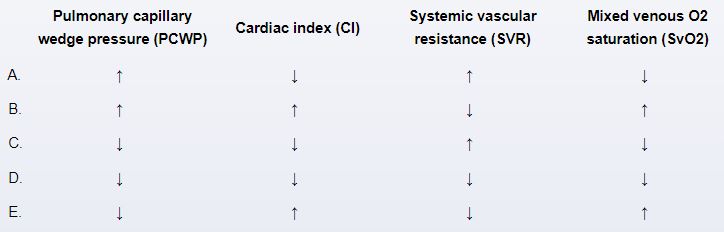
(Multiple Choice)
4.9/5  (67)
(67) A 20-year-old woman comes to the office due to dysuria, urgency and frequency. This symptoms started 2 days ago. She denied any fever or chills. She has recurrent episodes of cystitis and one epiosde of acute pyelonephritis over the past eight months. The symptoms tend to occur a few days following sexual intercourse. The patient has no other medical problems and takes no medications. Urinalysis reveals positive nitrites, positive leukocyte esterase, 50 white blood cells/hpf, and many bacteria. Urine Beta-hCG is negative. Which of the following is the most likely cause of this patient's infection?
(Multiple Choice)
4.9/5 (76)
(76) A newborn undergoes an abdominal ultrasound that shows kidneys of normal size, structure, and location. The patient does not appear to be in distress and physical examination reveals no abnormalities. If this patient were to be diagnosed with renal disease later in life, it would most likely be which of the following?
(Multiple Choice)
4.8/5 (70)
(70) A 65-year-old male complains of bilateral visual difficulty that has progressed over the last year. Funduscopy reveals small yellow retinal lesions clustered in the macula. Which of the following would you expect most on visual field examination?
(Multiple Choice)
4.8/5 (71)
(71) A 10-year-old boy is brought to the physician by his father, who is concerned because his son has been less interested in playing soccer with him recently. They used to play every weekend, but his son has started to tire easily and has complained of pain in the lower legs while running around on the soccer field. The boy has no personal or family history of serious illness. Physical examination shows a well-appearing child. The lungs are clear to auscultation. Cardiac auscultation findings at the left lower sternal border are given below. The auscultatory abnormality intensifies with the handgrip exercise. Which of the following is the most likely diagnosis?
(Multiple Choice)
4.8/5 (78)
(78) A 21-year-old woman comes to the physician for an annual health maintenance examination. She has no particular health concerns. Laboratory results obtained during today's visit are as follows: 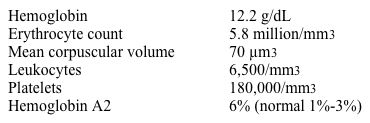 The patient's blood smear is shown in the image below.
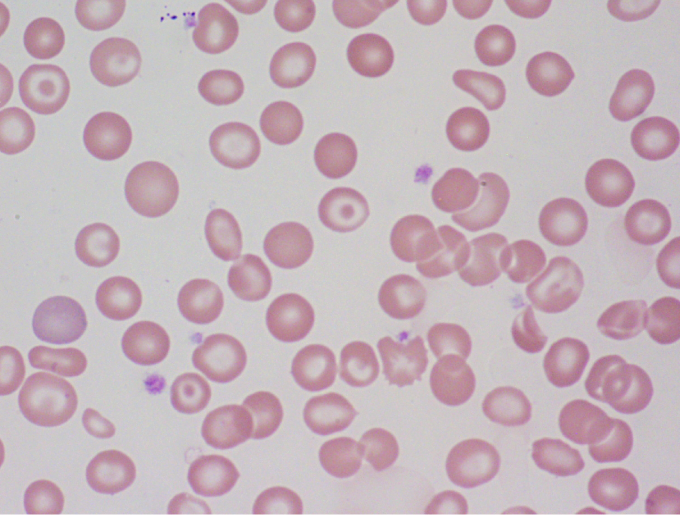 Which of the following processes is the initial step in the pathogenesis of this patient's disorder?
The patient's blood smear is shown in the image below. Which of the following processes is the initial step in the pathogenesis of this patient's disorder? (Multiple Choice)
4.9/5 (95)
(95) A 47-year-old guy visits the clinic because his shortness of breath has gotten worse over a period of time. The patient does not have a cough, fever, or weight loss. He does not use any drugs and has no further medical issues. The patient does not consume alcohol, cigarettes, or illegal substances. The vital indicators are typical. An examination of the lungs reveals wheezing and inadequate airflow. The following are the laboratory findings: 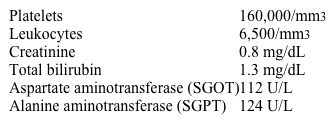 A liver biopsy is subsequently performed. Light microscopy of the tissue specimen after treatment with diastase and periodic acid-Schiff staining is shown in the exhibit.
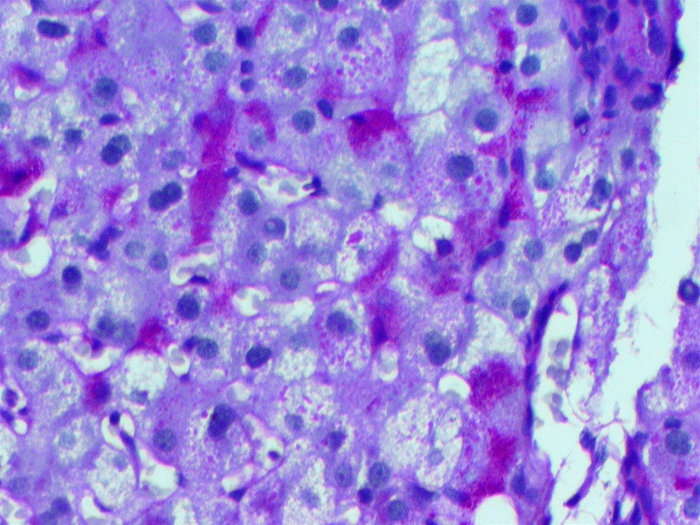 Given these findings, which of the following is the most likely cause of this patient's shortness of breath?
A liver biopsy is subsequently performed. Light microscopy of the tissue specimen after treatment with diastase and periodic acid-Schiff staining is shown in the exhibit. Given these findings, which of the following is the most likely cause of this patient's shortness of breath? (Multiple Choice)
4.8/5 (75)
(75) A 76-year-old woman is brought to the emergency department due to left leg pain. Seven days after undergoing bilateral total knee arthroplasty. Current medications include simvastatin, aspirin, and low molecular weight heparin. His vital signs are within normal limits. The surgical incision over her knees is healing well. Her left posterior calf is tender and swollen to the knee. Examination of the skin shows multiple coalescing blisters with areas of necrosis. Laboratory studies show a platelet count of 32,000/mm3. Which of the following is the most likely cause of this patient's thrombocytopenia?
(Multiple Choice)
4.9/5 (87)
(87) A 16-year-old boy is brought to the physician by his parents because they are worried about his behavior. For the past year, he has been setting mail boxes on fire in their neighborhood. Three months ago, he brought a box of matches to school and threatened to burn down a classroom. His father says, "We've tried everything, but he won't listen to us anymore. The last straw was when he broke into someone's car yesterday and stole a laptop!" The patient has no history of serious illness and takes no medications The patient does not smoke cigarettes. He drinks one to three beers on weekends. He has experimented with cocaine but has never used intravenous drugs. On mental status examination, he has an angry mood and anxious affect. He is fully oriented. Which of the following is the most likely diagnosis in this patient?
(Multiple Choice)
4.9/5 (68)
(68) A 5-year-old boy is brought to the physician for evaluation of pallor and increasing lethargy for 3 days. Six days ago, he experienced abdominal pain, vomiting, and bloody diarrhea that have since resolved. The day before the onset of symptoms, the patient swam in a lake and ate hamburgers at a family picnic. His temperature is 38.8°C (101.8°F), pulse is 128/min, respirations are 30/min, and blood pressure is 96/60 mm Hg. Examination shows pale conjunctivae and scleral icterus. Physical examination shows pallor but is otherwise normal. He has no peripheral edema or rashes. Laboratory evaluation shows anemia, thrombocytopenia, and elevated blood urea nitrogen and serum creatinine. Which of the following findings is most likely to be seen in this patient?
(Multiple Choice)
4.8/5 (81)
(81) A 72-year-old man is seen for an evaluation of a scaly lesion behind his right ear. A biopsy confirms the diagnosis of squamous cell carcinoma, and the lesion is excised with clear margins. Secondary intention allows the wound to heal. The patient returns to the office three weeks later with a 2.5-cm raised, soft, granular lesion at the excision site. The image below depicts a biopsy of a representative lesion: 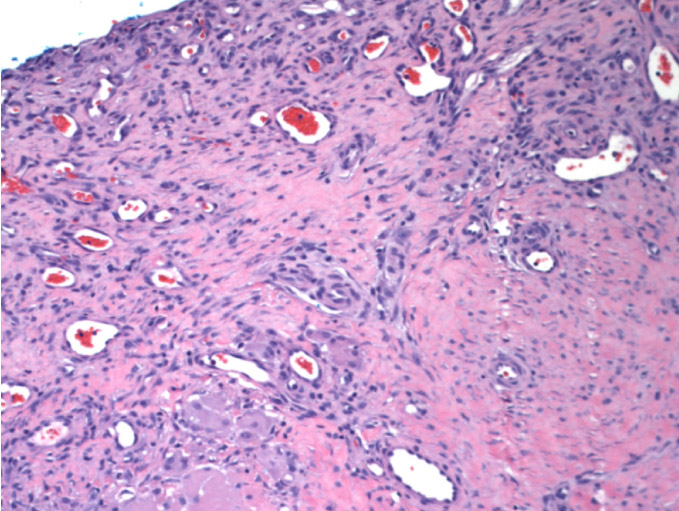 Which of the following is most likely responsible for this patient's postoperative changes?
 (Multiple Choice)
4.8/5 (67)
(67) A 28-year-old nulliparous woman comes to the physician because she has been unable to conceive for 3 years. Analysis of her husband's semen has shown normal sperm counts during this time. The patient also reports episodic pelvic and back pain accompanied by painful diarrhea for 5 years. She has about one such episode on average per month that lasts 4-6 days. She has taken ibuprofen for the pain, which has provided some relief. Menses have occurred at regular 29-day intervals since menarche at the age of 14 years and last for 7 days. She is sexually active with her husband and does not use contraception. Vital signs are within normal limits. Pelvic and bimanual examinations are normal; The posterior vaginal fornix is tender to palpation. A hysterosalpingogram 6 months prior showed normal results. This patient's condition most likely involves which of the following?
(Multiple Choice)
4.7/5 (77)
(77) A 38-year-old man comes to the physician because of progressive pain and swelling of his left knee for the past 2 days. He has been taking ibuprofen for the past 2 days without improvement. Four days ago, he scraped his left knee while playing baseball. The pain starts after waking up and lasts for 20 minutes. On examination, the left knee is swollen, erythematous, warm, and tender with restricted range of active and passive motion. The remainder of the examination is unremarkable. Which of the following is the best next step in management of this patient?
(Multiple Choice)
4.7/5 (75)
(75) A 58-year-old woman presented to the office complaining of urinary incontinence exacerbated by coughing and sneezing. The patient does not complain of dysuria, frequency, or urgency. She has had 5 vaginal deliveries. Physical examination shows anterior vaginal prolapse and vulvovaginal atrophy. The rest of the physical examination is normal. The patient is advised to do exercises to strengthen pelvic floor muscles. Which of the following muscles is the target of the exercise?
(Multiple Choice)
5.0/5 (83)
(83) A 34-year-old woman comes to the office due to diplopia, clumsiness of the left hand. Six months ago, the patient had numbness of the right hand, which resolved without treatment. The patient started having blurry vision and pain with eye movement 2 days ago. She has no other medical problems and takes no medications. The patient has a 10-pack-year smoking history. Both parents are healthy. Vital signs are normal. BMI is 27 kg/m2. Neurologic examination shows slowing of left eye adduction and left arm power of 4/5 with mild spasticity. Sensation to pinprick is decreased over the right foot. This patient's diplopia is most likely caused by which of the following mechanisms?
(Multiple Choice)
4.8/5 (78)
(78) A 62-year-old man comes to the physician for decreased exercise tolerance. Over the past four months, he has noticed progressively worsening shortness of breath while walking his dog. He also becomes short of breath when lying in bed at night. Cardiac examination shows a high-pitched, decrescendo murmur that occurs immediately after S2 and is heard best along the left sternal border. There is an S3 gallop. Carotid pulses are strong. which of the following findings is most likely to be present on further evaluation?
(Multiple Choice)
4.9/5 (73)
(73) A 68-year-old man comes to the physician because of double vision and unilateral right eye pain that began this morning. He has hypertension, and type 2 diabetes mellitus. The patient has smoked two packs of cigarettes daily for 40 years. His current medications include lisinopril, metformin, and insulin with meals. Physical examination shows right-sided ptosis and abducted. He can only minimally adduct the right eye. An MRI of the head shows no abnormalities. His fingerstick blood glucose concentration is 325 mg/dL. This patient's condition is most likely due to which of the following etiologies?
(Multiple Choice)
4.9/5 (62)
(62) A 17-year-old boy is brought to the physician because of swelling of his face and legs for 5 days. He has been healthy except for an episode of sore throat 2 weeks ago. His temperature is 37.0°C (98.6°F), pulse is 90/min, and blood pressure is 145/87 mm Hg. Examination shows periorbital edema and 3+ pitting edema of the lower extremities. .Laboratory results are as follows: 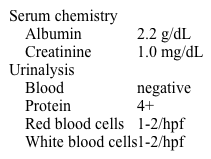 Urinary protein excretion is 6.0 g/24 hr. A kidney biopsy is performed, and electron microscopy of a glomerular capillary is shown below:
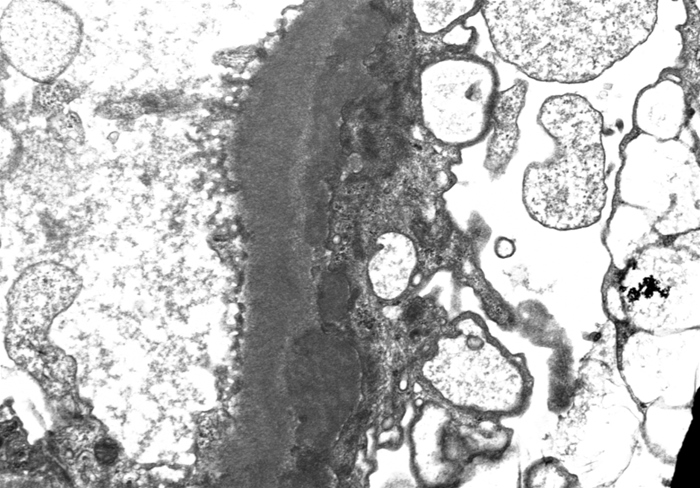 Which of the following is the most likely diagnosis?
Urinary protein excretion is 6.0 g/24 hr. A kidney biopsy is performed, and electron microscopy of a glomerular capillary is shown below: Which of the following is the most likely diagnosis? (Multiple Choice)
4.8/5 (85)
(85) A 52-year-old man is brought to the emergency department because of worsening shortness of breath for 6 hours. For the past 5 days, he has had intermittent stabbing pain in the middle of his chest that worsens with lying down or taking deep breaths. He has a history of stage 4 chronic kidney disease due to chronic glomerulonephritis. Systolic blood pressure decreases by 12 mm Hg during inspiration. Physical examination shows distant heart sounds and clear lungs. Echocardiography in this patient is most likely to reveal which of the following findings?
(Multiple Choice)
5.0/5 (78)
(78) A 25-year-old woman presented to the office complaining of shortness of breath of 2 weeks duration. The patient had an upper respiratory tract infection, which was followed by dyspnea, cough, and hemoptysis. She does not complain of fever, night sweats, or weight changes. Her blood pressure is 160/95 mm Hg and her pulse is 96/min and regular. On examination, the patient has bilateral inspiratory crackles and lower limbs edema. Her creatinine is 4.5 mg/dL. Urinalysis reveals proteinuria and hematuria showing dysmorphic red blood cells. Radiological imaging shows pulmonary infiltrates on bilateral lungs. This patient's presentation is due to antibodies directed against which the following targets?
(Multiple Choice)
4.9/5 (75)
(75) 
Filters
- Essay(0)
- Multiple Choice(0)
- Short Answer(0)
- True False(0)
- Matching(0)