



 Chat with AI
Exam 10: Pathology

Exam 1: Anatomy265 Questions
Exam 2: Behavioral Sciences178 Questions
Exam 3: Biochemistry102 Questions
Exam 4: Embryology59 Questions
Exam 5: Epidemiology, Biostatistics, and Medical Informatics94 Questions
Exam 6: Genetics88 Questions
Exam 7: Histology46 Questions
Exam 8: Immunology147 Questions
Exam 9: Microbiology and Virology330 Questions
Exam 10: Pathology817 Questions
Exam 11: Pharmacology and Toxicology509 Questions
Exam 12: Physiology339 Questions
Exam 13: Psychiatry and Psychotherapy23 Questions
Select questions type


A 38-year-old man comes to the physician because of a 1-year history of a painless skin lesion on his back. It has slowly increased in size over the past year. Examination shows multiple subcutaneous, soft, freely mobile, and nontender masses. The lesion on his back is shown in the image. 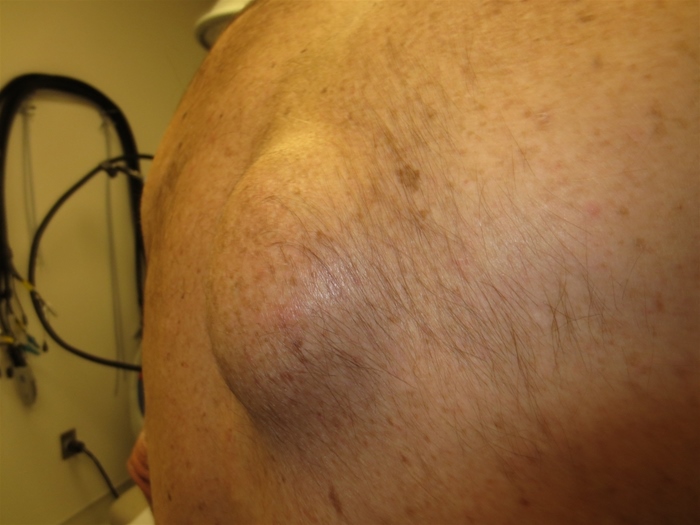 Histologic examination of the mass is most likely to show which of the following findings?
 (Multiple Choice)
4.9/5  (73)
(73) A 26-year-old male with myalgia, nasal congestion, and a cough shows up at the clinic. It is 38.3 C outside (100.9 F). On examination, hyperemia is seen in the nose and throat. Nasopharyngeal secretions tested quickly for influenza antigen are positive. Viral proteins are broken down and bound to major histocompatibility complex class I molecules within the infected cells of the patient's respiratory tract. These molecules are subsequently produced on the cell surface for presentation to cytotoxic CD8+ lymphocytes. Which of the following enzymes is most essential to initiating this process?
(Multiple Choice)
5.0/5 (72)
(72) A 27-year-old man is brought to the physician because of swelling of his face and legs for 5 days. He has been healthy except for an episode of sore throat 2 weeks ago. His temperature is 37.0°C (98.6°F), pulse is 90/min, and blood pressure is 145/87 mm Hg. Examination shows generalized edema. he abdomen is soft and nontender. Serum creatinine is 1.1 mg/dL. Urinalysis shows 4+ protein, 0-3 leukocytes/hpf, and oval fat bodies. Serum contains IgG4 antibodies to the phospholipase A2 receptor (PLA2R), a transmembrane protein abundant on podocytes. Which of the following is the most likely diagnosis?
(Multiple Choice)
5.0/5 (76)
(76) A 6-year-old boy is brought to the emergency department because of a 1-day history of colicky abdominal pain and vomiting. He also had a sore throat 2 weeks ago. His temperature is 37.0°C (98.6°F), pulse is 100/min, respirations are 28/min, and blood pressure is 90/55 mm Hg. Examination of the lower extremities shows nonblanching raised erythematous papules. The abdomen is soft and nontender. Bowel sounds are high-pitched. Which of the following additional findings is most likely present in this patient?
(Multiple Choice)
4.8/5 (70)
(70) Written beforeA 14-year-old child is taken to the doctor's office because he has painless nodules on his lips and tongue. The lesions first developed some months ago and have grown in size. Following the detection of a thyroid tumor 5 years ago, the patient had complete thyroidectomy and is now on thyroid hormone replacement. The patient is tall and thin, with excessively lengthy arms and legs, according to physical examination. His fingers are similarly long and slender, and he has joint laxity. His eyes are OK, and an oral examination reveals many tiny, soft, flesh-colored papules on his lips and tongue. TSH levels in the blood are normal. This patient most likely has which of the following conditions?
(Multiple Choice)
4.8/5 (78)
(78) An 82-year-old man arrives to the office because he has been experiencing increased dyspnea and weariness for the past year, which has limited his daily activities. He has also experienced bilateral foot edema. Amlodipine is used to treat the patient's hypertension. His blood pressure is 122/72 mm Hg, and his pulse rate is 55 beats per minute. Physical examination demonstrates high jugular venous pressure, a fast 'y' decline, and a pronounced S4. An abdominal exam reveals moderate ascites. The patient has 3+ bilateral pitting edema of the lower extremities. The echocardiogram shows left atrial enlargement, as well as significant left ventricular hypertrophy and a normal left ventricular ejection percentage. The complete blood count and basic metabolic panel are normal. The results of an endomyocardial biopsy are displayed below. 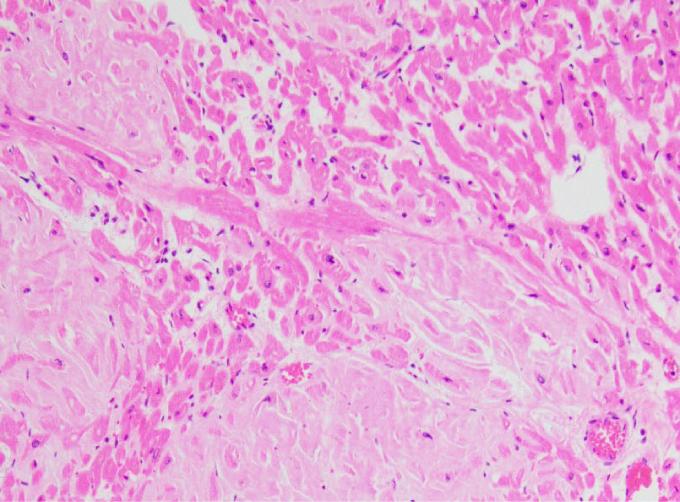 Which of the following is the most likely diagnosis?
 (Multiple Choice)
4.9/5 (73)
(73) A 77-year-old woman is brought to the physician for gradually increasing confusion and difficulty walking for the past 4 months. Her daughter is concerned because she has been forgetful and seems to be walking more slowly. She has also had increasingly frequent episodes of urinary incontinence and now wears an adult diaper daily. She has hyperlipidemia and hypertension. Current medications include lisinopril and atorvastatin. She is confused and oriented only to person and place. Neurological examination shows impaired attention and short-term memory. She has a broad-based gait and takes short steps. Laboratory studies are within normal limits. Which of the following is the most likely underlying cause of this patient's urinary incontinence?
(Multiple Choice)
4.8/5 (80)
(80) A 75-year-old woman comes to the physician because of progressive shortness of breath with exertion for the past 2 days. She is unable to walk further than a few houses down the street or climb the stairs at her home. She has occasional palpitations and a dry cough. She lives independently with her husband and is capable of doing her household chores. She has hypertension treated with hydrochlorothiazide and amlodipine. Pulse is 72/min, respirations are 20/min, and blood pressure is 145/90 mm Hg. A grade 4/6 holosystolic murmur and an early-diastolic heart sound are heard best at the cardiac apex. Bilateral crackles are heard on pulmonary examination. Which of the following would most likely increase the ratio of forward flow volume to regurgitant flow volume in this patient?
(Multiple Choice)
4.7/5 (92)
(92) A 59-year-old man is brought to the emergency department by his wife because of a 3-day history of worsening shortness of breath. He has a history of long-standing hypertension, type 2 diabetes mellitus, and gout. Current medications include enalapril, amlodipine, metformin, and ibuprofen as needed. His wife reports that he only takes his medications every second or third day. He has smoked one pack of cigarettes daily for 30 years. He stopped drinking alcohol after his first acute gout attack 3 years ago. His temperature is 37.1°C (98.9°F), pulse is 86/min, and blood pressure is 167/95 mm Hg. Pulse oximetry on room air shows an oxygen saturation of 91%. There is pitting edema in the bilateral lower extremities. Levels of which of the following substances will be higher in the pulmonary vein compared to the pulmonary artery in this patient?
(Multiple Choice)
4.9/5 (67)
(67) A 47-year-old man with gastroesophageal reflux disease comes to the physician because of severe burning chest pain and belching after meals. The discomfort has been less responsive than usual to over-the-counter antacids. He has no other chronic medical conditions. He has limited his caffeine intake and has been avoiding food close to bedtime. BMI is 34 kg/m2. Vital signs are within normal limits. Physical examination reveals no abnormalities. The recent worsening of this patient's symptoms is most likely related to which of the following?
(Multiple Choice)
4.9/5 (85)
(85) 60-year-old man comes to the emergency department because of nausea, headache, and generalized fatigue for 2 days. He was diagnosed with small cell lung cancer around 3 months ago. Examination shows decreased breath sounds over the left lung. Cardiac examination shows an S4. The abdomen is soft and nontender. Neurological examination shows no focal findings. Further evaluation reveals an electrolyte abnormality induced by ectopic antidiuretic hormone production from a lung mass. This patient is at greatest risk of which of the following conditions if his electrolyte abnormality is corrected too quickly?
(Multiple Choice)
4.8/5 (89)
(89) A 40-year-old man comes to the physician because of palpitations and a 5.4-kg (11.9-lb) weight loss over the past 3 months. He appears anxious. His pulse is 104/min and blood pressure is 148/101 mm Hg. He has no other medical problems and takes no medications. Physical examination shows warm skin, mild tremor, and an enlarged thyroid gland. His serum free thyroxine level is elevated and TSH level is decreased. He is found to have a positive assay for thyrotropin receptor antibodies. If present, which of the following additional findings would be most specific to the underlying cause of this patient's hyperthyroidism?
(Multiple Choice)
4.9/5 (66)
(66) A 54-year-old woman is brought to the physician by her brother for confusion and agitation. She is unable to personally give a history. Her brother says she has a problem with alcohol use and that he found an empty bottle of vodka on the counter at her home. She appears disheveled. Her temperature is 37°C (98.6°F), pulse is 85/min, and blood pressure is 140/95 mm Hg. On mental status examination, she is confused and oriented only to person. She recalls 0 out of 3 words after 5 minutes. She cannot perform serial sevens and is unable to repeat seven digits forward and five in reverse sequence. Neurologic examination shows horizontal nystagmus on lateral gaze. Thiamine infusion is started immediately, and his condition improves significantly over the next several days. Which of the following neurologic findings is most likely to persist despite treatment?
(Multiple Choice)
4.8/5 (78)
(78) A 21-year-old lady with a gravida 0 status arrives at the clinic complaining of postcoital bleeding. For six months, she has engaged in sexual activity with her male companion. Since she first started having sexual relations at age 15, the patient has been using birth control tablets. The patient and her boyfriend don't use condoms, and neither of them has ever had an STD identified. Every day, the patient smokes one pack of cigarettes. A tiny mobile uterus and no cervical motion pain are seen with bimanual examination. A vagina that is well-estrogenized and free of lesions is visible under a scope. The exterior os of the cervix is surrounded by an erythematous region, and there is little clear discharge. The cytological result of her first Papanicolaou smear is seen in the picture below. 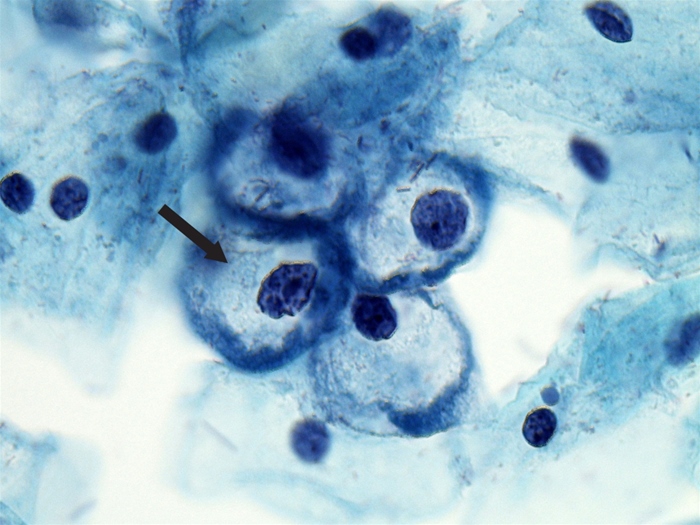 Which of the following best describes the finding shown on this patient's slide?
 (Multiple Choice)
5.0/5 (99)
(99) A 45-year-old woman comes to the physician because of a 1-year history of episodic abdominal cramps, bloating, and flatulence. The symptoms worsen when she has pizza or ice cream and have become more frequent over the past 4 months. There is no associated weight loss, abnormal bleeding, or joint pain. Past medical history is otherwise unremarkable, though the patient has not seen a physician for many years. Vital signs and physical examination are normal. Laboratory studies show normal hemoglobin, iron, and vitamin D levels. A biopsy sample of this patient's small bowel mucosa would most likely show which of the following?
(Multiple Choice)
4.8/5 (74)
(74) A 32-year-old hospitalized man is evaluated for new-onset shortness of breath and confusion. The patient was admitted for a displaced femoral neck fracture of the left hip acquired after a fall the day before. He develops worsening shortness of breath and confusion and dies despite appropriate management. There are several scattered petechiae on the anterior chest wall. Microscopic evaluation of his pulmonary vessels reveals the findings shown below. 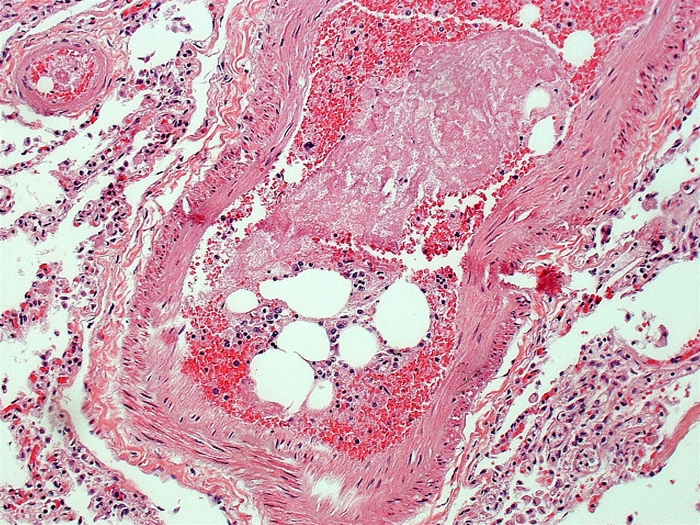 Which of the following most likely predisposed this patient to developing the observed histopathologic abnormality?
 (Multiple Choice)
4.9/5 (78)
(78) A 33-year-old woman comes to the physician because of vision impairment in her right eye. During this period, she was unable to distinguish colors with her right eye. She also reports pain with eye movement. She has no double vision. A year ago, she had an episode of partial vision loss in her left eye that resolved within 3 weeks. The patient has no other medical issues and takes no medication. She smokes half a pack of cigarettes a day and does not use alcohol or illicit drugs. Vital signs are normal. Ophthalmologic examination shows swelling of the optic disc on the right. Which of the following is the most likely cause of the patient's current condition?
(Multiple Choice)
4.9/5 (88)
(88) A 45-year-old man comes to the clinic due to a 2-month history of increased left arm clumsiness and weakness. He has recently developed problems with his gait. The patient's symptoms have interfered with daily activities such as bathing and dressing. He has had no recent injury, headaches, or bowel/bladder symptoms. On physical examination, there is reduced muscle strength in the left upper extremity. Further evaluation with brain MRI reveals a lesion involving the corticospinal tract. Which of the following additional signs is most likely to been seen in this patient?
(Multiple Choice)
4.8/5 (73)
(73) A 34-year-old woman comes to the office due to vague abdominal pain over the past several months. She has no significant past medical history. The patient does not use tobacco or alcohol. Temperature is 36.7 C (98.1 F). On physical examination, right upper quadrant fullness is present. Abdominal imaging reveals a dense liver mass. Angiography shows a well-demarcated, highly vascularized tumor surrounded by normal liver parenchyma. Which of the following substances most likely contributed the most to blood vessel development in this patient's tumor?
(Multiple Choice)
5.0/5 (74)
(74) A 23-year-old lady with exertional dyspnea shows up at the workplace. She occasionally has a dry cough, but she has never experienced palpitations, syncope, or chest discomfort. Three years ago, the patient left Cambodia. As a toddler, she experienced swelling in both knees. The results of cardiac auscultation above the cardiac apex are listed below. Which of the following describes the patient's symptoms most accurately?
(Multiple Choice)
4.9/5 (82)
(82) 
Filters
- Essay(0)
- Multiple Choice(0)
- Short Answer(0)
- True False(0)
- Matching(0)