



 Chat with AI
Exam 10: Pathology

Exam 1: Anatomy265 Questions
Exam 2: Behavioral Sciences178 Questions
Exam 3: Biochemistry102 Questions
Exam 4: Embryology59 Questions
Exam 5: Epidemiology, Biostatistics, and Medical Informatics94 Questions
Exam 6: Genetics88 Questions
Exam 7: Histology46 Questions
Exam 8: Immunology147 Questions
Exam 9: Microbiology and Virology330 Questions
Exam 10: Pathology817 Questions
Exam 11: Pharmacology and Toxicology509 Questions
Exam 12: Physiology339 Questions
Exam 13: Psychiatry and Psychotherapy23 Questions
Select questions type


A 32-year-old man comes to the urgent care clinic due to shortness of breath. Last week, He came with his family to the Mount Everest base camp at an elevation of 5,334 m (17,500 ft). He has had worsening dyspnea and cough. The patient now feels short of breath even with minimal exertion. Temperature is 37.3 C (99.1) F, blood pressure is 134/82 mm Hg, pulse is 98/min, and respirations are 22/min. Oxygen saturation is 86% on ambient air, which rapidly improves to 95% with supplemental oxygen. Physical examination shows pink mucous membranes, flat neck veins, bilateral inspiratory crackles, and no heart murmurs or pedal edema. Chest x-ray reveals patchy alveolar infiltrates. Which of the following is the most likely cause of this patient's current condition?
(Multiple Choice)
4.8/5  (70)
(70) A 54-year-old man comes to the physician for the evaluation of difficulty swallowing solid food and liquids for 1 month. During the past 5 months, he has also had increased weakness of his hands and legs. He sails regularly and is unable to hold the ropes as tightly as before. Ten years ago, he was involved in a motor vehicle collision. Examination shows atrophy of the tongue. Muscle strength is decreased in the right upper and lower extremities. There is muscle stiffness in the left lower extremity. Deep tendon reflexes are 1+ in the right upper and lower extremities, 3+ in the left upper extremity, and 4+ in the left lower extremity. Plantar reflex shows an extensor response on the left foot. Sensation to light touch, pinprick, and vibration is intact. Which of the following is the most likely diagnosis?
(Multiple Choice)
4.7/5 (69)
(69) A 3-month-old boy is brought to the office because he is fussy, not gaining weight, and has polyuria. The daily urine volume is 700-800 mL. Polydipsia and polyuria are symptoms of the patient's maternal grandfather. Serum sodium concentration is 151 mEq/L. A vasopressin-2 receptor mutation is discovered through genetic testing. Which of the following additional findings in this patient is most likely? 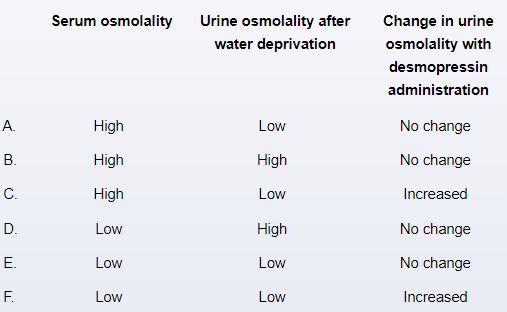
(Multiple Choice)
4.8/5 (79)
(79) A 67-year-old man comes to the physician because of worsening lower back pain for 6 weeks. He reports that the pain is most intense with movement and that it sometimes occurs at night. Over the past 3 months, he has noticed a weakened urinary stream. He has not seen any blood in his urine. His only daily medication is ibuprofen, which does not provide adequate pain relief. Examination shows no spinal deformities. Digital rectal examination reveals a firm prostatic nodule. The patient undergoes transrectal prostate biopsy, and microscopy reveals sheets of tumor cells infiltrating the stroma with no glandular differentiation; the tumor cells have large vesicular nuclei and prominent nucleoli. Imaging shows enlargement of several iliac lymph nodes. Which of the following is the best description of this patient's tumor?
(Multiple Choice)
4.7/5 (72)
(72) A 23-year-old woman is brought to the emergency department 2 hours after the sudden onset of shortness of breath and pleuritic chest pain. She has cystic fibrosis and, during the past year, has had 4 respiratory exacerbations that have required hospitalization. Current medications include an inhaled bronchodilator, an inhaled corticosteroid, inhaled N-acetylcysteine, and azithromycin. Physical examination shows a thin, tall patient in acute distress. The right side of the chest is hyperresonant to percussion and lacks audible breath sounds. His chest x-ray is shown below. 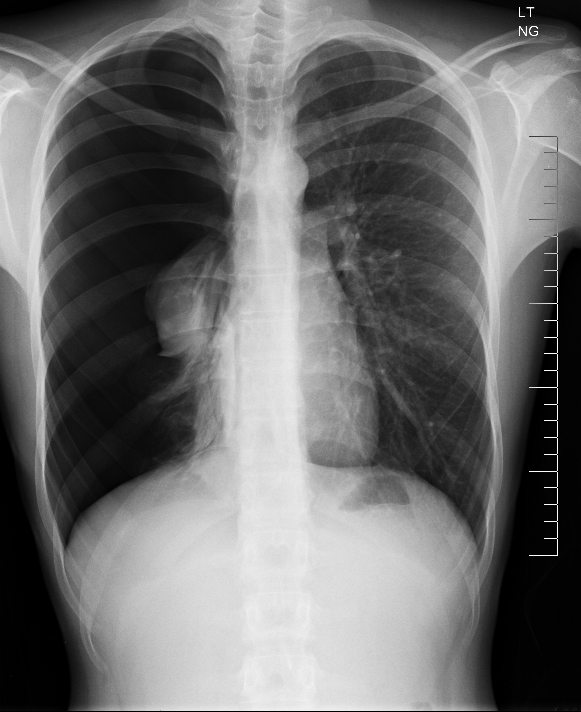 Which of the following conditions most likely led to this patient's presentation?
 (Multiple Choice)
4.9/5 (84)
(84) A 26-year-old woman's lower stomach pain is being assessed. For moderate intermittent asthma and migraines without an aura, medical history is important. She has never given birth. The patient and her spouse engage in sexual activity and use condoms to prevent pregnancy. She does not use smoke or illegal substances; she only consumes alcohol in social settings. Her grandpa passed away from colon cancer at the age of 77, and her mother was 52 when she received a breast cancer diagnosis. 30 kg/m2 is the BMI. An abdominal ultrasound identifies a right-sided adnexal tumor that is later surgically removed via laparoscopy. The picture below displays histologic results. 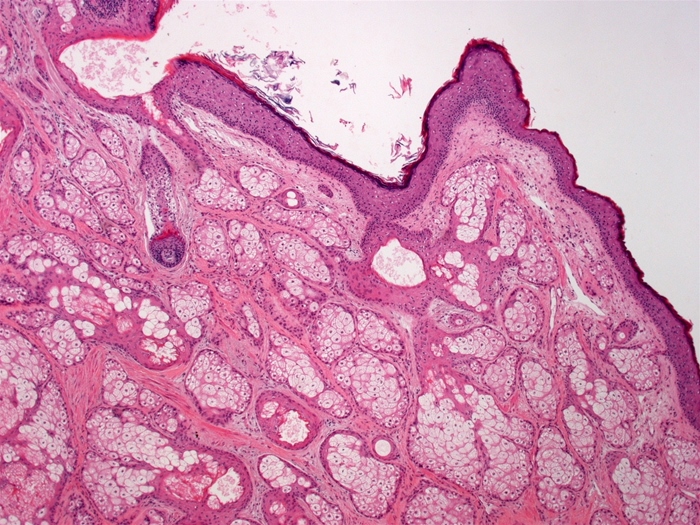 Which of the following is the most likely diagnosis?
 (Multiple Choice)
4.8/5 (73)
(73) An 8-year-old boy is brought to the physician by his parents for short stature. Neither his clothing nor his shoe size has changed over the past year. He also frequently bumps into obstacles such as furniture and has headaches at night. He is always thirsty for cold water and has been urinating more frequently. Three years ago, he had an asthma attack that was treated with albuterol and a one-week course of steroids. His mother has Hashimoto's thyroiditis and had precocious puberty. His mother's height is 147 cm (4 ft 10 in) and his father's height is 160 cm (5 ft 3 in). He is at the 5th percentile for height and 5th percentile for weight. His temperature is 37°C (98.6°F), pulse is 98/min, respirations are 16/min, and blood pressure is 100/64 mm Hg. Examination shows a soft and nontender abdomen. The genitals and pubic hair are both Tanner stage 1. Axillary hair is absent. Patellar reflexes are 1+ bilaterally. From which of the following structures is this mass most likely derived?
(Multiple Choice)
4.8/5 (70)
(70) A 33-year-old woman comes to the physician because of a 3-day history of headaches, and fatigue The patient does not appear to be in acute distress. Temperature is 37.7 C (99.9 F), blood pressure is 115/65 mm Hg, and pulse is 78/min. Light touch sensation is decreased in the right upper extremity and the lower right side of the face. Evaluation reveals severe thrombocytopenia. Laboratory results are as follows: 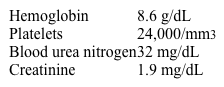 PT and PTT are normal. Peripheral blood smear shows numerous schistocytes. Urinalysis is positive for mild proteinuria. Which of the following is the most likely underlying cause of this patient's current condition?
 (Multiple Choice)
4.9/5 (78)
(78) A 55-year-old man comes to the emergency department because of cramps and left-sided flank pain, nausea, and urinary frequency for 3 hours. He has no history of serious illness and takes no medications. He drinks 2-3 alcoholic beverages daily. Temperature is 39.2 C (102.6 F), blood pressure is 90/50 mm Hg, pulse is 102/min, and respirations are 24/min. Examination of the back shows left costovertebral angle tenderness. The patient subsequently undergoes nephrectomy, and a cut section of the resected kidney is shown in the image below. 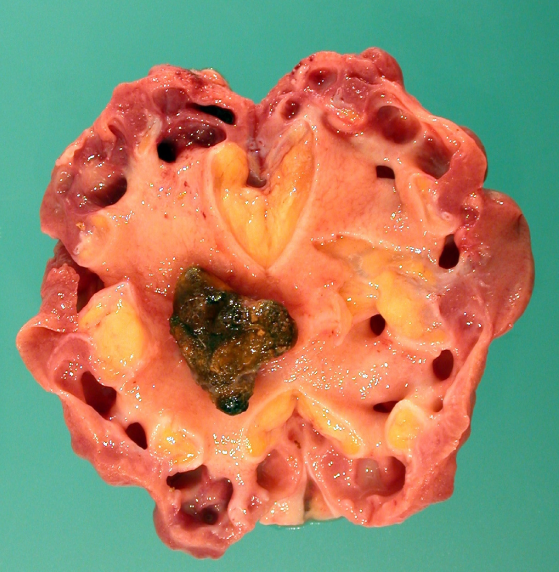 Further evaluation of this patient would most likely reveal which of the following?
 (Multiple Choice)
4.8/5 (72)
(72) A 73-year-old woman arrives at the office because her stomach is becoming bigger. Additionally, she suffers constipation and a reduced appetite, both of which have gotten worse over the past six months. Physical examination reveals a palpable right adnexal mass as well as a swollen, non-tender abdomen. The material is examined grossly and microscopically in the exhibit after the patient has a right oophorectomy. 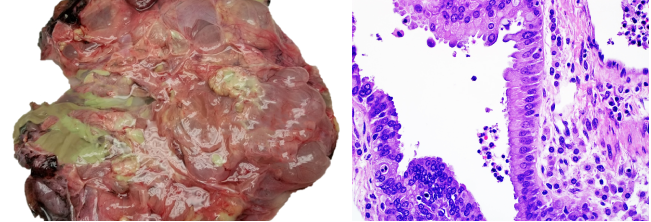 Which of the following markers is most likely to be elevated in this patient?
 (Multiple Choice)
4.9/5 (78)
(78) A 42-year-old woman comes to the physician because of progressive weakness for the past month. She has noticed increasing difficulty performing household chores and walking her dog. She has no other history of serious illness and takes no medications. She has smoked two packs of cigarettes daily for 25 years. Bilateral expiratory wheezes are heard at both lung bases. Examination shows drooping of the upper eyelids. There is diminished motor strength in the upper extremities. Sensation and reflexes are intact. The results of arterial blood gas analysis are as follows: 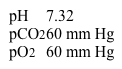 Which of the following is most likely abnormal in this patient?
 (Multiple Choice)
4.9/5 (75)
(75) Following a car accident, a 32-year-old man is hospitalized with multiple fractures and internal bleeding. He is successfully resuscitated and taken to the operating room for a left femoral fracture fixation. The patient's condition remains stable after surgery, and he is transferred to the operating room. The blood pressure is 118/68 mm Hg, and the pulse rate is 88 bpm. On the second day of his hospitalization, he develops oliguria. The results of a renal biopsy are represented in the image below. 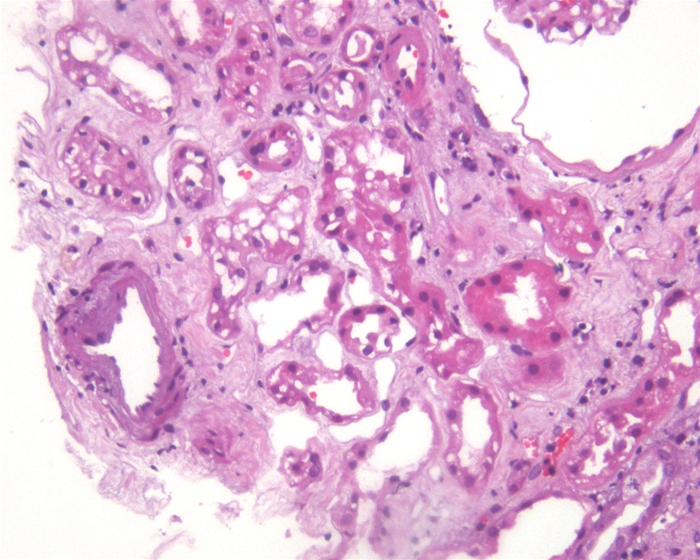 If the kidney biopsy were repeated 1 month from now, which of the following would most likely be seen?
 (Multiple Choice)
4.9/5 (92)
(92) An otherwise healthy 43-year-old woman comes to the physician because of several episodes of involuntary movement of her head over the past few months. These episodes are sometimes associated with neck pain and can last minutes to hours. Neurologic examination shows no abnormalities. During examination of the neck, the patient's head turns to the left. She states this movement is involuntary, and that she is unable to keep her head from turning. After 5 minutes, she is able to straighten her head again. This patient's condition can be best characterized as which of the following?
(Multiple Choice)
4.8/5 (74)
(74) A 25-year-old boy is brought to the physician because of left-sided groin pain and difficulty walking for one week. He reports having pain at rest and increased pain with activity. He recently started playing flag football but does not recall any trauma. He has had many episodes of joint and bone pain that required hospitalization in the past. The patient and his family emigrated from India 2 years ago. He is at the 25th percentile for height and 20th percentile for weight. His temperature is 37.0°C (98.6°F), pulse is 90/min, and blood pressure is 120/80 mm Hg. Examination shows tenderness over the lateral aspect of the left hip with no swelling, warmth, or erythema. There is pain with passive internal rotation of the left hip. . Laboratory evaluation shows a hemoglobin level of 6.7 g/dL.Histopathologic evaluation of this patient's spleen is most likely to reveal which of the following?
(Multiple Choice)
4.8/5 (80)
(80) A 34-year-old woman comes to the emergency department because of sharp chest pain that radiates to the left shoulder. The pain increases with inspiration and is partially relieved by sitting up and leaning forward. Review of her outpatient medical records shows that she was seen for a facial rash 6 months ago. She is also being evaluated for proteinuria that was identified during her last clinic appointment. Which of the following is the most likely cause of this patient's chest pain?
(Multiple Choice)
4.8/5 (81)
(81) A 2-month-old boy is found unresponsive in his crib. He had previously been well and had a normal physical examination at his 2-month visit approximately 1 week earlier. An autopsy is performed to determine the cause of death. The pathologist concludes that the infant likely died of sudden infant death syndrome. The autopsy also shows an incidental finding of bicuspid aortic valve. If this patient had survived, he would have been at greatest risk for which of the following events?
(Multiple Choice)
4.7/5 (82)
(82) A 20-year-old lady presents to the doctor with many burns on her hands. She claims that she frequently gets burnt when cooking, especially while using the oven. Additionally, she has burnt herself while grabbing her morning cup of coffee and while checking the shower's water temperature. The patient is worried because she struggles to tell when something is "very hot" and frequently doesn't realize she has burns until she examines her hands. She has no significant past medical history, no recent illnesses, and no sick contacts. Her only noteworthy surgical history is the removal of her impacted wisdom teeth from a year ago. The patient does not use illegal substances, occasionally consumes alcohol, and has never smoked. Her mother's mother has multiple sclerosis, thus her family history is important. Upon examination, the upper back, shoulders, and arms exhibit lessened pinprick and warmth feeling on both sides. The senses of light touch, location, and vibration remain retained. Lower extremity examination is uneventful. Which of the following spinal cord injuries is most likely to be to blame for the symptoms this patient is experiencing?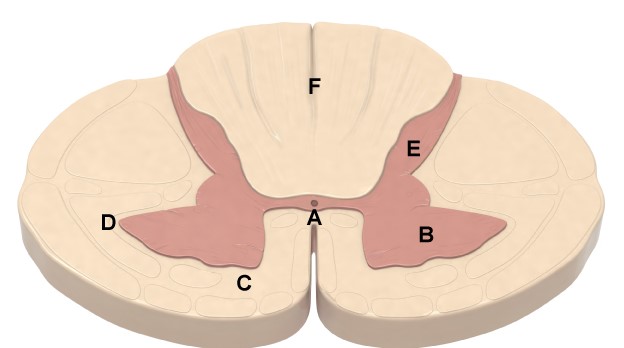
(Multiple Choice)
4.9/5 (82)
(82) A 66-year-old woman comes to the office due to 2 months of worsening fatigue and dyspnea with moderate exertion. The patient has a history of breast cancer treated with surgery and combination chemotherapy 6 years ago. She has no other medical conditions. Vital signs are within normal limits. Physical examination reveals normal jugular venous pressure, clear lungs, and normal heart sounds; there is no hepatosplenomegaly, lymphadenopathy, or extremity edema. Laboratory results are as follows: 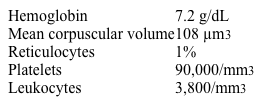 Peripheral blood smear shows oval macrocytic red cells and hyposegmented neutrophils. Bone marrow biopsy of this patient is most likely to reveal which of the following?
 (Multiple Choice)
4.9/5 (79)
(79) A 4-week-old male newborn is brought to the physician because of increasing yellowing of his eyes and skin for 2 weeks. The mother has noticed that his urine has appeared dark yellow, and he has had a few pale-colored stools. . The boy has been exclusively breastfeeding every 2-3 hours and is making 6 or 7 wet diapers a day. The patient was delivered vaginally at 39 weeks' gestation to a healthy woman without any complications. Vital signs are within normal limits. He is at the 50th percentile for length and at the 65th percentile for weight. Abdominal examination reveals a mildly enlarged and firm liver. Liver function results are as follows:  Which of the following is the most likely mechanism for the patient's presentation?
 (Multiple Choice)
4.9/5 (66)
(66) A 48-year-old lady arrives at the clinic 10 days after having breast reduction surgery. She is doing OK overall and is taking acetaminophen as needed for pain relief. Vital indicators are typical. The breasts are examined and show intact surgical incisions with no drainage; the wounds are pink, glossy, and somewhat heated. There is modest edema but no erythema on the surrounding skin.. Which of the following wound healing processes is most likely occurring at this time?
(Multiple Choice)
4.8/5 (75)
(75) 
Filters
- Essay(0)
- Multiple Choice(0)
- Short Answer(0)
- True False(0)
- Matching(0)