



 Chat with AI
Exam 10: Pathology

Exam 1: Anatomy265 Questions
Exam 2: Behavioral Sciences178 Questions
Exam 3: Biochemistry102 Questions
Exam 4: Embryology59 Questions
Exam 5: Epidemiology, Biostatistics, and Medical Informatics94 Questions
Exam 6: Genetics88 Questions
Exam 7: Histology46 Questions
Exam 8: Immunology147 Questions
Exam 9: Microbiology and Virology330 Questions
Exam 10: Pathology817 Questions
Exam 11: Pharmacology and Toxicology509 Questions
Exam 12: Physiology339 Questions
Exam 13: Psychiatry and Psychotherapy23 Questions
Select questions type


A prenatal appointment for a 31-year-old woman who is gravida 3 para 2 and 28 weeks pregnant takes place in the office. During this pregnancy, her persistent hypertension has been under good control. Her blood pressure during the patient's previous prenatal appointments ranged from 120/70 to 130/80 mm Hg. Her blood pressure is 150/100 mm Hg right now, and it was previously 152/98 mm Hg. 24 cm is the fundal height. Protein levels in urine are 2+. A fetus with growth limitation and oligohydramnios are seen on a transabdominal ultrasonography. Compared to normal placental parameters, this patient most likely has which of the following hemodynamic changes? 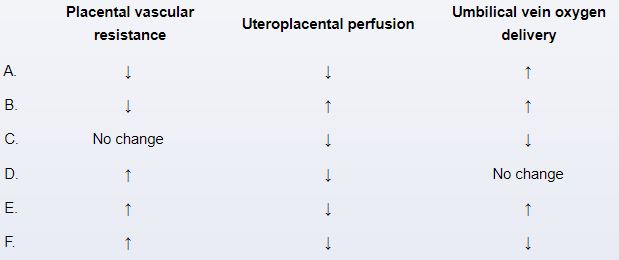
(Multiple Choice)
4.8/5  (83)
(83) A 50-year-old man comes to the physician for the evaluation of recurrent episodes of chest pain and rapid heart beating over the past two months. During this period, he has had a 4-kg (8.8-lb) weight loss, malaise, pain in both knees, and diffuse muscle pain. His temperature is 38°C (100.4°F), pulse is 110/min, and blood pressure is 150/90 mm Hg. Cardiopulmonary examination shows no abnormalities except for tachycardia. There are several ulcerations around the ankle and calves bilaterally. muscle biopsy demonstrates transmural inflammation of medium-sized arteries with areas of amorphous, eosin-staining arterial wall necrosis. Areas of disruption of the internal elastic lamina are also present. Which of the following is the most likely predisposing factor for this patient's current condition?
(Multiple Choice)
4.7/5 (82)
(82) A 48-year-old woman is brought to the emergency department by her husband found her confused before meal time. She has a history of type 1 diabetes mellitus. She was preparing to eat her meal and took a preprandial insulin injection but her baby was starting crying and skept her meal. Her husband found her passed out in her bedroom and administered glucagon immediately. The patient recovered consciousness within 15 minutes. Metabolic changes in which of the following organs are most likely responsible for this patient's recovery?
(Multiple Choice)
4.9/5 (89)
(89) A 48-year-old woman visits the office because she has had intermittent ear discharge for the past two years. She has recently noticed a decrease in hearing in her right ear. Obesity, hyperlipidemia, seasonal allergies, and diet-controlled diabetes mellitus all require a review of one's medical history. A small perforation in the right tympanic membrane and a pearly mass behind the membrane are visible on otoscopy. The right ear has conduction hearing loss. The rest of the ear, nose, and throat exam is routine. Which of the following is the most likely cause of this patient's aural mass?
(Multiple Choice)
4.8/5 (96)
(96) A 42-year-old lady visits her doctor for an usual check-up. She does not have any current problems and no major medical history. During a medical examination, the doctor notices lesions on her eyelids, which are depicted below. 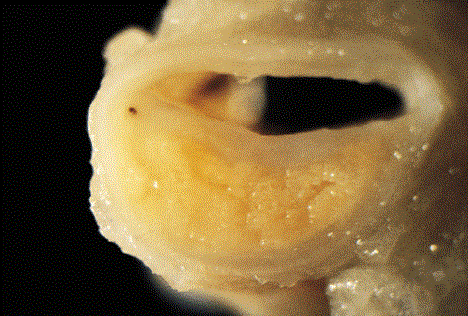 His father died of a heart attack at the age of 40. Assuming this patient's disease had a genetic basis, poor receptor expression in which of the following organs is most likely responsible for his condition?
 (Multiple Choice)
4.9/5 (78)
(78) A 31-year-old Caucasian female comes in for a usual check-up. You detect multiple subcutaneous lumps that appear to be Achilles tendons. Her father died of a heart attack when she was 35 years old, and her mother had rheumatoid arthritis. Her aunt was 55 years old when she was diagnosed with colon cancer. Which of the following is the best initial test in this patient?
(Multiple Choice)
4.9/5 (81)
(81) A 51-year-old woman comes to the physician because of fatigue and progressive pain and stiffness in her hands for the past 3 months. She used to play tennis but stopped 1 month ago because of difficulties holding the racket and her skin becoming "very sensitive to sunlight." Her last menstrual period was 1 year ago. She has diabetes mellitus controlled with insulin. She does not smoke or drink alcohol. Vital signs are within normal limits. Skin examination shows increased pigmentation over the knuckles and face. The liver is palpable 3-4 cm below the right costal margin. Which of the following is most likely contributing to the development of the patient's symptoms?
(Multiple Choice)
4.8/5 (96)
(96) A 7-year-old girl is brought to the physician because of generalized fatigue and facial puffiness. Four weeks ago, she was treated with topical mupirocin for a skin infection. Medical history is otherwise unremarkable and she takes no routine medications. Examination shows periorbital and 1+ pretibial edema bilaterally. The remainder of the examination shows no abnormalities. Urinalysis reveals: 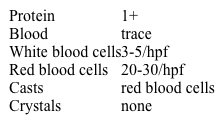 A biopsy image representative of this patient's disease process is shown below.
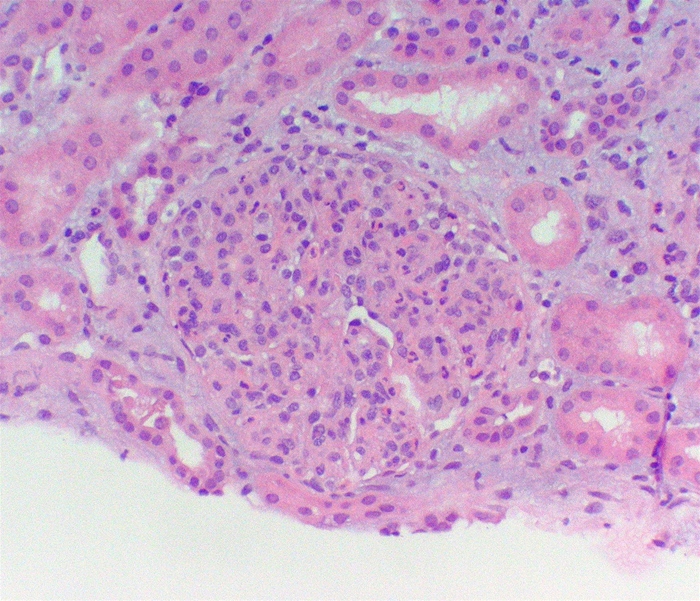 Which of the following additional findings is most likely to be present in this patient?
A biopsy image representative of this patient's disease process is shown below. Which of the following additional findings is most likely to be present in this patient? (Multiple Choice)
4.9/5 (82)
(82) A 47-year-old woman comes to the physician because of a history of prolonged menstrual bleeding. The patient has had irregular menses for the past 2 years, but now she has been bleeding daily for 2 weeks. She also feels fatigued. She is sexually active with her husband and does not use contraception. Vital signs are within normal limits. Pelvic examination shows a firm, irregularly-shaped uterus The patient has completed childbearing and would like definitive treatment for her symptoms. The patient undergoes hysterectomy with bilateral salpingo-oophorectomy. The final pathology report notes nuclear atypia and numerous mitoses in the affected portion of the myometrium. Which of the following is the most likely diagnosis?
(Multiple Choice)
4.9/5 (70)
(70) A 70-year-old man is brought to the hospital by his son for evaluation of worsening fatigue. The patient has not seen a physician in the past 15 years. He takes naproxen occasionally for knee arthritis. Physical examination of the prostate shows no abnormalities. Laboratory results are as follows: 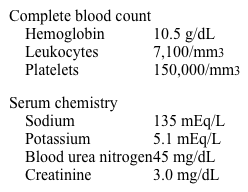 Urine sediment is unremarkable. Ultrasound examination shows bilateral small kidneys and no hydronephrosis. Kidney biopsy shows intimal thickening and luminal narrowing of the renal arterioles with evidence of glomerular sclerosis. Which of the following is most likely responsible for this patient's kidney disease?
 (Multiple Choice)
4.9/5 (83)
(83) A 25-year-old woman comes to the office due to amenorrhea. The patient's last menstrual period was 8 weeks ago, and she normally has regular, monthly menses. The patient has no chronic medical conditions and has had no surgeries. She takes no daily medications. Blood pressure is 100/60 mm Hg and pulse is 92/min. BMI is 24 kg/m2. Abdominal examination shows a soft, nontender abdomen with no palpable masses. Pelvic examination shows an 8-week-sized, nontender uterus. Serum B-hCG level is elevated. Which of the following is the most important direct role of hCG in this patient?
(Multiple Choice)
4.9/5 (86)
(86) A 12-year-old child is brought to the clinic with a rash on the back of his neck. The patient has had this rash on and off for several years. With the cooler season, the rash has gotten more pruritic in the previous two months, and the patient is continuously itching his neck. There are no additional medical issues or drugs that the patient is taking. Vital indicators are typical. The picture below depicts the posterior neck. 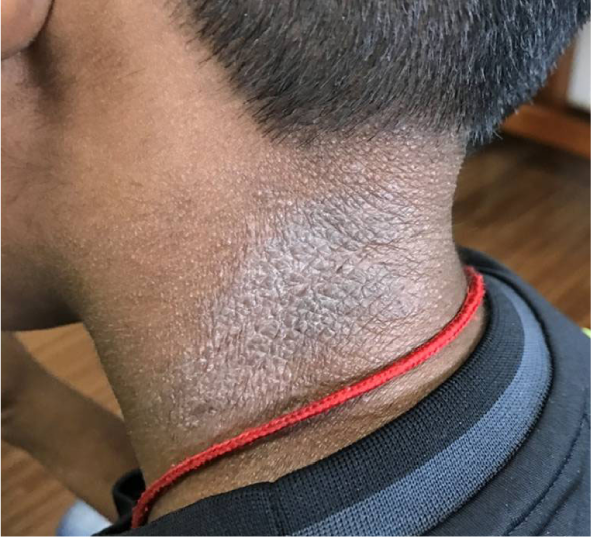 Which of the following is the most likely cause of this patient's rash?
 (Multiple Choice)
4.9/5 (77)
(77) A 72-year-old woman is brought to the emergency department because of lethargy and weakness for the past 5 days. During this period, she has had a headache that worsens when she leans forward or lies down. Her arms and face have appeared swollen over the past 2 weeks. She has a history of hypertension, gastroesophageal reflux disease, and osteoarthritis. She has smoked two packs of cigarettes daily for 40 years. Her temperature is 37.2°C (99°F), pulse is 103/min, and blood pressure is 98/56 mm Hg. Examination shows jugular venous distention, and engorged veins on the anterior chest wall. There is no axillary or cervical lymphadenopathy. There is 1+ pitting edema in both arms. Which of the following is the most likely cause of this patient's symptoms?
(Multiple Choice)
4.9/5 (88)
(88) A 53-year-old woman comes to physician because of recurrent headache, and multiple episodes of nosebleeds over the last few weeks. During this time, she has also been itching a lot, especially after getting ready for work in the mornings. She has had an 8-kg (17.6-lb) weight loss and increasing fatigue during the past 6 months. Her temperature is 37.8°C (100.0°F), pulse is 80/min, respirations are 15/min, and blood pressure is 158/90 mm Hg. Physical examination shows no lesions or evidence of trauma in the nasal cavity with facial plethora and moderate splenomegaly. Laboratory results are as follows: 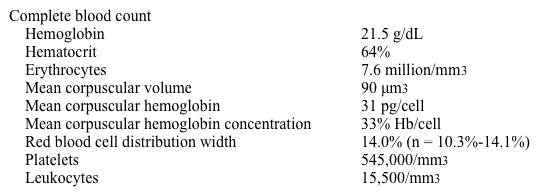 This patient most likely has a mutation in which of the following types of proteins?
 (Multiple Choice)
5.0/5 (79)
(79) A 63-year-old man comes to the physician because of a 3-month history of fatigue and constipation. He reports having dull pain in the left portion of the midback for 2 weeks that has persisted despite taking ibuprofen. His father died of prostate cancer at 70 years of age. The patient has smoked one pack of cigarettes daily for 45 years. Vital signs are within normal limits. Physical examination shows a left-sided varicocele both in supine and in standing position. Rectal examination shows a symmetrically enlarged prostate with no masses. MRI reveals lytic bone lesions in the corresponding vertebrae and also a right lower pole kidney mass. Histologic examination of the mass is shown below: 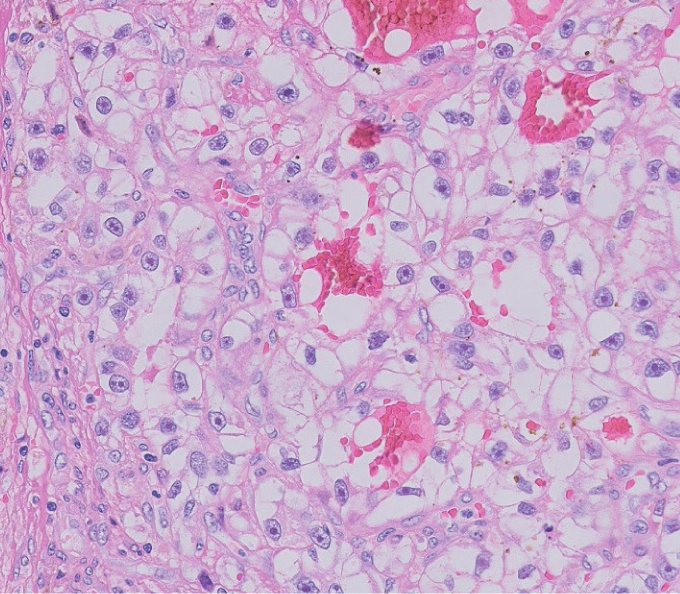 Which of the following risk factors most likely contributed to this patient's current condition?
 (Multiple Choice)
4.8/5 (79)
(79) A 38-year-old woman who is 32 weeks pregnant and gravida 1 para 0 comes into the office complaining of a headache that is getting worse. The patient also reports a 4.54 kg (10 lb) weight gain since her previous appointment, which was two weeks earlier, and increasing leg swelling. Her pregnancy has been uneventful, and she doesn't have any current medical conditions. According to a review of the patient's medical records, the blood pressure was 130/80 mm Hg at the 30-week gestation. Blood pressure right now is 165/100 mm Hg. To the knees, there is 2+ pitting edema. There is 0.9 mg/dL of serum creatinine. Which of the following findings would most likely be present in this patient's urinalysis? 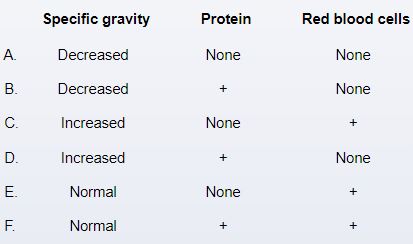
(Multiple Choice)
4.7/5 (76)
(76) A 4-year-old girl with an inwardly deviated right eye is brought to the clinic. In comparison to the left eye, the right eye exhibits a paler red response upon examination. The retina contains a well-circumscribed white mass, as seen on dilated funduscopic examination. Genetic testing reveals that the mass was caused by a germline mutation in the patient's cells. Which of the following is the most likely function of the protein affected by this patient's gene mutation?
(Multiple Choice)
4.8/5 (72)
(72) A 22-year-old woman is brought to the emergency department by her roommate for unusual behavior. She has been depressed with a suicidal ideation for several days. The patient reports fatigue and vivid, disturbing dreams. The nursing staff note that he is irritable, withdrawn, hypersomnolent, and hyperphagic. The patient has an extensive history of substance abuse and has been hospitalized previously for alcohol detoxification. Blood pressure is 110/80 mm Hg and pulse is 64/min. Physical examination shows old injuries from a motorcycle accident but no other abnormalities. On mental status examination, she appears lethargic and dysphoric. This patient's current symptoms are most likely the result of which of the following conditions?
(Multiple Choice)
5.0/5 (73)
(73) A 20-year-old woman is brought to the physician for a routine health maintenance examination. Her last visit was over a year ago. Menarche was at the age of 12 years; her last menstrual period was 4 months ago. She is on the school's gymnastics team and is currently preparing for an important competition. She is 165 cm (5 ft 6 in) tall and weighs 45 kg (99 lb); BMI is 16 kg/m2. Her temperature is 36.8°C (98.2°F), pulse is 53/min, and blood pressure is 98/64 mm Hg. Examination shows yellowish discoloration of the skin. There are bilateral soft symmetric masses below her mandible. The skin over the dorsal side of her right hand is thickened. A pregnancy test is negative. Which of the following laboratory findings are most likely present in this patient? 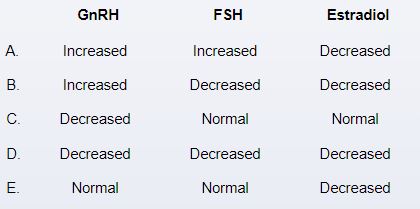
(Multiple Choice)
4.8/5 (78)
(78) A 56-year-old woman is brought to the physician by her daughter because of generalized fatigue over the past 4 months. She has had a 7-kg (15-lb) weight gain over this period. She is alert and oriented to time, place, and person. Her temperature is 36°C (97.6°F), pulse is 54/min, and blood pressure is 122/80 mm Hg. Physical examination shows hair loss involving the lateral third of the eyebrows. There is delayed relaxation of the deep tendon reflexes of the knee and ankle. Which of the following laboratory tests is the most appropriate next step in evaluation of this patient's symptoms?
(Multiple Choice)
4.7/5 (98)
(98) 
Filters
- Essay(0)
- Multiple Choice(0)
- Short Answer(0)
- True False(0)
- Matching(0)