



 Chat with AI
Exam 10: Pathology

Exam 1: Anatomy265 Questions
Exam 2: Behavioral Sciences178 Questions
Exam 3: Biochemistry102 Questions
Exam 4: Embryology59 Questions
Exam 5: Epidemiology, Biostatistics, and Medical Informatics94 Questions
Exam 6: Genetics88 Questions
Exam 7: Histology46 Questions
Exam 8: Immunology147 Questions
Exam 9: Microbiology and Virology330 Questions
Exam 10: Pathology817 Questions
Exam 11: Pharmacology and Toxicology509 Questions
Exam 12: Physiology339 Questions
Exam 13: Psychiatry and Psychotherapy23 Questions
Select questions type


A 31-year-old man comes to the physician because of a 9-month history of increasing fatigue and recurrent nausea. During this period, he has had a 3.8-kg (8.4-lb) weight loss. He also reports feeling lightheaded when he stands up suddenly. The patient has type 1 diabetes mellitus and has noticed decreased insulin requirements over this time. Physical examination shows hyperpigmentation of the lips and oral mucosa. Measurement of serum cortisol before and after administration of exogenous adrenocorticotropic hormone (ACTH) shows no difference in the levels. Which of the following changes in serum laboratory values is most likely present in this patient? 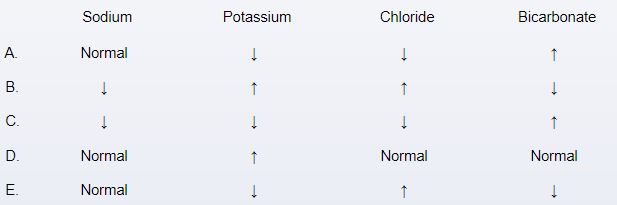
(Multiple Choice)
4.8/5  (89)
(89) A 17-year-old child visits the office to have a rash evaluated. The patient has experienced recurring skin lumps that are typically red and uncomfortable for the past two years. He has no other medical issues and does not use any medications. The vital indicators are within normal ranges. The results of the skin examination are displayed below. 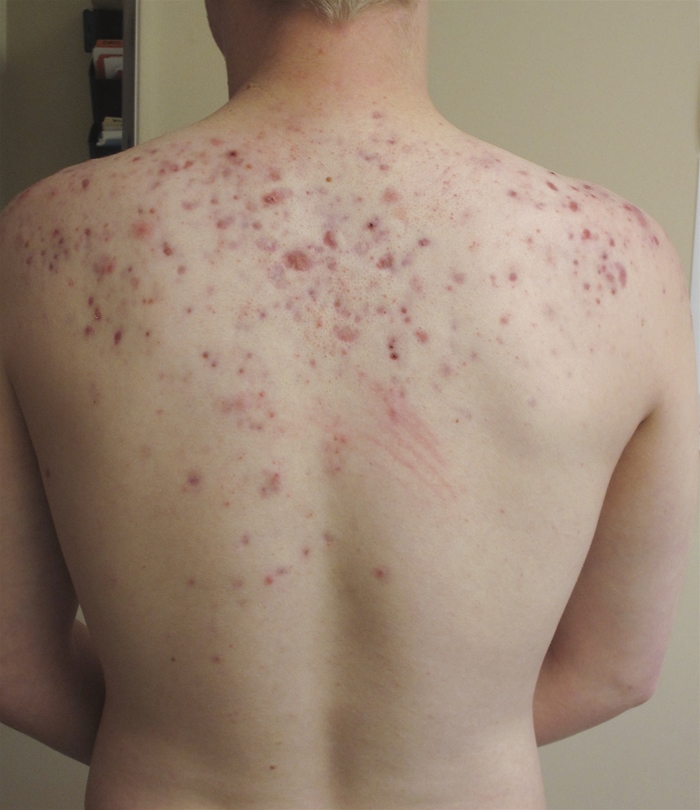 This patient's skin condition primarily affects which of the following structures?
 (Multiple Choice)
4.9/5 (75)
(75) A 34-year-old woman is evaluated in the emergency department due to 1-day of chest and left shoulder pain. The patient describes the pain as constant and worse in certain positions. A month ago, she was treated for a skin rash and joint pain. Her medical history is otherwise unremarkable. She is a lifetime nonsmoker and does not use alcohol or illicit drugs. Her father has hypertension and had a stroke at age 64. Temperature is 37.5 C (99.5 F), blood pressure is 122/70 mm Hg, and pulse is 97/min and regular. A triphasic, scratchy sound is heard over the left sternal border with the patient sitting up. The lungs are clear on auscultation. ECG shows sinus rhythm with ST-segment elevation in all leads except avR and V1. Which of the following is the most likely diagnosis?
(Multiple Choice)
4.8/5 (84)
(84) A 60-year-old man comes to the emergency department because of nausea, headache, and generalized fatigue. He has smoked a pack of cigarettes daily for 30 years. He has a 3-month history of cough and weakness. Over the past month, he has had poor appetite and a 5-kg (11-lb) weight loss. Lung examination shows mildly prolonged expiration with end-expiratory wheezes. Laboratory results are as follows: 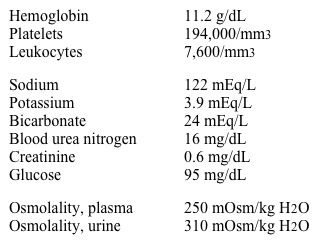 Chest x-ray reveals overinflated lung fields and a 2.5-cm left hilar mass. Biopsy of the mass would most likely show which of the following?
 (Multiple Choice)
4.9/5 (84)
(84) A 4800 g (10.6 lb) male newborn is delivered at term to a 35-year-old woman, gravida 1, para 1. Significant lateral neck traction is required during delivery. Apgar scores are 9 and 9 at 1 and 5 minutes, respectively. He is found irritable and confused in the newborn nursery. The infant has not yet breastfed as his mother is still recovering from surgery. His serum glucose is 21 mg/dL. . Which of the following factors is the most likely cause of this neonate's hypoglycemia?
(Multiple Choice)
4.8/5 (83)
(83) A 28-year-old woman is brought to the physician because of progressive difficulty walking, slowed speech, and a tremor for the past 5 months. Medical history is notable for depression over the past year. Her grandfather died of bleeding esophageal varices at the age of 42 years. She does not drink alcohol. She is alert and oriented but has a flat affect. Her speech is slurred and monotonous. Examination shows a broad-based gait and a low-frequency tremor of her left hand. Abdominal examination shows hepatosplenomegaly. The most likely cause of this patient's condition is an abnormality in which of the following physiologic processes?
(Multiple Choice)
4.9/5 (75)
(75) A 27-year-old woman comes to the office due to exertional dyspnea over the past 3 months. The patient initially had shortness of breath during exercise but now becomes dyspneic with routine activities. She has had no cough, fever, or leg swelling but has noticed increased fatigue over this time. The patient does not use tobacco, alcohol, or illicit drugs. Vital signs are within normal limits. Physical examination reveals a loud pulmonic component of S2 but is otherwise unremarkable. Chest x-ray shows clear lungs. Which of the following is the most likely cause of this patient's findings?
(Multiple Choice)
4.8/5 (69)
(69) An 18-year-old woman presented to the emergency department due to lower side abdominal pain, nausea, and vomiting. The pain started around the umbilical region this morning. The pain developed to become more severe and localized in the right lower quadrant. Temperature is 38.3 C (100.9 F), blood pressure is 120/84 mm Hg, the pulse is 122/min, and respirations are 13/min. On examination, there is tenderness in the right lower quadrant, two-thirds of the distance from the umbilicus to the anterior superior iliac spine. Decreased bowel sound. Laboratory studies show a white blood cell count of 19,000/mm3. The change in this patient's pain characteristics is most likely explained by which of the following?
(Multiple Choice)
4.8/5 (88)
(88) When taking a shower, a 47-year-old woman who is gravida 2 para 2 noticed a pea-sized lump in her right breast. She then came to the office. Her three pack-years of cigarette consumption during her 20s have a substantial impact on her medical history. For all of her pregnancies, she underwent in vitro fertilization and infertility therapy. There is no history of breast or ovarian cancer in the patient's family. A hard, fixed lump in the right breast with a little patch of overlying puckered skin is detected during a clinical breast exam. The results of a mammogram are very likely to be cancerous, and a needle biopsy indicates infiltrating ductal carcinoma. A right mastectomy and axillary lymph node dissection are scheduled. Overexpression of which of the following markers is most likely to be associated with aggressive disease in this patient?
(Multiple Choice)
4.9/5 (83)
(83) A 64-year-old guy who has been experiencing nausea and a headache that becomes worse when he leans over is now being assessed. A hemispheric cerebral mass is detected by brain imaging and is then biopsied. The picture below displays a tissue specimen under light microscopy. 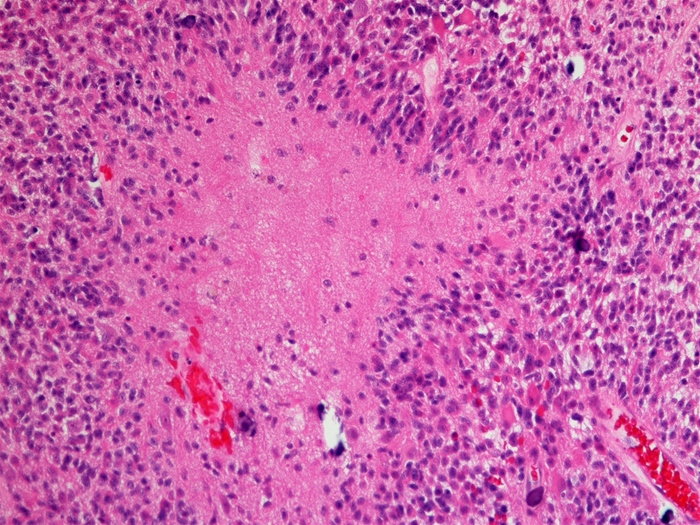 Which of the following histologic findings is most characteristic of this lesion?
 (Multiple Choice)
4.9/5 (69)
(69) A 38-year-old man comes to the office due to a 2-month history of an enlarging, localized swelling on the left foot. Tying his shoelaces too tight leads to localized pain and numbness in the third and fourth toes. Examination shows a firm, nontender, well-circumscribed lesion on the dorsum of the foot as shown in the exhibit. 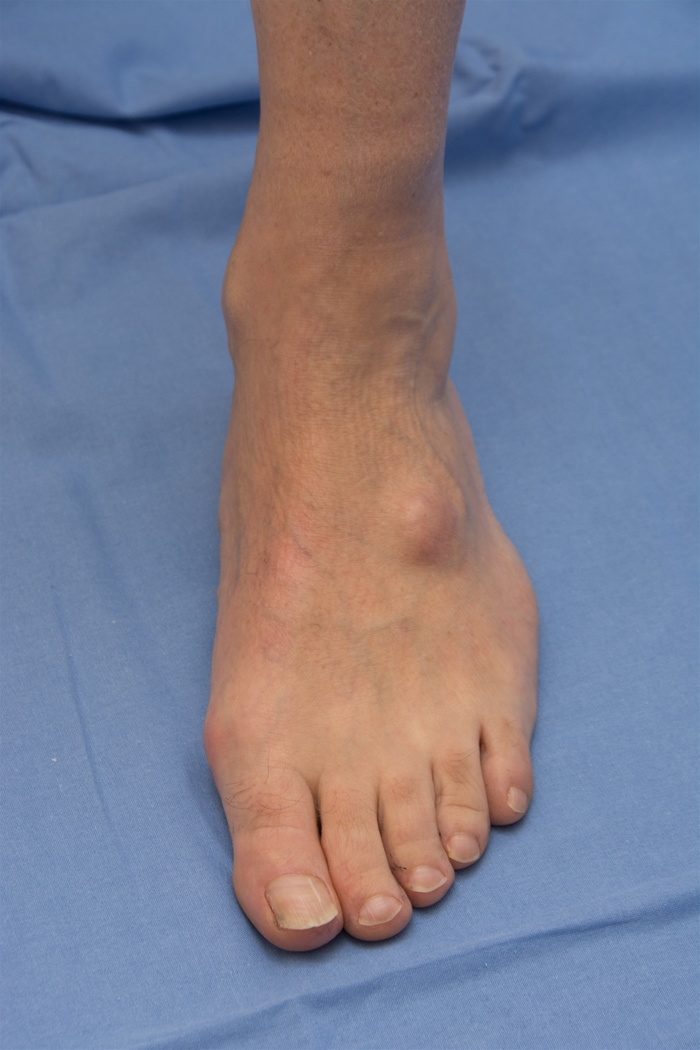 The lesion transilluminates when a penlight is applied to it. Without treatment, which of the following is most likely to occur in this patient?
 (Multiple Choice)
4.8/5 (84)
(84) A 36-year-old woman comes to the clinic for evaluation of a 4-month history of nonproductive cough and exertional dyspnea. Her only other medical problem is frequent heartburn, for which she takes over-the-counter antacids. Temperature is 37.1 C (98.8 F), blood pressure is 126/74 mm Hg, pulse is 88/min, and respirations are 20/min. Examination shows bilateral crackles and normal heart sounds. The remainder of the examination is unremarkable. An x-ray of the chest shows bilateral reticulonodular densities with interstitial fibrosis. Microscopic examination of a lung biopsy specimen shows noncaseating granulomas in the interstitium. Which of the following is the most likely diagnosis?
(Multiple Choice)
4.9/5 (78)
(78) A 46-year-old man comes to the physician for a follow-up evaluation one week after being discharged from the hospital for acute pancreatitis and alcohol withdrawal. He drinks 8 to 10 beers daily. When the physician asks him about his alcohol use, the patient says, "This is the second time in a year that I have experienced such severe belly pain because of my pancreas. My wife and daughter also say that I need to quit. I have made an appointment with a counselor to talk about my options." Which of the following best describes this patient's stage of behavioral change?
(Multiple Choice)
4.9/5 (86)
(86) A 60-year-old man comes to the physician because of progressive shortness of breath for 2-hour. The dyspnea occurs on moderate exertion and during the night; he sometimes wakes up coughing and "gasping for air." He has also had several episodes of heart pounding. Two weeks ago, he had a runny nose and a productive cough. He has type 2 diabetes mellitus and peripheral arterial disease. He has never smoked. He drinks one to two beers occasionally. He has a history of intravenous illicit drugs use but has not used in over 25 years. Current medications include aspirin, atorvastatin, and metformin. Blood pressure is 98/60 mm Hg and pulse is 112/min and regular. A short systolic murmur is heard at the apex. Bilateral crackles are present on lung auscultation. Bedside echocardiography reveals a flail posterior mitral leaflet due to chordal rupture and severe mitral regurgitation. Which of the following best reflects this patient's left ventricular hemodynamics compared to the normal heart?
(Multiple Choice)
4.9/5 (81)
(81) A 68-year-old male presents to your office complaining of difficulty urinating. His past medical history is significant for prostate cancer treated with radiation therapy one year ago. Ultrasonography reveals bilateral dilation of the ureters and renal calyces. If related to the previous therapy, which of the following is the most likely cause of this patient's current condition?
(Multiple Choice)
4.9/5 (72)
(72) A 10-year-old boy is brought to the physician because of increasing swelling around his eyes for the past 3 days. During this period, he has had frothy light yellow urine. He had a sore throat 12 days ago. He appears tired. His temperature is 37.0°C (98.6°F), pulse is 90/min, and blood pressure is 105/65 mm Hg. Examination shows periorbital edema and pitting edema of the lower extremities. Cardiopulmonary examination shows no abnormalities. Which of the following is most likely decreased in this patient?
(Multiple Choice)
4.7/5 (73)
(73) A 6-year-old boy is brought to the physician because of increasing swelling around his eyes for the past 3 days. During this period, he has had frothy light yellow urine. He had a sore throat 12 days ago. He appears tired. His temperature is 37.0°C (98.6°F), pulse is 90/min, and blood pressure is 105/65 mm Hg. Examination shows periorbital edema and pitting edema of the lower extremities. Cardiopulmonary examination shows no abnormalities. Urinalysis results are as follows: 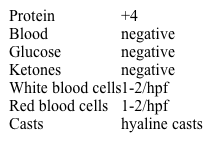 Biopsy of this patient's kidneys would most likely show which of the following microscopy findings?
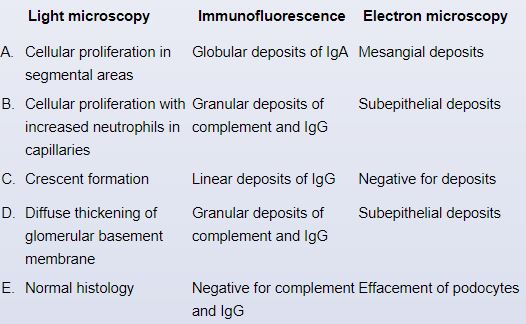
Biopsy of this patient's kidneys would most likely show which of the following microscopy findings? (Multiple Choice)
4.9/5 (87)
(87) A 34-year-old lady arrives at the clinic complaining of palpitations, heavy perspiration, and anxiety dating back two weeks. The patient is obese and has tried unsuccessfully to lose a lot of weight through diet and exercise. She has been ingesting excessive doses of levothyroxine, which a buddy gave it to her for. The pulse rate is 110 beats per minute. The thyroid gland is a normal size and soft, non-tender, according to a physical examination of the hands. TSH is suppressed in the laboratory examination, and free thyroxine levels are higher (T4). Which additional finding from the list below is most likely to be present in this patient? 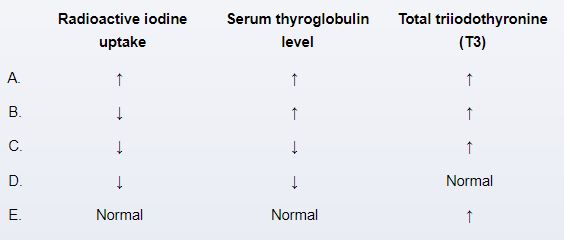
(Multiple Choice)
4.8/5 (83)
(83) A 42-year-old man comes to the hospital for sharp right-sided flank pain that radiates started two hours ago. The pain is also colicky and radiates to the right groin. The patient has no nausea or vomiting. He has a history of crohn disease for which he takes his medications regularly. Urinalysis shows hematuria. A day later, the patient passes a urinary stone. Abdominal imaging reveals several additional kidney stones. Which of the following is the most likely underlying cause of this patient's kidney stones?
(Multiple Choice)
4.9/5 (73)
(73) A mother of a 10-year-old girl comes to the office because she is concerned about a new genetic test result. Her daughter has a missense mutation in the VHL gene. Her examination is unremarkable. Periodic surveillance with which of the following is most likely to be of benefit in this patient?
(Multiple Choice)
4.9/5 (78)
(78) 
Filters
- Essay(0)
- Multiple Choice(0)
- Short Answer(0)
- True False(0)
- Matching(0)