



 Chat with AI
Exam 10: Pathology

Exam 1: Anatomy265 Questions
Exam 2: Behavioral Sciences178 Questions
Exam 3: Biochemistry102 Questions
Exam 4: Embryology59 Questions
Exam 5: Epidemiology, Biostatistics, and Medical Informatics94 Questions
Exam 6: Genetics88 Questions
Exam 7: Histology46 Questions
Exam 8: Immunology147 Questions
Exam 9: Microbiology and Virology330 Questions
Exam 10: Pathology817 Questions
Exam 11: Pharmacology and Toxicology509 Questions
Exam 12: Physiology339 Questions
Exam 13: Psychiatry and Psychotherapy23 Questions
Select questions type


A 35-year-old woman comes to the physician because of intermittent palpitations over the past 2 weeks. During this period, she also has had constipation and felt more tired than usual. She was diagnosed with hypertension 4 weeks ago. After the initial laboratory workup, an abdominal CT is performed that shows a 2-cm left-sided adrenal mass. The patient undergoes an uncomplicated left-sided adrenalectomy. Gross examination of the adrenal gland demonstrates a well-defined yellowish tumor within the cortex. Assuming the tumor cells are functionally similar to cells from the outermost layer of the adrenal cortex, this patient would most likely have presented with which of the following additional symptoms?
(Multiple Choice)
4.9/5  (79)
(79) A 17-year-old boy comes to the physician because of a history of weakness in his legs. He is concerned because he has had difficulty running and keeping up with peers for the past several years. He has a family history of same symptoms and his father uses wheelchair. Examination shows decreased muscle strength in the distal muscles of the lower extremities. Abnormal function of which of the following is the most likely cause of this patient's condition?
(Multiple Choice)
4.9/5 (77)
(77) A 14-month-old child is taken to the clinic by her parents because she has foot sores. Since her first steps three months ago, she has suffered blisters on the soles of her feet, which eventually break down and heal slowly. The patient did not flourish as a newborn due to repeated mouth ulcerations, but he has otherwise been healthy and has met all of his developmental goals. Examining the soles reveals tiny bullae with slight erythema and no scarring. A biopsy conducted near the blister's edge reveals an intraepidermal cleavage plane. Which of the following factors is most likely to be involved in the etiology of this patient's condition?
(Multiple Choice)
4.8/5 (68)
(68) A 32-year-old woman comes to the office due to recent fatigue and weight gain. She has no medical histrory and takes no medication. Blood pressure is 115/65 mm Hg and pulse is 85/min. On physical examination, there is a diffuse neck swelling with no palpable nodules, she says her neck has gradually gotten larger, and she does not like how it appears in the mirror. Serum TSH and free thyroxine levels are normal. She has a sister with vitiligo. There is no history of head and neck irradiation. Antibodies against thyroid peroxidase are present in high titers. Biopsy of this patient's thyroid is most likely to show which of the following findings?
(Multiple Choice)
4.9/5 (81)
(81) A 27-year-old woman arrives at the emergency room with a one-day history of skin rash. She experienced an incident of recurring vaginal lesions two weeks ago, which started as little papules and progressed to vesicular lesions with ulceration, crusting, and final healing. There are no additional medical issues or drugs that the patient is taking. Physical examination reveals that she is at ease. The temperature is 37 degrees Celsius (98.6 F). Her oral mucosa shows tiny linear erosions. The picture below depicts skin results. 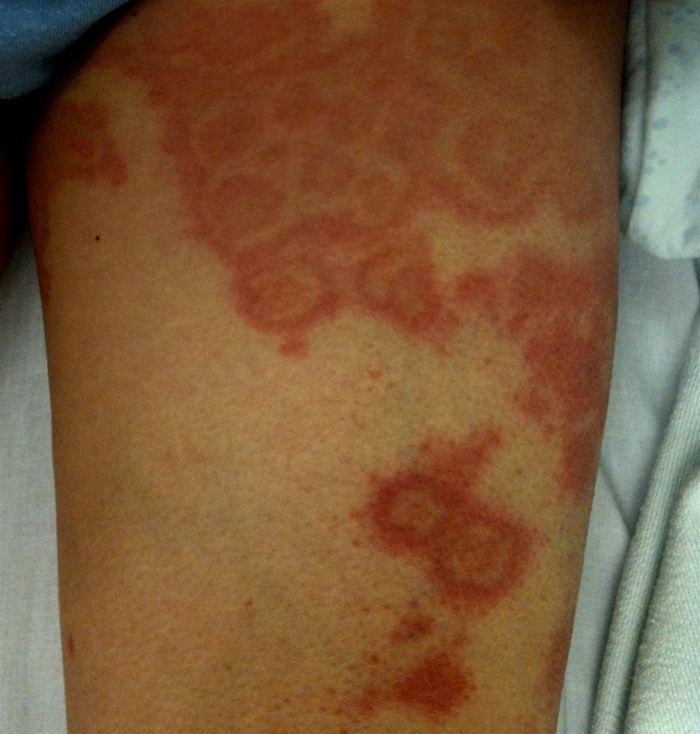 Which of the following is the most likely diagnosis?
 (Multiple Choice)
5.0/5 (94)
(94) An 8-year-old boy is brought to the physician by his parents for short stature. Neither his clothing nor his shoe size has changed over the past year. He also frequently bumps into obstacles such as furniture and has headaches at night. He is always thirsty for cold water and has been urinating more frequently. Three years ago, he had an asthma attack that was treated with albuterol and a one-week course of steroids. His mother has Hashimoto's thyroiditis and had precocious puberty. His mother's height is 147 cm (4 ft 10 in) and his father's height is 160 cm (5 ft 3 in). He is at the 5th percentile for height and 5th percentile for weight. His temperature is 37°C (98.6°F), pulse is 98/min, respirations are 16/min, and blood pressure is 100/64 mm Hg. Examination shows a soft and nontender abdomen. The genitals and pubic hair are both Tanner stage 1. Axillary hair is absent. Patellar reflexes are 1+ bilaterally. From which of the following structures is this mass most likely derived?
(Multiple Choice)
4.9/5 (73)
(73) A 46-year-old guy arrives at the office with the skin lesions seen in the photo below. After returning from a trip to Hawaii, the patient observed the lesions for the first time a week ago. He has no additional severe rashes or skin abnormalities, although he does have autoimmune thyroiditis. 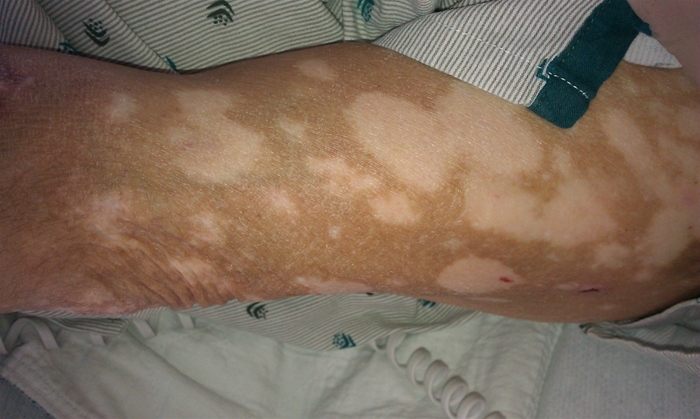 Which of the following would most likely be seen on histopathologic examination of this patient's lesions?
 (Multiple Choice)
4.8/5 (76)
(76) A 72-year-old man is evaluated in the emergency department due to sudden onset memory loss. The patient was partying with his family when he suddenly started having abnormal behavior. He was confused and kept asking repetitive questions. He does not have any other neurological deficits, headaches, or any other symptoms. The patient is known to have hypertension, diabetes mellitus, and migraine. Blood pressure is 136/84 mm Hg and pulse is 80/min. Neurological examination shows that the patient is conscious. He looks confused and keeps asking " Where am I?, What happened?"He knows his name, his date of birth, and where he lives. He recognizes his family members and is aware of everything around him. He can not retain the name of the hospital or the doctor's name. He can not recall objects after several minutes. There is no dysarthria or aphasia. Cranial nerves examination is normal. Motor, sensory and cerebellar exams are all normal without any significant findings. CBC and the chemistry panel are normal. The drug screen is negative. Radiological imaging does not show any abnormalities. 5 hours later, the patient recovered and returned to normal condition spontaneously. Dysfunction of which of the following structures explain the patient's symptoms?
(Multiple Choice)
4.7/5 (80)
(80) A 34-year-old man comes to the physician because of increasing lower back and neck pain for the past 7 months. The pain is worse in the morning and improves when he plays basketball. He has noticed shortness of breath while playing for the past 2 months. He is sexually active with two female partners and uses condoms inconsistently. He appears lethargic. His vital signs are within normal limits. Examination of the back shows tenderness over the sacroiliac joints. Range of motion is limited by pain. The lungs are clear to auscultation. Which of the following is most helpful to monitor disease progression in this patient?
(Multiple Choice)
5.0/5 (75)
(75) A 6-year-old boy is brought to the emergency department because of a 1-day history of colicky abdominal pain and vomiting. He also had a sore throat 2 weeks ago. His temperature is 37.0°C (98.6°F), pulse is 100/min, respirations are 28/min, and blood pressure is 90/55 mm Hg. Examination of the lower extremities shows nonblanching raised erythematous papules. The abdomen is soft and nontender. Bowel sounds are high-pitched. Urinalysis results are as follows: 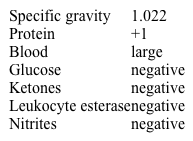 Which of the following renal abnormalities is most likely present in this patient?
 (Multiple Choice)
4.9/5 (82)
(82) A 29-year-old woman comes to the office for evaluation of infertility. The patient and her husband have been trying to conceive for the past 2 years but have been unsuccessful. Her husband recently underwent infertility evaluation and was found to have no abnormalities. Menses had previously occurred at regular 28-day intervals with moderate flow. Her last menstrual period was 12 weeks ago. She is sexually active with her husband but reports decreased interest in sexual intercourse over the past few months. The patient does not smoke or drink alcohol. She is 168 cm (5 ft 6 in) tall and weighs 68 kg (150 lb); BMI is 24 kg/m2. She appears uncomfortable. Vital signs are within normal limits. A urine pregnancy test is negative. A pelvic ultrasound shows atrophic endometrium. Neurological examination shows diminished vision in the bilateral temporal visual fields. Examination of the other cranial nerves is normal and there is no focal weakness or sensory loss. An abnormality originating in which of the following is the most likely cause of this patient's current condition?
(Multiple Choice)
4.8/5 (83)
(83) A 32-year-old lady is sent to the emergency room with "bruising." She is a group home resident with a persistent mental condition. Care professionals accompanying the patient indicate that she fell three days ago but has not complained of discomfort. There were no evidence of damage until a huge area of discoloration was noticed on the upper arm while washing. The patient's medical history is ordinary, and he or she is not on any drugs. Vital indicators are typical. The results of the skin examination are depicted in the figure below. There is no concomitant warmth, and the patient displays no symptoms of discomfort when the afflicted region is palpated. 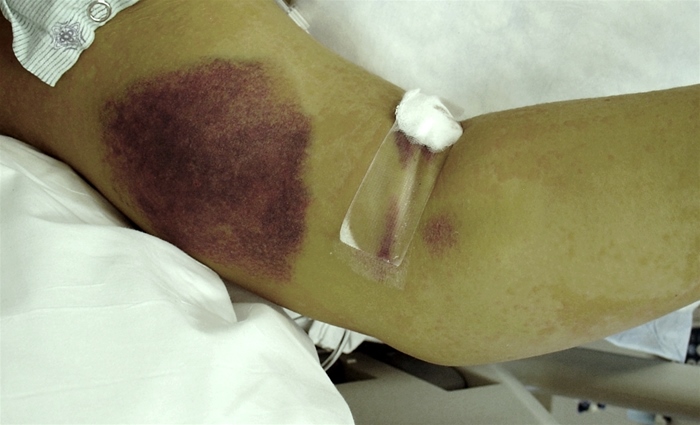 Which of the following terms best describes this abnormality?
 (Multiple Choice)
4.9/5 (78)
(78) A 72-year-old man arrives at the emergency department complaining of severe abdominal pain and nausea. He has a history of coronary artery disease and had cardiac angiography recently. The patient is an active smoker with a 30-pack-year smoking history. He has an emergency laparotomy after an initial evaluation. A section of the small intestine is removed. As seen in the image below, there are several large-caliber vessels with needle-shaped cholesterol clefts in their lumens. 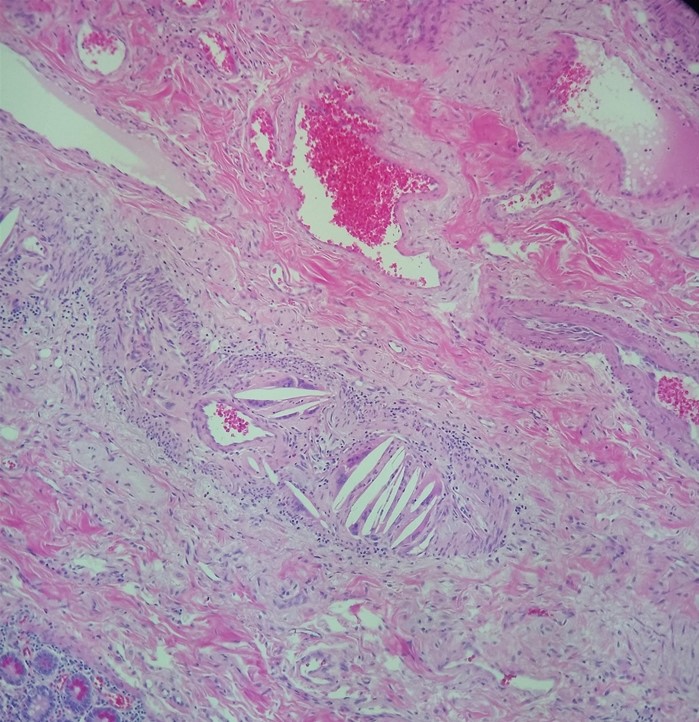 Given these findings, the patient is at highest risk for which of the following complications?
 (Multiple Choice)
4.7/5 (74)
(74) A 72-year-old man comes to the physician because of a 2-month history of fatigue and worsening abdominal pain. During this period, he has also had night sweats and shortness of breath on exertion. Over the past 3 months, he has had a 5.6-kg (12-lb) weight loss. He had a myocardial infarction 3 years ago. He has hypertension, diabetes mellitus, and chronic bronchitis. His medications include insulin, aspirin, lisinopril, and an albuterol inhaler. He has smoked one-half a pack of cigarettes for the past 45 years. Vital signs are within normal limits. The spleen is palpated 6 cm below the left costal margin. Laboratory studies show: pancytopenia. Bone marrow aspiration is attempted but yields no marrow, and a bone marrow biopsy is subsequently performed. Which of the following findings is most likely to be observed in this patient's bone marrow?
(Multiple Choice)
4.8/5 (74)
(74) A 43-year-old woman comes to the physician because of a 2-month history of pain and swelling in her wrists and hands. She has had a 5-kg (11-lb) weight loss over the past 2 months. Her temperature is 36.7°C (98.1°F), pulse is 75/min, and blood pressure is 150/80 mm Hg. Examination shows tightness of the skin of the fingers; there are small nonhealing, nonpurulent ulcers over thickened skin on the fingertips. Histologic sections show expansion of the dermal layer with atrophy of the intradermal adipose tissue and dermal appendages. High-power images of the dermis demonstrate extensive deposition of dense, eosinophilic connective tissue. This patient is most at risk for which of the following conditions?
(Multiple Choice)
4.9/5 (81)
(81) A 16-year-old girl is brought to the physician for a routine health maintenance examination. Her last visit was over a year ago. Menarche was at the age of 12 years; her last menstrual period was 4 months ago. She is on the school's gymnastics team and is currently preparing for an important competition. She is 165 cm (5 ft 6 in) tall and weighs 45 kg (99 lb); BMI is 16 kg/m2. Her temperature is 36.8°C (98.2°F), pulse is 53/min, and blood pressure is 98/64 mm Hg. Examination shows yellowish discoloration of the skin. There are bilateral soft symmetric masses below her mandible. The skin over the dorsal side of her right hand is thickened. Which of the following is the most likely diagnosis?
(Multiple Choice)
4.8/5 (73)
(73) A 54-year-old man comes to the physician because of progressive weakness in his upper extremities over the past 7 months. He initially noticed difficulty writing but now has difficulty performing his activities of daily living. He currently lives with his son. He has no personal or family history of serious illness and takes no medications. Vital signs are within normal limits. There is mild atrophy and twitching of the tongue. A diagnosis of amyotrophic lateral sclerosis is made and treatment with riluzole is initiated. If an autopsy is made to this pathient after death, it would most likely reveal which of the following additional findings?
(Multiple Choice)
4.8/5 (83)
(83) A 35-year-old woman is evaluated in the office due to decreased taste sensation. She says that she could not enjoy her meals, all food tastes the same. One month ago, the patient had a motor vehicle collision, where she received a head trauma. She does not complain of visual problems, abnormal speech, dysphagia, unsteadiness, weakness, or sensory deficits. Vital signs are within normal limits. Neurological examination is normal. Which of the following is the most likely cause of this patient's current symptoms?
(Multiple Choice)
4.8/5 (84)
(84) A 66-year-old man is brought to the emergency department because of weakness of his left leg for the past hour. He was unable to get out of bed that morning. His pants are soaked with urine. He has hypertension and coronary artery disease but he does not take his medications as prescribed. Examination shows intact cranial nerves and sensory function. The patient has 3/5 muscle strength on the right side. Initial CT scan without contrast reveals no abnormalities. Four weeks later, repeat brain imaging shows a 9-mm, fluid-filled cavitary lesion in the left internal capsule. This patient's condition is most likely caused by which of the following?
(Multiple Choice)
4.8/5 (85)
(85) A 30-year-old man comes to the physician for a routine health maintenance examination. He feels well. He was recently fired from his job as a cashier because of mistakes and absenteeism. He says that he finds it difficult to maintain focus on any task and often feels restless. He admits that he often forgets to pay his bills and often misplaces his cell phone and keys. He has had poor academic performance and dropped out of high school at 15 years of age. Mental status examination shows a normal mood and a reactive affect. Which of the following is the most likely diagnosis in this patient?
(Multiple Choice)
4.8/5 (83)
(83) 
Filters
- Essay(0)
- Multiple Choice(0)
- Short Answer(0)
- True False(0)
- Matching(0)