



 Chat with AI
Exam 10: Pathology

Exam 1: Anatomy265 Questions
Exam 2: Behavioral Sciences178 Questions
Exam 3: Biochemistry102 Questions
Exam 4: Embryology59 Questions
Exam 5: Epidemiology, Biostatistics, and Medical Informatics94 Questions
Exam 6: Genetics88 Questions
Exam 7: Histology46 Questions
Exam 8: Immunology147 Questions
Exam 9: Microbiology and Virology330 Questions
Exam 10: Pathology817 Questions
Exam 11: Pharmacology and Toxicology509 Questions
Exam 12: Physiology339 Questions
Exam 13: Psychiatry and Psychotherapy23 Questions
Select questions type


A 32-year-old nulliparous woman with HIV comes to the physician for a pelvic examination and Pap smear. The patient acquired HIV from her mother at birth and has been noncompliant with health maintenance visits. Menarche occurred at the age of 10 years. She became sexually active at the age of 14 years. Her mother had cervical cancer at the age of 51 years. She is 165 cm (5 ft 5 in) tall and weighs 79 kg (174 lb); BMI is 29 kg/m2. Examination shows mild facial acne. A Pap smear shows high-grade cervical intraepithelial neoplasia. Which of the following is this patient's strongest predisposing factor for developing this condition?
(Multiple Choice)
4.9/5  (82)
(82) A 53-year-old man is brought to the emergency department following an episode of loss of consciousness 1 hour ago. He had just finished shaving when he fell down. His wife heard the noise and found him unconscious on the floor. He regained consciousness after 30 seconds and was able to talk normally with his wife immediately. There was no urinary incontinence. On arrival, he is alert and oriented. Cardiopulmonary examination shows no abnormalities. Neurologic examination shows no focal findings. Serum concentrations of glucose, creatinine, and electrolytes are within the reference range. An electrocardiogram shows no abnormalities. Which of the following factors is most likely contributing to this patient's symptomatic episodes?
(Multiple Choice)
4.9/5 (71)
(71) An adult girl is brought to the physician because of generalized fatigue and dark urine for 1 week. Four weeks ago, she was treated with topical mupirocin for a skin infection. Medical history is otherwise unremarkable and she takes no routine medications. Her temperature is 37°C (98.6°F), pulse is 90/min, respirations are 14/min, and blood pressure is 132/89 mm Hg. Examination shows periorbital and 1+ pretibial edema bilaterally. The remainder of the examination shows no abnormalities. Laboratory studies show: decreased C3 levels, elevated antistreptolysin O titer and microscopic hematuria. Which of the following patient characteristics is most likely to indicate a poor long-term prognosis?
(Multiple Choice)
4.7/5 (89)
(89) A 43-year-old woman is brought to the emergency department because of a sudden and severe headache. Her blood pressure is 160/90 mm Hg and pulse is 90/min. Her pupils are symmetric and reactive to light and she can move all four extremities without weakness. CT of her head is shown below. 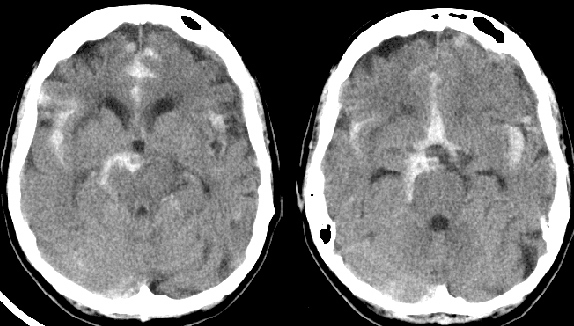 This patient's condition is most likely caused by which of the following?
 (Multiple Choice)
4.9/5 (72)
(72) A 65-year-old patient presents to the emergency department complaining of palpitations of one-day duration. His medical history includes hypertension, his wife complains of his noncompliance with antihypertensive drugs. The patient had consumed multiple wine cups the previous night. On examination, Bp 160/90 mm Hg and pulse are 140/min and irregular. ECG showed irregularly irregular pulse with absent P waves and narrow QRS. What is the most likely diagnosis?
(Multiple Choice)
4.8/5 (76)
(76) A 35-year-old woman comes to the emergency department because of abdominal pain and progressive fatigue . During this time, she has noticed that her urine is darker when she wakes up in the morning. Her stool is of normal color. Five months ago, she was diagnosed with type 2 diabetes mellitus, for which she takes metformin. Physical examination shows pallor and jaundice. There is no splenomegaly. His laboratory test results are as follows: 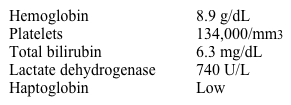 Magnetic resonance angiography of the abdomen reveals mesenteric vein thrombosis. Which of the following is the most likely pathologic renal finding in this patient?
 (Multiple Choice)
4.7/5 (78)
(78) A 65-year-old man is being assessed for chronic shortness of breath. He has had exertional dyspnea for the past year and has recently had weight gain and peripheral edema. He has no history of cardiovascular or pulmonary problems. The histopathologic results of a cardiac biopsy of the left ventricle are shown on the slide below. 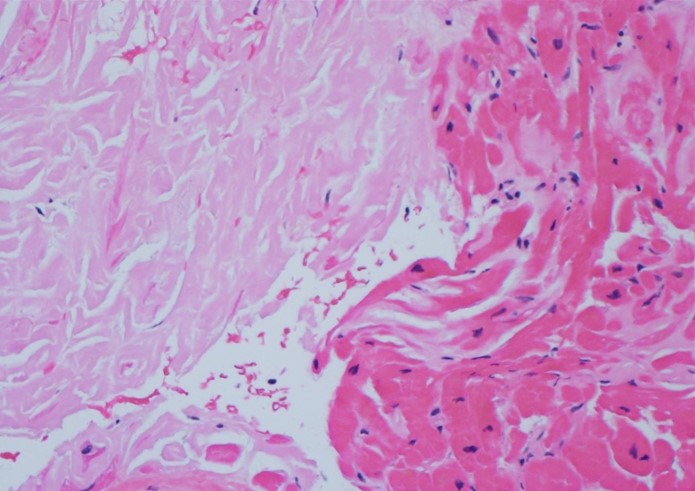 Which of the following echocardiographic results are most likely in this patient?
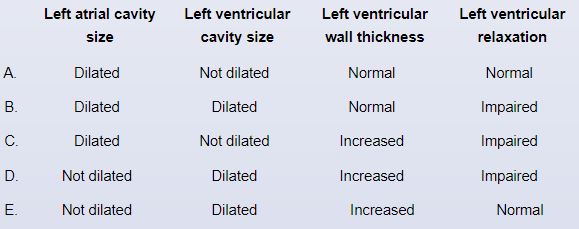
Which of the following echocardiographic results are most likely in this patient? (Multiple Choice)
4.8/5 (72)
(72) A 43-year-old woman comes to the physician because of a 3-week history of progressive weakness. She has had increased difficulty combing her hair and climbing stairs. She has hypertension. She has smoked one pack of cigarettes daily for 25 years. She does not drink alcohol. Her mother had coronary artery disease and systemic lupus erythematosus. Her current medications include chlorthalidone and vitamin supplements. Her temperature is 37.8°C (100.0°F), pulse is 71/min, and blood pressure is 132/84 mm Hg. Muscle biopsy reveals major histocompatibility complex class I molecule overexpression on the sarcolemma with CD8+ lymphocyte infiltration. Which of the following is the most likely cause of this patient's condition?
(Multiple Choice)
4.8/5 (88)
(88) The patient is admitted to the hospital for further workup and treatment. After initial evaluation, a CT scan of the chest is obtained, an image of which is shown on the slide below. 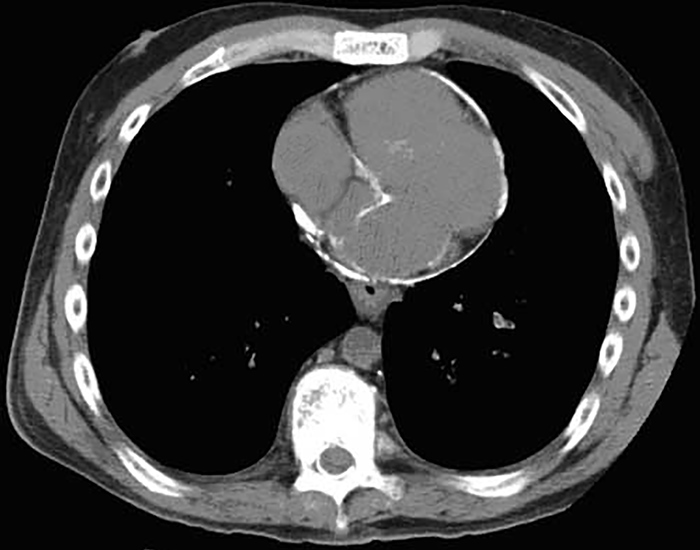 Which of the following is the most likely diagnosis?
 (Multiple Choice)
4.7/5 (85)
(85) A 46-year-old male is brought to the hospital because of sudden-onset headache associated with nausea and vomiting for 30 minutes ago. He has a history of polycystic kidney disease. He is alert and oriented to person, place, and time. Her temperature is 38.2°C (100.8°F), pulse is 89/min, respirations are 19/min, and blood pressure is 150/90 mm Hg. Cardiopulmonary examination shows no abnormalities. Cranial nerves II-XII are intact. She has no focal motor or sensory deficits. She flexes her hips and knees when her neck is flexed while lying in a supine position. Which of the following is the most likely diagnosis?
(Multiple Choice)
4.8/5 (81)
(81) A 65-year-old man presented to the emergency department complaining of severe tearing chest pain radiating to the back, unrelieved by analgesics. It started a few hours ago, with nausea, vomiting, and excessive sweating. The patient is a known case of essential hypertension since he was 25 years old. He is not compliant with his drugs. He has COPD with 35-pack-year smoking history. He has chronic kidney disease. On examination, BP 200/100, Heart rate 120 pulse/min, O2 sat 98%. ECG showed signs of left ventricular hypertrophy, with no ischemic changes. He has normal chest expansion bilaterally, with normal tactile fremitus and normal breath sounds. Transesophageal echocardigram was done and aortic dissection involving ascedning and descending aorta was detected . What is the origin of the intimal flap?
(Multiple Choice)
4.8/5 (99)
(99) A 35-year-old woman, gravida 3, para 2, at 37 weeks' gestation comes to the physician for a prenatal visit. She feels well. She states that she did not follow up with her gynecologist on a regular basis due to a busy work schedule. Pregnancy and delivery of her first two children were uncomplicated. Her temperature is 37.2°C (99°F), pulse is 90/min, and blood pressure is 155/95 mm Hg. All other vital signs are normal. Urinalysis shows 2+ protein. This patient's condition is most likely due to decreased activity of which of the following?
(Multiple Choice)
4.9/5 (72)
(72) A 28-year-old woman comes to the hospital because of a 4-day history of lower abdominal and confusion . Her temperature is 39.7°C , blood pressure is 80/44 mm Hg and respirations are 28/min. There is tenderness to palpation over the pelvic region. On mental status examination, she is oriented only to person. Her urine dipstick is positive for leukocyte esterase and nitrites. Few hours later, the patient becomes progressively shorten of breath and requires mechanical ventilation. This patient's respiratory symptoms are most likely due to which of the following pathologic conditions?
(Multiple Choice)
4.8/5 (93)
(93) A 10-old boy is brought to the physician for a health examination. He is at the 60th percentile for length and weight. Vital signs are within normal limits. The abdomen is soft and nontender. The external genitalia appear normal. Examination shows a single palpable testicle in the right hemiscrotum. The scrotum is nontender and not enlarged. There is a palpable mass in the left inguinal canal. Biopsy of the mass shows marked fibrotic changes with prominent Leydig cells and hypoplastic Sertoli cells. The patient's parents are advised that the mass should be removed. Which of the following is the most likely explanation for the need for surgery in this patient?
(Multiple Choice)
4.7/5 (75)
(75) A 42-year-old woman comes to the physician because of progressive weakness for the past month. She has noticed increasing difficulty performing household chores and walking her dog. Sometimes, she feels too fatigued to cook dinner. She has noticed that she feels better after sleeping. She does not have chest pain, shortness of breath, or a history of recent illness. She has no other history of serious illness and takes no medications. She has smoked two packs of cigarettes daily for 25 years. She appears fatigued. Examination shows drooping of the upper eyelids. There is diminished motor strength in the upper extremities. Sensation and reflexes are intact. Which of the following changes involving the postsynaptic muscle cell most likely explains this patient's symptoms?
(Multiple Choice)
4.9/5 (81)
(81) A 3-year-old boy is brought to clinic by his mother because she is concerned regarding neck swelling and fevers. Three weeks ago, the patient developed viral upper respiratory infections. He attends day care, where several children have had the same symptoms. His symptoms had briefly resolved 10 days ago, but the fever recurred last week after the patient returned to day care. Since then, his mother has noticed a swelling in the neck region which suddenly appear. Temperature is 38.3 C (100.9 F). Examination shows enlarged lymph nodes in the neck region. Lymphadenopathy at which of the following locations is most concerning for malignancy rather than infection in this patient?
(Multiple Choice)
4.8/5 (80)
(80) A 75-year-old man presented to the clinic suffering from numbness and tingling in the hands. For the last 3 months, the patient has been experiencing numbness in his hands. There is numbness over the middle, index, and thumb fingers. The patient is a known case of type 2 diabetes mellitus, and end-stage renal disease. The patient has been receiving hemodialysis for the last 10 years. The patient has stable vital signs. on examination, cardiopulmonary examination shows no abnormalities. Physical examination shows bilateral thenar atrophy, with swelling over the wrists bilaterally. which of the following is The underlying pathophysiological process for this patient's presentation?
(Multiple Choice)
4.8/5 (64)
(64) A 15-year-old boy is brought to the physician because of left-sided groin pain and difficulty walking for 3 weeks. He reports having pain at rest and increased pain with activity. He recently started playing flag football but does not recall any trauma. Medical history is significant for sickle cell disease. He is at the 25th percentile for height and 20th percentile for weight. His temperature is 37.0°C (98.6°F), pulse is 90/min, and blood pressure is 120/80 mm Hg. Examination shows tenderness over the lateral aspect of the left hip with no swelling, warmth, or erythema. There is a decrease in an active and passive internal and external rotation, extension, and abduction. Imaging of the hip is shown in the exhibit. 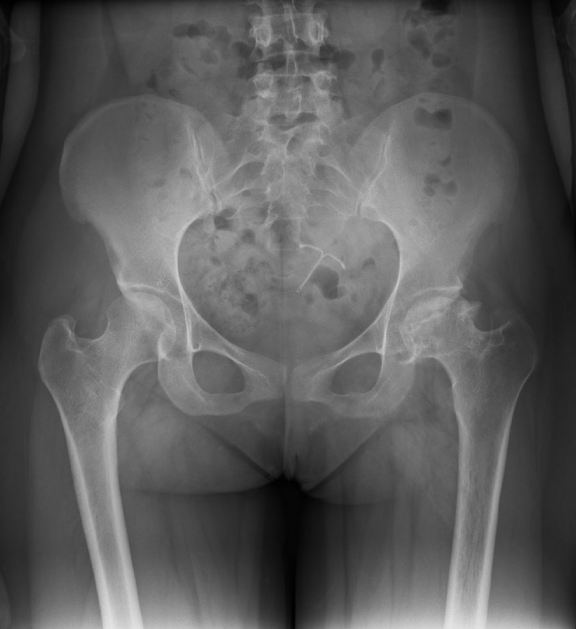 Which of the following is the most likely cause of this patient's pain?
 (Multiple Choice)
4.9/5 (81)
(81) A 3-year-old boy is brought to the physician by his mother because of fever for 6 days. Yesterday, his mother noted a rash on his lower body . His temperature is 38.9°C (102°F) pulse is 140/min, and respirations are 30/min. Examination shows right-sided anterior cervical lymphadenopathy, bilateral conjunctival injection, erythema of the tongue and lips, and a maculopapular rash involving the hands, feet, perineum, and trunk. The remainder of the examination is unremarkable. Which of the following is the most likely diagnosis?
(Multiple Choice)
4.9/5 (70)
(70) A 42-year-old woman is brought to the physician by her husband because of a 1-year history of abnormal behavior. During this time she has been irritable, and restless, and has had multiple episodes of hearing voices. Over the past month, she has also had difficulty swallowing. She has a 2-year history of depression. She was let go by her employer 6 months ago because she could no longer handle all her tasks and often forgot about assignments. The patient has smoked one pack of cigarettes daily over the past 20 years. Physical examination shows intermittent, fidgety, jerky movements of the hands. MRI of the brain is ordered. Which of the following neuroimaging findings is most likely to be seen in this patient?
(Multiple Choice)
4.9/5 (81)
(81) 
Filters
- Essay(0)
- Multiple Choice(0)
- Short Answer(0)
- True False(0)
- Matching(0)