



 Chat with AI
Exam 10: Pathology

Exam 1: Anatomy265 Questions
Exam 2: Behavioral Sciences178 Questions
Exam 3: Biochemistry102 Questions
Exam 4: Embryology59 Questions
Exam 5: Epidemiology, Biostatistics, and Medical Informatics94 Questions
Exam 6: Genetics88 Questions
Exam 7: Histology46 Questions
Exam 8: Immunology147 Questions
Exam 9: Microbiology and Virology330 Questions
Exam 10: Pathology817 Questions
Exam 11: Pharmacology and Toxicology509 Questions
Exam 12: Physiology339 Questions
Exam 13: Psychiatry and Psychotherapy23 Questions
Select questions type


A 65-year-old woman comes to the physician because of a 2-week history of stabbing pain in her lower back. The pain radiates to the back of her right leg and is worse at night. She reports decreased sensation around her buttocks and inner thighs. During the last several days, she has had trouble urinating. Three years ago, she was diagnosed with breast cancer and was treated with lumpectomy and radiation. Her only medication is anastrozole. Her temperature is 37.0°C (98.6°F), pulse is 80/min, respirations are 12/min, and blood pressure is 130/70 mm Hg. Which of the following is the most likely cause of this patient's current symptoms?
(Multiple Choice)
4.8/5  (80)
(80) A 3-year-old child with constipation is brought to the office by his parents. Before, the boy had one to two soft stools each day. His bowel motions have, however, diminished over the past three months to one every three to four days, with severe straining and the formation of firm stool balls. The boy's general appetite has not been influenced by his sporadic diffuse stomach pain and increasing agitation. A maternal aunt who has celiac disease and a paternal grandma who has "thyroid difficulties" are significant family members. The youngster and his parents moved into a home that has belonged to their family for many generations four months ago, and now the boy's parents are concerned that the stress of the move may be a factor in his symptoms. Which of the following is the most appropriate diagnostic test for this patient?
(Multiple Choice)
4.9/5 (93)
(93) A 4-hour-old male infant is being assessed because of bluish discoloration of his lips and tongue. He was born at term and the antenatal period showed tetralogy of fallot. Initial Apgar scores are 5 and 7 at 1 and 5 minutes after birth, respectively. His temperature is 37.3°C (99.1°F), pulse is 170/min, respirations are 65/min, and blood pressure is 70/46 mm Hg. Pulse oximetry on room air shows an oxygen saturation of 92%. A grade 3/6 holosystolic murmur is heard over the left upper sternal border. This patient should be immediately treated with a medication producing which of the following effects?
(Multiple Choice)
4.8/5 (76)
(76) A 62-year-old man with a history of inadequate medical follow-up visits visits the office because he is having vision problems. For the past two weeks, his eyesight has been fuzzy. He witnessed a shadow appear abruptly over his right eye's visual field a day ago. The patient hasn't recently had headaches, nausea, dizziness, double vision, or vertigo. Examined pupils exhibit identical reactivity to light. Confrontational visual field testing demonstrates spotty vision loss. On funduscopic examination, as seen in the image below, a flame-shaped retinal hemorrhage is discovered in the right eye. 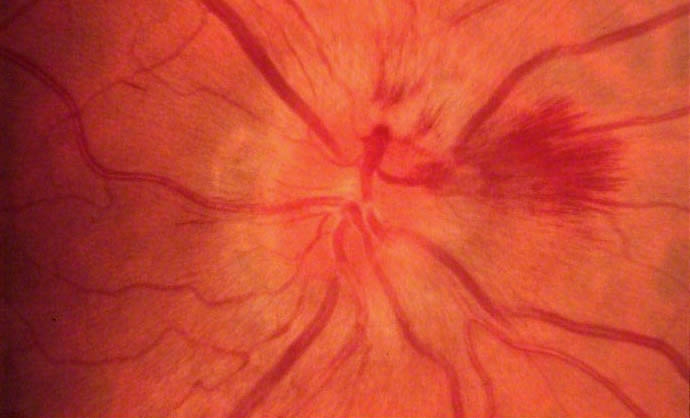 Which of the following is the most likely cause of his visual disturbance?
 (Multiple Choice)
4.7/5 (79)
(79) A 14-year-old girl is brought to the physician for a follow-up examination. She has had frequent falls over the past 2 years. During the past 6 months, she has been unable to walk or stand without assistance and she now uses a wheelchair. Her mother was diagnosed with a vestibular schwannoma at age 52. Her vital signs are within normal limits. Her speech is slow and unclear. Neurological examination shows nystagmus in both eyes. Her gait is wide-based with irregular and uneven steps. Her proprioception and vibration senses are absent. Muscle strength is decreased especially in the lower extremities. Deep tendon reflexes are 1+ bilaterally. The remainder of the examination shows kyphoscoliosis and foot inversion with hammertoes. . This patient most likely has which of the following neuropathologic findings?
(Multiple Choice)
4.9/5 (74)
(74) A 65-year-old man is admitted to the hospital with an acute ST-segment elevation myocardial infarction. The patient undergoes coronary angiography with stent placement in the left circumflex artery, and he is started on therapy with a beta blocker and antiplatelet agents. On day 3 of hospitalization he experiences chest pain. The pain, described as sharp and radiating to his neck and shoulders, is exacerbated by coughing and swallowing. He has no shortness of breath, lightheadedness, or abdominal pain. Temperature is 37.5 C (99.5 F), blood pressure is 130/80 mm Hg, pulse is 90/min and regular, and respirations are 20/min. The lungs are clear on auscultation. There is no peripheral edema. Which of the following is the most likely cause of this patient's chest pain?
(Multiple Choice)
4.9/5 (75)
(75) A 72-year-old man comes to the physician because of urinary frequency and urgency for 2 weeks. He is especially concerned because last week he also noticed blood in his urine for the first time. He has smoked one pack of cigarettes daily for 44 years. Vital signs are within normal limits. Physical examination shows a nondistended, nontender abdomen; there is no costovertebral angle tenderness. Digital rectal examination shows a mildly enlarged, nontender prostate without palpable masses. Urinalysis shows 50 RBCs/hpf. Cystoscopy is planned for visualization and biopsy of suspected urinary tract cancer. Which of the following features would be most suggestive of a poor prognosis?
(Multiple Choice)
4.9/5 (70)
(70) A 73-year-old woman comes to the physician because of a 5-day history of intermittent palpitations. She has no history of syncope or chest pain. She had similar symptoms one year ago and following workup has been treated with daily flecainide since then. She drinks one to two glasses of wine on the weekends. She does not smoke. Her pulse is 71/min and her blood pressure is 134/72 mm Hg. A complete blood count shows no abnormalities. Serum creatinine, electrolytes, and TSH are within normal limits. An ECG is shown. 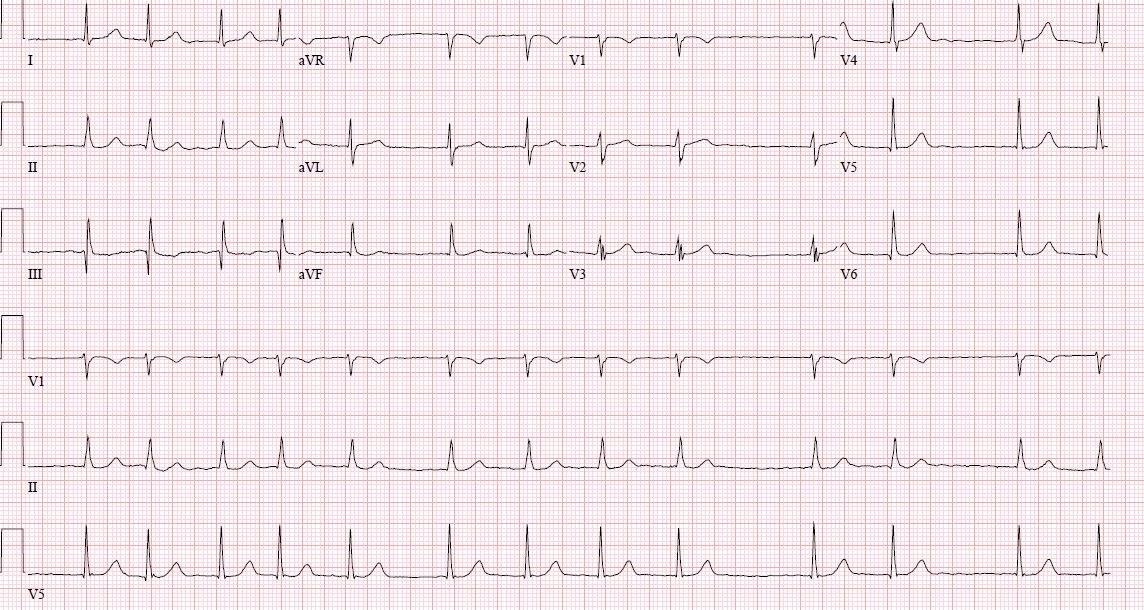 Which of the following is most likely the strongest risk factor for this patient's presentation?
 (Multiple Choice)
4.8/5 (83)
(83) A 62-year-old man experiences a new-onset generalized tonic-clonic seizure and is sent to the emergency room. According to his wife, he has been experiencing episodic headaches, nausea, and deteriorating strength over the previous few weeks. The headaches occasionally cause him to lose sleep and are especially bad at night. Along with osteoarthritis, he also has well-controlled hypertension. The patient is postictal yet compliant throughout a physical examination. He is brought to the hospital for further assessment, but aspiration pneumonia and septic shock kill him a few days later. The picture below depicts a brain segment that was acquired during a postmortem examination. 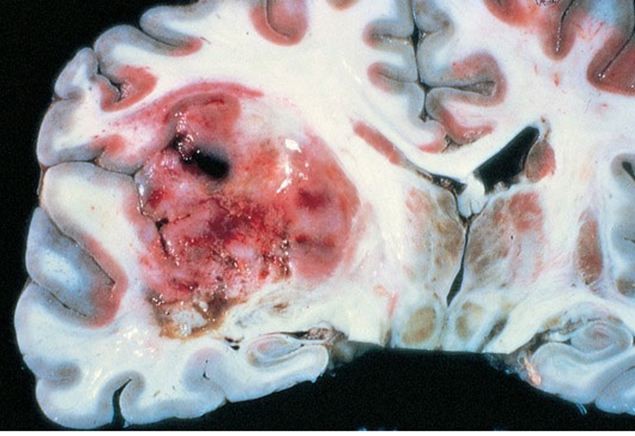 This patient most likely had which of the following conditions?
 (Multiple Choice)
4.8/5 (77)
(77) A 78-year-old man dies of advanced esophageal cancer. The man's family donates his body for teaching purposes and an autopsy is performed. Gross examination of the heart reveals left ventricular chamber size and wall thickness within normal limits. No significant atherosclerosis is seen in the coronary arteries. On microscopic examination, myocardial cells demonstrate prominent yellow-brown intracytoplasmic granules as shown in the exhibit.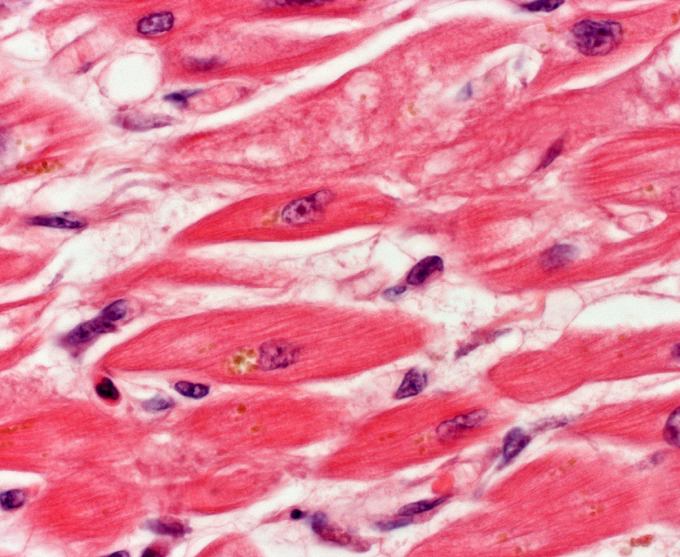 Which of the following most likely accounts for the observed microscopic changes?
 (Multiple Choice)
4.7/5 (79)
(79) A 25-year-old woman at 30 weeks gestation presented to the emergency department complaining of severe right upper quadrant abdominal pain. The patient was in her usual state of health, until this morning when she started complaining of severe abdominal pain associated with nausea and vomiting. Temperature is 36.7 C (98.1 F), blood pressure is 175/120 mm Hg, and pulse is 120/min. BMI is 35 kg/m2. Physical examination shows right upper quadrant abdominal tenderness. Aspartate aminotransferase (SGOT) is 230 U/L and alanine aminotransferase (SGPT) is 250 U/L. Imaging shows hepatic subcapsular hematoma. This patient is most at risk for which of the following complications?
(Multiple Choice)
4.8/5 (77)
(77) A 4-month-old African-American infant is brought to the pediatrician for a well-baby check-up. He was born at term through a normal vaginal delivery and has been well since. His 4-year old brother has sickle-cell disease. He is exclusively breastfed and receives vitamin D supplements. His immunizations are up-to-date. He appears healthy. His length is at the 70th percentile and weight is at the 75th percentile. Cardiopulmonary examination is normal. The patient's mother smokes a pack of cigarettes daily. Which of the following conditions is the infant at highest risk for developing from exposure to cigarette smoke?
(Multiple Choice)
4.9/5 (75)
(75) A 23-year-old man is evaluated for left-hand tremors for the past month. He feels shy in social activities and has this tremor affected his function level. He was diagnosed with multiple sclerosis with a relapsing-remitting course. Physical examination does not show any tremors at rest. A tremor appears when the patient is asked to grab an object from the table. Once the patient's hand is close to the object, it becomes more intense. Dysfunction in which of the following structures explain the patient's symptoms?
(Multiple Choice)
4.8/5 (76)
(76) A 76-year-old man comes to the office with a 2-month history of progressive low back pain. The pain is relatively constant and nagging and is unrelieved by rest or position changes. It is especially bad at night and interferes with sleep. The patient has taken acetaminophen and ibuprofen without relief. Medical history is significant for hypertension and osteoarthritis affecting the knees and hands. The patient used intravenous drugs occasionally when he was younger but not for >30 years. Which of the following processes is most likely responsible for this patient's back pain?
(Multiple Choice)
4.8/5 (66)
(66) A 40-year-old woman comes to the office because of a 3-month history of itchiness in both eyes. During this time, she has also had difficulty swallowing solid food. She is sexually active with her husband and has recently noticed increased pain with sexual intercourse. Medical history is unremarkable and she takes no medications. Her sister has vitiligo. Vital signs are within normal limits. Oropharyngeal examination shows dry mucous membranes and prominent tongue fissures. Ophthalmologic examination shows normal visual acuity and scleral injection in both eyes. A filter paper placed on the patient's lower eyelid wicks 3 mm of moisture after 5 minutes. A salivary gland biopsy image representative of this patient's disease process is shown in the exhibit. 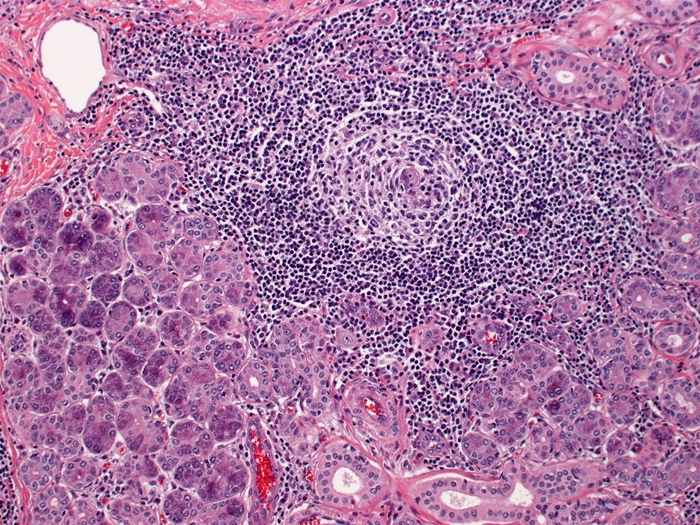 This patient is at greatest risk for which of the following due to her current condition?
 (Multiple Choice)
4.9/5 (76)
(76) A 5-year-old boy is brought to the office by his mother, who notes that her son's eyes and feet have looked puffy over the last several weeks. The boy has no pain but mentions that his shoes seem to fit tightly and bother him, especially when he runs outside during recess at school. The mother also remarks that the boy's urine has been excessively foamy recently. Physical examination is remarkable for periorbital edema and lower extremity edema. Urinalysis shows 4+ proteinuria but is otherwise unremarkable. Which of the following mechanisms is the most likely cause of this patient's abnormal laboratory findings?
(Multiple Choice)
4.7/5 (72)
(72) An 11-year-old boy is brought to the physician for the evaluation of frequent falling. His mother reports that the patient has had increased difficulty walking over the past few months and has refused to eat solid foods for the past 2 weeks. He has met all developmental milestones. The patient has had multiple ear infections since birth. His temperature is 37.0°C (98.6°F), pulse is 90/min, and blood pressure is 120/80 mm Hg. Examination shows foot inversion with hammer toes bilaterally. His gait is wide-based with irregular and uneven steps. This patient is at greatest risk of dying from which of the following conditions?
(Multiple Choice)
4.8/5 (77)
(77) A 35-year-old woman comes to the physician because of recurring episodes of headache for the past 5 months. During this period, she has had headaches for approximately 18 days per month. The episodes last for about 2 hours each. She describes the headaches as dull, pressing, and nonpulsating holocranial pain. The symptoms do not increase with exertion. She has no vomiting, nausea, phonophobia, or photophobia. She has been taking ibuprofen irregularly when the headaches are particularly severe. Which of the following is the most likely diagnosis?
(Multiple Choice)
5.0/5 (78)
(78) A 39-year-old woman comes to the physician because of progressive pain and swelling of her wrists and hands for the past 2 months. Her hands are stiff in the morning; the stiffness decreases as she starts her chores. She also reports early-morning neck pain at rest for the past 3 weeks. She has no history of serious illness and takes no medications. Her sister has systemic lupus erythematosus. Vital signs are within normal limits. Examination shows bilateral swelling and tenderness of the wrists, second, third, and fourth metacarpophalangeal joints; range of motion is limited by pain. There is no vertebral tenderness. Cardiopulmonary examination shows no abnormalities. Neurologic examination shows no focal findings. Laboratory studies show anemia. Which of the following is most likely to be the earliest finding during the development of this patient's condition?
(Multiple Choice)
4.8/5 (78)
(78) A 57-year-old man comes to the physician because of a 2-month history of worsening shortness of breath with walking. He has not had any cough, fevers, or recent weight loss. He has hypercholesterolemia, for which he takes simvastatin, but otherwise is healthy. He smoked 2 packs of cigarettes daily for 35 years. On lung auscultation, there are reduced breath sounds at the base of the left lung. An X-ray shows a left pleural effusion and multiple nodular pleural lesions. Electron microscopy shows tumor cells with long and slender microvilli are joined by desmosomes. Which of the following is the most likely diagnosis?
(Multiple Choice)
4.8/5 (95)
(95) 
Filters
- Essay(0)
- Multiple Choice(0)
- Short Answer(0)
- True False(0)
- Matching(0)