



 Chat with AI
Exam 10: Pathology

Exam 1: Anatomy265 Questions
Exam 2: Behavioral Sciences178 Questions
Exam 3: Biochemistry102 Questions
Exam 4: Embryology59 Questions
Exam 5: Epidemiology, Biostatistics, and Medical Informatics94 Questions
Exam 6: Genetics88 Questions
Exam 7: Histology46 Questions
Exam 8: Immunology147 Questions
Exam 9: Microbiology and Virology330 Questions
Exam 10: Pathology817 Questions
Exam 11: Pharmacology and Toxicology509 Questions
Exam 12: Physiology339 Questions
Exam 13: Psychiatry and Psychotherapy23 Questions
Select questions type


A 64-year-old guy visits the office because he has blisters on his trunk and groin. Itching has been going on for several weeks, and blisters appeared around a week ago. He has a history of high blood pressure and osteoarthritis. At the age of 60, the patient received the zoster vaccination. A thorough examination reveals multiple 0.5- to 3-cm bullous skin lesions. The results of a skin biopsy are depicted in the figure below: 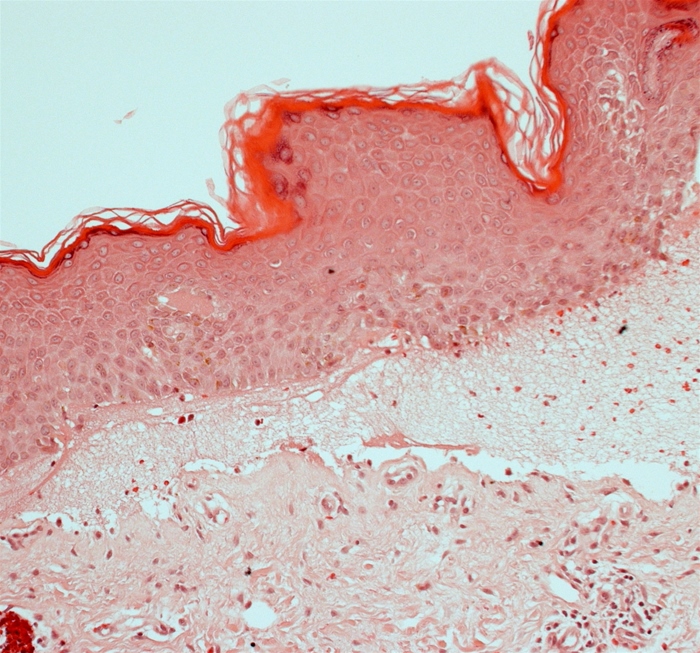 Which of the following is the most likely diagnosis?
 (Multiple Choice)
4.9/5  (71)
(71) A 5-year-old boy is brought by his mother because of a diffculty walking. He has multiple respiratory infections. Cultured cells from this patient demonstrate a high rate of radiation-induced genetic mutation. This patient is most likely to experience which of the following?
(Multiple Choice)
5.0/5 (82)
(82) A 65-year-old woman with chronic obstructive pulmonary disease comes to the office for a follow-up appointment. The patient reports increasing shortness of breath that is not relieved by her inhalers. Her other medical conditions include osteoarthritis. She is a former smoker with a 45-pack-year history. Blood pressure is 120/70 mm Hg, pulse is 75/min, and respirations are 22/min. Oxygen saturation on room air is 91% at rest. On physical examination, jugular venous pressure is elevated. There is increased intensity of the pulmonic component of S2. Breath sounds are decreased bilaterally with scattered wheezes but no crackles. There is 2+ lower extremity edema. Which of the following hemodynamic parameters is most likely to be increased in this patient?
(Multiple Choice)
4.7/5 (90)
(90) A 12-year-old child is brought to the clinic after suffering with a nonproductive cough and rash for a week. He's also experienced low-grade fevers, lethargy, and headaches. The patient has no past medical issues and is fully immunized. An examination of the lungs reveals bilateral crackles and wheezes. As shown in the exhibit, he has a generalized rash across his body and extremities. 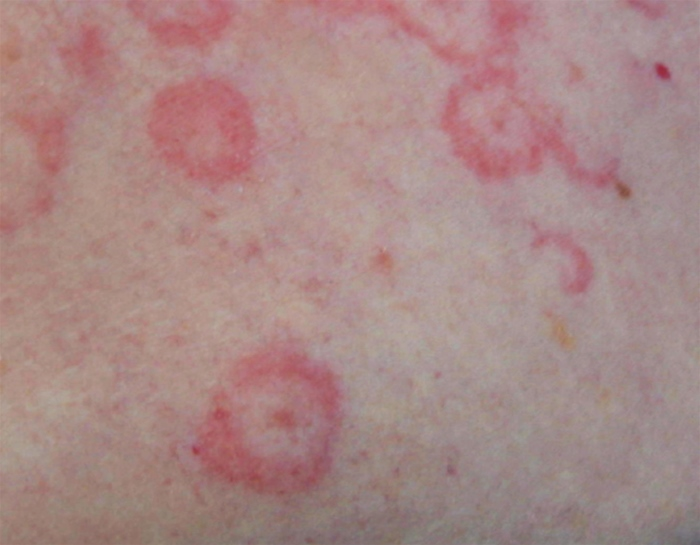 Which of the following is the most likely cause of this patient's skin lesions?
 (Multiple Choice)
4.8/5 (77)
(77) A 37-year-old woman comes to the physician because of tiredness and dyspnea on exertion for several months. . She has no history of blood disorders. Physical examination shows mild mucosal pallor. Hemoglobin is 7.8 g/dL. Peripheral blood smear is shown in the image below. 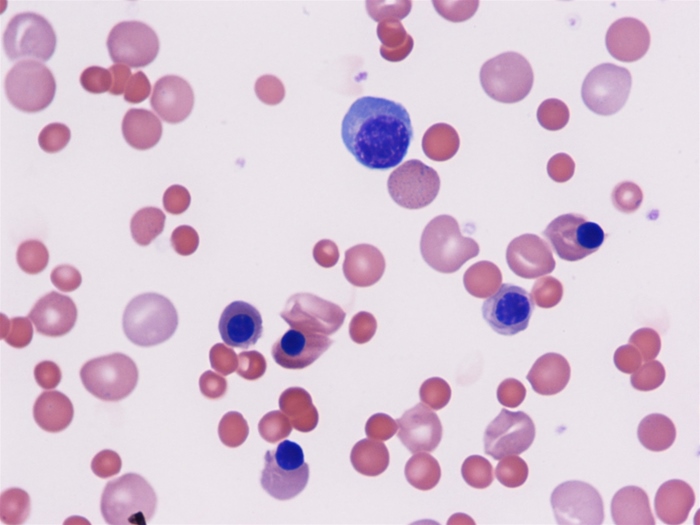 Which of the following is the most likely cause of this patient's anemia?
 (Multiple Choice)
4.8/5 (79)
(79) A 4-year-old girl is brought to the physician because of a rash and malaise for the past 2 days. She had a 4-day history of diarrhea that subsided two days ago. One month ago, she had a 3-day episode of high fever, followed by a rash with bright red discoloration over her cheeks for two days before subsiding without treatment. Her vaccinations are up-to-date. She is alert and oriented. Her vital signs are within normal limits. Examination shows petechiae on her trunk and extremities. Abdominal examination shows diffuse abdominal tenderness with hyperactive bowel sounds. Laboratory studies are as follows: 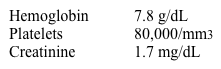 Urinalysis shows proteinuria and hematuria. Which of the following mechanisms is the most likely cause of this patient's condition?
 (Multiple Choice)
4.8/5 (73)
(73) A 66-year-old woman is brought to the emergency department due to sudden loss of consciousness. The family reports that the patient had a severe headache before he lost consciousness. He did not have any recent head trauma or significant falls. The patient has a previous medical history of chronic hypertension and diabetes mellitus. On examination, the patient is conscious, oriented, and alert. He has a normal neurological examination. He is continuously complaining of a headache. Initial radiological imaging shows a right-sided temporal hemorrhage. Over the next 24 hours, the patient's state deteriorated and he had a tonic-clonic seizure. Blood pressure is 185/92 mm Hg, the pulse is 36/min, and respirations are 9/min. The monitor showed recurrent episodes of brief apnea. The patient was sent for radiological examination again, which showed expansion of the acute hemorrhage. It indicated a new brain herniation. Which of the following findings would be observed in this patient?
(Multiple Choice)
4.8/5 (78)
(78) A 40-year-old woman comes to the physician to evaluate recurrent right abdominal pain especially severe after fatty meals. She has a hsitory of recurrent same episodes which is localized to the upper quadrent. She has no history of medical diseases and takes no medication. Vital signs and abdominal examination are normal. ltrasound of the abdomen reveals several mobile echogenic foci within the gallbladder lumen. Which of the following sets of conditions is most likely present within this patient's gallbladder? 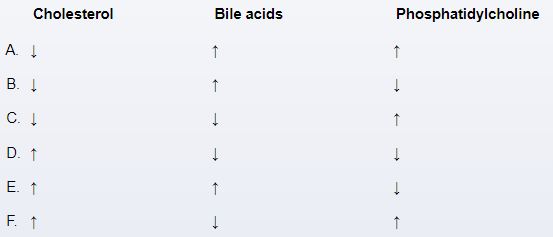
(Multiple Choice)
4.9/5 (91)
(91) A 40-year-old guy arrives at the clinic with lesions on his thigh that he observed two weeks earlier. The lesions do not cause discomfort or itching. The patient has previously been infected with HIV. He has not been adhering to HIV treatment. The patient seems somewhat cachectic on physical examination. Vital indicators are typical. On his right thigh, he has two elliptical, elevated, nontender, violaceous lesions. There are no additional skin or mucous membrane lesions. Lymphadenopathy does not exist. The CD4 cell count is 100/mm3. Which of the following cells is most likely responsible for the patient's skin condition?
(Multiple Choice)
4.8/5 (73)
(73) A 45-year-old male sustains a traumatic injury at work and presents to the emergency department with a deep laceration on the palm of his right hand. Three weeks later, actin-containing fibroblasts and increased metalloproteinase activity are detected at the site of injury. These findings are most likely related to which of the following complications?
(Multiple Choice)
4.9/5 (77)
(77) A 48-year-old woman comes to the hospital due right abdominal pain which radiates to the right shoulder. She has a hsitory of recurrent same episodes but this one is more painful than before and the pain is graded 6/10 in intesity. She has a history of crohns disease for which she takes infliximab. Vital signs and abdominal examination are normal. Abdominal ultrasonography reveals multiple mobile calculi within the gallbladder. Which of the following processes is most likely responsible for the development of gallstones in this patient?
(Multiple Choice)
4.9/5 (75)
(75) A 61-year-old man comes to the physician because of progressively worsening swelling of his ankles. He says he has felt exhausted lately. Over the past 3 months, he has gained 5 kg (11 lb). He has smoked one pack of cigarettes daily for 30 years. His pulse is 75/min and his blood pressure is 140/90 mm Hg. Examination shows 2+ pitting edema in the lower extremities. Neurologic examination shows diminished two-point discrimination over the fingers and toes. Laboratory studies show a serum creatinine concentration of 1.9 mg/dL. A urine sample is noted to be foamy. A kidney biopsy is performed; light microscopic findings following staining with hematoxylin and eosin are shown in the image below: 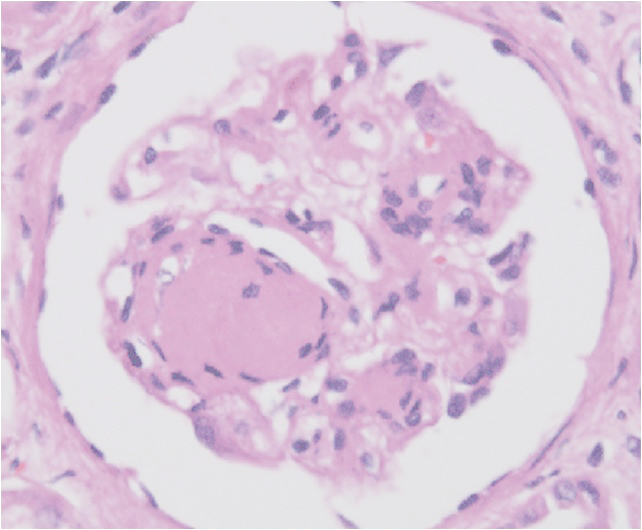 Which of the following is the most likely explanation for this patient's biopsy findings?
 (Multiple Choice)
4.9/5 (74)
(74) A 3-week-old girl is brought to her primary care provider for a routine visit. The patient was born by normal spontaneous vaginal delivery at 39 weeks gestation. The mother is breastfeeding exclusively, . Newborn screening results from hemoglobin electrophoresis are as follows: 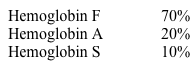 The patient's mother has sickle cell trait, and a maternal cousin has sickle cell anemia. Examination shows a well-appearing infant with no pallor or splenomegaly. Which of the following is most likely true about this patient?
 (Multiple Choice)
4.9/5 (77)
(77) A 49-year-old man presented to the clinic complaining of a sore throat for the previous two months. Additionally, he has noticed difficulty in initiating swallowing due to throat pain. The patient is an alcoholic, and he smokes 2 packs of cigarettes for the last 15 years. Physical examination reveals ulcerative lesions on the left side. Biopsy has revealed squamous cell carcinoma. What is the first site of the spread of this malignancy?
(Multiple Choice)
4.9/5 (69)
(69) A 41-year-old woman comes to the physician because of a 6-hour history of right flank pain and gross hematuria. Over the past 2 weeks, she has also developed progressive lower extremity swelling and a 3-kg (7-lb) weight gain. She has a history of chronic hepatitis B infection, which was diagnosed 10 years ago. She frequently flies from California to New York for business. She appears fatigued. Her pulse is 98/min, respirations are 18/min, and blood pressure is 135/75 mm Hg. Examination shows periorbital edema, a distended abdomen, and 2+ edema of the lower extremities. The lungs are clear to auscultation. A CT scan of the abdomen shows a nodular liver with ascites, a large right kidney with abundant collateral vessels, and a filling defect in the right renal vein. Urinalysis shows 4+ protein, positive glucose, and fatty casts. Urinary loss of which of the following substances most likely predisposed this patient to his acute condition?
(Multiple Choice)
4.7/5 (81)
(81) A 62-year-old woman is evaluated in the emergency department due to right lower extremity weakness. The patient woke up unable to move his right leg. In addition, she has urinary incontinence. One month ago, the patient was diagnosed with atrial fibrillation. The patient did not seek a cardiological consult and did not take any medication. Blood pressure is 160/90 mm Hg and pulse is 112/min and irregularly irregular. On examination, there is decreased motor strength of the right lower extremity and sensory loss. Additionally, she has a positive Babinski sign. Otherwise, the neurological examination is free. Embolic occlusion of which of the following regions would explain the patient's symptoms?
(Multiple Choice)
5.0/5 (81)
(81) A 23-year-old man comes to the physician with a 1-week history of sharp, substernal chest pain that is worse with inspiration and relieved with leaning forward. He has also had nausea and myalgias. He has end-stage kidney disease related to polycycstic kidney disease and receives intermittent hemodialysis through a tunneled catheter. Temperature is 39 C (102.2 F), blood pressure is 108/64 mm Hg, and pulse is 120/min. The patient is ill-appearing. Cardiac examination shows a high-pitched rubbing sound between S1 and S2 that is best heard at the left sternal border. Echocardiography reveals a moderate-sized pericardial effusion. Pericardiocentesis yields turbid fluid with a large number of neutrophils. Microbiologic analysis of this patient's pericardial fluid is most likely to reveal which of the following pathogens?
(Multiple Choice)
4.8/5 (88)
(88) A 59-year-old man with a history of alcoholic cirrhosis is brought to the hospital by his wife for a progressive confusion for the past two hours. He has also an abdominal distension and yellowing of the eyes. His wife report two episodes of bloody emesis in the morning .He is admitted to the hospital and the appropriate treatment is initiated. Neurologic examination shows normal, reactive pupils and a flapping tremor when the wrists are extended. Which of the following is most likely contributing to this patient's altered mental status?
(Multiple Choice)
4.8/5 (76)
(76) A 64-year-old man arrives at the clinic with a 4-day history of acute left-sided chest pain. The pain is persistent and has a burning sensation to it. The patient has acquired a rash in the region of pain during the previous day. He had never experienced anything like this before. The patient's medical history is ordinary. The patient is awake and alert, and his vital signs are normal. A vesicular rash in the 5th left intercostal area is discovered on physical examination. Which of the following pathologic findings in the afflicted region is most likely?
(Multiple Choice)
4.8/5 (71)
(71) A 65-year-old man comes to the physician because of a 10-day history of episodic retrosternal pain and shortness of breath. The episodes occur when he climbs stairs or tries to walk briskly on his treadmill. The symptoms resolve with rest. The previous evening he felt dizzy and weak during such an episode. Physical examination shows a mid-systolic murmur at the upper sternum and slow-rising carotid pulses. After initial evaluation, cardiac catheterization is performed and reveals 30% stenosis of the mid-left anterior descending artery. A 50 mm Hg pressure gradient is seen when a catheter is passed across the aortic valve. Which of the following is the most important contributor to this patient's presenting symptoms?
(Multiple Choice)
4.8/5 (92)
(92) 
Filters
- Essay(0)
- Multiple Choice(0)
- Short Answer(0)
- True False(0)
- Matching(0)