



 Chat with AI
Exam 10: Pathology

Exam 1: Anatomy265 Questions
Exam 2: Behavioral Sciences178 Questions
Exam 3: Biochemistry102 Questions
Exam 4: Embryology59 Questions
Exam 5: Epidemiology, Biostatistics, and Medical Informatics94 Questions
Exam 6: Genetics88 Questions
Exam 7: Histology46 Questions
Exam 8: Immunology147 Questions
Exam 9: Microbiology and Virology330 Questions
Exam 10: Pathology817 Questions
Exam 11: Pharmacology and Toxicology509 Questions
Exam 12: Physiology339 Questions
Exam 13: Psychiatry and Psychotherapy23 Questions
Select questions type


A 28-year-old man comes to the physician because of a 2-day history of intermittent bloody urine. He has not had dysuria or abdominal pain. There has been no change in urine output or urinary frequency. He has also had a runny nose, dry cough, and a sore throat for the past 4 days. He has no history of serious illness and takes no medications. His temperature is 38.1°C (100.6°F), pulse is 70/min, respirations are 14/min, and blood pressure is 140/80 mm Hg. Cardiopulmonary and abdominal examinations show no abnormalities. There is flank tenderness to palpation bilaterally. Urinalysis results are as follows: 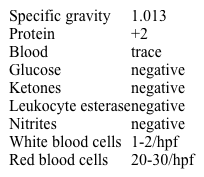 A renal biopsy is performed Which of the following findings is most likely to be seen on microscopic evaluation?
 (Multiple Choice)
4.8/5  (93)
(93) A 57-year-old woman comes to the physician because of repetitive tongue twisting and abnormal movements of the hands and legs that started several days ago. She has a 2-year history of schizophrenia that has been controlled with fluphenazine. Two weeks ago, she was switched to risperidone. Examination shows protrusion of the tongue and smacking of the lips. She makes twisting movements of the arms and frequently taps her right foot. Which of the following is the most likely diagnosis?
(Multiple Choice)
4.9/5 (75)
(75) A 12-month-old girl is brought to the physician by his parents for a well-child check. Her mother is concerned because she is unable to sit and has not learned how to crawl. She attained neck control at 4 months and could roll from front to back at 5 months of age. She does not engage in play, reach for toys, or maintain eye contact. She babbles and does not mimic sounds. She does not follow simple instructions. Her vital signs are within normal limits. She is at the 25th percentile for length and 10th percentile for weight. Neurological examination shows increased muscle tone in all extremities. The ankle clonus and extensor plantar responses are present bilaterally. Which of the following is the most likely cause of this patient's condition?
(Multiple Choice)
4.9/5 (88)
(88) A 54-year-old woman comes to the physician because of constant dull pain, swelling, and progressive stiffness of the right knee for 3 days. Use of over-the-counter analgesics has only provided minimal relief of her symptoms. She has not had any similar symptoms in the past. She takes hydrochlorothiazide for hypertension. Examination of the right knee shows a large effusion and mild erythema. There is moderate tenderness to palpation. Range of motion is limited by pain. Arthrocentesis of the right knee is performed, and microscopic examination of the synovial fluid under polarized light is shown. 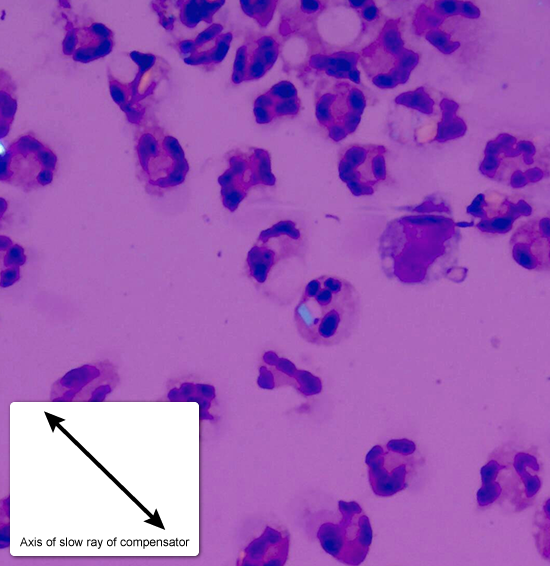 These crystals are most likely composed of which of the following substances?
 (Multiple Choice)
4.9/5 (94)
(94) A 42-year-old previously healthy woman comes to the office due to fever and sore throat. She has no cough. Physical examination shows tonsillar exudate and a nontender cervical lymph node that measures 3.5 cm in diameter. Oral antibiotic therapy is started and on a follow-up visit a week later, the patient reports that her symptoms have resolved. The previously enlarged cervical lymph node has decreased slightly in size. On several follow-up visits over the following year, the patient remains asymptomatic and the size of the lymph node fluctuates but does not disappear completely. The patient is referred to a specialist for surgical removal of the enlarged node. Biopsy reveals abnormal lymph node architecture and numerous lymphocytes. Which of the following, if present, would be most consistent with malignancy in this patient?
(Multiple Choice)
4.8/5 (74)
(74) A 40-year-old woman presented to the emergency department due to bloody vomiting. The patient was resuscitated, and she underwent upper gastrointestinal endoscopy, which shows bleeding gastroesophageal gastric ulcer. While she was hospitalized, the patient started having decreased urine output. Serum creatinine rises to 3.2 mg/dL from a baseline of 1.3 mg/dL. Microscopy reveals patchy epithelial necrosis of the tubules, tubulorrhexia, and intratubular casts. One week later, urine output significantly started increasing and serum creatinine levels declined. Over the next few days, this patient is at the highest risk for which of the following complications?
(Multiple Choice)
4.8/5 (80)
(80) A 14-year-old girl is brought to the physician because of a 1-week history of malaise and chest pain. Three weeks ago, she had a sore throat that resolved without treatment. Her parents say that she is also making unintentional rapid and irregular movements of his hands. Her temperature is 38.7°C (101.7°F). Physical examination shows several firm, painless nodules under the skin near his elbows and the dorsal aspect of both wrists. A new-onset early systolic murmur is heard at the apex in the left lateral position. Which of the following is the most likely mechanism for this patient's condition?
(Multiple Choice)
4.8/5 (84)
(84) A 72-year-old man comes to the physician because of a 2-month history of intermittent retrosternal chest pain and tightness on exertion. He has type 2 diabetes mellitus, osteoarthritis of the right hip, and hypertension. Current medications include insulin, ibuprofen, enalapril, and hydrochlorothiazide. Vital signs are within normal limits. His troponin level is within the reference range. He undergoes dobutamine infusion with simultaneous cardiac imaging. The following is seen:Before infusion: normal left ventricular contractility, ejection fraction 60%During infusion: decreased apical contractility, ejection fraction 45%Five minutes after infusion: normal left ventricular contractility, ejection fraction 60%Which of the following best explains the observed findings?
(Multiple Choice)
4.9/5 (78)
(78) A 55-year-old man comes to the hospital because of progressively increasing shortness of breath for 1-hour ago. He has no chest pain. He has rheumatic heart disease and type 2 diabetes mellitus. He emigrated from India about 25 years ago. His current medications include carvedilol, torasemide, and insulin. He appears uncomfortable. His temperature is 37.3°C (99.1°F), pulse is 72/min and regular, respirations are 18/min, and blood pressure is 130/80 mm Hg. Physical examination reveals a diastolic murmur. Chest x-ray shows severe pulmonary vascular congestion and edema. However, during his hospitalization, he develops right-sided hemiparesis. Which of the following additional findings in this patient would be most suggestive of combined disease involving the mitral and aortic valves rather than exclusive mitral involvement?
(Multiple Choice)
4.9/5 (75)
(75) A 72-year-old man is brought to the emergency department due to diarrhea and vomiting for the last 24 hours. The patient's daughter states that he has been unable to take in much fluid during this time. He has hypertension treated with hydrochlorothiazide, which he has not taken since the onset of symptoms. Blood pressure is 90/60 mm Hg and pulse is 105/min. Examination shows dry mucous membranes. Urinalysis reveals concentrated urine with a specific gravity of 1.030. Which of the following changes in renal plasma flow (RPF), glomerular filtration rate (GFR), and filtration fraction (FF) are most likely to be present in this patient as compared with the normal state? 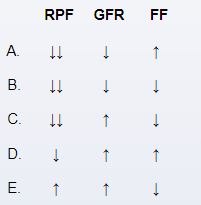
(Multiple Choice)
4.8/5 (67)
(67) A 17-year-old boy is brought to the physician because of progressive right knee pain for the past 3 months. He reports that the pain is worse at night and while doing sports at school. He has not had any trauma to the knee or any previous problems with his joints. His vital signs are within normal limits. Examination of the right knee shows mild swelling and tenderness without warmth or erythema; the range of motion is limited. X-rays reveal a large lytic lesion involving the proximal tibia with extensive soft-tissue swelling. Histologic examination of the mass is shown in the exhibits. 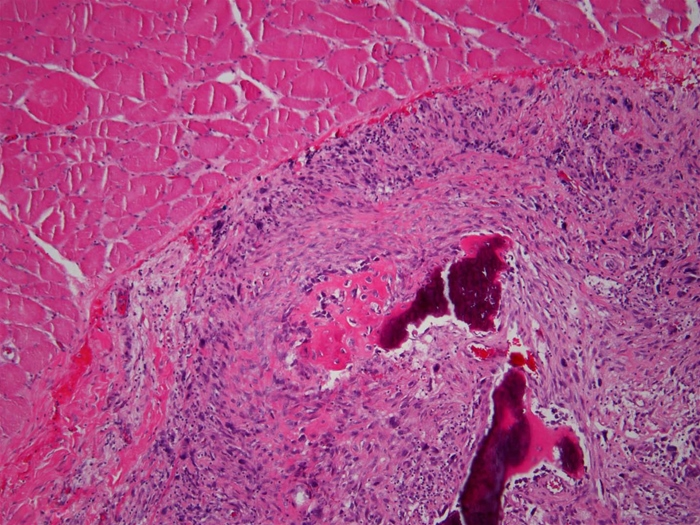
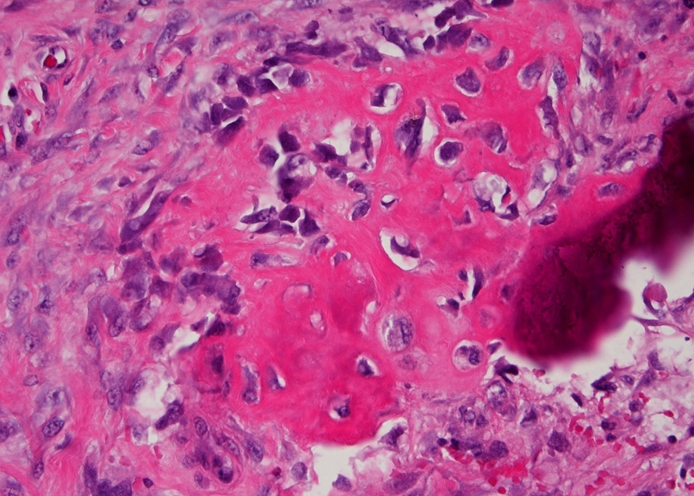 Which of the following is the most likely diagnosis?
 (Multiple Choice)
4.9/5 (79)
(79) A 4-year-old girl is brought to the physician because of a 2-day history of fever and crying while passing urine. She was born at term and has been healthy since. She has had several episodes of fever and abdominal pain, which her parents had treated with over-the-counter antibiotics . Her temperature is 39.0°C (102.2°F), pulse is 144/min, and blood pressure is 85/40 mm Hg. Physical examination shows no abnormalities. Her leukocyte count is 14,000/mm3. Urine dipstick shows leukocyte esterase and nitrites; urinalysis shows WBCs and gram-negative rods. Urine culture results are pending. Renal ultrasound reveals dilated calyces with overlying cortical atrophy bilaterally, mostly in the upper and lower poles. Which of the following is the most likely cause of this patient's ultrasound findings?
(Multiple Choice)
4.7/5 (66)
(66) A 39-year-old woman presents to the office due to a 3-week history of increasing fatigue. She says that she feels less energetic than before and cannot complete the morning walks she previously liked to take. Physical exam reveals conjunctival pallor, hepatomegaly, and massive splenomegaly. Further evaluation reveals a gain-of-function mutation of a non-receptor tyrosine kinase protein in hematopoietic cells, leading to persistent activation of signal transducers and activators of transcription (STAT) proteins. This patient is most likely suffering from which of the following disorders?
(Multiple Choice)
4.8/5 (75)
(75) A 32-year-old woman visits the office to have a breast lump evaluated. She noticed the lump a few months ago and believes it is growing larger. The patient had a right lower limb amputation at the age of 17 due to osteosarcoma. Her mother died from an adrenal tumor, and her younger sister from leukemia. A 5-cm firm immobile mass with irregular borders is found in the left breast. Which of the following gene mutations is the most likely etiology for this patient's condition?
(Multiple Choice)
4.8/5 (101)
(101) Three weeks after beginning radiation therapy for prostate cancer, a 64-year-old man experiences diarrhea, stomach pain, nausea, vomiting, and anorexia. Abdominal tenderness is visible on physical examination. The intestinal mucosa has hyperemia, edema, erosion, and ulceration, according to sigmoidoscopy. The chemistry of the stool and serum is typical. Suspected radiation enteritis. Which of the following is most likely the primary mechanism responsible for this patient's intestinal changes?
(Multiple Choice)
5.0/5 (80)
(80) A 43-year-old man comes to the office due to malaise, night sweats, and cough for the past several weeks. He also has chronic constipation with bowel movements once every two to three days. He has not had fevers, night sweats, or weight loss. Pulmonary examination shows normal air exchange with scattered crackles and no wheezes. The patient also has nontender cervical lymphadenopathy. Serum chemistry shows a calcium level of 12.0 mg/dL. Chest x-ray demonstrates scattered nodules and parenchymal infiltrates, as shown in the image below. 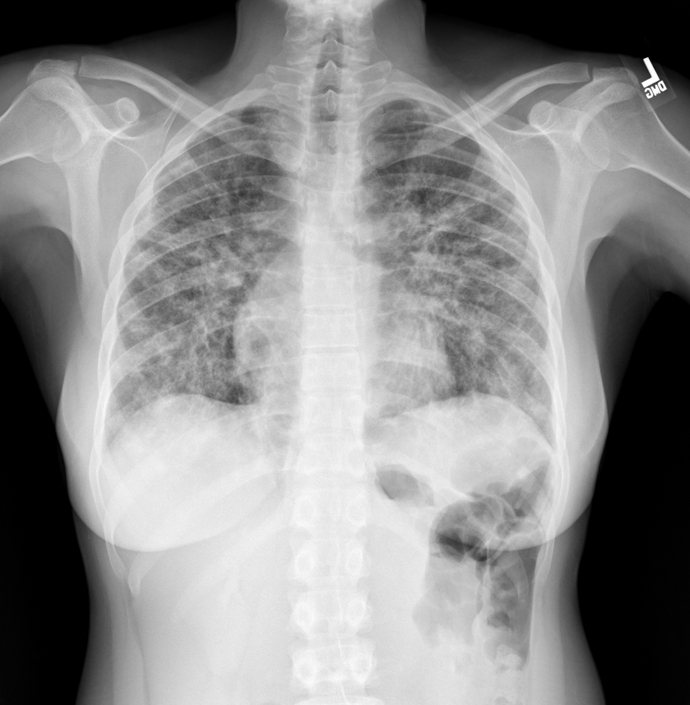 Lymph node biopsy reveals noncaseating granulomas. Which of the following is the most likely cause of the elevated calcium level in this patient?
 (Multiple Choice)
4.9/5 (80)
(80) A 17-year-old boy is brought to the physician because of a 12-day history of increasing pain and swelling of his right knee. For the past 3 weeks, he has experienced episodes of pain when urinating. He had a painful, swollen left ankle joint that resolved without treatment one week ago. His mother has rheumatoid arthritis. He is sexually active with 2 female partners and uses condoms inconsistently. He appears anxious. This patient's condition is most likely associated with which of the following?
(Multiple Choice)
4.9/5 (70)
(70) A 46-year-old woman is brought to the emergency department after she is found unconscious. Temperature is 37.2 C (98.96 F), blood pressure is 130/90 mm Hg, and pulse is 120/min. She is not responsive and has a dry mucous membrane. The patient is started on intravenous fluids, she starts to improve. Later, her urine output decreased and she started having flank pain. Renal microscopy shows ballooning and vacuolar degeneration of the proximal tubules. Additionally, multiple oxalate crystals were observed in the lumen. The acute kidney injury in this patient is due to one of the following?
(Multiple Choice)
4.7/5 (92)
(92) A 38-year-old woman comes to the physician because of a 4-month history of worsening fatigue. She has had occasional exertional chest pain and shortness of breath over the past year but has not seen a physician. She takes no medications. Her temperature is 37°C (98.6°F), pulse is 94/min, respirations are 24/min, and blood pressure is 130/84 mm Hg. Lung auscultation is normal. An echocardiogram shows an enlarged coronary sinus. Which of the following is the most likely cause of the observed finding in this patient?
(Multiple Choice)
4.7/5 (67)
(67) A 55-year-old woman is brought to the office by her husband for evaluation of strange behavior. She has been spending large amounts of money to buy expensive clothes and jewelry. The patient has also offered sex to unknown men in the neighborhood and has become increasingly indifferent toward her family, about whom she used to care deeply. She usually drinks 1 or 2 glasses of wine on weekends but lately has been drinking 2 or 3 glasses almost every day. When asked about these changes during the interview, the patient states that she has not noticed any change in her behavior. Vital signs are normal. The general physical and neurologic examinations are normal. This patient most likely has a condition that predominantly involves which of the following structures?
(Multiple Choice)
4.8/5 (82)
(82) 
Filters
- Essay(0)
- Multiple Choice(0)
- Short Answer(0)
- True False(0)
- Matching(0)